هذا المقال متوفر باللغة العربية — اقرأ بالعربية
Building a successful lighting store website WooCommerce platform requires far more than uploading product photos and setting a retail price. As Safya, senior WordPress and WooCommerce architect at heshamsaad.com, I regularly audit fixture catalogs across Saudi Arabia, the United Arab Emirates, and Egypt where a single showroom sells decorative residential chandeliers alongside recessed architectural spotlights, outdoor garden bollards, linear LED aluminum profiles, and smart home control modules. When an online catalog treats a hand-blown glass pendant the same way it treats an industrial DALI track spotlight, both homeowners and commercial contractors abandon their carts.
Showroom owners and electrical distributors across the Middle East and North Africa face a distinct dual-audience challenge. On one side, villa owners and apartment renovators browse visual collections by room style, brass or matte black finish, and ceiling drop height, expecting installment payments and white-glove installation. On the other side, interior architects, MEP engineers, and electrical contractors search by precise photometric performance, requiring downloadable specification sheets, bulk project quotations, and verified warehouse stock across Riyadh, Jeddah, Dubai, or Cairo.
What a lighting store website WooCommerce build must handle
A physical showroom uses separate display zones to guide different buyers: double-height galleries for statement crystal chandeliers, dark testing rooms for architectural beam angles, and technical counters for LED tape, drivers, and smart dimmers. Translating that physical experience into a digital storefront through tailored WordPress development means designing a single database architecture that adapts to decorative retail, cut-to-length linear components, and contract specification workflows simultaneously.
When lighting retailers evaluate platform options during a WooCommerce vs Shopify comparison, catalog dimensionality and B2B workflow ownership quickly become the deciding factors. Hosted template platforms often restrict how many variant axes a single fixture can carry or charge recurring transaction fees when you introduce custom measurement pricing and multi-branch trade portals. By building on core WooCommerce documentation standards, a MENA distributor retains full control over product taxonomy tables, bilingual Arabic and English technical sheets, and direct ERP inventory synchronization.
To support architectural lighting e-commerce MENA operations without splitting your inventory across multiple disconnected websites, your store architecture must reconcile five distinct product categories under one unified checkout and quotation engine:
- Decorative residential statement fixtures: Multi-tier crystal chandeliers, alabaster dining pendants, bedside wall sconces, and floor lamps where visual dimensions, chain suspension length, bulb socket type (such as E14 or E27), and fragile crating logistics dominate the purchase decision.
- Commercial and architectural recessed fixtures: Anti-glare downlights, gimbal spotlights, and trimless ceiling modules where ceiling cutout diameter in millimeters, lumen efficacy, beam degree spread, and flicker-free driver protocols determine project compatibility.
- Exterior architectural and garden lighting: Facade wall washers, inground uplights, pathway bollards, and underwater pool luminaires engineered to withstand Gulf summer heat, airborne dust, and coastal humidity through verified ingress protection ratings.
- Modular magnetic tracks and linear LED profiles: Extruded aluminum channels, flexible neon silicone tubes, and low-voltage magnetic rail systems sold by custom linear measurements along with matched transformers, corner connectors, and suspension kits.
- Smart home lighting and automation controls: Matter, Zigbee, Tuya, KNX, and DALI gateways, smart wall switches, and tunable white RGBW fixtures that require clear ecosystem compatibility badges so buyers never pair incompatible dimmers with constant-current drivers.
Technical specification matrices and photometric attribute filters
When a lighting designer or homeowner visits a WooCommerce lighting showroom containing thousands of SKUs, basic filters like price and color finish are completely insufficient. A shopper looking for a brass spotlight might accidentally order a harsh 6500K daylight fixture with a narrow 15-degree pin beam for a low-ceiling bedroom because the storefront hid the photometric data inside an unsearchable paragraph description.
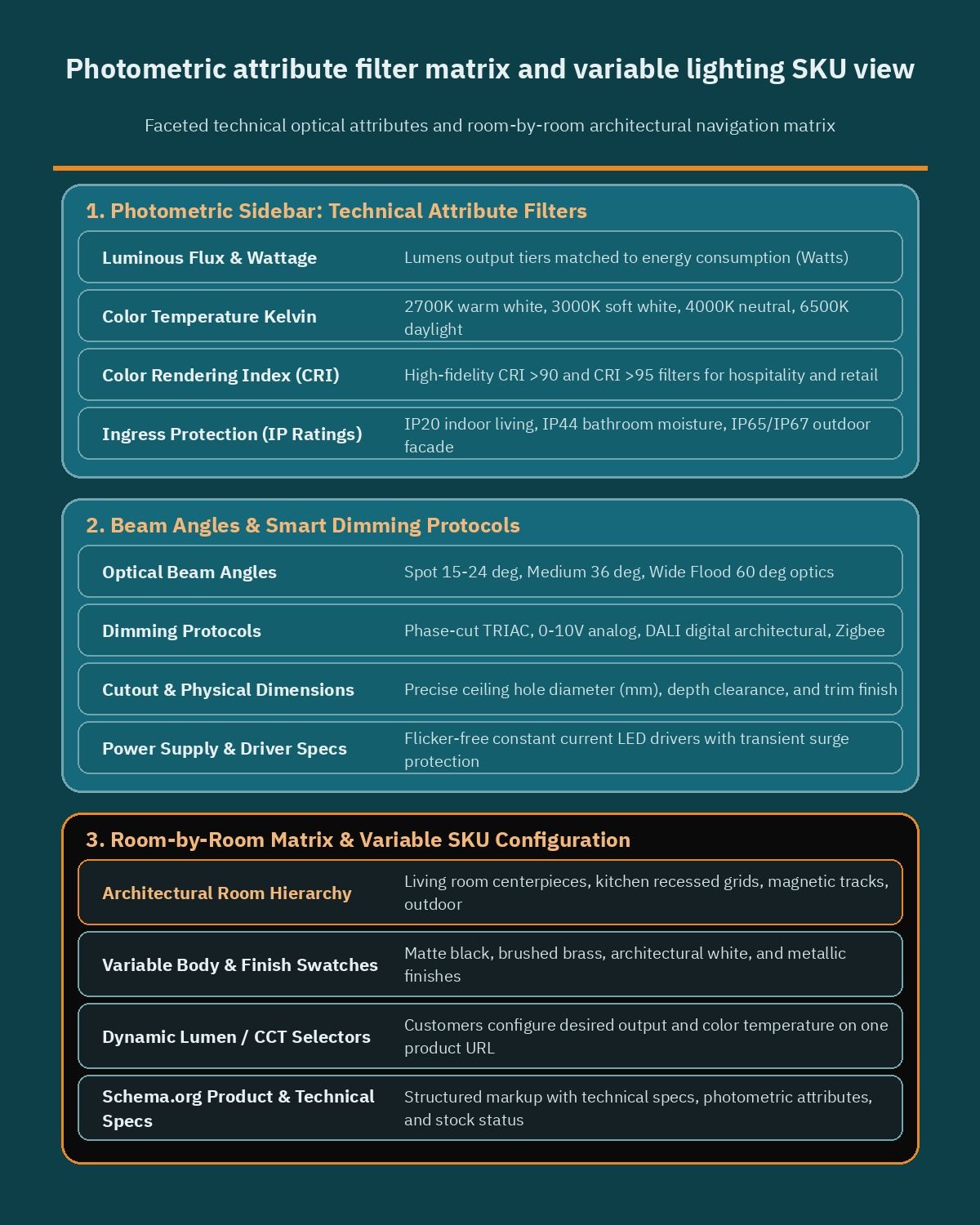
Much like structuring an electronics store website on WooCommerce where voltage and processor specifications must be filterable, lighting catalogs rely on structured global taxonomies. Following official WooCommerce Managing Product Taxonomies practices, you should configure every core photometric metric under Products > Attributes rather than using plain text custom fields. Global attributes allow shoppers to combine multiple technical criteria in the sidebar or horizontal filter bar while generating clean, indexable archive URLs when appropriate.
Core photometric attributes every lighting catalog requires
Whether you sell European designer imports or locally assembled commercial luminaires, your WooCommerce attribute schema should standardize the following technical specifications across all product lines:
- Luminous flux (Lumens output) and power consumption (Wattage): Modern buyers and engineers shop by actual light output in lumens rather than legacy incandescent wattage alone. Providing store-configurable lumen range filters alongside exact watt consumption helps buyers calculate room brightness and circuit load accurately.
- Correlated Color Temperature (Kelvin ratings): Configure visual swatches and checkboxes for specific Kelvin steps, including 2700K warm cozy residential light, 3000K warm white hospitality illumination, 4000K neutral white for kitchens and offices, 6500K crisp daylight for industrial task areas, and tunable white (2700K to 6500K) dynamic fixtures.
- Color Rendering Index (CRI): Retail boutiques, art galleries, luxury dressing rooms, and restaurants require high color accuracy so fabrics, wood grains, and skin tones appear natural. Filtering between standard CRI 80+ and high-fidelity CRI above 90 (including CRI 95+ or CRI 97+ museum-grade LED chips) immediately separates architectural-grade fixtures from budget utility bulbs.
- Beam angle and optical distribution: Allow buyers to filter spotlights and wall washers by precise optical spread, such as 15-degree narrow accent beams for double-height columns, 24-degree and 36-degree medium flood beams for artwork and retail shelving, and 60-degree or wider general ambient illumination.
- Ingress Protection (IP ratings) for moisture and dust: Categorize fixtures clearly from IP20 for dry indoor living rooms, to IP44 and IP54 for bathroom vanity zones and covered balconies, up to IP65, IP67, and IP68 weather-sealed fixtures for exterior facades, dusty garden pathways, and submerged water features.
- Dimming protocols and smart control ecosystems: Prevent costly installation mistakes by tagging every fixture with its exact driver dimming method, including non-dimmable on/off, phase-cut TRIAC dimming, 0-10V analog control, DALI and DALI-2 digital addressing, or wireless Tuya, Zigbee, Casambi, and Apple Home smart protocols.
- Physical installation and cutout measurements: Include recessed ceiling cutout diameter (such as 68mm, 75mm, or 90mm), fixture recess depth for shallow concrete or gypsum slabs, overall pendant drop height, and luminaire weight in kilograms.
Structuring variable fixtures and technical Schema markup
In architectural catalogs, a single recessed downlight model often ships in three body finishes (white, black, brushed gold), three reflector baffle colors, three Kelvin temperatures (2700K, 3000K, 4000K), two beam angles (24 degrees, 36 degrees), and three driver options (on/off, TRIAC, DALI). Using native WooCommerce Variable Products, you can group those options under one canonical parent product page while assigning each combination its own manufacturer SKU, stock count, and wholesale or retail price.
To prevent variant bloat when a fixture has dozens of permutations, configure non-price-changing attributes (or made-to-order assembly combinations) sensibly and display a live SKU specification matrix table using clean CSS flex or list layouts on the product page. Furthermore, map your WooCommerce attributes to structured Schema.org Product properties, including brand, MPN (Manufacturer Part Number), GTIN, material, color, and additionalProperty pairs for Kelvin and lumen ratings so search engines and AI shopping assistants index your exact technical inventory.
When shoppers toggle a specific Kelvin temperature or beam angle on the product page, your front-end gallery should dynamically update either the product photograph or an interactive visual beam preview graphic. Showing the visual difference between a warm 2700K wall graze and a neutral 4000K wide flood reduces buyer uncertainty and dramatically lowers product return requests caused by mismatched light color in finished rooms.
Room-by-room navigation, modular track systems, and LED profile measurement pricing
While electrical engineers filter by IP rating and DALI compatibility, homeowners building or renovating a residence navigate differently. A homeowner running a search on a chandelier online store WordPress site thinks in terms of spatial function and interior atmosphere: a grand staircase chandelier, kitchen island linear pendants, glare-free home office lighting, or warm perimeter cove lighting for a majlis or reception room.
Just as a well-architected furniture store website on WooCommerce organizes catalogs by room collections and spatial dimensions, a lighting storefront needs dual navigation hierarchies. Your primary header mega-menu should present both a “Shop by Room & Application” path (Living & Majlis, Dining Room, Kitchen, Bathroom & Vanity, Bedroom, Facade & Garden) and a “Shop by Fixture Category” path (Chandeliers, Pendants, Recessed Spotlights, Magnetic Track Systems, Linear LED Profiles, Outdoor Bollards).
Selling cut-to-length LED profiles and neon flex by custom measurements
Linear lighting is one of the fastest-growing segments in residential and commercial interiors across MENA, used inside gypsum ceiling coves, under kitchen cabinetry, along wardrobe shelving, and across exterior building facades. However, linear lighting cannot be sold effectively as a rigid single-unit item because one customer needs 3.4 meters of recessed aluminum channel while another contractor needs 45 meters of IP67 outdoor silicone neon flex.
By integrating the official WooCommerce Measurement Price Calculator extension, your store can sell LED strips, extruded aluminum profiles, polycarbonate diffuser covers, and suspension cables either by exact user-entered length (in meters or centimeters) or by predefined stock bar increments (such as 1-meter, 2-meter, or 3-meter extruded bars) based on your warehouse cutting policy. Store-configurable pricing rules allow you to set minimum cut lengths, add optional workshop cutting or soldering service fees, and deduct accurate linear footage from master roll inventory.
Guided bundling for magnetic track lighting and LED driver matching
Buying a magnetic track system or a linear LED profile involves multiple interdependent hardware components. If a customer orders four magnetic grille spotlights and two meters of recessed rail but forgets the 48V DC power supply, the input power feed connector, or the 90-degree ceiling-to-wall L-joint, the electrician cannot install the system on site.
Using WooCommerce Product Bundles, you can transform complex multi-part assemblies into guided, error-proof kits. Instead of forcing retail buyers to hunt across ten separate catalog categories, configure structured bundle templates on your flagship track and linear pages:
- Complete magnetic track starter kits: Group recessed or surface-mounted aluminum rails (1m, 2m, or 3m) with selectable quantities of linear flood modules, foldable accent spots, pendant adapters, mechanical joiners, and an appropriately rated 48V constant-voltage driver.
- Automatic LED driver wattage sizing prompts: When a buyer configures a 10-meter run of 14.4W-per-meter LED tape, your product template can calculate total load consumption, apply a store-configurable safety headroom margin, and recommend the exact 24V constant-voltage waterproof or indoor power supply required to run that circuit safely.
- Chandelier and decorative fixture accessory packs: Offer matched sets of dimmable filament LED bulbs, extra brass suspension chain links for high villa ceilings, and ceiling canopy reinforcement plates right inside the chandelier product bundle so the buyer receives everything in one shipment.
Specialized fragile cargo logistics, shockproof crating, showroom pickup, and installation booking
Fulfillment is where many poorly configured lighting e-commerce stores lose money. A carton of six die-cast aluminum downlights can travel safely through standard domestic parcel couriers. In contrast, a multi-tier bohemian crystal chandelier, an alabaster wall sconce, or a 3-meter bundle of anodized aluminum profiles will suffer shattered glass or bent extrusions if handed to an unspecialized parcel carrier without protective crating.
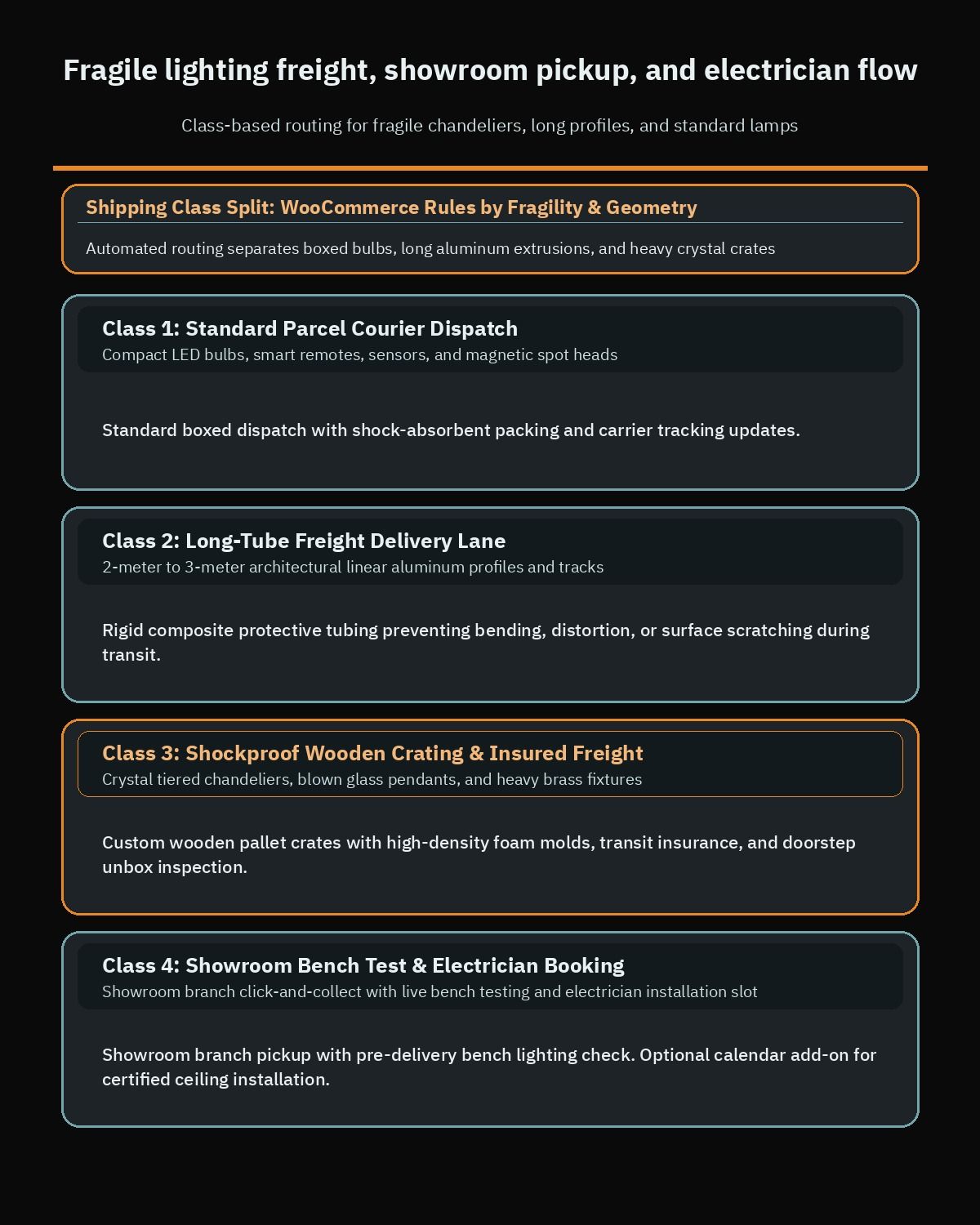
When we configure regional logistics following our guide on WooCommerce shipping zones in Egypt and the Gulf, we combine geographic zones (such as Greater Cairo and Alexandria, Riyadh and Dammam, or Dubai and Abu Dhabi) with granular product classification. By setting up WooCommerce Shipping Zones alongside WooCommerce Product Shipping Classes under WooCommerce > Settings > Shipping, your checkout automatically separates everyday parcel items from delicate or oversized freight.
Shipping classes, shockproof wooden crating, and damage inspection rules
In a well-structured lighting store, every SKU is assigned to one of four store-configurable shipping classes, each governed by clear volumetric weight and handling rules:
- Standard durable parcel fixtures: Recessed spotlights, LED bulbs, drivers, and smart switches packed in factory foam cartons that qualify for standard domestic courier rates and free shipping thresholds.
- Oversized linear extrusions and track rails: Aluminum LED profiles and magnetic tracks measuring 2 meters or 3 meters in length, which require long-cargo freight carriers or dedicated showroom delivery vans because standard parcel lockers and compact courier bikes reject tubes over store-defined length limits.
- Fragile glass and mid-sized decorative pendants: Blown-glass globes, ceramic table lamps, and delicate wall sconces that require double-wall corrugated cartons, high-density foam molds, insured fragile handling, and explicit delivery inspection checklists upon arrival.
- Heavy crystal chandeliers and palletized project cargo: Large statement chandeliers, heavy brass hotel fixtures, and bulk contractor orders that automatically switch checkout to scheduled white-glove showroom truck delivery or wooden shockproof crating with freight insurance.
To protect both the showroom and the buyer on fragile shipments, your checkout and order confirmation emails should clearly state your store-configurable delivery inspection and spare crystal policy. Many luxury chandelier retailers automatically include a small pouch of spare crystal drops and pins with every chandelier order, and provide a streamlined post-delivery photo upload form so a customer who discovers a cracked glass globe during unpacking can request an immediate replacement part without shipping the entire heavy frame back to the warehouse.
Branch showroom click-and-collect and certified electrician booking
In cities like Riyadh, Jeddah, Dubai, and New Cairo, electrical contractors and homeowners frequently prefer to collect fixtures directly from a physical showroom branch. Contractors often send a site driver to pick up downlights and LED tape immediately, while homeowners visiting a showroom to pick up a pendant appreciate having staff unbox and test the fixture on a live test bench before loading it into their vehicle. Configuring native WooCommerce Local Pickup locations lets buyers select their preferred showroom or central warehouse at checkout, view branch readiness times, and avoid fragile freight charges entirely.
For residential customers who want turnkey service, offering professional installation directly on the product page converts hesitant shoppers who worry about hiring an unqualified handyman for an expensive chandelier. Using WooCommerce Product Add-Ons, you can display store-configurable service options right above the Add to Cart button:
- Ceiling height and scaffolding selection: Let the customer specify whether the fixture will be mounted on a standard 3-meter apartment ceiling or a double-height 6-meter villa atrium requiring specialized scaffolding and two-person rigging teams.
- Ceiling structure and wiring readiness: Capture whether the mounting point is a reinforced concrete slab, a hollow gypsum board ceiling requiring load-bearing toggle anchors, or a new point needing electrical point extension and smart dimmer calibration.
- Preferred installation window and wooden crate fees: Allow buyers in eligible metropolitan zones to request a morning or afternoon certified electrician visit after delivery, or opt into custom wooden export crating when forwarding fixtures to a coastal resort or regional construction site.
B2B trade customer portal for interior designers, architects, and electrical contractors
While retail homeowners provide healthy margins on decorative pieces, long-term volume in the lighting industry comes from B2B trade accounts. Interior design studios, architectural lighting consultants, hospitality procurement officers, and MEP contractors source hundreds of recessed spots, linear meters of LED tape, and exterior facade fixtures for a single villa compound, office fit-out, or boutique hotel.
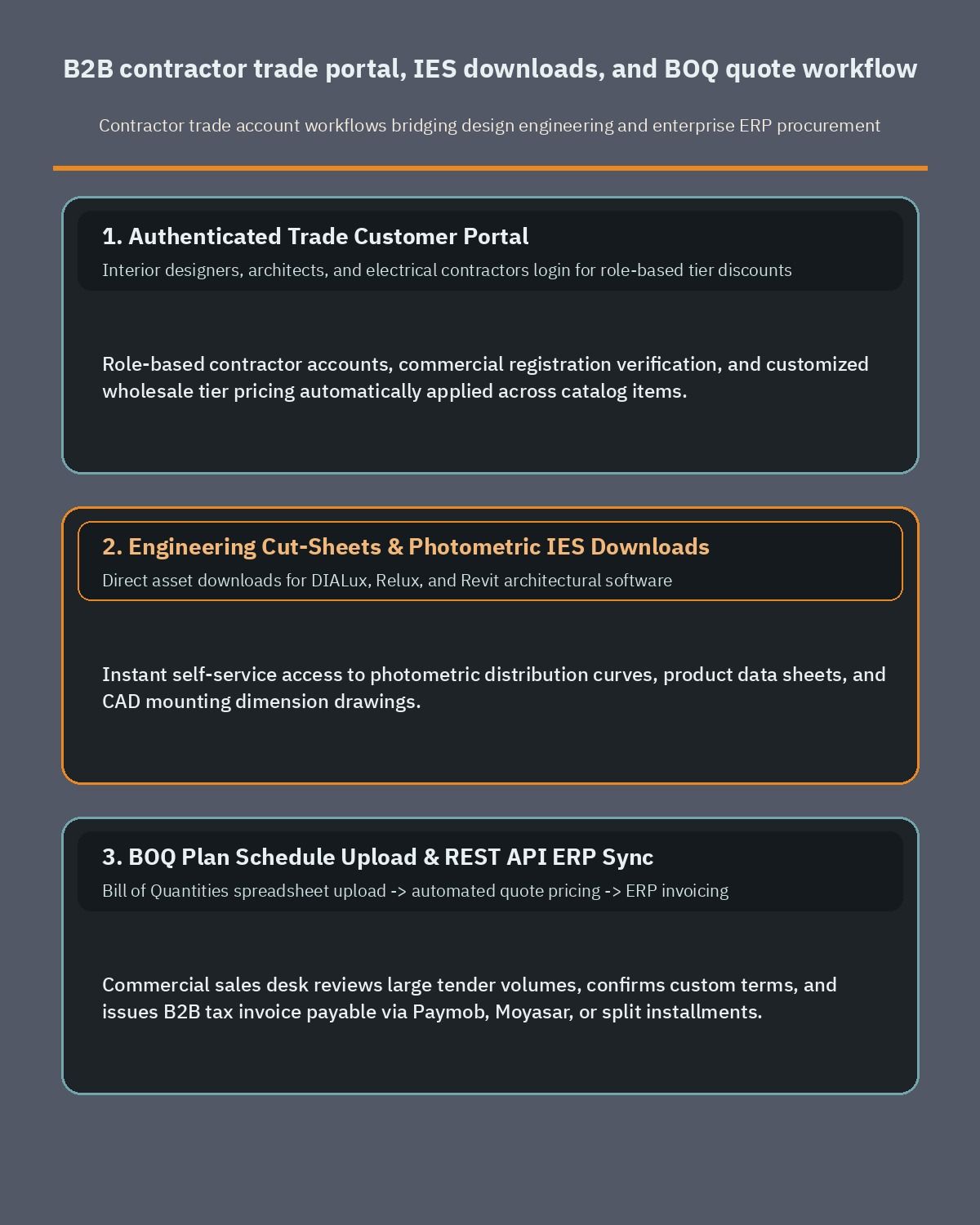
When we build digital platforms for studios running an interior design website on WordPress, those designers tell us what frustrates them most about lighting supplier websites: missing CAD/IES files, hidden stock levels, and having to call a sales rep on WhatsApp just to check trade discounts. By deploying B2B for WooCommerce alongside custom account workflows, your store can serve retail shoppers and verified trade professionals from the exact same catalog.
Role-based trade tier pricing and project tax handling
A B2B contractor lighting quotation WooCommerce architecture starts with a dedicated trade registration workflow where applicants submit their commercial registration (CR), tax identification number, and company profile (Interior Designer, Architect, Electrical Contractor, or Hospitality Developer). Once your sales team approves an account, the user is assigned to a store-configurable customer role with tailored catalog rules:
- Tiered role-based and volume pricing: Display standard VAT-inclusive retail prices to guests while automatically showing net wholesale prices or store-configurable trade tier discounts to logged-in designers and contractors, with additional dynamic tier breaks when ordering full master cartons of downlights or LED drivers.
- Project sub-lists and room schedules: Allow interior designers to create multiple named specification lists inside their account (such as “Villa Project Ground Floor Majlis” or “Penthouse Master Bathroom”) and export clean PDF lookbooks with or without visible prices to share with their end clients for visual sign-off.
- Lead-time transparency for stock vs made-to-order fixtures: Clearly differentiate between stock available for immediate dispatch from your local warehouse and factory backorder or custom-finished architectural fixtures that carry store-configurable manufacturing and sea/air freight lead times.
Downloadable IES photometric files, spec cut-sheets, and BOQ quote uploads
Before an architectural consultant or MEP engineer specifies your spotlight on a commercial tender, they must verify its illumination curves inside lighting simulation software such as DIALux or Relux. If your product page only offers a lifestyle photograph, the engineer will switch to a competitor who provides downloadable technical assets.
Every architectural product template on your WooCommerce site should include a structured “Technical Downloads & Spec Sheets” tab containing direct links to high-value engineering files:
- IES and LDT photometric data files: Industry-standard photometric distribution files that lighting engineers import directly into DIALux or Relux to calculate lux levels on floors, walls, and work surfaces.
- Dynamic PDF specification cut-sheets: Auto-generated or uploaded one-page technical data sheets featuring exact line-art dimension drawings, cutout sizes, wiring diagrams, IP/IK ratings, and space for the consultant to stamp project approval.
- 2D CAD blocks, 3D BIM/Revit models, and installation manuals: Downloadable DWG, OBJ, or RFA geometry files so interior designers can drop your exact chandelier or linear pendant into their 3D room renders, accompanied by bilingual Arabic and English wiring instructions for site electricians.
For large tenders, contractors rarely add fifty separate fixture types to a consumer cart one by one. Instead, equip your portal with a Request for Quotation (RFQ) and Bill of Quantities (BOQ) schedule upload module. Contractors can either add selected SKUs to a quote basket or upload an Excel/CSV fixture schedule alongside architectural ceiling plans, triggering an internal sales workflow connected via the WordPress REST API to your ERP or CRM so your lighting engineers can propose matching fixtures, lock in project pricing, and convert the approved quote into a payable WooCommerce order.
Regional high-ticket payment security, installment financing, and fast media delivery
Furnishing an entire villa or apartment with decorative chandeliers, architectural downlights, and smart dimmers quickly results in a high average order value. When a retail buyer or project owner reaches checkout with a substantial cart total, payment friction or slow page rendering will stall the transaction immediately.
In the MENA market, local payment method familiarity and flexible split-payment options play a decisive role in converting high-ticket home improvement orders. Depending on where your showroom is registered and which regional markets you serve, WooCommerce supports specialized regional payment and Buy Now, Pay Later (BNPL) plugins:
- Regional card, wallet, and local debit gateways: Merchants commonly integrate Paymob for WooCommerce or Moyasar to accept local debit networks such as Mada, KNET, local bank cards, digital wallets, and Apple Pay alongside international Visa and Mastercard payments. Always verify the current supported countries, settlement currencies, transaction terms, and WooCommerce compatibility on the official Paymob and Moyasar plugin pages before finalizing your checkout architecture.
- Split-payment and installment financing (BNPL): For high-value chandeliers and multi-room lighting packages, integrating Tamara Checkout and Tabby Checkout allows eligible retail shoppers to split their purchase into scheduled installments while displaying dynamic installment messaging directly on product pages. Because BNPL regulations, maximum order caps, and geographic availability evolve, always check the official Tamara and Tabby plugin pages and merchant documentation to confirm their current supported countries, currencies, and merchant eligibility terms before planning your checkout.
- B2B bank transfer, LC, and milestone deposit workflows: For large contractor BOQ orders and custom-manufactured hotel chandeliers, configure offline bank wire transfer gateways with automated proforma invoice generation and IBAN instructions, or support staged payment schedules (such as an initial production deposit followed by a pre-dispatch balance payment).
Visual gallery optimization and bilingual Arabic/English storefront speed
Lighting photography is uniquely demanding because customers need to see how a fixture looks in two states: “Lights Off” (showing the daylight metallic finish, brushed brass texture, or crystal clarity) and “Lights On” (showing the warm illumination glow, shadow patterns, and absence of harsh glare). Adding 4K lifestyle galleries, 360-degree spin views, dimming comparison videos, and heavy PDF cut-sheets can easily bloat product pages if media delivery is not engineered carefully.
Applying the technical steps we cover on how to speed up WordPress Arabic sites ensures your showroom stays responsive even when shoppers filter hundreds of variable fixtures on mobile networks. Convert all high-resolution chandelier and architectural photography to modern AVIF or WebP formats, lazy-load below-the-fold gallery frames and installation diagrams, serve static assets and downloadable IES/PDF sheets through an edge Content Delivery Network (CDN), and use Redis object caching so complex multi-attribute photometric queries execute in milliseconds across both RTL Arabic and LTR English views.
What drives development budgeting and how to brief your WooCommerce team
When showroom directors and lighting distributors ask how to budget for a custom WooCommerce build, the engineering effort is rarely determined by the visual theme alone. Instead, scope and timeline are driven by catalog data complexity, custom calculation logic, and back-office integrations.
Before you hire a WooCommerce developer or agency, evaluate where your business sits across these four core architectural cost drivers:
- Photometric taxonomy readiness and SKU normalization: If your product data currently lives inside unstructured PDF catalogs or inconsistent supplier spreadsheets, allocating time for data engineering to extract clean attributes (Lumens, Kelvin, CRI, Beam Angle, IP rating, Cutout size) and build structured variable products will be a primary project phase.
- Custom linear calculators and interactive track configurators: A store selling standard boxed chandeliers requires simpler product templates than a showroom offering cut-to-the-centimeter aluminum LED profiles with automated wattage-to-driver matching rules and interactive magnetic track kit builders.
- B2B portal depth and ERP/warehouse integration: Synchronizing live stock quantities, multi-branch showroom availability, batch numbers, and role-based trade pricing with an external ERP (such as Odoo, SAP, Microsoft Dynamics, or Zoho Inventory) via the WordPress REST API adds middleware engineering and testing requirements.
- Bilingual RTL/LTR localization and technical document generation: Building a truly bilingual Arabic and English showroom where every photometric filter, installation add-on, and dynamically generated PDF specification cut-sheet renders cleanly in both languages requires disciplined template engineering.
To prepare a clear technical brief for your build, start by auditing a sample of twenty representative products across your catalog: five multi-variant architectural spotlights, five decorative crystal chandeliers, five linear LED profiles with matching drivers, and five outdoor weather-sealed garden fixtures. Document every filter attribute a customer or engineer needs to find those twenty items, define your shipping and wooden crating rules per product class, and outline how your sales team currently handles contractor BOQ quotations.
If you are planning to launch a new digital showroom or upgrade an existing lighting catalog for retail homeowners and B2B project specifiers across MENA, book a free consultation with our team at heshamsaad.com. We will review your fixture categories, photometric filter structure, fragile freight workflows, and trade portal requirements to map out a practical WooCommerce architecture tailored to your showroom.
Frequently asked questions
How should a WooCommerce store structure photometric attributes like lumens and Kelvin ratings?
You should configure photometric metrics such as lumens output, Kelvin color temperature, Color Rendering Index, beam angle, IP weather protection, and dimming protocol as global product attributes under Products and Attributes in WooCommerce. Global taxonomies power layered catalog filtering on archive pages while allowing shoppers to select exact Kelvin or dimming variations directly on a single variable product page without creating duplicate catalog entries.
Can customers buy custom lengths of LED strips and aluminum profiles with matching drivers in WooCommerce?
Yes, combining the WooCommerce Measurement Price Calculator extension with Product Bundles allows shoppers to order linear LED strips and recessed aluminum channels by custom meter or centimeter lengths. Your storefront can automatically calculate total wattage from the entered length and prompt the buyer to add a compatible power driver, end caps, and mounting clips before checkout so every component matches on site.
How do online lighting showrooms handle fragile crystal chandelier shipping alongside standard spotlights?
Store owners assign each product to a dedicated WooCommerce shipping class such as standard parcel boxes, oversized aluminum tracks, or fragile crated chandeliers. Within each regional shipping zone, those classes trigger tailored carrier rules, store-configurable wooden crating surcharges, and insured freight handling for delicate glass or brass fixtures while keeping everyday recessed downlights eligible for fast parcel courier delivery.
What features do architects and electrical contractors need in a B2B WooCommerce lighting portal?
Trade buyers need verified account registration, role-based tiered pricing, downloadable PDF specification cut sheets, and IES photometric files for simulation software directly on product pages. Adding a Bill of Quantities upload workflow lets contractors submit multi-room fixture schedules and request formal project quotations with store-configurable manufacturing lead times without filling out individual consumer checkout forms.
How can a lighting website offer showroom pickup and certified electrician installation at checkout?
You can enable WooCommerce Local Pickup locations for physical showrooms in cities like Riyadh, Dubai, or Cairo so contractors and homeowners collect tested fixtures directly from branch warehouses. For home delivery orders, WooCommerce Product Add-Ons let buyers select certified electrician installation based on ceiling height and wiring readiness before completing payment.
References
- WooCommerce Official Documentation
- WooCommerce: Managing Product Categories, Tags and Attributes
- WooCommerce: Variable Product Documentation
- B2B for WooCommerce Extension
- WooCommerce Measurement Price Calculator Extension
- WooCommerce Product Bundles Extension
- WooCommerce Product Add-Ons Documentation
- WooCommerce: Setting up Shipping Zones
- WooCommerce: Product Shipping Classes
- WooCommerce: Local Pickup Shipping Method
- WordPress REST API Handbook
- Schema.org Product Structured Data Specification
- Paymob for WooCommerce on WordPress.org
- Moyasar Payment Gateway Plugin on WordPress.org
- Tamara Checkout Plugin on WordPress.org
- Tabby Checkout Plugin on WordPress.org