هذا المقال متوفر باللغة العربية — اقرأ بالعربية
On November 17, 2026, Google announced that Tasks in Gemini is rolling out free of charge to hundreds of millions of people across six countries, powered by its new Gemini 4 Hydrogen model. The announcement, authored by Josh Woodward, Vice President of Labs, Gemini app, and AI Studio, marks a clear shift from conversational chat responses to supervised task execution across phones, calendars, email inboxes, and online stores. Alongside the six-country free rollout, Google introduced a wave of advanced agentic features starting in the U.S., backed by hardware-isolated cloud virtual machines and new payment protocols.
For business owners and agencies running WordPress or WooCommerce sites across Egypt, Saudi Arabia, and the wider MENA region, this release is more than consumer gadget news. Even when a Google rollout starts in North America and Asia-Pacific, the underlying standards, such as Google Shopping Graph, Agent Payments Protocol (AP2), Universal Commerce Protocol (UCP), and assistant-friendly web access, quickly shape how customers discover businesses and complete purchases. Understanding what changed today helps your team prepare your store catalog, booking details, and security rules ahead of wider expansion.
What changed in the Tasks in Gemini free rollout
Inside the Gemini mobile app, Google added a direct switch on the home screen that lets users flip from Chat to Task. That single toggle changes how the assistant behaves: instead of answering with static text, Gemini connects with permitted user context, runs multi-step actions in the background, and returns with completed appointments, bill breakdowns, or ready-to-confirm carts.
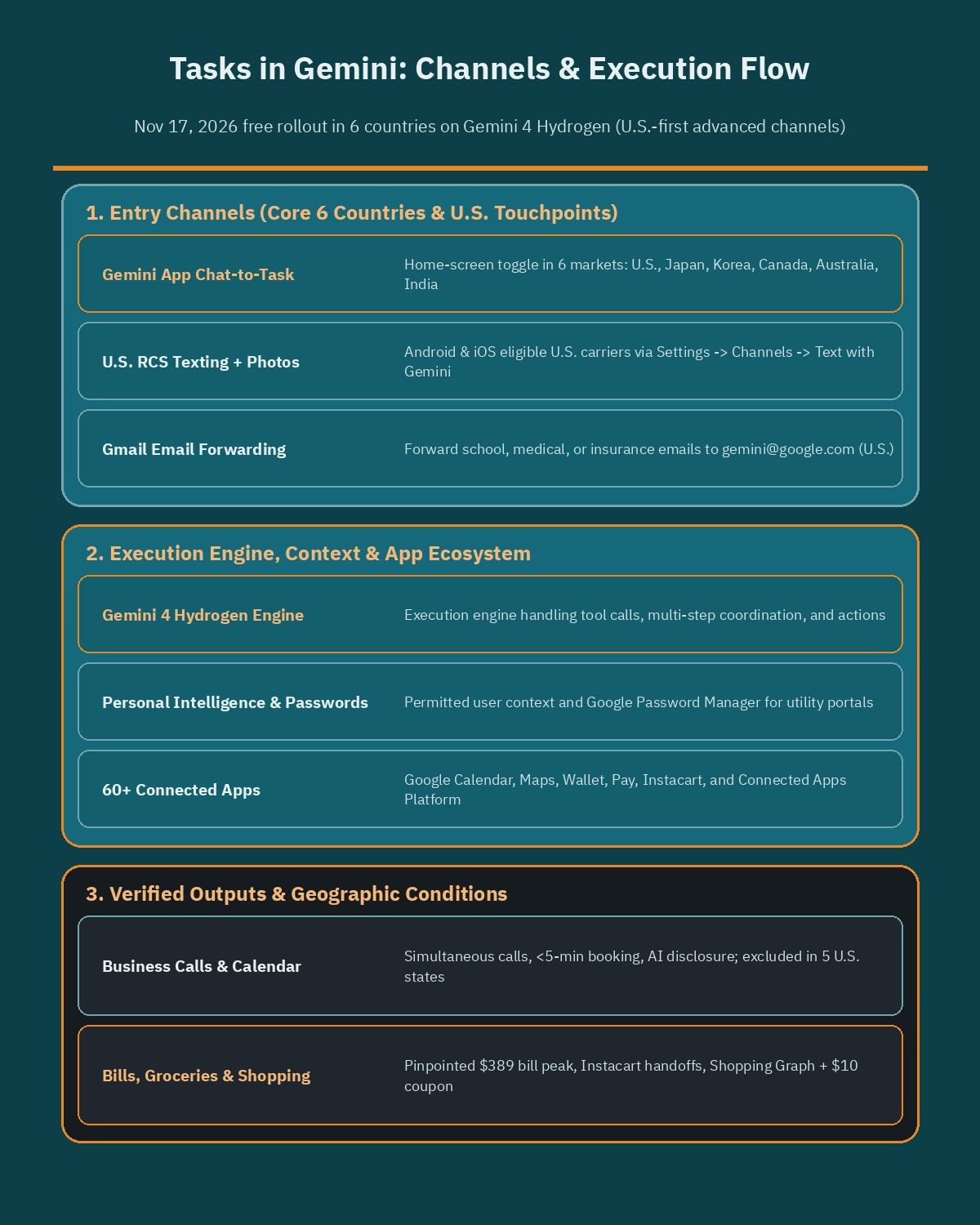
The core update rolls out free of charge across six launch markets: the U.S., Japan, Korea, Canada, Australia, and India. Google specifically pairs this rollout with Gemini 4 Hydrogen, which serves as the execution engine handling tool calls, multi-step coordination, and structured actions across connected apps.
At the same time, it helps to separate consumer assistant updates from enterprise API planning. While engineering teams evaluate developer-facing releases like GPT-6.2 Astra and Sol for custom backend chatbots and server middleware, Google is embedding agentic execution directly into everyday consumer touchpoints: the Gemini app, Google Calendar, Google Maps, Google Wallet, RCS messaging, and Gmail forwarding.
| Capability area | Launch availability | Key technologies and partners | Verified limits or conditions |
|---|---|---|---|
| Tasks in Gemini core rollout | Free in U.S., Japan, Korea, Canada, Australia, and India | Gemini 4 Hydrogen, Chat-to-Task toggle in mobile app | Advanced calling, RCS, and email forwarding start in U.S. only |
| Autonomous business calling | U.S. rollout | Personal Intelligence, Google Maps, Google Calendar | Unavailable in Indiana, Louisiana, Minnesota, Montana, and Nebraska; businesses can opt out |
| Email and portal bill analysis | U.S. rollout | Gmail forwarding to [email protected], Google Password Manager | Requires explicit user permission to access portals and billing statements |
| Agentic shopping and checkout | U.S. rollout | Shopping Graph, Google Pay, AP2 digital tokens, Google Wallet on iOS | Mastercard and Visa supported; American Express coming soon; UCP integration up next |
| RCS texting and app ecosystem | U.S. rollout and 60+ connected apps | Android and iOS RCS Channels, Instacart handoff, Connected Apps Platform | Requires a U.S. phone number with an eligible mobile carrier |
Inside the U.S. agentic features: calling, bills, and messaging
While six countries receive the free Tasks in Gemini update powered by Gemini 4 Hydrogen, Google is debuting its deepest real-world integrations in the United States first. These capabilities illustrate how personal assistants are moving beyond browser tabs into phone calls, utility portals, and native carrier messaging.
Autonomous business calling and calendar booking
In the announcement, Josh Woodward shared a concrete example of how Gemini handles phone-based chores using Personal Intelligence. When his 2019 Honda Odyssey minivan showed a check-engine light, he asked Gemini to call the two nearest dealerships and book an early Friday morning service slot over the next month. Because Gemini already knew the vehicle model and home location from Personal Intelligence, it identified nearby shops on Google Maps and placed calls to both dealerships simultaneously.
Instead of making the user wait on hold, Gemini waited through hold music in the background, checked which dealership accepted scheduled appointments rather than walk-ins only, cross-checked Google Calendar availability, and booked the Friday morning appointment in less than five minutes. On the receiving end, Google states that Gemini immediately discloses that it is an AI, businesses can opt out whenever they choose, and Gemini will not share payment or private account information unless instructed by the user. Calling is currently excluded in five U.S. states: Indiana, Louisiana, Minnesota, Montana, and Nebraska.
Utility portal analysis, email forwarding, and RCS texting
Google also extended Gemini into document-heavy household management. By granting permission through the new Google Password Manager integration, a user asked Gemini to log into a utility portal and inspect historical billing PDFs and emails after receiving a $389 electric bill. Within a few minutes, Gemini pinpointed the cause: the home heat pump was turning on around 4 p.m. during peak utility pricing.
Two additional U.S. channels remove the need to even open the Gemini app first:
- Email forwarding to [email protected]: Users can forward batches of school emails, medical bills, or insurance renewals from Gmail. In Woodward’s school email test, Gemini added every date to Google Calendar in under a minute, invited his spouse, spotted a basketball practice conflict, and offered to text another parent to trade carpool duty.
- RCS texting with photo follow-ups: Users on Android or iOS with an eligible U.S. mobile carrier number can open Settings, tap Channels, choose Set up under Text with Gemini, and verify their phone number. Texting a grocery list plus snapping a photo of an empty Cheerios box let Gemini populate an Instacart order and hand it off for completion.
- 60+ connected apps and developer onboarding: Gemini already integrates with more than 60 popular apps, and third-party developers can apply to join Google’s Connected Apps Platform.
Agentic commerce: Shopping Graph, AP2, Google Wallet, and UCP
For e-commerce merchants and WooCommerce store owners, the commerce stack inside this release deserves close attention. Rather than scraping random pages blindly, Gemini leans on structured product discovery and tokenized payment rails built with major card networks.
When a user asks Gemini to find an item such as a USB-C charger for an upcoming trip, Gemini pulls options through Google’s Shopping Graph and asks follow-up clarifying questions about specifications like wattage and color. In the announcement’s example, Gemini compared products, applied a discount code that saved an extra $10, and completed checkout through the new Google Pay integration.
Behind that checkout sits the Agent Payments Protocol (AP2). Google is partnering with Mastercard and Visa today, with American Express coming soon, to secure purchases using digital tokens on supported cards. Crucially for consumer adoption, shoppers still retain their credit card points, airline miles, cashback, and purchase protections, while an upfront hard spending cap keeps Gemini strictly inside the user’s stated budget. All receipts and order tracking details land automatically inside Google Wallet, which Google is expanding to iOS starting November 17, 2026.
Looking one step ahead, Google confirmed that it will integrate the Universal Commerce Protocol (UCP) into Gemini next. According to Woodward, adding UCP is intended to deliver an even faster and more reliable shopping flow from initial product discovery all the way through checkout.
Strengths, tradeoffs, and verified limitations
Evaluating this release objectively shows both real operational progress and clear boundaries that businesses should keep in mind before assuming AI agents handle everything automatically.
- Key strengths: Users across six major markets get task mode free on Gemini 4 Hydrogen; ecosystem integration keeps emails, passwords, calendars, and payment cards under one provider; hard spending caps and card rewards remove friction for supervised checkout; and multi-channel access via RCS and email fits daily habits.
- Current tradeoffs and geographic limits: Business calling, Password Manager bill analysis, RCS texting, and email forwarding to [email protected] start in the U.S. only, leaving MENA and even the five non-U.S. launch countries waiting for feature parity. Calling is blocked in five U.S. states, carrier eligibility restricts RCS setup, and American Express AP2 tokenization is not live yet.
- Web navigation maturity: Google openly notes that tasks still fail or miss the mark at times. Many websites are not built for personal assistants yet, so Gemini frequently navigates most of a checkout or booking flow and then hands the screen back to the human user to click the final confirmation button.
How Google secures agentic tasks with isolated cloud VMs
Handing an AI assistant access to passwords, utility portals, email threads, and payment cards raises immediate security questions. Google addressed those concerns by describing a multi-layer defense-in-depth architecture rather than relying on prompt rules alone.
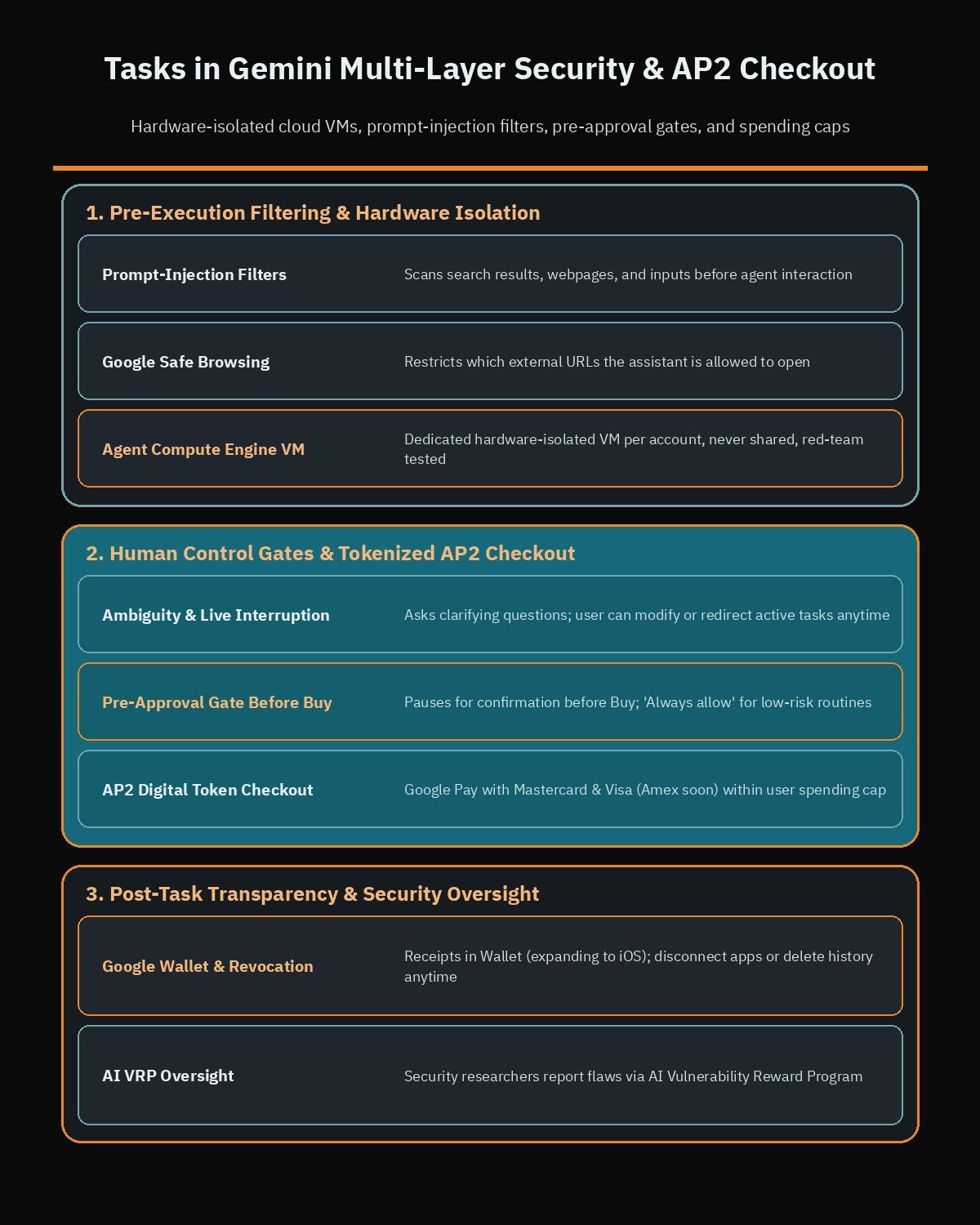
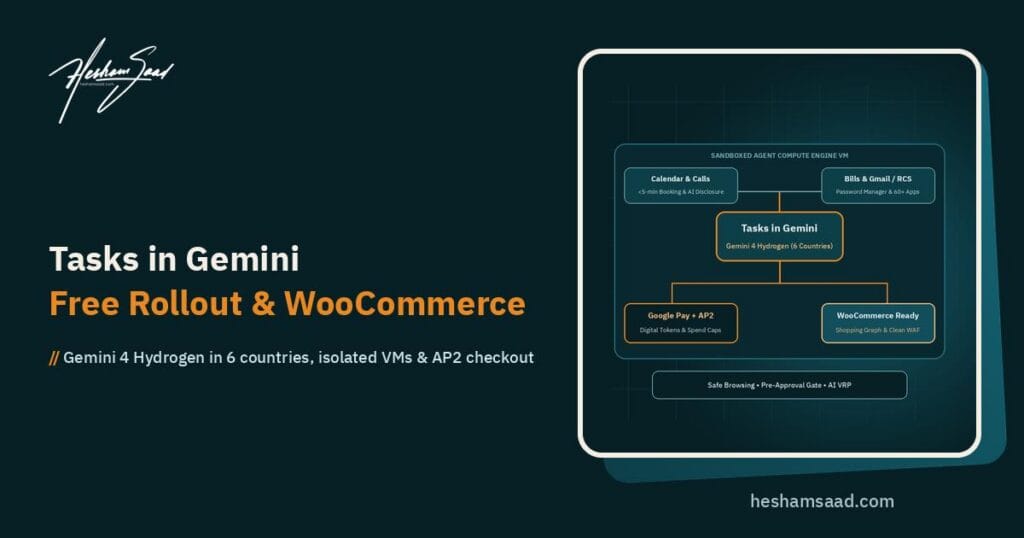
Whenever a user assigns a task, Gemini runs inside Google Cloud’s Agent Compute Engine using a hardware-isolated virtual machine dedicated strictly to that user’s account. That VM is never shared across different users, operates in a sandboxed environment, and undergoes regular testing by Google’s internal security red teams.
Before Gemini even interacts with external web content inside that sandbox, prompt-injection filters scan search results, webpages, and other inputs, working alongside Google Safe Browsing to restrict which links the assistant can open. During execution, the user stays in control through several checkpoints:
- Live interruption: Users can step in at any moment to modify or redirect an active task.
- Mandatory ambiguity and purchase gates: Gemini asks clarifying questions when instructions are unclear and pauses for explicit confirmation or pre-approval before clicking “Buy.”
- Selective automation: Routine low-risk tasks, such as adding recurring groceries to a cart, can be set to “Always allow” so the assistant skips repetitive prompts.
- Data revocation and bug bounties: Users can adjust task settings, disconnect Google or third-party apps, or delete chat history anytime, while security researchers can report agentic flaws through Google’s AI Vulnerability Reward Program (AI VRP) backed by a newly published technical paper.
What MENA WordPress and WooCommerce businesses should prepare now
Although the six-country free rollout covers the U.S., Japan, Korea, Canada, Australia, and India, and U.S. agentic features remain regional today, MENA businesses should not treat this as distant news. International buyers, tourists, and Gulf expats already use U.S.-registered accounts, and Google explicitly signaled that it is partnering with websites and security providers now while preparing Universal Commerce Protocol (UCP) next. Store owners who prepare their WordPress and WooCommerce architecture early gain visibility when agentic discovery expands.
Structured product feeds and Shopping Graph readiness
Remember how Gemini handled the USB-C charger request: it queried Google’s Shopping Graph, compared structured attributes, asked follow-up questions about wattage and color, and applied a discount code. If your WooCommerce store hides technical specifications inside unformatted paragraphs or blurry product images, neither Shopping Graph nor an AI assistant can match your products accurately.
Start by auditing your WooCommerce catalog fundamentals with a qualified WooCommerce developer:
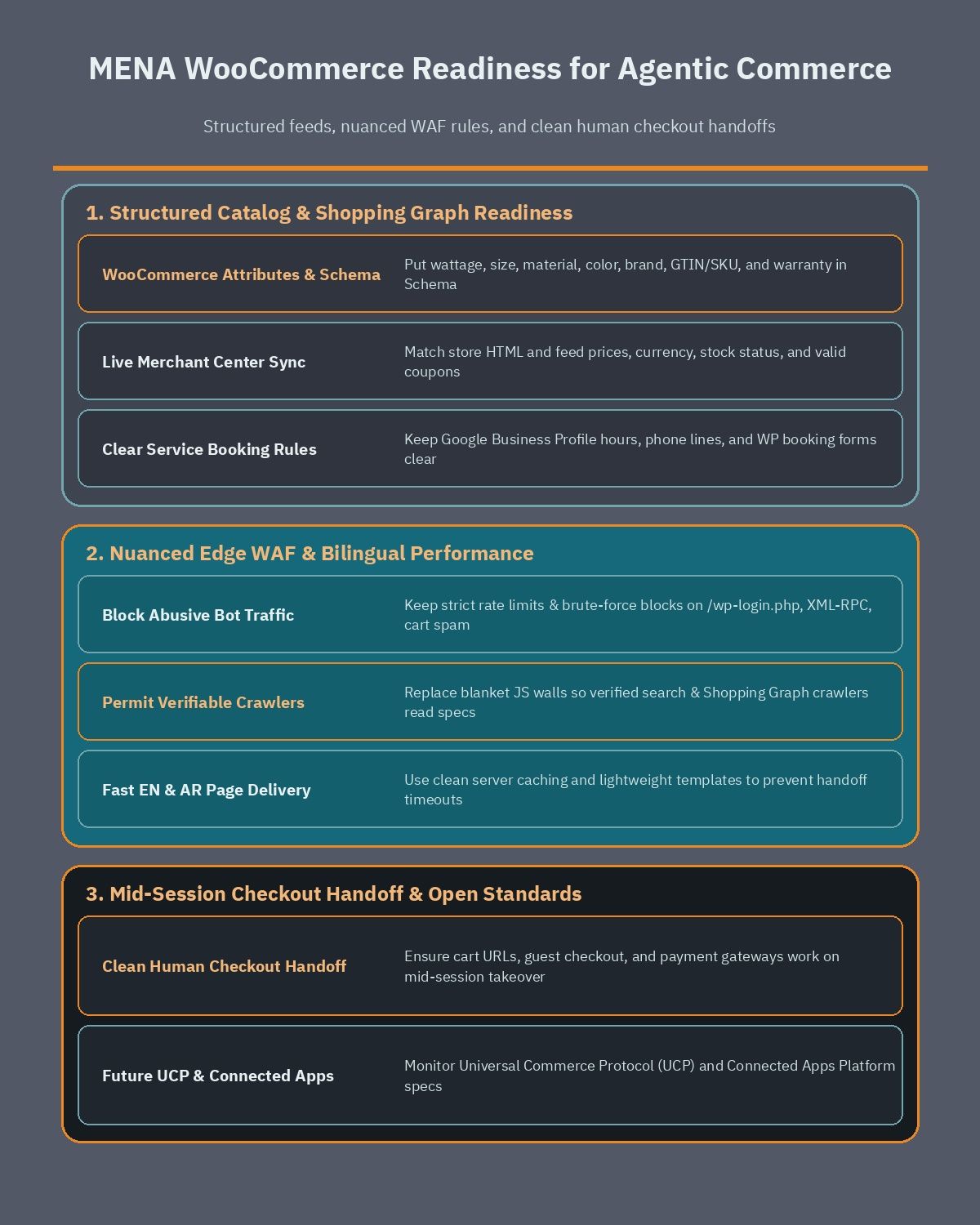
- Standardize product attributes and Schema markup: Put wattage, size, material, color, brand, GTIN or SKU, warranty terms, and delivery timelines in structured WooCommerce attributes and valid Product Schema rather than burying them in image banners.
- Keep live pricing, stock, and coupons synchronized: Ensure your Google Merchant Center feed and store HTML report identical prices, regional currency, stock status, and valid coupon logic so an assistant never quotes an expired offer.
- Maintain fast Arabic and English page delivery: When automated shopping layers or real buyers jump from discovery to checkout, slow server response causes timeouts and failed handoffs. Follow proven steps to speed up WordPress Arabic sites using clean server caching and lightweight templates.
- Publish clear appointment and service rules: In Google’s dealership example, Gemini skipped a walk-in-only shop and booked the shop that accepted scheduled appointments. Service businesses in Riyadh, Dubai, or Cairo should keep Google Business Profile hours, phone lines, and WordPress booking forms crystal clear.
Nuanced assistant access instead of blanket bot blocking
One line in Josh Woodward’s post carries direct technical weight for every WordPress security administrator: for decades, websites blocked bots by default because most automated traffic was malicious, whereas personal assistants require a more nuanced approach built on open, verifiable standards.
Across MENA e-commerce sites, it is common to see aggressive CDN firewalls, JavaScript challenge walls, or blanket user-agent blocks turned on to stop scrapers. Those blunt rules carry a growing commercial cost. If a user’s personal assistant gets hit with a hard challenge wall while trying to confirm stock, verify a return policy, or guide the shopper to checkout, the assistant simply moves to a competitor whose catalog stays readable.
Instead of dropping security or allowing unrestricted scraping, move toward layered, server-side verification:
- Separate abusive traffic from verifiable reads: Keep strict rate limiting, login protection, and brute-force blocks on
/wp-login.php, XML-RPC, and cart-spam endpoints, while allowing verified search and Shopping Graph crawlers clean access to public product pages and structured feeds. - Support clean human handoffs at checkout: Google notes that Gemini often navigates partway through a site and hands the screen back to the buyer for the final button click. Make sure your WooCommerce cart URLs, guest checkout flow, and payment gateways load cleanly without breaking when a user takes over mid-session.
- Prepare for verifiable commerce standards: Monitor Google’s Connected Apps Platform and upcoming Universal Commerce Protocol (UCP) specifications so your store can integrate cleanly rather than relying on fragile browser automation.
Next steps for WordPress site owners and teams
Tasks in Gemini shows where personal computing is heading: users expect an assistant powered by fast execution models like Gemini 4 Hydrogen to compare products, verify appointments, check bills, and prepare purchases under strict spending caps and isolated virtual machines. Businesses that make their data easy to verify and their checkout flows predictable will capture that demand smoothly.
Pick one concrete step this week: audit your top 20 WooCommerce products or core service pages to verify that structured attributes, live stock, booking rules, and WAF bot rules do not block legitimate product discovery. If you want an engineering team to prepare your structured feeds, tune server performance, and harden your firewall without breaking assistant-ready checkout flows through our WordPress development services, you can book a free consultation to review your site roadmap.
Frequently asked questions
Where is Tasks in Gemini rolling out for free right now?
Google is rolling out Tasks in Gemini free of charge across six countries: the U.S., Japan, Korea, Canada, Australia, and India, powered by the Gemini 4 Hydrogen model. Users activate it by flipping the home-screen toggle from Chat to Task in the Gemini mobile app. More advanced features such as business calling, RCS texting, and email forwarding to [email protected] are launching first in the U.S.
How does business calling work in Gemini and which U.S. states are excluded?
Gemini uses Personal Intelligence and Google Maps to locate nearby businesses, calls multiple providers at once, waits through hold music, and schedules free slots directly on Google Calendar. It immediately discloses that it is an AI, lets businesses opt out anytime, and keeps private payment details hidden unless permitted. Calling is not currently available in Indiana, Louisiana, Minnesota, Montana, and Nebraska.
What are AP2 and UCP in Google agentic shopping?
The Agent Payments Protocol, or AP2, secures Gemini purchases through Google Pay using digital tokens with Mastercard, Visa, and American Express coming soon, while preserving card rewards and enforcing user spending caps. Receipts and tracking appear in Google Wallet, which is expanding to iOS. Next, Google will integrate the Universal Commerce Protocol, or UCP, to make discovery-to-checkout shopping faster and more reliable.
How does Google protect sensitive user data during Gemini tasks?
Every task executes inside a hardware-isolated virtual machine on Google Cloud Agent Compute Engine dedicated solely to one account and never shared with other users. Google layers prompt-injection filters and Google Safe Browsing to restrict risky links, pauses for pre-approval before clicking Buy, and lets users disconnect apps, delete history, or report flaws via the AI Vulnerability Reward Program.
How should MENA WooCommerce stores prepare for personal AI assistants?
MENA WooCommerce stores should move product specs such as size, color, wattage, stock, and pricing into structured attributes and clean feeds compatible with Google Shopping Graph. Site owners should also replace blanket firewall blocks with nuanced rules that stop malicious scrapers while allowing verifiable crawlers and smooth human checkout handoffs on fast Arabic and English pages.