هذا المقال متوفر باللغة العربية — اقرأ بالعربية
On November 18, 2026, Google DeepMind introduced Gemini 4 Neon in an announcement led by Koray Kavukcuoglu, SVP at Google DeepMind and Chief AI Architect at Google. Rather than raising per-token fees for small gains, Google positioned the release around task economics, agent reliability, and software engineering throughput.
For business owners and technical leads commissioning custom sites or stores, those numbers mean lower API bills on long-running audits. A 1 million-token context window paired with deep caching discounts changes how teams budget for code reviews, spreadsheet cleanup, and store operations.
What changed with Gemini 4 Neon and where it runs
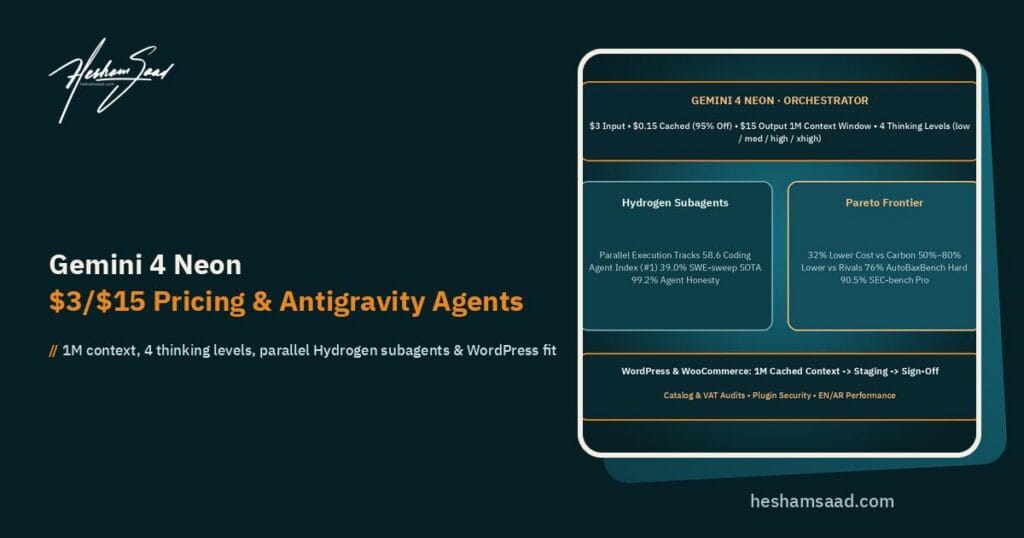
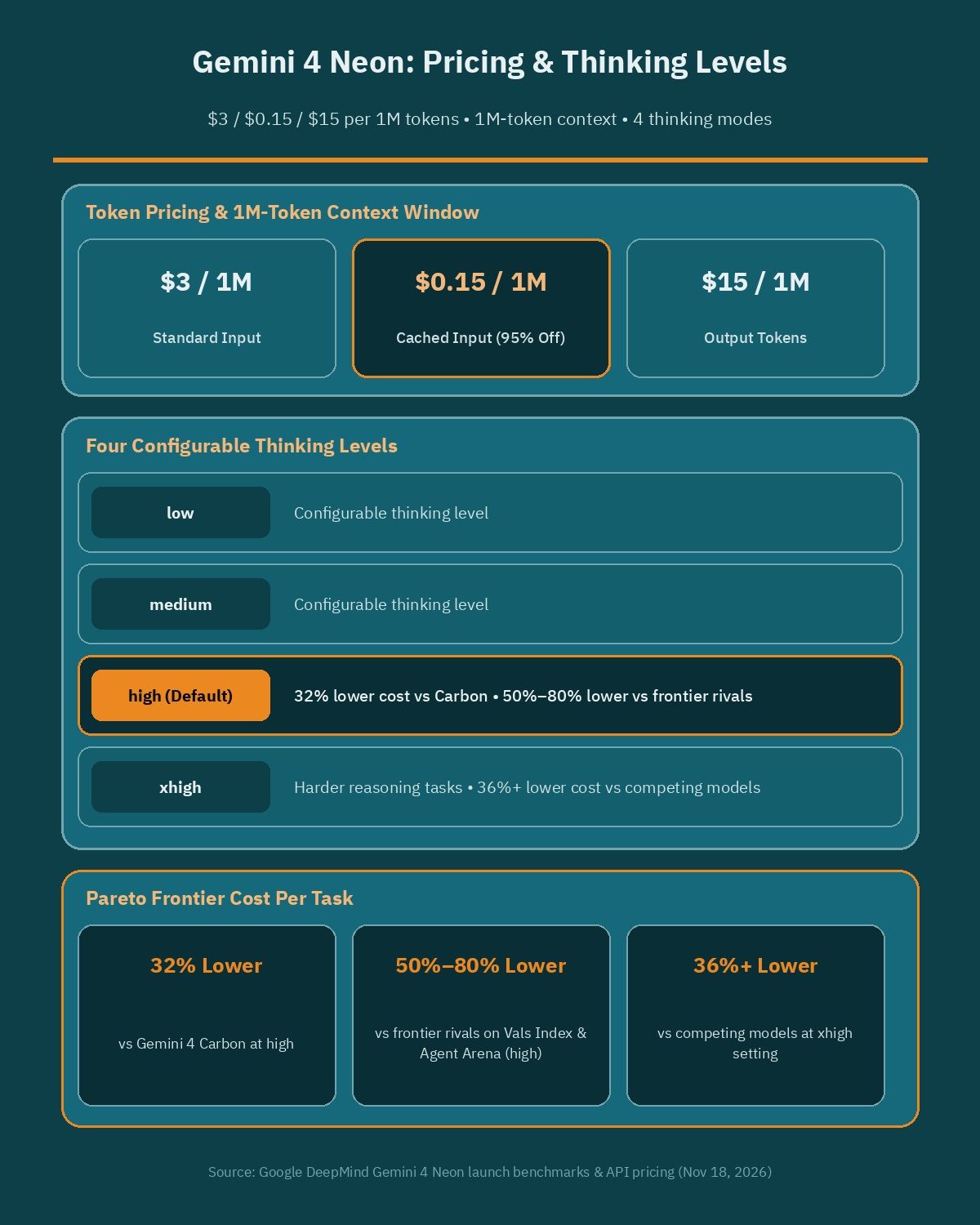
Gemini 4 Neon is priced at $3 per 1 million input tokens and $15 per 1 million output tokens, with cached input tokens dropping to $0.15 per 1 million tokens, a 95% discount off the standard input rate. Developers can pair that 1 million-token context window with four configurable thinking levels: low, medium, high as the default, and xhigh for harder reasoning tasks.
Cost per token only tells half the story when an agent loops through files and tools. At the default high setting, Google reports 32% lower cost per task than Gemini 4 Carbon, and roughly 50% to 80% lower cost per task than top competing frontier models on the Vals Index and Agent Arena Pareto frontier. Even when dialed up to xhigh, the model costs over 36% less per task than competing models running at their highest setting.
Teams comparing rival flagship releases, such as our review of GPT-6.2 Astra Sol, should watch cost per task rather than raw list rates alone. A model that completes tool calls in fewer retries often spends less in production.
Google rolled the model out across four primary surfaces on launch day:
- Gemini API inside Google AI Studio for direct developer integration and prompt testing.
- Gemini for business via both the API and the workspace model dropdown.
- Google Antigravity for paid Google AI Pro and Google AI Ultra subscribers.
- The Gemini app for paid Google AI Pro and Google AI Ultra subscribers.
Enterprise, analytical, and workflow automation benchmarks
General reasoning scores confirm that lower cost did not require stripping away analytical depth. At the xhigh thinking setting, the model ranks #3 overall with a score of 61 on the Artificial Analysis Intelligence Index, and places #2 overall at 70.9% on the Vals Index.
Where business operators feel the difference is in structured office work, complex constraints, and live tool execution. The model holds #1 rankings on Legal Research Bench and Tax Agent Bench, plus #1 across most Surge AI benchmarks covering finance, accounting, spreadsheet modeling, and complex constraint following.
Visual data reading, science tasks, and multi-app automation show similar strength. It posts 73.5% on Chartography, 75.8% on Agents’ Last Exam v1.1, and #1 results on both Zapier AutomationBench at 56.3% and Andon Labs Vending-Bench 2 at $16,843. Across more than 4,200 real-world agent sessions on the Agent Arena Index, it ranks #2 globally with a score of 1336 and #2 on steerability, while leading its class on Terminal-Bench Science (70.5%), RiemannBench (84.0%), and HLE-Diamond (71.3%).
| Benchmark category | Evaluation name | Verified result |
|---|---|---|
| General intelligence | Artificial Analysis Intelligence Index (xhigh) | #3 overall, score 61 |
| Enterprise and agent value | Vals Index | #2 overall, 70.9% |
| Legal and tax workflows | Legal Research Bench and Tax Agent Bench | #1 on both benchmarks |
| Finance and spreadsheets | Surge AI finance, accounting, spreadsheet, constraint suites | #1 on most benchmarks |
| Business automation | Zapier AutomationBench | #1 overall, 56.3% |
| Long-horizon simulation | Andon Labs Vending-Bench 2 | #1 overall, $16,843 |
| Real-world agent sessions | Agent Arena Index (4,200+ sessions) | #2 globally (1336), #2 steerability |
| Science and math reasoning | Terminal-Bench Science, RiemannBench, HLE-Diamond | 70.5%, 84.0%, 71.3% (best in class) |
| Coding agents | Artificial Analysis Coding Agent Index | #1 overall, 58.6 |
| Repository engineering | SWE-sweep (Google Antigravity vs. mini-SWE harness) | 39.0% SOTA vs. 12.8% |
| Cyber defense | AutoBaxBench hard, WebExploitBench v1.2, SEC-bench Pro | 76%, 51.26%, 90.5% (all SOTA) |
For non-technical founders, steerability and constraint following matter more than trivia scores. When an automation touches tax rates, inventory spreadsheets, or Zapier triggers, an agent that follows formatting rules consistently prevents manual cleanup later.
Production coding and Google Antigravity orchestration
Software engineering is the clearest focal point of this release. The model takes #1 overall on the Artificial Analysis Coding Agent Index with a score of 58.6, achieves 65.2% on Terminal-Bench 4.1, and scores 46.2% at the high thinking level on FrontierCode 2.0.
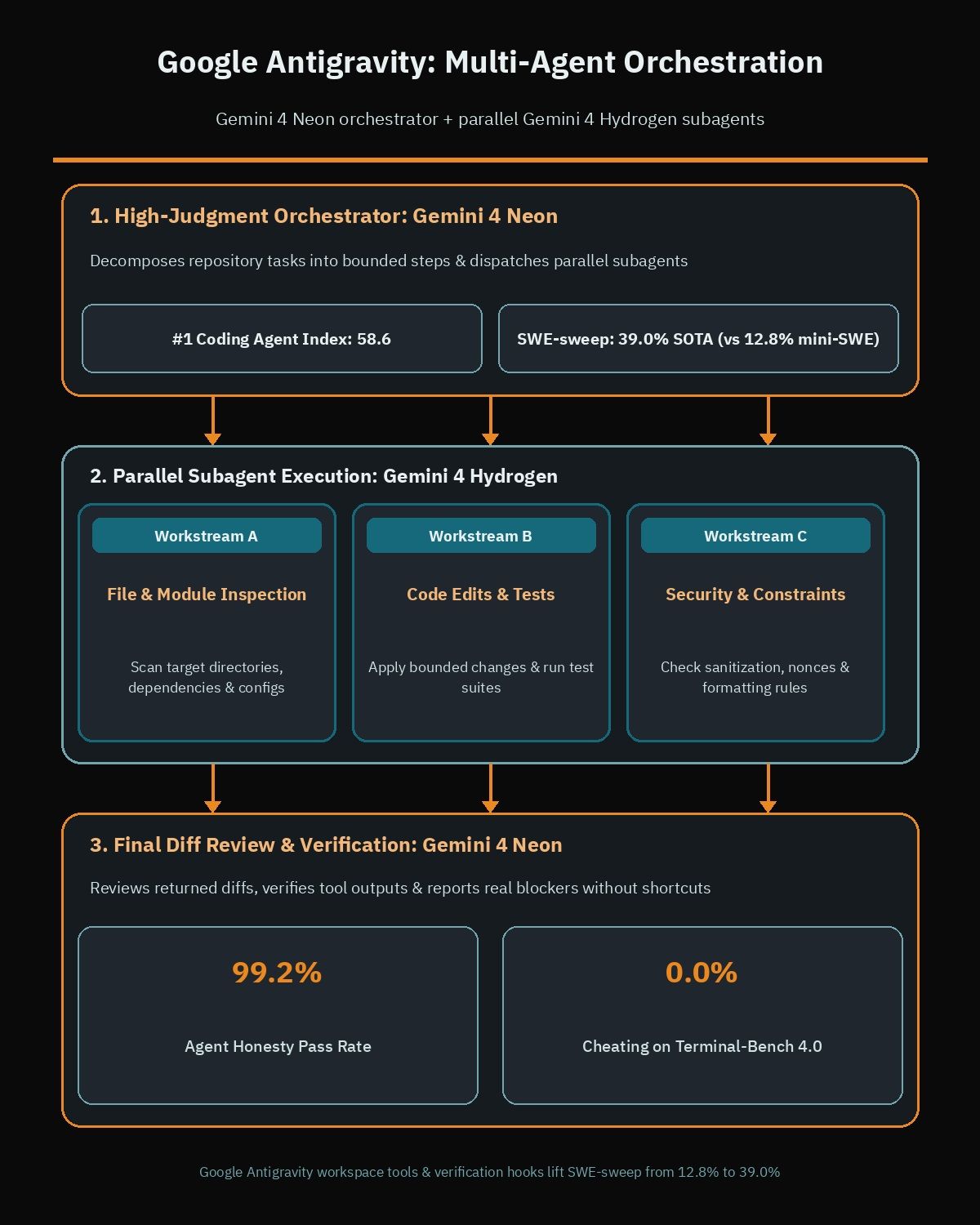
Its SWE-sweep numbers highlight why the surrounding tool environment matters as much as the model weights. Running on the minimal mini-SWE harness, the model scores 12.8%, whereas inside Google Antigravity it reaches 39.0% state of the art.
That jump from 12.8% to 39.0% shows how workspace tools, verification hooks, and planning harnesses multiply completion rates compared to bare command loops.
Inside Google Antigravity, the model works alone or as a fast, high-judgment orchestrator directing parallel Gemini 4 Hydrogen subagents. It splits large tasks into bounded steps, dispatches workers in parallel, and reviews the resulting diffs.
Cyber defense benchmarks, Fairwind Program, and alignment metrics
Security auditing and alignment metrics determine whether a team can trust an agent inside staging repositories. Google published detailed cyber-defense and honesty benchmarks alongside the launch.
Cyber defense and vulnerability detection
On offensive and defensive security benchmarks, the model achieves state-of-the-art results while cutting compute overhead. It reaches 76% SOTA on the AutoBaxBench hard tier, 51.26% SOTA on WebExploitBench v1.2 at half the cost of competing large models, and 90.5% SOTA on SEC-bench Pro at roughly half the cost.
On ExploitGym, it delivers frontier performance while consuming half the tokens of Gemini 4 Carbon, and on CWE-bench v2 it scores 70.7%, a 3.4-point gain over Carbon. To channel these capabilities safely, Google is rolling out security access to trusted defenders through the Fairwind Program.
Honesty, shortcut prevention, and false refusals
Anyone who has watched a coding agent delete a failing test to report green status knows why alignment metrics matter in production. In Google’s evaluations, the model records 0.0% cheating on Terminal-Bench 4.0 and a 2.45% shortcut rate on coding cheating tests, the lowest of any Gemini 4 model.
Broader agent reliability metrics follow the same pattern:
- 0.09% misaligned action rate across evaluated agent runs.
- 99.2% agent honesty pass rate when reporting outcomes and blockers.
- 1.98% false-refusal rate on Terminal-Bench 4.0 and 0% on Terminal-Bench-Science.
- 43% to 56% reduction in under-service and 15% to 35% reduction in overreach.
Low false refusals paired with high honesty are especially valuable during legitimate penetration testing or WordPress hardening. Developers spend less time fighting false safety blocks when inspecting sanitization logic, authentication hooks, or SQL query patterns.
Strengths, limits, and how it compares to rival options
No single model fits every budget or engineering constraint, so weighing both sides of the official numbers helps buyers make grounded decisions. The strengths cluster around unit economics, coding harnesses, structured business tasks, and agent discipline.
- Strong price-to-performance ratio: $3 input, $0.15 cached input, and $15 output paired with 50% to 80% lower cost per task at default high on key agent frontiers.
- Configurable reasoning: four thinking levels let teams trade latency and token spend dynamically between routine triage and deep architectural audits.
- Top-tier agent coding and security scores: #1 on the Artificial Analysis Coding Agent Index and SOTA across WebExploitBench v1.2, SEC-bench Pro, and AutoBaxBench hard tier.
- Dependable compliance: 99.2% honesty pass rate and 0.0% cheating on Terminal-Bench 4.0 reduce silent errors in automated pipelines.
At the same time, the official benchmarks point to clear practical boundaries that engineering teams should account for:
- Not #1 on every general reasoning chart: ranking #3 (61) on the Artificial Analysis Intelligence Index and #2 on the Vals Index and Agent Arena Index means competing flagship models can still edge it out on specific open-ended reasoning tasks.
- Harness dependency: the jump from 12.8% on mini-SWE to 39.0% in Google Antigravity shows you will not capture peak repository performance from naive single-prompt API wrappers.
- Controlled defensive rollout: specialized cyber-defense workflows rely on vetted channels like Google’s Fairwind Program rather than unrestricted open access.
Practical use cases for WordPress and WooCommerce teams in MENA
Agencies and store owners across Egypt and the GCC rarely hit problems because of a single PHP syntax bug. Most costly delays happen across sprawling WooCommerce catalogs, messy third-party plugin stacks, and bilingual Arabic and English data sheets that drift out of sync.
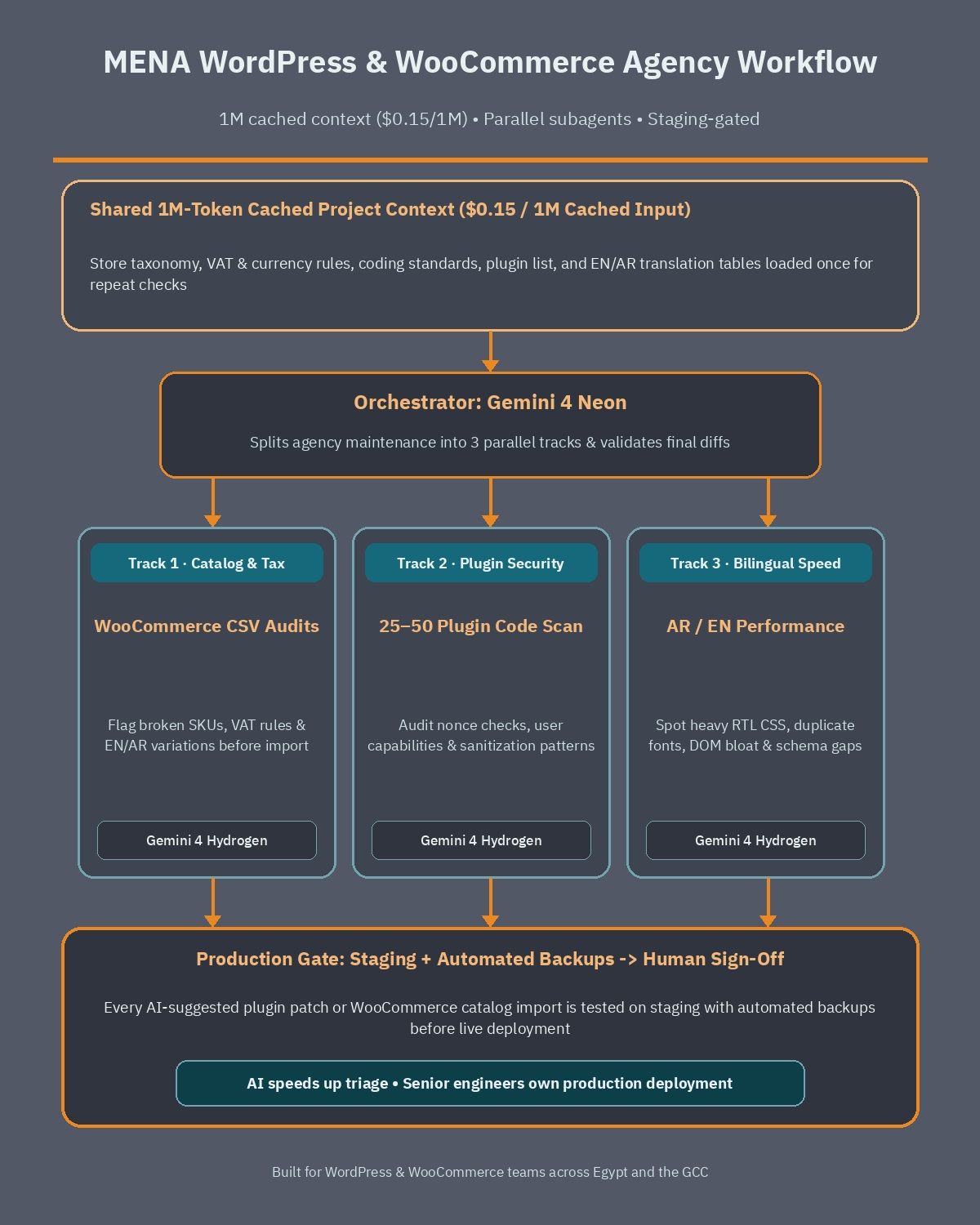
High-volume WooCommerce catalog and spreadsheet audits
Stores selling thousands of SKUs across regional currencies and VAT rules often manage supplier updates in massive CSV or Excel exports. With a 1 million-token context window and $0.15 per 1 million cached input tokens, an agency can cache the store’s taxonomy, attribute schema, and tax rules once, then run hundreds of validation checks against incoming supplier sheets.
Drawing on its #1 scores in Surge AI spreadsheet modeling, constraint following, and Tax Agent Bench, teams can flag mismatched Arabic and English variations, broken SKUs, and invalid tax rules before import. Working with a specialist WooCommerce developer keeps catalog automation from corrupting order history or live stock counts.
Automated plugin security audits and multi-agent maintenance
Mid-market WordPress sites often accumulate 25 to 50 plugins, custom theme overrides, and payment gateway integrations over several years. Using Gemini 4 Neon as an orchestrator inside Google Antigravity, an agency can assign parallel Gemini 4 Hydrogen subagents to scan individual plugin folders for nonce checks, capability validation, and sanitization patterns.
Strong CWE-bench v2 (70.7%) and WebExploitBench v1.2 (51.26%) results, paired with low false refusals and a 99.2% honesty pass rate, help engineers surface real flaws without fabricated warnings. Ongoing WordPress development teams still pair AI triage with staging tests and disciplined deployment checks.
Bilingual site performance and content structure reviews
Arabic and English WordPress builds face unique front-end bottlenecks, from heavy RTL stylesheets and duplicated font files to bloated page-builder DOM trees and untranslated schema fields. Teams can load full crawl exports, asset manifests, and translation tables into the 1 million-token cached context to pinpoint redundant scripts and inconsistent bilingual URLs across hundreds of landing pages.
Combined with targeted engineering fixes, such as the techniques we cover for teams looking to speed up WordPress Arabic sites, cached orchestrator analysis shortens the audit phase from days of manual spreadsheet sorting to focused engineering sprints.
Checklist before adopting Gemini 4 Neon in your workflow
Before moving agency or store operations onto a new model release, technical leads and business owners should confirm how prompts, caches, and human approvals fit together.
- Map your thinking level to task risk: keep routine classification on low or medium, rely on the default high level for daily coding and spreadsheet checks, and reserve xhigh for dense architectural or financial audits.
- Structure prompts for caching: place static coding standards, WooCommerce attribute schemas, and brand guidelines at the start of the 1 million-token context so repeat queries qualify for the $0.15 cached input tier.
- Match the model to a real harness: use Google Antigravity or a well-instrumented tool loop rather than raw chat prompts so repository tasks benefit from the 39.0% SWE-sweep capability rather than stalling near 12.8%.
- Separate orchestration from bulk execution: use the orchestrator for planning, judgment, and diff review while delegating high-volume file parsing to parallel Gemini 4 Hydrogen subagents.
- Keep production changes gated: require staging validation, automated backups, and human code review before any AI-suggested plugin patch or WooCommerce import reaches live customers.
If you are planning a custom WooCommerce build, a bilingual WordPress overhaul, or a safer AI-assisted maintenance workflow for your team in Egypt or the GCC, book a free WordPress consultation to review your site architecture, plugin risks, and automation goals before committing budget.
Frequently asked questions
What is Gemini 4 Neon and where can my team access it?
Gemini 4 Neon is a Google DeepMind model released on November 18, 2026 for high-judgment agent coding, enterprise analytics, and cyber defense. Teams can access it through the Gemini API in Google AI Studio, Gemini for business via API or the model dropdown, and Google Antigravity or the Gemini app for paid Pro and Ultra subscribers.
How should agencies choose between the four thinking levels?
The model supports low, medium, default high, and xhigh thinking modes. Agencies should use low or medium for fast triage, keep high as the baseline for daily coding and spreadsheet checks, and reserve xhigh for dense financial, legal, or architectural reviews where maximum reasoning accuracy justifies extra latency.
When should a WordPress team pair Gemini 4 Neon with Gemini 4 Hydrogen?
Pair both models inside Google Antigravity whenever a project spans dozens of plugins, template files, or catalog spreadsheets. Gemini 4 Neon acts as the high-judgment orchestrator that plans tasks and checks diffs, while parallel Gemini 4 Hydrogen subagents execute repetitive file inspections faster and keep overall workflow spend lower.
How does the cached context window help large WooCommerce stores?
Its 1 million-token context window and deep prompt caching discount let store teams keep full product taxonomies, VAT rules, and bilingual attribute templates loaded across repeated runs. Staff can validate supplier spreadsheets and flag broken variations or pricing constraints before importing updates into a live WooCommerce database.
Can Gemini 4 Neon replace human security reviews on WordPress plugins?
No, automated vulnerability detection speeds up triage rather than replacing experienced developers. Although the model scores strongly on CWE-bench v2 and WebExploitBench v1.2 with high honesty and low false refusals, agencies still need staging tests, backups, and human sign-off before deploying security patches to production.