هذا المقال متوفر باللغة العربية — اقرأ بالعربية
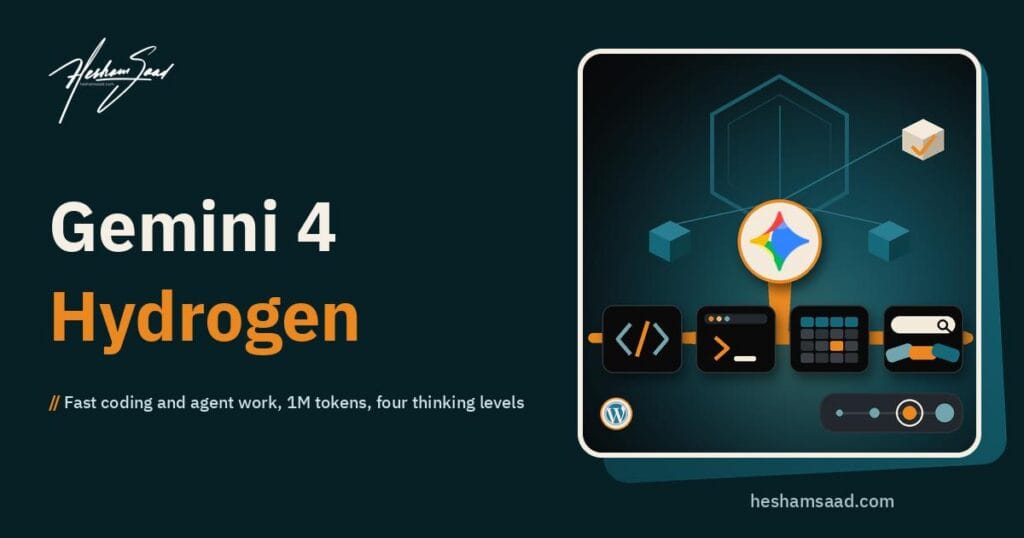
Google DeepMind announced Gemini 4 Hydrogen on November 12, 2026, positioning the release as its everyday execution engine for coding and multi-step agentic workflows. The announcement comes from Koray Kavukcuoglu, Senior Vice President at Google DeepMind and Chief AI Architect at Google. For WordPress and WooCommerce site owners, agencies, and developers across Egypt, Saudi Arabia, and the Gulf, this release fills a practical gap between high-cost frontier reasoning models and lightweight routing models.
What Gemini 4 Hydrogen is and where you can use it today
In plain terms, Google built Hydrogen to deliver fast, cost-efficient execution for tasks where software has to read files, call tools, recover from errors, and return structured answers. Inside the Gemini 4 family, frontier models such as Gemini 4 Carbon and Gemini 4 Argon are designed for deep, long-horizon reasoning on the hardest analytical problems. Hydrogen is adapted from Carbon and serves as the rapid workhorse that can run standalone or act as the execution engine alongside Carbon and Argon.
Google also clarifies how earlier models fit into the lineup. Hydrogen is the recommended upgrade from Gemini 3.8 Flash as well as earlier Gemini 3 and 2.5 models. Meanwhile, Gemini 3.5 Flash-Lite remains the fastest and lowest-cost choice for high-volume classification and routing. When your application only needs a strict yes or no check or a closed-set label, using the Gemini Decisions API or Flash-Lite remains a cheaper path than calling a full agentic model.
According to the model card and Gemini API documentation, the stable model ID is gemini-4-hydrogen, with its latest update dated November 2026 and a knowledge cutoff of March 2026. The model accepts text, images, audio, video, and PDF inputs, and it produces text output. It does not generate audio or images and does not support the Live API, so teams looking at dedicated media models from earlier releases can compare it with Gemini Omni 1.2 Flash depending on their workflow.
Google started rolling the model out globally on November 12, 2026 across consumer, enterprise, and developer products:
- Developers: Available in the Gemini API and Google AI Studio on both free and paid tiers through
GenerateContentand the Interactions API, on the paid tier in Android Studio, and in Google Antigravity for paid Google AI Pro and Ultra subscribers. In addition, the Antigravity agent in Gemini Managed Agents now usesgemini-4-hydrogenby default. - Enterprises: Available in Gemini for business through the API or the model drop-down menu, in Google Antigravity, and in Gemini in Google Sheets for eligible business subscriptions.
- Everyone: Available in the Gemini app model drop-down menu, in Google Search for all users globally, and in Gemini in Google Sheets starting with Google AI Pro and Ultra subscribers. Free Gemini app users receive Hydrogen through automatic model selection whenever it is the appropriate model for their prompt.
While Google has not published a Hydrogen-specific country list, the official Gemini API and Google AI Studio available regions page lists Egypt, Saudi Arabia, the United Arab Emirates, Kuwait, Qatar, Bahrain, Oman, Jordan, and Morocco. Development teams and store owners in these markets can access the API directly under Google’s standard regional availability.
API pricing, free tier rules and a worked cost example
Understanding how Google bills for tokens and tool calls helps business owners avoid surprises on their monthly cloud invoices. In the Gemini API and Google AI Studio, Google offers a rate-limited free tier alongside paid standard, Batch, and Flex tiers. Google lists rate limits on a separate page, and we did not verify Hydrogen-specific numbers for this article.
There is one privacy distinction every business owner and agency must note before testing with real store or client data. On the free tier, Google’s pricing documentation states that prompts and responses are used to improve Google products (Yes). On the paid tier, your data is not used to improve Google products (No). Any WordPress or WooCommerce site handling customer inquiries, orders, or internal documents should use a paid billing account.
- Paid standard tier (flat across the full 1M token window): 1.50 USD per 1 million input tokens and 7.50 USD per 1 million output tokens, with thinking tokens billed at the output rate.
- Implicit caching: 0.075 USD per 1 million cached input tokens, which represents a 95 percent discount off the standard input rate. Implicit caching runs by default on prompts of at least 4,096 tokens, whereas explicit caching is not supported.
- Batch and Flex inference: 0.75 USD per 1 million input tokens and 3.75 USD per 1 million output tokens.
- Grounding with Google Search or Google Maps: Each service includes 5,000 free requests per month (Search requests are shared across Gemini 3 and newer models), followed by 14 USD per 1,000 requests, with a daily cap of 1,500 requests per day on Search grounding.
Google counts and bills every token processed by the model. That total includes internal thinking tokens as well as internal tool system instructions and function declarations whenever grounding or tool calling is active. Compared with the frontier tier, Gemini 4 Carbon and Argon carry an introductory API price of 2 USD per 1 million input tokens and 10 USD per 1 million output tokens; once that introductory period ends on November 30, 2026, Carbon increases to 4 USD per 1 million input tokens and 20 USD per 1 million output tokens.
To make those rates concrete, here is a worked cost example based on our own arithmetic. Suppose a WooCommerce business runs 1,000 API requests in a month, where each request sends 20,000 input tokens (such as catalog rules and product data) and returns 2,000 output tokens. By our arithmetic, 1,000 requests multiply out to 20 million input tokens (30 USD at 1.50 USD per million) plus 2 million output tokens (15 USD at 7.50 USD per million), equaling 45 USD at standard paid prices before any implicit caching discounts or grounding fees. Because thinking tokens are billed as output tokens, your real output bill can be higher depending on the thinking level you select.
Context window, long decode and the four thinking levels
Unlike earlier models that maintained separate input and output budgets, gemini-4-hydrogen uses a unified context window of 1,048,576 tokens shared across input, thinking, and output tokens. Every token the model reads, reasons through, or writes draws from that single pool.
For synchronous requests, the default and maximum output limit is 65,536 tokens per request. When a task requires generating massive files or full codebase migrations in a single pass, developers can enable long decode to reach up to the full 1,048,576 token window. Long decode works either by setting background to true and raising max_output_tokens above 65536, or by using client-side continuation in the latest Google GenAI SDKs.
To help developers balance latency, token consumption, and reasoning depth, Hydrogen supports four thinking levels:
low: Fewest tokens and lowest latency. Google suggests it for cost and latency sensitive work such as fast chat and high-throughput processing, and says it is still capable on agentic tasks.medium: Lower token use and faster responses, aimed at interactive coding, live UI prototyping, responsive chat and latency sensitive tool calls.high(default): Balanced intelligence and speed. Google recommends it for most tasks, including complex coding, agentic execution, tool calling and multimodal knowledge work.xhigh: The new top level, with the most tokens and the deepest reasoning, meant for hard multi-step coding and agentic problems wherehighfalls short. Google notes thatxhighcan cause overthinking on simpler prompts and advises teams to start withhigh. By comparison, Carbon and Argon default tomediumand cap athigh.
On the capabilities list, the model supports code execution, computer use, file search, function calling, Grounding with Google Search, Grounding with Google Maps, structured outputs, URL context, agentic video understanding (which defaults to static mode), implicit caching, and Batch, Flex, and Priority inference.
What Google claims about speed and benchmarks
In its launch posts, Google shares several benchmark and latency figures comparing Hydrogen against both Gemini 3.8 Flash and larger models. Because the model just launched on November 12, 2026, all performance numbers below come from Google and the leaderboards it cites; no independent third-party testing beyond those leaderboards is available yet, and Google has published no Arabic-specific benchmark scores.
On the Artificial Analysis Intelligence Index, Google reports that Hydrogen scores 51 at its default high thinking level compared with 50 for Gemini 4 Argon, and reaches 54 when configured at xhigh. Compared with Gemini 3.8 Flash, Google states that Hydrogen finishes tasks 2.5 times faster at high, jumps from 18.2 percent to 57 percent on Terminal-Bench 4.1, and cuts fabricated claims by more than 5 times by flagging missing context instead of guessing. Google adds that the model batches file-read and search calls in parallel and adapts its approach when a tool call fails or a search query returns empty results.
According to Google, early enterprise partners testing graph processing, SQL generation, and data-heavy workflows observed runs completing 2 times to 2.8 times faster while consuming 12 percent to 23 percent fewer tokens than Gemini 3.8 Flash. In Google Sheets, canvas outputs reportedly generate over 30 percent faster than on previous models.
Across external and specialized leaderboards cited by Google, Hydrogen ranks #5 on Agent Arena (arena.ai), outperforms similar-tier models on SWE-sweep, leads its class on HLE-Diamond at 58.8 percent, places #1 overall on Vals Tax Agent Bench at 52.3 percent, ties for #1 on Vals Legal Research Bench at 55.8 percent, leads its class on AutomationBench-AA, scores 53.4 percent on Multimodal Knowledge Agent (MKA), and reaches 71.6 percent on Agents’ Last Exam v1.1. Google also showcased demonstrations where the model built an e-commerce storefront in one shot using a new Gemini front-end design skill in Antigravity, and produced a Google Slides presentation from a YouTube keynote using an automated audit-and-fix loop.
Orchestrator in Antigravity: pairing Carbon and Hydrogen
One of the most practical engineering patterns highlighted in the launch is combining a frontier planner with a fast executor. Inside Google Antigravity, a new Orchestrator feature automatically switches between models such as Carbon and Hydrogen within a single session. According to Google, on Terminal-Bench 4.0, Orchestrator achieved task success close to standalone Carbon while using 24 percent less quota on average and finishing 19 percent faster.
When running parallel agents in Antigravity, Carbon can coordinate the high-level architecture and task breakdown while Hydrogen powers worker and verifier agents operating in isolated workspaces. We should note that the dedicated Antigravity blog post linked from Google’s main announcement was not available when we checked it, so further details on Orchestrator plans, pricing, and quota rules are not yet confirmed.
For engineering teams building their own integrations outside Antigravity, the Google AI Studio documentation describes a similar planner and executor pattern through the API. By using the Interactions API and passing previous_interaction_id across turns, your backend can route initial planning turns to gemini-4-carbon and switch subsequent tool-execution and verification turns to gemini-4-hydrogen within the same conversation state.
What changes in Google Search and the Gemini app
Alongside the developer release, Robby Stein, Vice President of Product for Google Search, announced that Hydrogen is rolling out in Google Search for all users globally, calling it the biggest model upgrade to Search yet. According to Google, the upgrade improves intent understanding when users type multi-part questions or include typos, expands query fan-out so Search links out to a broader range of websites, and produces more visual responses featuring images, structured responses, comparison tables, and custom interactive tools across all supported AI Mode languages.
In the Gemini app, Google says the model follows user instructions and tone requirements more closely, selects tools more reliably, and pulls context across uploaded files, Gmail, Google Drive, and Connected Apps such as Airtable and Dropbox.
From our side as WordPress developers, the Search upgrade reinforces habits that serious business owners should already follow. When Google Search fans a single user question out into multiple background sub-queries and assembles structured comparisons, pages that state clear facts, transparent pricing or service scope, and logical HTML headings are much easier for both search systems and human buyers to parse. We never promise traffic increases or ranking jumps from a Google model update, because search performance depends on many factors outside any single update, but clean page structure and original expertise remain your best foundation.
Safety results, alert thresholds and known limits
Because agentic models can run code, call external APIs, and read untrusted documents, safety behavior directly affects production reliability. According to Google’s announcement, compared with Gemini 3.8 Flash, Hydrogen reduces agentic overreach by up to 81 percent, cuts under-service by up to 79 percent, lowers misaligned actions and task shortcutting by 12 times, and is up to 2 times less likely to bypass permission boundaries when faced with impossible or blocked tasks.
Google also reports a 96.7 percent honesty rate on an internal agent honesty evaluation, 99.9 percent chain-of-thought legibility with zero deceptive reasoning edits across more than 200,000 audited turns, more than 2.3 times greater resilience on the Gray Swan indirect prompt injection (IPI) benchmark, and false refusals below 0.4 percent on HealthBench Pro.
However, the model card also discloses an important trade-off that developers must plan around. While text safety rose by 0.80 percentage points, multilingual safety by 1.10 percentage points, and image-to-text safety by 7.00 percentage points over Gemini 3.8 Flash, refusal tone dipped by 0.65 percentage points and unjustified refusals increased by 5.57 percentage points, particularly on multimodal prompts. In practice, that means workflows processing images, PDFs, or audio may encounter more false-positive refusals on benign business inputs and will need clear fallback logic.
Under Google’s Frontier Safety Framework, the model card notes that Hydrogen does not reach critical capability levels (CCL) for CBRN (chemical, biological, radiological, or nuclear) or cyber operations, but it does reach the CCL alert thresholds for both domains. Google states that the full Safety and Security Report is coming soon. Finally, the model card lists standard known limitations: the model can still hallucinate, may experience occasional slowness or timeouts, uses more tokens at higher thinking levels, and has a March 2026 knowledge cutoff.
Moving from Gemini 3.8 Flash: a developer checklist
If your team already runs custom PHP, Node.js, or Python services on Gemini 3.8 Flash, upgrading to Hydrogen is not a drop-in model string swap. Although Google has not announced a retirement date for Gemini 3.8 Flash, several parameter rules have changed in the AI Studio migration guide and can break existing requests if left untouched.
- Update the model identifier: Change your model parameter from
gemini-3.8-flashtogemini-4-hydrogen. - Remove low output token caps: Gemini 3.8 Flash separated its 1M input budget from a 64K output budget, whereas Hydrogen shares a single 1,048,576 token window across input, thinking, and output. Remove tight
max_output_tokenscaps such as8192, or raise them to65536so thinking tokens do not truncate your visible answer. - Adjust thinking level settings: The default thinking level is now
highinstead ofmedium, and passingminimalis rejected with an API error. Specifylow,medium,high, orxhighexplicitly where needed. - Remove explicit caching fields: Because explicit caching is unsupported, delete any
cached_contentfields from your payload and rely on automatic implicit caching for prompts of 4,096 tokens or more. - Strip sampling parameters:
temperature,top_p, andtop_kare ignored by the model and should be removed from API calls. - Declare tools natively: Always register tools through native function calling or structured outputs. Prompting the model to output raw-text JSON tool calls when zero tools are declared can trigger a
MALFORMED_FUNCTION_CALLerror. - Preserve conversation and thought state: Pass
previous_interaction_idwhen using the Interactions API, or return thought signatures unchanged insidegenerateContentmessage histories.
Pros, cons and practical uses for WordPress and WooCommerce
Before wiring any new model into a live website, business owners should weigh where it shines and where it introduces friction. We checked the ecosystem at launch and found no ready-made WordPress or WooCommerce plugin built specifically for Gemini 4 Hydrogen, which means early adopters will connect through custom API code or update existing custom integrations.
Strengths and trade-offs for business owners
Here is a balanced look at the model’s pros and cons based on Google’s documentation:
- Pros: Lower standard token costs than Carbon and Argon (1.50 USD input and 7.50 USD output per million tokens, plus 95 percent implicit caching savings on repeated large prompts), fast tool calling and parallel file reads, four selectable thinking levels, and native support for text, images, audio, video, and PDF inputs across a 1,048,576 token window.
- Cons: Thinking tokens are billed at output rates and draw from the shared context window, unjustified refusals increased by 5.57 percentage points compared with 3.8 Flash (especially on multimodal prompts), explicit caching and image or audio generation are not supported, and no independent benchmarks or Arabic-specific scores are published yet.
Practical workflows for WordPress and WooCommerce
In our view, Hydrogen fits best when used as a reliable worker behind the scenes of a WordPress or WooCommerce site rather than an unsupervised content publisher. Five practical use cases stand out for merchants and agencies in Egypt, Saudi Arabia, and the Gulf:
- Support and order-question assistants: A store can power a WordPress AI chatbot that uses native function calling to check WooCommerce order statuses, shipping zones, and return policies. Google says Hydrogen cuts fabricated claims by more than 5 times compared with 3.8 Flash by flagging missing context, which suits an assistant that should hand a shopper to a person when it lacks the answer.
- Product description and catalog cleanup drafts: Stores managing thousands of SKUs can use Batch or Flex jobs at half the standard token price to turn messy supplier sheets into structured specifications and bilingual draft copy, queued inside WordPress as drafts for an editor to review.
- Multimodal document and invoice reading: Because the API accepts PDFs and images, back-office tools can extract line items from supplier invoices, customs forms, or bank transfer receipts into structured JSON, provided your code catches and routes any false-positive multimodal refusals to a staff member.
- Coding help for theme and plugin work: Developers can use Hydrogen in Android Studio, AI Studio, or Antigravity to write custom Gutenberg blocks, WooCommerce hooks, and database queries, then review and test every line on a staging environment before deployment.
- Pairing Hydrogen with Carbon and Flash-Lite: Use Hydrogen for everyday tool execution and drafting, call Carbon when planning complex multi-step workflows, and keep Gemini 3.5 Flash-Lite or the Decisions API for high-volume intent routing.
How to plan your next step on WordPress
If you decide to connect Hydrogen to your site, follow three architectural rules: store your Gemini API key strictly on the server (never in browser JavaScript), run long or document-heavy prompts asynchronously through background queues such as Action Scheduler so page loads and checkout stay fast, and keep a human review step before AI-generated changes go live. When you are ready to hire a WooCommerce developer to build a secure integration or upgrade an older Gemini 3.8 Flash workflow, explore our WordPress development services or book a free consultation to map out the right architecture and budget for your business.
Frequently asked questions
What is Gemini 4 Hydrogen and what can it process?
Gemini 4 Hydrogen is a Google DeepMind model released on November 12, 2026 for fast everyday coding and multi-step agentic workflows. Adapted from Gemini 4 Carbon, it accepts text, images, audio, video, and PDF files within a unified 1,048,576 token context window and produces text outputs. It cannot generate images or audio and does not support the Live API, and its knowledge cutoff is March 2026.
How much does Gemini 4 Hydrogen cost in the API?
On the standard paid tier, Gemini 4 Hydrogen costs 1.50 USD per million input tokens and 7.50 USD per million output tokens across the full context window, with thinking tokens billed as output. Implicit caching cuts cached input costs by 95 percent to 0.075 USD per million tokens on prompts of at least 4,096 tokens, while Batch and Flex processing cost 0.75 USD per million input tokens and 3.75 USD per million output tokens.
Can businesses and developers in Egypt, Saudi Arabia and the Gulf use Gemini 4 Hydrogen?
Yes, Google is rolling out Gemini 4 Hydrogen globally in Search, the Gemini app, Google AI Studio, and the Gemini API. While no Hydrogen-specific country list is published, the official Gemini API regions page includes Egypt, Saudi Arabia, the United Arab Emirates, Kuwait, Qatar, Bahrain, Oman, Jordan, and Morocco. Businesses should use the paid tier so data is not used to improve Google products.
When should a team choose Gemini 4 Hydrogen instead of Gemini 4 Carbon?
Choose Gemini 4 Hydrogen for fast, everyday execution across coding tasks, tool calling, and multi-step workflows where cost and speed matter. Reserve Gemini 4 Carbon for deep, long-horizon reasoning and difficult architectural planning. You can also combine both models in one session by letting Carbon create the plan and routing execution steps to Hydrogen, while keeping Gemini 3.5 Flash-Lite for high-volume classification and routing.
Is there an official WordPress or WooCommerce plugin for Gemini 4 Hydrogen?
We found no dedicated WordPress or WooCommerce plugin built specifically for Gemini 4 Hydrogen at launch. Store owners and agencies can connect to the model through custom server-side PHP integrations using the Gemini API. Typical uses include order-support assistants, background catalog drafting, and invoice extraction, always keeping the API key on the server, running heavy tasks in background queues, and requiring human review before publishing.
References
- Google Blog: Introducing Gemini 4 Hydrogen
- Google AI Studio Documentation: What is new in Gemini 4 Hydrogen
- Gemini API Documentation: Gemini 4 Hydrogen Model Page
- Gemini API Documentation: Pricing
- Google DeepMind: Gemini 4 Hydrogen Model Card PDF
- Google Blog: Gemini 4 Hydrogen for developers
- Google Search Blog: Gemini 4 Hydrogen Search Upgrade
- Google Blog: Gemini 4 Carbon is now available
- Google AI Studio Documentation: Available Regions