هذا المقال متوفر باللغة العربية — اقرأ بالعربية
On November 17, 2026, OpenAI announced GPT-6.2 Astra and Sol, a two-model release that changes how software teams and business owners budget for frontier and everyday AI tasks. As an AI News technical writer at heshamsaad.com, I look at every major model release through a practical lens: what actually changed in the API, where the unit economics improve, and how a WordPress or WooCommerce team should architect around it. Both models went live immediately in ChatGPT Work, Codex, and the OpenAI API, giving agencies and companies a clear split between deep reasoning and high-frequency execution.
What changed in GPT-6.2 Astra and Sol
OpenAI structured this release around two distinct model IDs rather than one all-purpose flagship. The frontier model, gpt-6.2-astra, targets complex professional work, multi-step coding, computer use, scientific research, and formatting-aligned outputs such as spreadsheets, slides, and legal or scientific documents. The efficiency model, gpt-6.2-sol, is built for high-frequency everyday workflows that need strong general reasoning, coding, and agent execution at a much lower per-token rate.
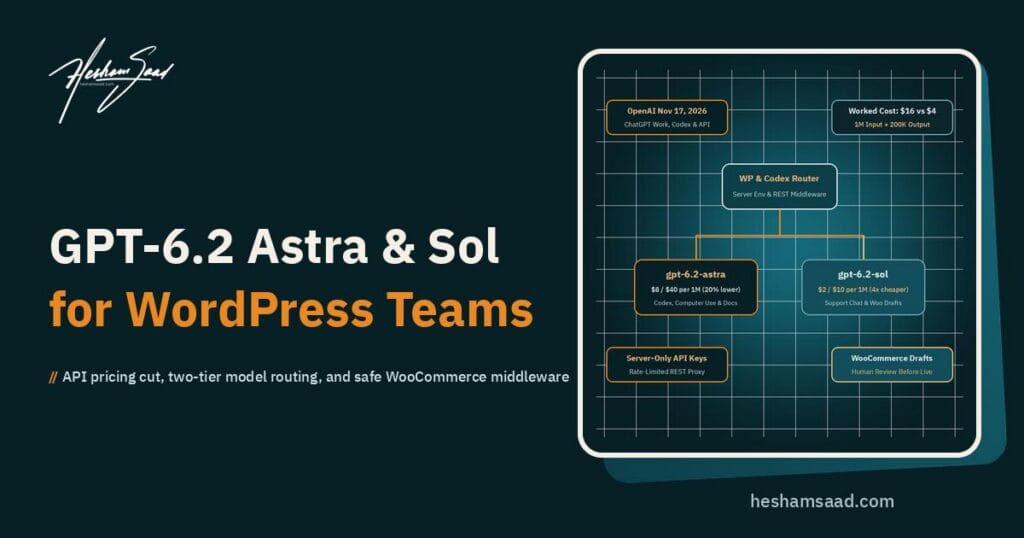
The biggest commercial shift in GPT-6.2 Astra and Sol is the price cut on the top tier. OpenAI reduced gpt-6.2-astra API pricing by 20 percent on both input and output compared with GPT-6 Astra, bringing it down from $10 per 1 million input tokens and $50 per 1 million output tokens to $8 and $40. That reduction matters when an engineering team or enterprise client runs long agent loops that consume large prompt histories and generate detailed code patches or formatted reports.
Meanwhile, gpt-6.2-sol holds steady at $2 per 1 million input tokens and $10 per 1 million output tokens. That matches the GPT-6 Sol tier, which had previously cut pricing in half compared with GPT-5.6 Sol at $4 input and $20 output. For MENA businesses running bilingual Arabic and English websites, keeping the efficiency tier at $2 and $10 while upgrading its underlying model generation protects monthly operating budgets.
Availability across three surfaces on day one is equally practical for mixed teams. Non-technical operations staff can work with the updated models directly inside ChatGPT Work, developers can invoke them inside Codex for repository-level engineering, and backend services can call gpt-6.2-astra and gpt-6.2-sol over the OpenAI API without waiting for a separate rollout window.
API pricing breakdown and worked cost example
When business owners ask why two models from the same release matter for website budgets, token math makes the answer obvious. Most WordPress integrations send large blocks of context on every call, such as product attributes, order statuses, support policies, or code files, and receive shorter structured responses back. Comparing the three recent OpenAI price tiers side by side shows where each model sits.
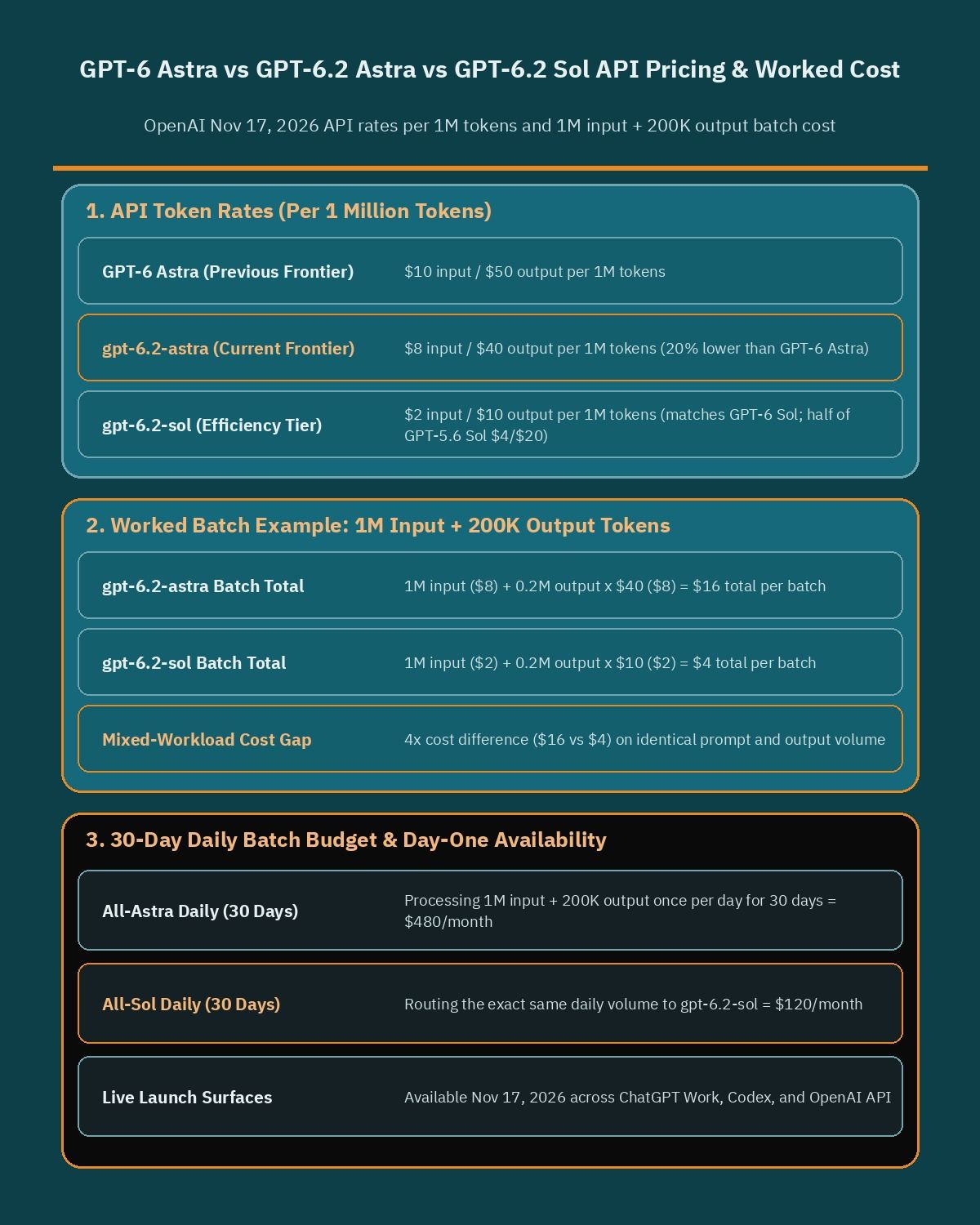
- GPT-6 Astra (previous frontier tier): $10 per 1 million input tokens and $50 per 1 million output tokens.
gpt-6.2-astra(current frontier tier): $8 per 1 million input tokens and $40 per 1 million output tokens, a 20 percent reduction on both sides.gpt-6.2-sol(current efficiency tier): $2 per 1 million input tokens and $10 per 1 million output tokens, matching GPT-6 Sol and half the $4/$20 price of GPT-5.6 Sol.
Worked API cost example: consider a typical agency or WooCommerce batch workload that processes 1 million input tokens and generates 200,000 output tokens. On gpt-6.2-astra, 1 million input tokens cost $8 and 200,000 output tokens (0.2 million multiplied by $40) cost another $8, bringing the total batch to $16. Running the exact same 1 million input tokens and 200,000 output tokens through gpt-6.2-sol costs $2 for input and $2 for output (0.2 million multiplied by $10), for a total of $4.
That 4x difference ($16 versus $4) scales fast on live sites. If a busy online store or multi-site agency processes that 1 million input and 200,000 output volume once per day over a 30-day month, routing every call to gpt-6.2-astra totals $480, whereas routing those calls to gpt-6.2-sol costs $120. Splitting traffic so only complex tasks hit Astra keeps spending predictable while still giving technical teams access to frontier quality.
How OpenAI compares with Gemini 4 and DeepSeek in multi-model stacks
No serious engineering team evaluates OpenAI pricing in a vacuum anymore. Many WordPress agencies across the MENA region already maintain abstraction layers that let them compare providers by task accuracy, latency, and regional availability. In that broader comparison, OpenAI’s frontier and efficiency pairing sits directly alongside Google’s recent lineup and open-weight or budget API alternatives.
Teams tracking Google’s ecosystem often benchmark tasks against Gemini 4 Hydrogen when evaluating top-end reasoning and structured output workflows, while looking at Gemini 4 Carbon for lighter, high-throughput workloads that mirror the role of gpt-6.2-sol. Similarly, cost-sensitive projects frequently test the DeepSeek API for coding assistance or high-volume internal tooling before deciding which vendor owns each route in production.
Because OpenAI’s announcement focused on its own generation-over-generation pricing and capability improvements rather than publishing cross-vendor benchmark tables, the smartest move is running your own prompt test suite. Take 30 to 50 real requests from your WordPress site, including Arabic customer questions, WooCommerce attribute extraction, and custom PHP debugging, and measure pass rates and actual invoice totals across your shortlisted APIs before locking into one provider.
Formatting alignment, Codex coding, and computer-use workflows
Lower API rates only help if the model finishes multi-step jobs without breaking layout or syntax. OpenAI positioned gpt-6.2-astra specifically around reliability in complex professional deliverables, highlighting stronger formatting alignment alongside new high marks on Agents Last Exam and Terminal-Bench-Science. Together, those signals point toward better adherence to rules when a model works inside real tools rather than answering isolated chat prompts.
Formatting alignment sounds minor until a business tries to automate client reporting or technical documentation. When a model generates spreadsheets, presentation slides, or legal and scientific documents, small structural errors force staff to spend an hour fixing broken columns, misaligned headings, or inconsistent section numbering. Improvements in formatting alignment inside gpt-6.2-astra reduce that cleanup overhead in ChatGPT Work and API document pipelines.
Codex and WordPress engineering workflows
Inside Codex, the distinction between gpt-6.2-astra and gpt-6.2-sol maps cleanly to everyday software engineering. Complex WordPress builds rarely fail on simple syntax; they fail when custom plugins interact awkwardly with WooCommerce checkout hooks, caching layers, multilingual plugins, or database queries under load. The new high marks for GPT-6.2 Astra on Terminal-Bench-Science and Agents Last Exam reflect stronger terminal command execution, multi-file debugging, and structured reasoning across long engineering sessions.
For a WordPress developer, that means gpt-6.2-astra is the right tool inside Codex when auditing a legacy plugin, writing automated integration tests, or refactoring a custom REST API endpoint. Meanwhile, gpt-6.2-sol fits day-to-day coding tasks inside Codex and editor workflows where fast feedback matters more than deep multi-step planning, such as scaffolding block templates, writing unit test stubs, or converting repetitive CSS rules.
Computer use, commerce, and regulated workflows
OpenAI also highlighted computer use and agent execution across both tiers, with GPT-6.2 Astra taking the lead on complex multi-step actions. Computer-use models interact with interfaces, forms, and software dashboards when clean APIs are missing, which is common in older ERP systems, shipping portals, and regional payment back offices used by MENA businesses. As agentic interfaces mature, teams are also connecting conversational assistants with digital payment rails such as ChatGPT Wallet and agentic checkout workflows.
Regulated industries are another area where formatting precision and verified agent behavior carry real weight. Clinics, medical groups, and healthcare platforms exploring automation often evaluate OpenAI computer-use agents in healthcare for intake coordination and structured record summaries, where a misplaced field or unverified step is unacceptable. Even with improved scores on Agents Last Exam, any business in healthcare, finance, or legal services still needs strict permission boundaries and human sign-off before an agent writes to live records.
Pros, cons, and model-routing trade-offs
Every model release looks impressive in an announcement summary, yet production deployments succeed or fail on trade-offs. Looking objectively at GPT-6.2 Astra and GPT-6.2 Sol helps agency leads and business owners avoid overpaying for frontier capacity or underpowering complex tasks.
Where GPT-6.2 Astra and Sol stand out
- 20 percent frontier price reduction: Dropping
gpt-6.2-astrafrom $10/$50 to $8/$40 per 1 million tokens makes complex coding, research, and document generation more economical than GPT-6 Astra. - Predictable efficiency tier: Keeping
gpt-6.2-solat $2 input and $10 output per 1 million tokens gives high-frequency apps strong general reasoning, coding, and agent execution at a quarter of Astra’s cost. - Unified rollout: Immediate availability in ChatGPT Work, Codex, and the OpenAI API lets non-technical staff and developers standardize on the same model family.
- Stronger agent and format reliability: New high marks on Agents Last Exam and Terminal-Bench-Science, paired with formatting-aligned spreadsheet, slide, and document generation, reduce manual rework.
Limitations and verification gaps to watch
- Frontier costs still compound in agent loops: Even at $8/$40, a multi-step agent that re-reads large files or long chat histories across ten turns multiplies input token usage quickly.
- No published Arabic-specific benchmark scores: Exact Arabic-specific benchmark scores were not published in the announcement, so MENA companies serving Arabic customers must test Gulf, Egyptian, Levantine, and Modern Standard Arabic prompts directly before committing.
- Unpublished technical parameters in the summary: Specific limits such as context window ceilings and rate quotas should be checked directly in the OpenAI developer documentation rather than assumed from earlier versions.
- Risk of over-routing to Astra: Without clear routing rules in code, plugins often default every call to the flagship model ID and quietly inflate monthly invoices by 4x.
Routing tasks between gpt-6.2-sol and gpt-6.2-astra
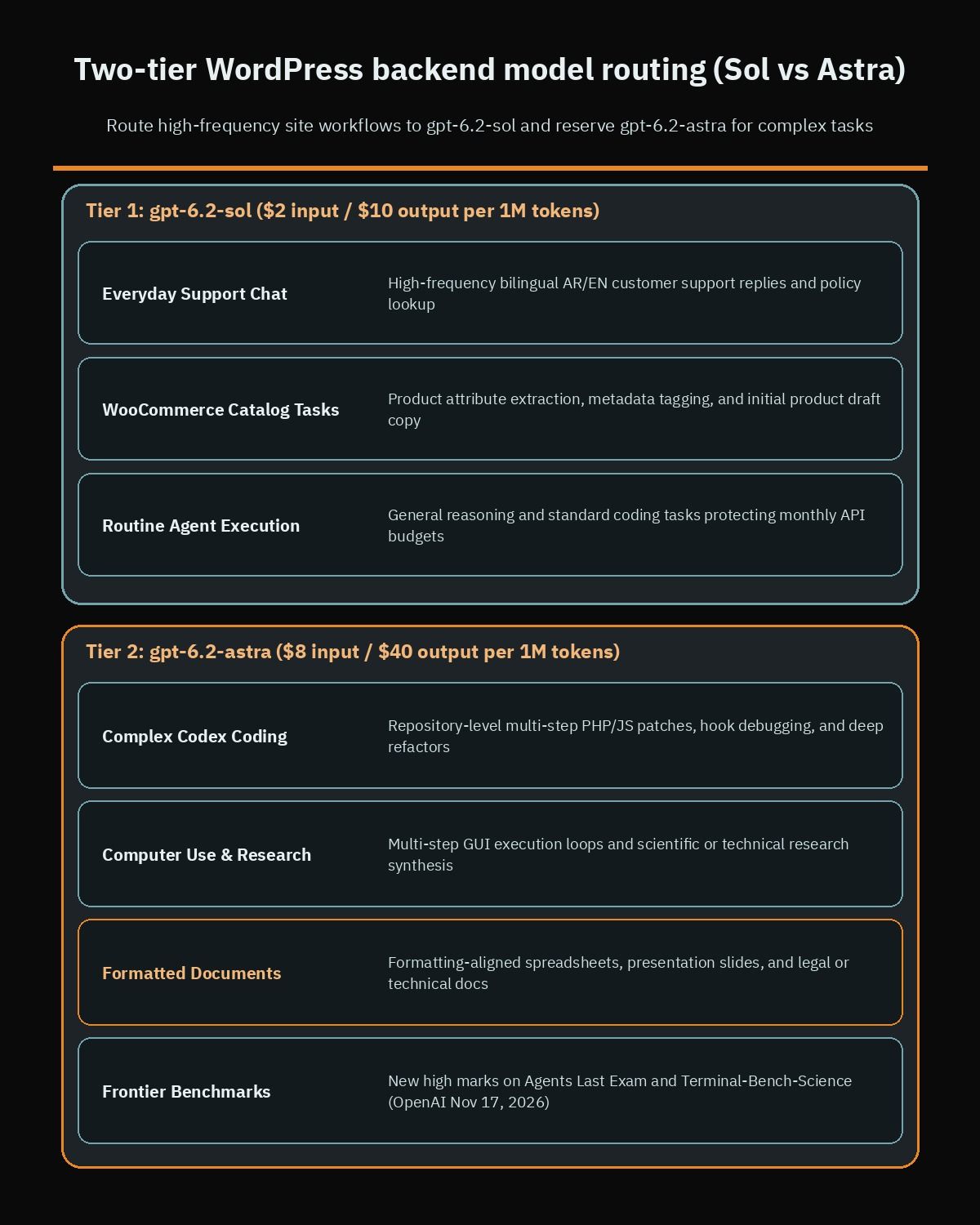
The clean engineering pattern is two-tier routing inside your backend application. Instead of hardcoding one model ID across every feature, your server inspects the task type and selects gpt-6.2-sol by default for fast, repetitive requests. Only workflows that genuinely require deep multi-step planning, repository-wide code reasoning, computer use, or strict spreadsheet and document formatting get routed to gpt-6.2-astra.
In practice, a simple configuration map in your WordPress middleware can control this routing cleanly. Customer support replies, FAQ matching, short product summaries, and metadata tagging belong on gpt-6.2-sol at $2/$10. Escalated diagnostic tasks, complex quote spreadsheets, legal review drafts, and Codex engineering runs belong on gpt-6.2-astra at $8/$40, with per-endpoint budgets logged daily.
What WordPress and WooCommerce businesses should do next
If you run a WordPress business site or WooCommerce store, you do not need to rebuild your stack to benefit from GPT-6.2 Astra and Sol. You do need disciplined architecture so new AI features improve conversion and team speed without exposing credentials or damaging catalog accuracy.
Practical routing for chatbots and WooCommerce catalogs
Start by matching your highest-volume customer touchpoints to the efficiency tier. If you operate a WordPress AI chatbot that answers shipping questions, checks store policies, or helps visitors narrow down product categories, gpt-6.2-sol provides strong general reasoning at $2 per 1 million input tokens and $10 per 1 million output tokens. The same applies to generating initial WooCommerce product descriptions, short summaries, and SEO meta drafts across large multilingual catalogs.
Save gpt-6.2-astra for the smaller number of high-value workflows where formatting precision or deep code reasoning pays for itself. Examples include building custom WooCommerce shipping or pricing plugins inside Codex, preparing formatted proposal spreadsheets and technical documentation in ChatGPT Work, or running supervised computer-use workflows that reconcile supplier sheets with back-office tools.
Server-side middleware and API key security
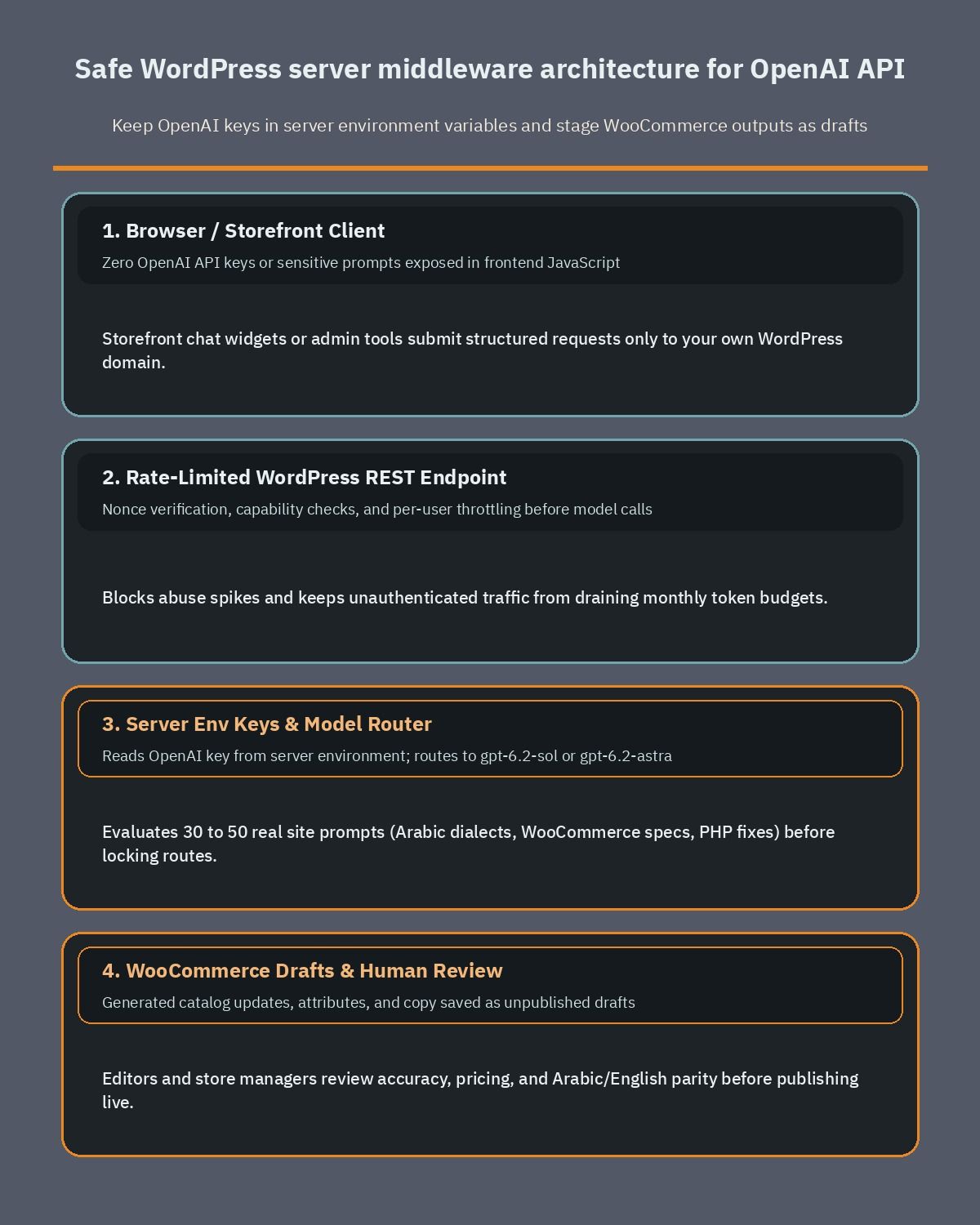
Regardless of which model ID you call, never place OpenAI API keys in browser JavaScript, theme scripts, or public AJAX payloads. Any visitor can open browser developer tools, copy an exposed key, and run unauthorized requests against your $8/$40 or $2/$10 billing account within minutes. All API calls must originate from server-side PHP or dedicated middleware where keys live in protected server environment variables.
A production-ready WordPress integration also needs three guardrails around the middleware layer. First, enforce per-user and per-IP rate limits so automated bots cannot flood your chat widget and spike token bills. Second, log token consumption by model ID so you can verify your gpt-6.2-sol versus gpt-6.2-astra ratio every week. Third, save AI-generated WooCommerce product updates, prices, and Arabic copy as drafts so a human editor reviews factual accuracy before anything goes live to shoppers.
Your immediate next step is to audit one concrete workflow on a staging copy of your site before changing production plugins. Pick 50 real Arabic and English customer inquiries or 50 WooCommerce product rows, run them through gpt-6.2-sol first, and escalate only the failed or formatting-heavy cases to gpt-6.2-astra to measure the true quality and cost difference. If your team wants help architecting secure server-side endpoints, custom routing, and clean editorial controls through our WordPress development services, you can book a free consultation to review your site requirements with our engineering team.
Frequently asked questions
What is the difference between GPT-6.2 Astra and GPT-6.2 Sol?
GPT-6.2 Astra is the OpenAI frontier model built for complex professional work, coding, computer use, scientific research, and formatting-aligned outputs such as spreadsheets and slides. GPT-6.2 Sol is the efficiency model designed for high-frequency everyday workflows, balancing lower per-token cost with strong general reasoning, coding, and agent execution. Both models launched together on November 17, 2026.
How much do gpt-6.2-astra and gpt-6.2-sol cost in the OpenAI API?
In the OpenAI API, gpt-6.2-astra costs $8 per 1 million input tokens and $40 per 1 million output tokens, a 20 percent drop from GPT-6 Astra at $10 and $50. Meanwhile, gpt-6.2-sol costs $2 per 1 million input tokens and $10 per 1 million output tokens. Processing 1 million input and 200,000 output tokens costs $16 on Astra versus $4 on Sol.
When should a WordPress team route requests to gpt-6.2-sol instead of gpt-6.2-astra?
Route high-frequency tasks like customer support chatbot replies, routine content summaries, and initial WooCommerce product drafts to gpt-6.2-sol because it costs four times less per token. Reserve gpt-6.2-astra for complex plugin debugging, multi-step computer-use workflows, scientific or legal document drafting, and formatted spreadsheets or slides where extra reasoning accuracy justifies higher spending.
Where are GPT-6.2 Astra and Sol available right now?
OpenAI made GPT-6.2 Astra and Sol available immediately on November 17, 2026 across three main surfaces: ChatGPT Work, Codex, and the OpenAI API. Business teams can use ChatGPT Work for formatted documents and spreadsheets, engineering teams can run coding tasks inside Codex, and developers can integrate gpt-6.2-astra and gpt-6.2-sol directly into backend applications.
How should a WordPress or WooCommerce site connect safely to the OpenAI API?
Always connect to the OpenAI API through server-side WordPress endpoints or middleware and never place API keys inside browser JavaScript. Store credentials in server environment variables, apply strict rate limits per user, and save generated WooCommerce product copy as drafts so a human editor reviews prices, Arabic phrasing, and factual accuracy before publishing.