
هذا المقال متوفر باللغة العربية — اقرأ بالعربية
Planning a sporting goods website WooCommerce architecture in the Middle East and North Africa requires far more than uploading product photos into a standard retail template. As a senior WordPress and WooCommerce architect at heshamsaad.com, I regularly audit athletic retail platforms across Saudi Arabia, the United Arab Emirates, and Egypt where a single shopping cart must reconcile a 140-kilogram commercial treadmill, a carbon-fiber padel racket, running shoes, and temperature-sensitive whey protein tubs. Each of those product lines carries distinct variation attributes, packaging dimensions, carrier constraints, and post-purchase service expectations.
When a store treats heavy strength rigs and small athletic accessories as identical catalog items, margin erosion happens fast. Either heavyweight freight gets undercharged at checkout, or express parcel shipping fees inflate so much that shoppers abandon simple orders for replacement grips and hydration tablets. Building on core WooCommerce documentation standards lets equipment importers, multi-sport retail chains, and specialty distributors unify complex catalog taxonomies, tiered logistics, and institutional quoting under one roof.
What a sporting goods website WooCommerce build must handle
Athletic retail in Riyadh, Jeddah, Dubai, and Cairo spans five distinct business models that often overlap inside one growing company. You might operate a multi-branch sporting goods chain, distribute imported commercial cardio and strength machines, outfit padel and tennis clubs, curate performance footwear and apparel, or run a dedicated sports nutrition operation. While a service-focused gym website on WordPress centers on class timetables, trainer bios, and membership pass renewals, an equipment and activewear commerce platform must orchestrate physical inventory, dimensional freight, and assembly scheduling.
Merchants comparing platforms through our WooCommerce vs Shopify architectural breakdown frequently discover that off-the-shelf hosted templates hit rigid walls once a catalog mixes parcel couriers with two-person truck delivery and corporate procurement quotes. A custom-engineered WooCommerce sports equipment store gives your operations team full ownership over database schemas, checkout conditional logic, and multi-warehouse ERP hooks without recurring per-transaction platform penalties.
- Heavy cardio and commercial strength machinery: Motor-driven treadmills, air bikes, rowing ergometers, power racks, and dual-adjustable pulley stations require gross weight tracking, crated dimensions, floor space specifications, and optional technician installation.
- Free weights and modular conditioning gear: Olympic barbells, urethane bumper plates, competition kettlebells, and hex dumbbells demand per-increment weight pricing and shipping rules that account for high weight density in compact boxes.
- Racket sports and club equipment: Padel rackets, tennis frames, pressurized ball cases, court nets, and stringing accessories rely on technical filtering by balance point, core foam density, surface texture, and grip circumference.
- Combat sports and studio mats: Boxing gloves (measured in ounces), shin guards, Brazilian jiu-jitsu gis, and interlocking foam tatami mats introduce bulky volumetric dimensions despite relatively modest scale weights.
- Athletic footwear, technical apparel, and sports nutrition: Running shoes, compression wear, protein powders, amino acids, and electrolyte sachets depend on rapid size or flavor swatch switching, batch expiry tracking, and repeat refill automation.
Designing a fitness equipment online store MENA buyers trust means making sure all five merchandise profiles coexist cleanly. A procurement manager from a boutique hotel in Dubai should be able to request a formal PDF quote for six commercial spin bikes, while an amateur padel player in New Cairo checks out in under a minute with an overgrip pack and a tub of creatine.
Multi-department catalog hierarchy and faceted attribute filtering
The foundation of a scalable WooCommerce sports equipment store lies in how you separate product categories from product attributes. Following official guidelines for WooCommerce Managing Product Taxonomies prevents the common mistake of creating hundreds of nested category folders for weights, sizes, or brands. Instead, categories should represent stable shopping departments and equipment types, while global attributes power dynamic sidebar or drawer filters.
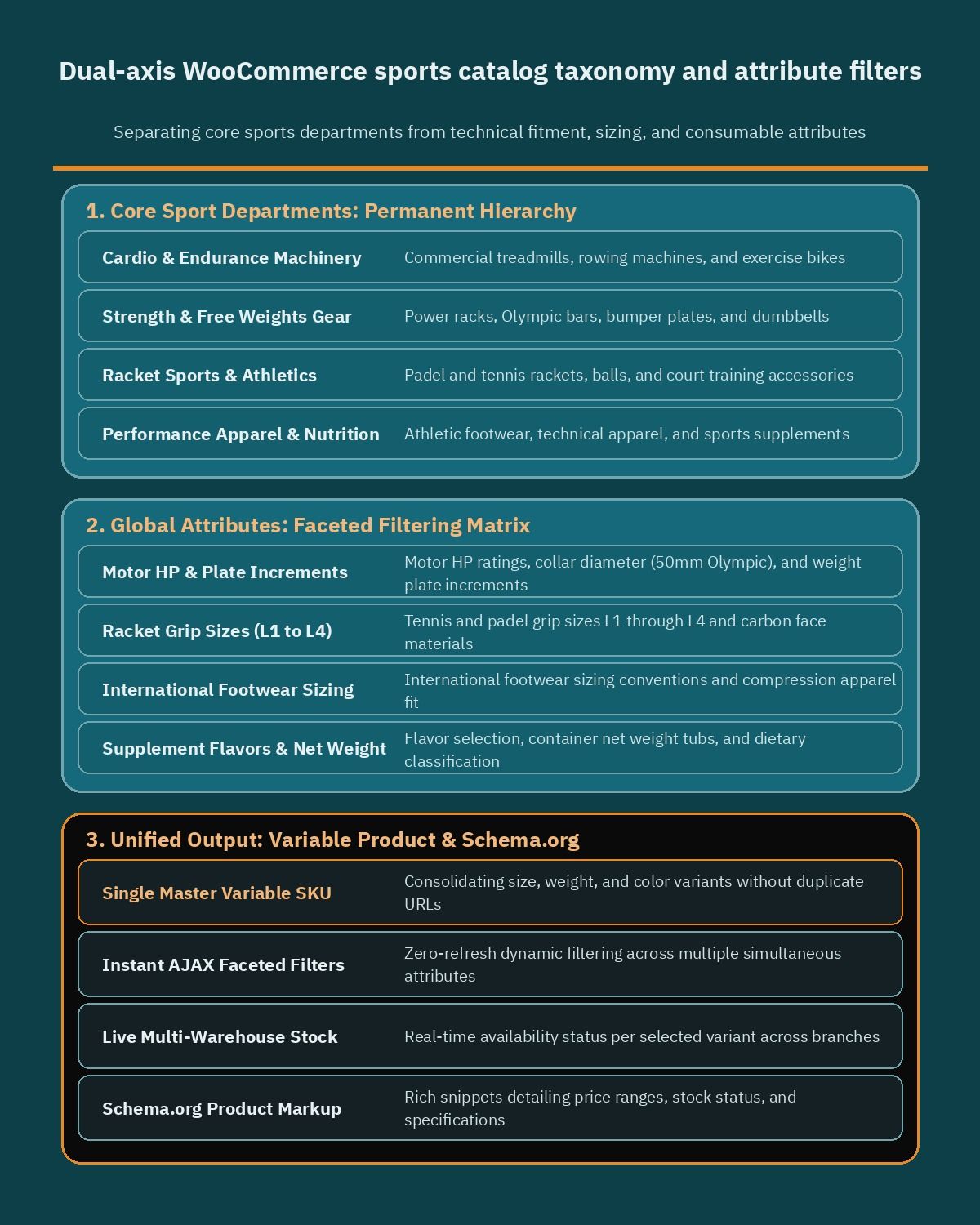
When you configure WooCommerce Variable Products under Products > Attributes in the WordPress admin dashboard, each child variation holds its own SKU, stock counter, net weight, boxed dimensions, and price. This granular data structure keeps your warehouse picking lists accurate and prevents shoppers from ordering out-of-stock variations.
Structuring global attributes across cardio, strength, racket sports, and apparel
Athletes and gym owners shop by technical specifications rather than marketing descriptions. A powerlifter looking for calibrated steel plates wants to filter immediately by barbell collar diameter (50mm Olympic versus standard) and weight increments in kilograms or pounds. Similarly, a padel player comparing carbon frames needs facet checkboxes for racket shape (diamond, teardrop, or round), balance profile, and weight range.
For footwear and activewear departments, shoppers frequently bounce between European, United States, and United Kingdom sizing conventions depending on the brand. Applying the same variable swatch architecture we detail in our guide to building a clothing store website on WooCommerce lets you display interactive size conversion charts alongside unified EU/US/UK selector buttons, frame sizes for cycling or rowing equipment, and moisture-wicking fabric ratings.
- Cardio and conditioning attributes: Console display type, motor horsepower rating, maximum user weight capacity, foldable frame mechanism, and power requirement (self-powered generator versus wall outlet).
- Strength and free-weight attributes: Uprights steel gauge, rack height and hole spacing, barbell shaft coating, and weight increments (store-configurable options such as 1.25kg to 25kg plates or 5lb to 100lb dumbbells).
- Racket and combat sport attributes: Tennis grip size (L1 through L4), padel face material (3K, 12K, or 18K carbon), boxing glove weight in ounces (8oz to 16oz), and mat thickness in millimeters.
- Sports nutrition attributes: Flavor profile (chocolate, vanilla, unflavored, berry), container net weight (such as 500g, 1kg, or 2.27kg tubs), serving count, and dietary classification (whey isolate, plant-based, caffeine-free, or halal-certified).
Keeping these attributes normalized at the global taxonomy level ensures that faceted search widgets load rapidly even when your catalog scales to thousands of parent products and tens of thousands of child variations. Shoppers can narrow a broad category page down to their exact training requirement in two taps without full page reloads.
A disciplined attribute taxonomy also simplifies merchandising for seasonal promotions and clearance events. Store managers can bulk-edit variation prices or attach promotional badges to specific supplement flavors or end-of-season running shoe sizes without disrupting the parent product URL or its accumulated search ranking authority.
Technical specifications and Schema.org Product structured data
Search engines and comparison shopping feeds rely on structured metadata to match high-intent queries like Olympic bumper plates in Riyadh or commercial air bike in Dubai. Mapping your WooCommerce product fields and global attributes directly into Schema.org Product JSON-LD markup exposes brand names, manufacturer part numbers (MPN), global trade item numbers (GTIN), material properties, weight values, and real-time stock status per variation.
Rather than pasting static text tables inside the main product description editor, our custom templates pull structured custom fields into a dedicated technical specification accordion on the product page. When your warehouse team updates the crated dimensions or power specification of a commercial elliptical inside the product data metabox, both the customer-facing spec list and the underlying Schema.org Product output update automatically.
Modular equipment bundles, technician assembly add-ons, and pre-orders
Selling standalone SKUs is only half of the revenue equation for a fitness equipment online store MENA athletes rely on. Home gym builders rarely buy a squat rack without a barbell, bench, and weight plates, and commercial equipment buyers expect clear options for professional delivery assembly and advance reservation of incoming sea freight containers.
By combining WooCommerce Product Bundles, WooCommerce Product Add-Ons, and WooCommerce Pre-Orders, you can turn standard product pages into interactive equipment configurators that increase average order value while protecting operational accuracy.
Configurable home gym kits with real-time component inventory
When a store creates a static single SKU for a home gym package, warehouse stock quickly falls out of sync because the same 20kg Olympic bar and 10kg bumper plates are also sold individually. Using WooCommerce Product Bundles solves this by linking a parent bundle product to existing individual simple or variable child products in your catalog.
You can structure store-configurable bundle tiers such as a starter garage gym kit, an intermediate strength package, or a complete padel player bundle (racket, thermal bag, three-ball tube, and overgrips). Within the bundle template, the buyer chooses their preferred rack color, bench model, and total plate weight pack, while WooCommerce deducts the exact component quantities from your master SKU inventory and calculates the combined shipping weight of all selected items.
On-site technician assembly booking and machine calibration at checkout
A multi-station cable crossover, smith machine, or motorized commercial treadmill arrives in heavy wooden crates or multi-box pallets containing hundreds of bolts, steel cables, and electronic console harnesses. Most residential and corporate buyers want the option to have certified technicians assemble, level, and calibrate the machine inside their training room.
Implementing WooCommerce Product Add-Ons allows you to attach structured service selectors directly above the Add to Cart button on eligible machinery pages. All fee structures, lead windows, and floor placement rules can be configured by the store administrator per equipment class:
- Assembly service selection: Offer a clear radio or checkbox option between box-drop delivery only and full on-site technician assembly with packaging debris removal.
- Installation floor and access notes: Capture whether the destination room is on the ground floor, reachable via a service elevator, or requires a multi-flight staircase carry, alongside optional rubber flooring mat installation.
- Preferred technician window: Allow the customer to indicate a preferred post-delivery assembly window (configured by the merchant according to regional technician dispatch schedules and city coverage).
Because these add-on selections travel with the order line item into the WooCommerce admin panel and warehouse dispatch emails, your logistics coordinator immediately sees whether an order requires a standard freight driver or a two-technician installation van carrying torque wrenches and belt tension gauges.
Managing seasonal racket drops and container shipments with pre-orders
Importers of commercial fitness machines and flagship padel brands frequently experience high demand while ocean containers are still clearing customs or awaiting manufacturer release dates. Instead of displaying a passive Out of Stock badge that drives buyers to competitors, WooCommerce Pre-Orders lets you capture committed orders ahead of arrival.
Under the extension settings, merchants can configure whether a pre-order charges the full order amount upfront or bills the customer when the shipment arrives at the warehouse, or pair it with store-configurable deposit workflows for high-ticket commercial equipment. The product page and checkout summary display a transparent expected availability date, and if a container schedule shifts at port, the store manager can update the release date in bulk and notify all reserved buyers automatically.
Dual-tier freight logistics and dimensional weight shipping rules
Logistics is where most generic e-commerce setups break down for athletic retailers. Handling bulky gym freight shipping WooCommerce workflows requires separating your catalog into distinct fulfillment tracks so lightweight parcels and palletized machines never collide inside a single flat-rate formula.
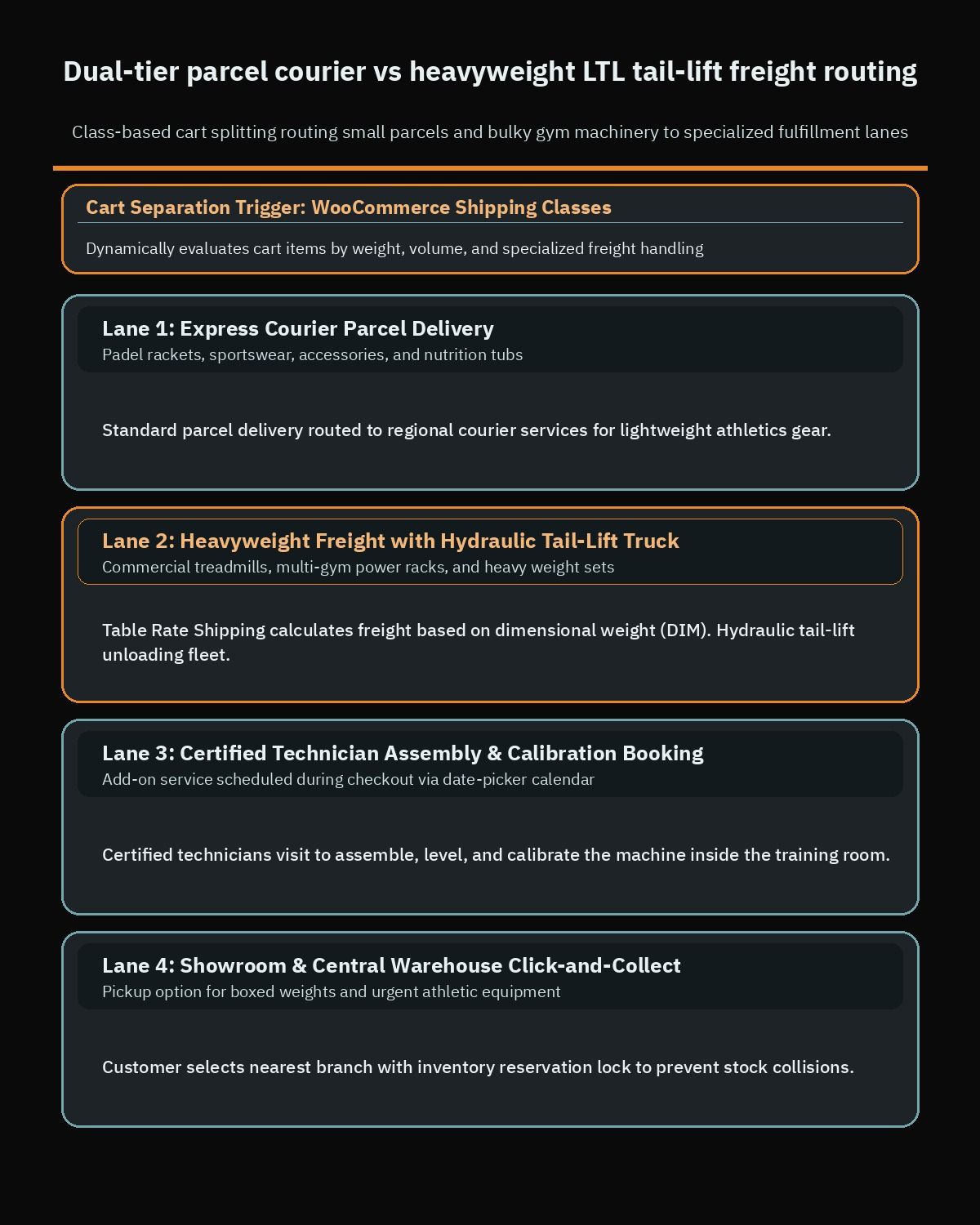
By combining WooCommerce Shipping Zones, Product Shipping Classes, WooCommerce Table Rate Shipping, and Local Pickup, your checkout can evaluate the exact contents, total weight, volumetric footprint, and destination city of every cart in real time. For a deeper look at regional zone mapping, review our architectural guide on WooCommerce shipping zones in Egypt and the Gulf.
Separating express parcel couriers from heavyweight LTL tail-lift freight
Inside WooCommerce > Settings > Shipping, we architect two primary fulfillment tiers supported by specific Product Shipping Classes (such as Standard-Parcel, Oversized-Volumetric, Heavy-Plate-Pack, and LTL-Tail-Lift-Machinery). When a customer orders athletic socks, a padel racket, or a two-kilogram tub of whey protein, the cart routes through domestic express parcel couriers integrated via the workflows covered in our WooCommerce courier plugins for Egypt and Saudi Arabia breakdown.
However, once the cart includes a multi-station functional trainer, a commercial treadmill, or a heavy iron plate set exceeding a store-configurable weight threshold (for example, when a single machine or cumulative cart weight crosses a merchant-defined 50kg+ boundary), standard parcel couriers must be suppressed or split. Table Rate Shipping rules step in to calculate Less-Than-Truckload (LTL) freight dispatch rates that account for vehicles equipped with hydraulic tail-lifts, pallet jacks, and scheduled residential or commercial delivery appointments.
When a shopper places a mixed cart containing both an in-stock shaker bottle and a heavy squat rack requiring freight scheduling, your checkout message should clearly state whether the order ships together via freight carrier or splits into an immediate parcel waybill plus a scheduled truck delivery. Clear expectations at checkout significantly reduce customer support inquiries after payment.
Dimensional weight calculations and branch showroom collection
Scale weight alone does not tell the full shipping story in sporting goods. Items like interlocking EVA foam martial arts tatami mats, pre-inflated medicine balls, plyometric jump boxes, and carbon bicycle frames weigh very little on a scale but occupy substantial cubic volume inside a delivery van. Express couriers and freight forwarders bill these shipments by dimensional (volumetric) weight rather than dead weight.
Entering accurate length, width, and height measurements on every product variation allows your shipping rate calculator or carrier API to compare actual weight against volumetric weight and charge the appropriate bracket. In addition, configuring WooCommerce Local Pickup under WooCommerce > Settings > Shipping > Local Pickup lets buyers collect heavy kettlebells, bumper plates, or custom-strung rackets directly from retail showrooms or distribution warehouses in Riyadh, Jeddah, Dubai, or Cairo, avoiding heavy freight charges entirely while driving foot traffic to your physical branches.
B2B corporate quotation portal and recurring supplement subscriptions
A mature sporting goods operation rarely relies solely on one-off retail checkouts. On the high-ticket side, commercial fitness centers, universities, private schools, padel clubs, real estate developers, and hotels purchase equipment in bulk through formal procurement cycles. On the high-frequency side, everyday athletes buy sports nutrition and court consumables every few weeks.
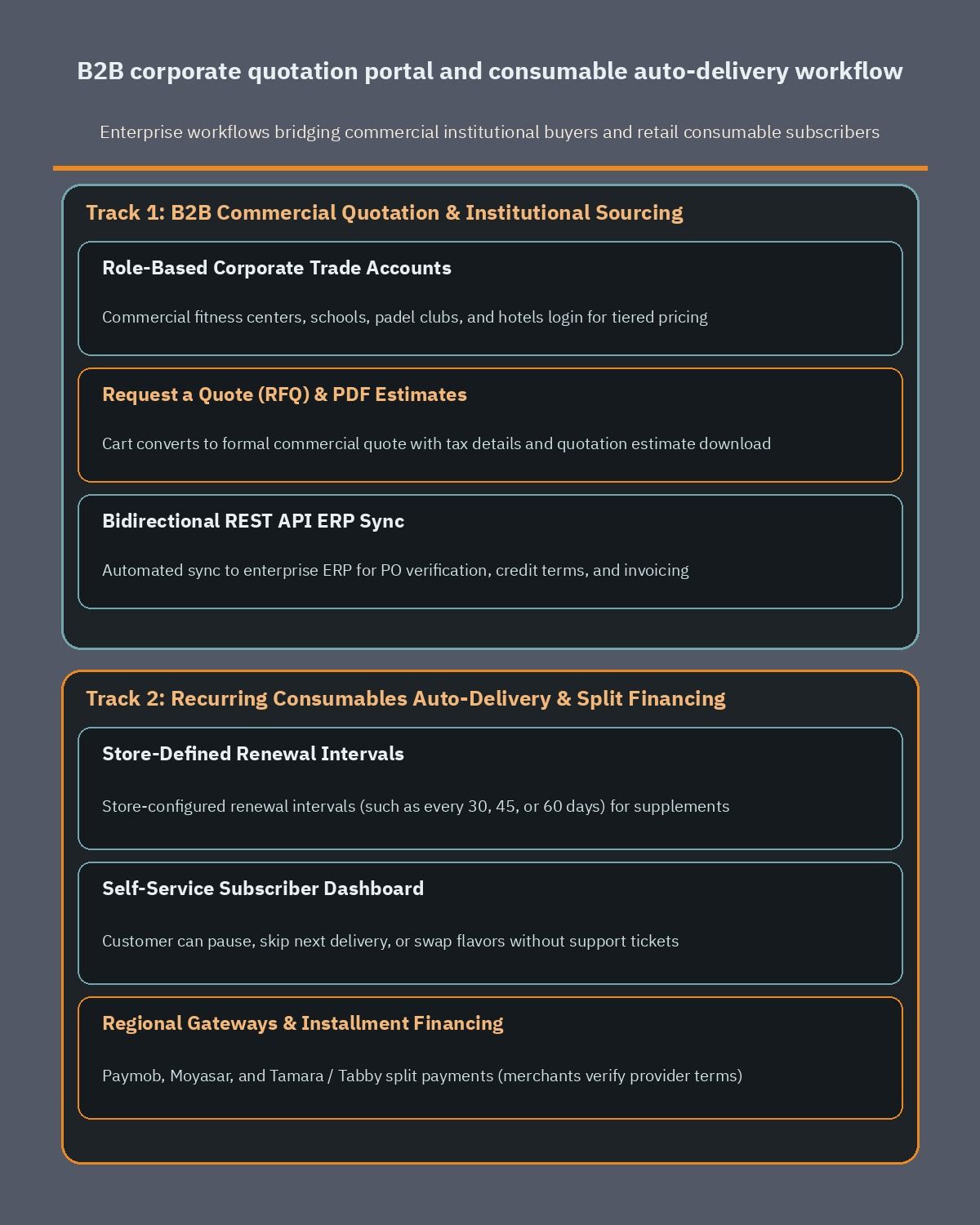
Implementing B2B for WooCommerce alongside WooCommerce Subscriptions equips a single WordPress installation to run both an institutional wholesale quotation desk and an automated consumer refill engine.
Wholesale club quotes and volume pricing for gyms, schools, and hotels
Institutional buyers cannot charge twenty commercial treadmills and a full free-weight zone to a personal credit card at retail prices. They need an itemized quotation showing commercial unit discounts, delivery and installation charges, warranty coverage terms, and tax registration details so their finance department can issue a purchase order or bank transfer.
With B2B for WooCommerce, you can register verified corporate accounts (such as Commercial Gym Outfitter, School Athletic Department, or Padel Club Operator) and expose role-based wholesale pricing or store-configurable quantity tier brackets. Even for unauthenticated corporate visitors, a Request a Quote button can sit alongside or replace the standard Add to Cart button on commercial equipment lines:
- Multi-item quote basket: Facility managers browse your cardio, strength, and flooring departments, adding desired quantities to a dedicated quote list rather than a standard checkout cart.
- Project scope and CAD layout notes: The quote submission form captures facility square footage, target opening date, delivery location, and architectural floor plan attachments for gym layout consultation.
- Downloadable PDF estimate and one-click invoice conversion: Your sales engineers review the submission inside the WooCommerce dashboard, adjust volume discounts and freight fees, generate a branded PDF proposal, and allow the client to approve and convert the quote directly into a payable order.
This workflow keeps every B2B negotiation tied to your live product catalog and SKU database instead of scattered across disconnected spreadsheet attachments that quickly go stale when equipment stock changes.
Once a corporate quote is approved, the order moves into the exact same warehouse fulfillment and ERP inventory pipeline as your retail orders, preserving unified stock visibility across the entire company.
Auto-delivery subscriptions for protein, electrolytes, and replacement grips
While gym machines represent long-cycle capital purchases, consumables drive predictable monthly cash flow. Building a dedicated sports nutrition e-commerce WordPress workflow with WooCommerce Subscriptions lets athletes switch any eligible consumable from a one-time purchase to a recurring auto-delivery schedule right on the product page.
Merchants can configure store-defined renewal intervals (such as every 30, 45, or 60 days) and optional subscriber loyalty discounts for whey protein isolate, pre-workout formulas, creatine monohydrate, endurance energy gels, pressurized padel or tennis ball tubes, and racket replacement overgrips. From the My Account > Subscriptions dashboard, subscribers can swap their protein flavor from chocolate to vanilla before the next billing cycle, skip a delivery while traveling, or add a one-time resistance band to their upcoming shipment without calling customer support.
Regional payment gateways, installment financing, and mobile checkout UX
Converting traffic on a fitness equipment online store MENA shoppers visit daily requires aligning your checkout with regional payment habits across different basket sizes. An athlete buying a jump rope and electrolyte tabs on a smartphone between training sets wants one-tap digital wallet speed, whereas a household investing in a complete home gym or a professional padel racket often looks for split-installment financing.
WooCommerce supports modular payment gateway architecture so you can present the right payment methods dynamically based on billing country, cart currency, and order total.
Structuring local cards, digital wallets, and buy-now-pay-later options
Rather than relying on a single international card processor that may experience higher decline rates on domestic debit cards, MENA sporting goods stores typically integrate dedicated regional gateways from the official WordPress plugin directory, including Paymob for WooCommerce and Moyasar, alongside split-payment extensions like Tamara Checkout and Tabby Checkout.
These integrations allow your checkout to support regional debit and wallet rails such as Mada, KNET, Apple Pay, and local card networks alongside installment plans. Because gateway availability, minimum and maximum basket rules, and settlement schedules evolve over time, merchants should always verify current supported countries, currencies, and merchant terms directly on the official plugin page and merchant documentation for Tabby Checkout, Tamara Checkout, Paymob for WooCommerce, and Moyasar before finalizing their checkout blueprint.
- On-page installment messaging: Display transparent installment breakdown badges on eligible variable products and home gym bundles according to the active provider rules configured in your plugin settings.
- Express digital wallet checkout: Surface Apple Pay and fast local debit processing for quick mobile purchases of sportswear, footwear, and supplement refills.
- B2B bank transfer and invoice payment rails: Enable corporate wire transfer instructions or secure payment links specifically for approved commercial gym quotations that exceed standard retail card limits.
Tailoring payment visibility by order profile keeps the checkout screen clean and prevents retail installment widgets from appearing on large institutional B2B invoices where bank wire or corporate card settlement applies.
Frictionless mobile filtering and cart validation for multi-item athletes
Most retail browsing for athletic gear, padel rackets, and nutrition starts on mobile devices through social campaigns, club communities, or search ads. If a mobile shopper has to scroll past lengthy text blocks just to select a shoe size or see whether a 15kg dumbbell pair is in stock, conversion rates suffer.
We design mobile product views with thumb-friendly sticky attribute drawers, instant AJAX variation swatches that dim out-of-stock sizes immediately, and a slide-out mini-cart that clearly separates express parcel items from scheduled freight items. At checkout, simplified address fields capture district, street, building number, floor level, and delivery access notes so both express couriers and heavy freight teams arrive prepared on the first attempt.
Warehouse ERP synchronization and what drives development budgeting
When a sporting goods business operates physical showrooms alongside regional fulfillment warehouses, manual CSV stock uploads quickly fail. Selling a commercial rowing machine online five minutes after a showroom salesperson sold the last floor unit in Riyadh creates costly fulfillment conflicts. Equally important, sports nutrition retailers must track lot numbers, cold-storage bin locations, and product expiration dates so warehouse pickers always ship the earliest-expiring stock first.
Through custom WordPress development, we connect your storefront directly to your enterprise resource planning (ERP), point-of-sale (POS), and warehouse management systems so inventory, pricing, and order statuses synchronize without manual spreadsheet intervention.
Multi-branch stock synchronization and batch expiry tracking via REST API
Using the WordPress REST API and WooCommerce webhook architecture, we build asynchronous background synchronization queues between your ERP and your website database. Rather than slowing down front-end page loads with live external API calls on every visitor click, scheduled webhooks and queue workers update variation stock counts, branch pickup availability, and supplement batch metadata in the background.
For sports nutrition and consumable catalogs, custom meta fields attached to each variation record the active batch number and expiration date synced from your warehouse system. You can display transparent best-before dates on product pages to build buyer confidence and automate promotional clearance rules when specific flavor batches enter a store-configurable window before expiry.
Key architectural factors that shape your project scope and timeline
Every athletic retailer enters a digital transformation project with a unique mix of product lines, showroom locations, and operational software. Rather than relying on arbitrary fixed package estimates, scoping when you hire a WooCommerce developer depends on five concrete architectural drivers:
- Catalog structure and variation depth: The total number of departments, global attributes, size conversion matrices, and technical specification fields required across cardio, strength, racket sports, apparel, and nutrition.
- Modular bundles, assembly add-ons, and pre-orders: Whether your storefront requires interactive home gym kit builders, city-based technician installation scheduling, or container pre-order reservation workflows.
- Dual-tier freight and multi-branch pickup logic: The complexity of your Table Rate Shipping matrices, dimensional weight formulas, express courier plugins, LTL tail-lift freight rules, and showroom Local Pickup locations.
- B2B corporate quoting and recurring subscriptions: Whether the platform combines wholesale role-based tier pricing and PDF quotation workflows with automated consumer refill subscriptions.
- ERP, POS, and regional gateway integrations: The scope of bi-directional WordPress REST API synchronization with your accounting, multi-warehouse inventory, batch expiry tracking, and regional payment and installment providers.
Mapping these five workflows before writing code ensures your storefront launches with clean taxonomy data, accurate freight margins, and a fast mobile checkout experience built for both individual athletes and commercial facility buyers.
If you are planning a new sporting goods storefront or re-architecting an existing fitness and nutrition catalog in Saudi Arabia, the UAE, or Egypt, book a free consultation with our team at heshamsaad.com. We will review your SKU taxonomy, heavy freight rules, B2B quoting requirements, and ERP integration goals to map out a practical, high-converting WooCommerce roadmap for your business.
Frequently asked questions
How should a WooCommerce store organize products across cardio machines, strength gear, apparel, and supplements?
A scalable sporting goods catalog separates broad department categories from global product attributes under Products in the WordPress dashboard. You can assign variable product attributes for weight plate increments in kilograms or pounds, racket grip sizes, international footwear sizing conversions, and supplement flavors or net weights. This structure powers fast faceted filtering on category pages and feeds accurate Schema.org Product structured data to search engines without creating duplicate product listings.
How does WooCommerce separate standard parcel shipping from heavy gym equipment freight delivery?
You can combine WooCommerce Shipping Zones, Product Shipping Classes, and Table Rate Shipping to route orders by actual weight, volumetric dimensions, and shipping class. Lightweight items like padel rackets, athletic apparel, and protein tubs qualify for standard express courier rates. Once a cart includes bulky cardio machines or strength racks above a store-configurable weight threshold, checkout automatically switches that shipment to scheduled truck freight with tail-lift unloading or showroom local pickup.
Can customers book on-site technician assembly or reserve imported fitness machines before stock lands?
Yes, WooCommerce Product Add-Ons lets shoppers attach optional on-site technician assembly, floor mat placement, and machine calibration directly on the product page before adding heavy equipment to the cart. For incoming commercial containers or seasonal padel racket drops, WooCommerce Pre-Orders allows merchants to accept advance reservations with store-configurable upfront payment or release-date billing while displaying the expected dispatch window at checkout.
Can one WooCommerce website handle both B2B gym equipment quotes and recurring supplement subscriptions?
A single WooCommerce installation can serve both commercial buyers and retail athletes by pairing B2B for WooCommerce with WooCommerce Subscriptions. Commercial gyms, schools, padel clubs, and hotels can submit Request a Quote forms, view role-based quantity tier pricing, and download PDF estimates for procurement approval. Meanwhile, retail customers can schedule store-configurable recurring auto-delivery intervals for protein powders, electrolytes, and replacement grips from the same storefront.
Which payment gateways and installment options work best for a MENA sporting goods online store?
MENA sporting goods retailers typically combine regional card and digital wallet gateways such as Paymob for WooCommerce and Moyasar with split-payment providers like Tamara Checkout and Tabby Checkout. This mix supports local debit schemes including Mada and KNET, mobile wallets like Apple Pay, and installment plans for high-ticket home gym machines. Merchants should always verify current supported countries, currencies, and merchant terms directly on each provider official plugin page before launch.
References
- WooCommerce Documentation
- WooCommerce: Managing Product Categories, Tags and Attributes
- WooCommerce: Variable Product Documentation
- WooCommerce Table Rate Shipping
- WooCommerce Product Bundles
- WooCommerce Product Add-Ons Documentation
- WooCommerce Pre-Orders Documentation
- WooCommerce Subscriptions Documentation
- B2B for WooCommerce
- WooCommerce: Setting up Shipping Zones
- WooCommerce: Product Shipping Classes
- WooCommerce: Local Pickup
- WordPress REST API Handbook
- Schema.org Product Specification
- Paymob for WooCommerce on WordPress.org
- Moyasar on WordPress.org
- Tamara Checkout on WordPress.org
- Tabby Checkout on WordPress.org