هذا المقال متوفر باللغة العربية — اقرأ بالعربية
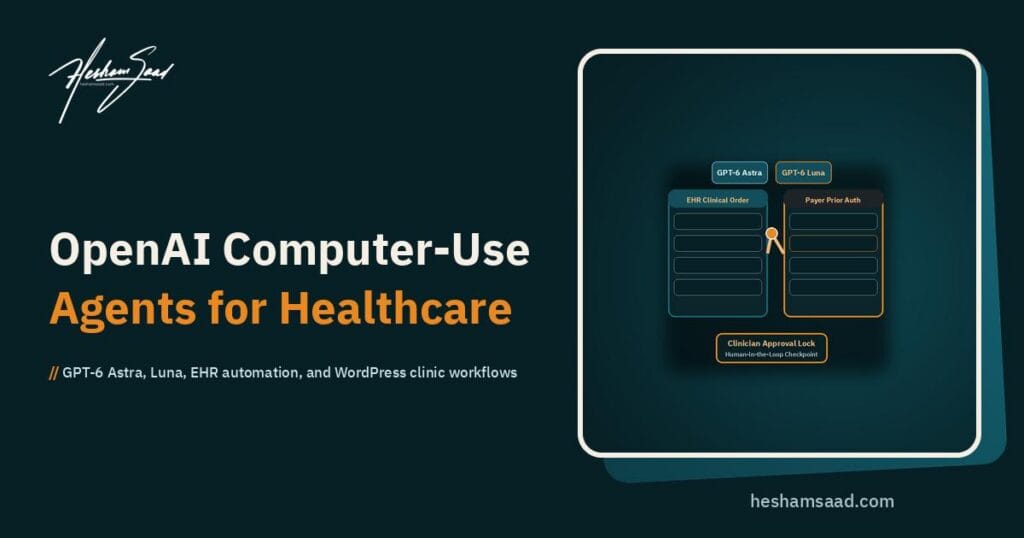
OpenAI computer-use agents for healthcare officially launched on November 16, 2026, introducing screen-level operational automation across the OpenAI API, ChatGPT for Healthcare, and ChatGPT for Clinicians. Detailed in OpenAI’s official announcements, Advancing computer-use agents for healthcare teams and More ways to move care forward with ChatGPT for Healthcare, these agents move beyond conversational text generation to inspect graphical screens, position cursors, click buttons, and enter structured data across disconnected medical software.
For clinic founders, diagnostic lab operators, online pharmacies, optical chains, and healthcare software engineers across Egypt, Saudi Arabia, and the Gulf, this release shifts the practical conversation around medical artificial intelligence. Instead of asking clinicians to copy and paste summaries out of a chat box, healthcare engineering teams can now evaluate models tested on multi-step administrative workflows, led by GPT-6 Astra and the cost-optimized GPT-6 Luna. Below, I break down what changed in the November 16, 2026 release, how the benchmark and safety numbers hold up, how production partners use the tools, and how to architect WordPress and WooCommerce patient portals safely.
What changed in OpenAI computer-use agents for healthcare
Earlier clinical chat assistants focused on summarizing consultation transcripts, drafting patient instructions, or answering medical reference questions inside an isolated text prompt. Those tools helped reduce typing during an appointment, but they stopped at the boundary of the chat window. As soon as a doctor ordered a diagnostic procedure or a specialist consult, administrative staff still had to open multiple browser tabs and desktop applications to retype the exact same clinical details.
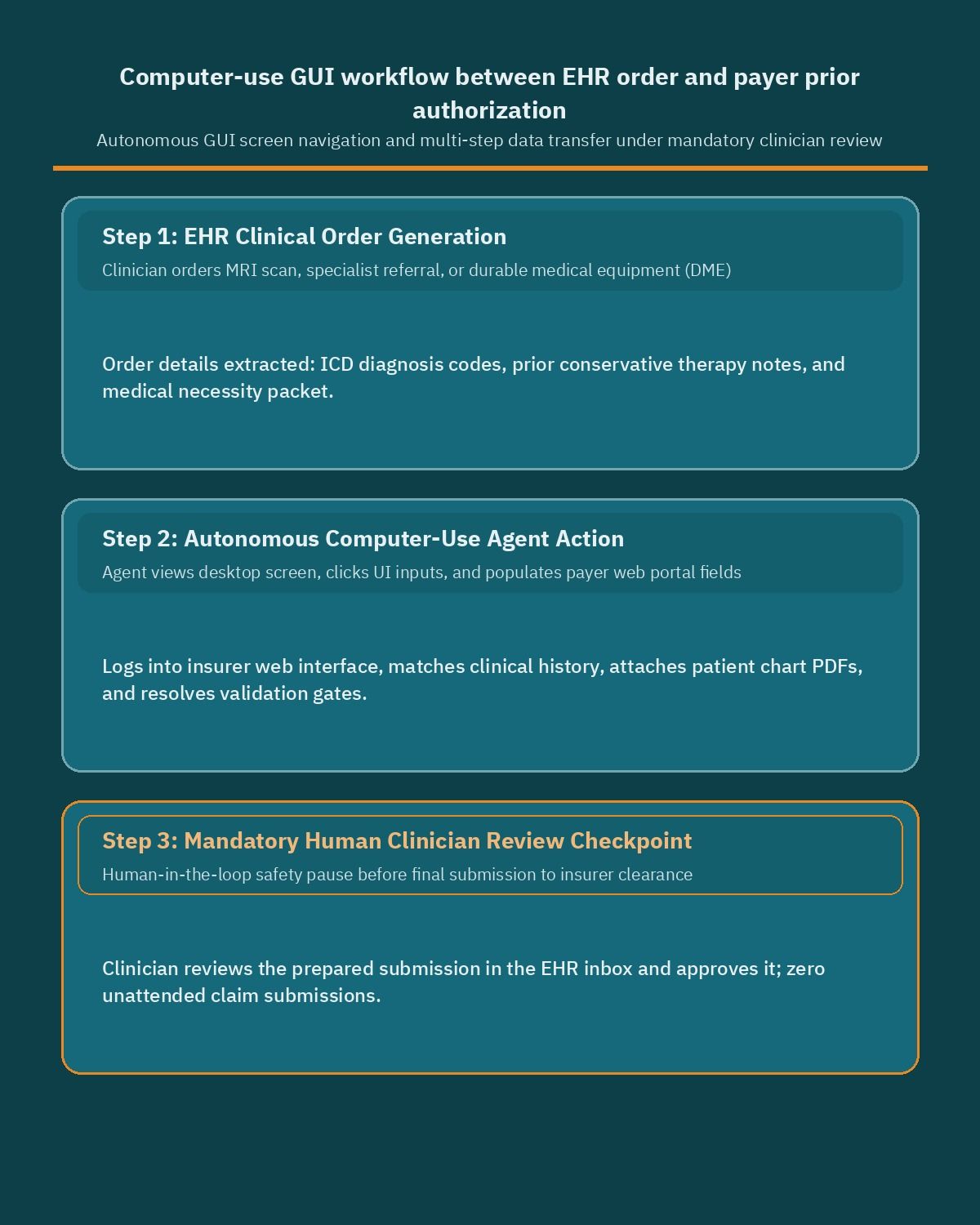
The November 16, 2026 release addresses this cross-application bottleneck directly by equipping ChatGPT for Healthcare, ChatGPT for Clinicians, and the OpenAI API with specialized computer-use capabilities. Rather than requiring every electronic health record (EHR) vendor and every insurance payer portal to build and maintain custom point-to-point API integrations, a computer-use agent interacts with the software through its graphical user interface. It reads the screen state, moves the mouse cursor, clicks dropdown menus, fills out form inputs, and navigates multi-page portals while keeping a human specialist in the approval loop.
Consider a common clinical scenario highlighted in OpenAI’s release: a physician orders a magnetic resonance imaging (MRI) scan inside the clinic’s EHR system. In a traditional setup, an authorization specialist must open the patient chart, locate the diagnosis codes and prior conservative treatment notes, log into the insurer’s web portal, and manually retype those fields across several screens. With computer-use automation, the agent reads the relevant context from the EHR chart, navigates the payer portal interface, populates the required fields, attaches supporting documentation, and pauses at the final verification step for a human specialist to review and submit.
OpenAI designed these computer-use workflows around five high-friction administrative categories that consume staff hours in outpatient clinics and hospitals alike:
- Prior authorizations for imaging and procedures: Extracting clinical justification, lab history, and ordering codes from the EHR to populate insurer pre-approval forms for scans such as MRIs.
- Specialist referrals and consult coordination: Assembling patient demographics, clinical notes, and diagnostic attachments to route referrals across external provider networks.
- Appeals and denials management: Gathering chart evidence and payer policy criteria when an initial insurance claim or authorization request is rejected, then preparing the structured appeal packet.
- Inpatient discharge planning: Coordinating post-acute care requirements, follow-up appointments, and facility transfer packets so patients are not delayed in hospital beds by administrative paperwork.
- Durable medical equipment (DME) orders: Compiling clinical necessity records and supplier forms required for home medical equipment approvals and delivery scheduling.
In every one of these workflows, the defining architectural choice is human-in-the-loop oversight. The agent performs the repetitive screen navigation, document retrieval, and form population, while the clinical or billing professional retains final authority over any submission that affects patient care or financial coverage.
GPT-6 Astra vs GPT-6 Luna on HealthAdminBench and safety evaluations
To measure how well these models handle real administrative software rather than static multiple-choice questions, OpenAI evaluated its latest generation of models on HealthAdminBench, a benchmark developed alongside Stanford researchers. According to OpenAI’s November 16, 2026 disclosures, HealthAdminBench grades models against detailed multi-step rubrics that simulate realistic healthcare operations across clinical and administrative environments.
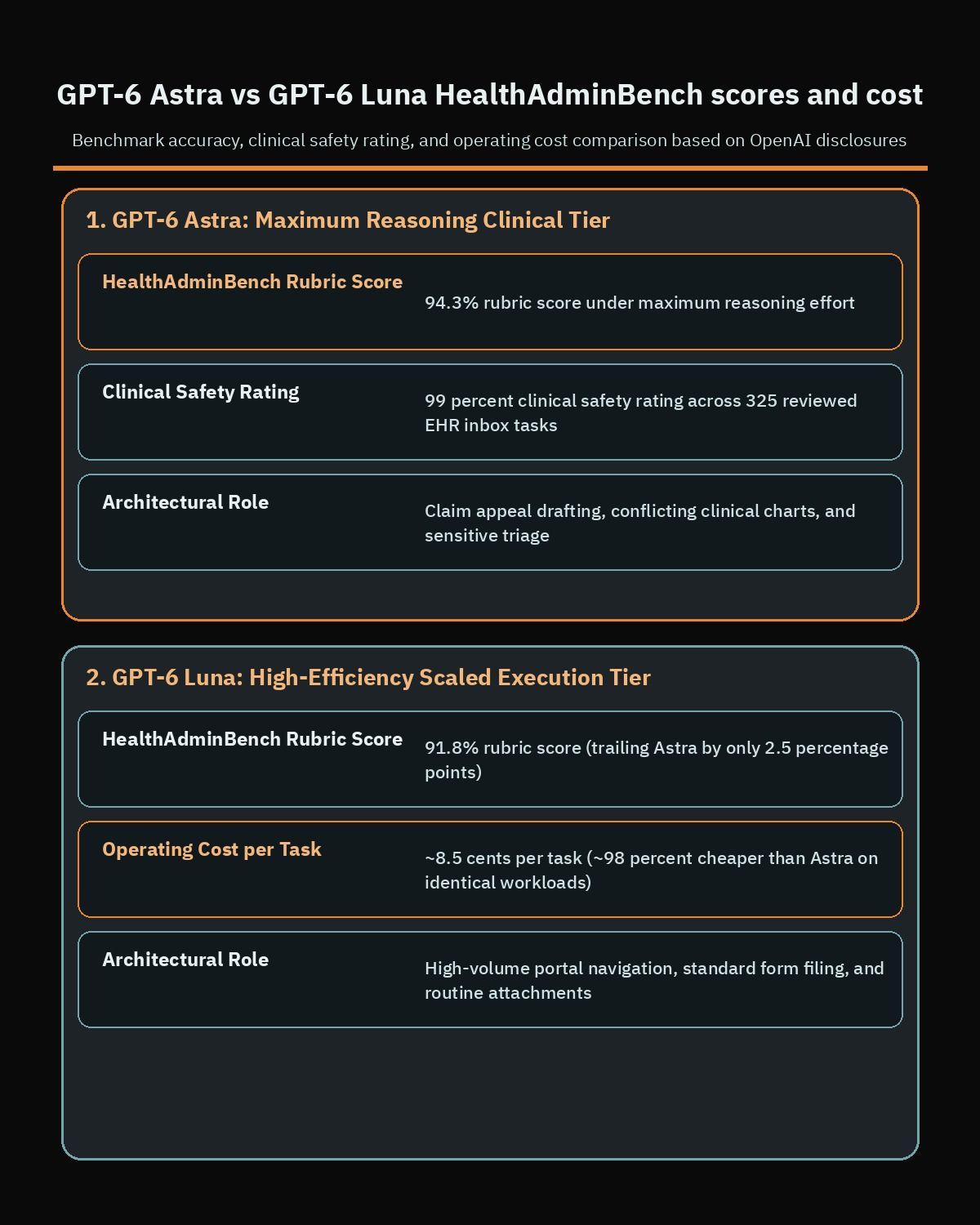
OpenAI introduced two distinct model tiers for these workloads: GPT-6 Astra, configured for maximum reasoning effort on complex clinical-administrative edge cases, and GPT-6 Luna, engineered for high-efficiency execution at scale. Understanding the performance and cost gap between the two models is essential for any healthcare organization planning an integration budget.
Rubric accuracy, per-task economics, and EHR inbox safety
All benchmark figures and unit costs below come directly from OpenAI’s November 16, 2026 healthcare release materials:
GPT-6 AstraonHealthAdminBench: Achieved 94.3 percent of available rubric points when running under maximum reasoning effort, setting the upper bound for multi-step administrative accuracy across the benchmark suite.GPT-6 Astraon EHR inbox clinical safety: Earned a 99 percent clinical safety rating across 325 reviewed EHR inbox tasks, evaluating whether the model’s drafted actions and triage steps remained clinically safe when inspected by medical reviewers.GPT-6 LunaonHealthAdminBench: Scored 91.8 percent of available rubric points on the same benchmark, trailingGPT-6 Astraby only 2.5 percentage points across the evaluated tasks.GPT-6 Lunaper-task operating cost: Completed administrative benchmark tasks at roughly 8.5 cents per task, making it approximately 98 percent cheaper thanGPT-6 Astraon identical healthcare administrative workloads.
The trade-off between a 94.3 percent rubric score and a 91.8 percent rubric score at a 98 percent cost reduction has immediate architectural implications. If a regional hospital group or diagnostic network processes thousands of routine eligibility checks, referral packet uploads, and standard prior-authorization drafts every week, running every single screen interaction on maximum-reasoning GPT-6 Astra would create an unnecessary compute bill.
Instead, the benchmark data supports a tiered routing architecture. Engineering teams can assign GPT-6 Luna at roughly 8.5 cents per task as the default worker for high-volume portal navigation, standard form preparation, and document assembly. When a task involves an appealed claim denial, conflicting clinical chart notes, or sensitive EHR inbox triage where the extra 2.5 percentage points of rubric accuracy and the 99 percent safety profile across 325 reviewed EHR inbox tasks matter most, the middleware can escalate that specific case to GPT-6 Astra prior to clinician sign-off.
Over 20 healthcare plugins, Epic connectivity, and partner deployments
Computer-use screen navigation is only half of the November 16, 2026 platform update. Alongside GUI automation, OpenAI expanded its broader healthcare suite, building on the foundation established in OpenAI for Healthcare and Introducing ChatGPT Health. The updated platform adds over 20 new healthcare plugins and native read-only EHR chart connectivity, including integration with Epic.
The decision to make EHR chart connectivity read-only is a deliberate clinical governance safeguard. When an agent prepares a referral, a discharge packet, or a DME order, it needs reliable access to patient history, medication lists, lab results, and diagnostic codes stored in Epic or other connected EHRs. By enforcing read-only chart access at the connector level, healthcare IT administrators ensure that an agent can read clinical truth directly from the source without any risk of autonomously overwriting or corrupting the legal medical record.
How CVS Health, Cigna, Ambience, Abridge, and Assort use the platform
OpenAI detailed production pilots and ecosystem integrations with five healthcare organizations that illustrate how these capabilities operate in live administrative and clinical settings:
- CVS Health: Uses the agent workflows to process incoming referrals, transmit required clinical documents between systems, and handle multi-step consult coordination steps that previously required manual staff intervention.
- Cigna Healthcare: Deploys the tools to assist clinical case managers in gathering patient information across multiple separate administrative systems, reducing the time spent switching between internal portals during care management reviews.
- Ambience Healthcare: Integrates the models into inpatient and outpatient clinical documentation workflows to address hospital discharge barriers. Crucially, Ambience configures the agents to pause automatically and request explicit clinician sign-off whenever the workflow encounters ambiguous chart records or prior authorization submissions.
- Abridge: Connects clinical conversation capture and medical documentation with downstream administrative follow-through so orders discussed during a visit translate cleanly into structured next steps.
- Assort: Applies the platform to patient access, intake coordination, and scheduling workflows across clinic front desks and call centers.
To support regulated hospital networks and payers, OpenAI paired these workflow tools with enterprise security and compliance controls. Administrators can configure role-based access controls (RBAC) so that billing staff, nurses, and attending physicians only trigger plugins and computer-use actions matching their institutional permissions. Every screen action, plugin query, and approval pause is recorded in structured audit logs for compliance review.
For organizations operating under United States healthcare privacy laws, OpenAI provides enterprise paths supporting Health Insurance Portability and Accountability Act (HIPAA) compliance through formal Business Associate Agreements (BAAs). Furthermore, OpenAI explicitly states that customer data submitted through enterprise and healthcare offerings is never used to train OpenAI foundation models.
How healthcare computer-use compares with direct APIs and rival models
Whenever a major AI lab launches a graphical computer-use agent, technical leaders should ask a pragmatic engineering question: when should we use a screen-clicking agent, and when should we stick to structured API calls or competing foundation models? Having analyzed recent frontier releases across major labs, we view GUI computer-use as a specialized bridge for legacy software rather than a replacement for well-architected backend APIs.
For example, if your engineering team is building multimodal document analysis or long-context clinical research synthesis where clean API endpoints already exist, Google’s frontier architecture covered in our analysis of Gemini 4 Hydrogen offers formidable multimodal reasoning over large document sets. Similarly, if your workflow relies entirely on deterministic JSON payloads, database lookups, and structured function calls over modern web services, you can compare OpenAI’s structured tool specifications in the OpenAI developer documentation against lower-cost open-weight and API alternatives we evaluated in our guide to the DeepSeek full-suite app and API.
It also helps to separate clinical back-office automation from consumer payment automation. In our breakdown of ChatGPT Wallet and Google Wallet in Gemini, agentic checkout focuses on helping an individual shopper authorize a retail payment inside a consumer chat interface. Healthcare computer-use agents solve a completely different institutional problem: navigating multi-screen enterprise software where a clinic coordinator must reconcile an internal EHR order with an external insurer portal under strict audit logging and clinician sign-off.
- When direct REST or FHIR APIs win: If both your clinical software and your insurance clearinghouse expose documented, bidirectional REST or HL7 FHIR APIs, direct code-level integration is faster, cheaper per transaction, and immune to visual web page redesigns.
- When OpenAI computer-use agents win: If your clinic or lab reads chart data from an EHR (or via read-only Epic connectivity) but must submit prior authorizations, referrals, DME requests, or appeal attachments through insurer web portals that offer no write API, `GPT-6 Luna` and `GPT-6 Astra` eliminate manual retyping without waiting years for the payer to modernize their backend.
Pros, cons, and regional realities for MENA healthcare providers
Before healthcare founders or hospital IT directors in Cairo, Riyadh, Jeddah, Dubai, or Abu Dhabi rush to plug computer-use agents into their daily operations, it is important to weigh the operational upsides against the technical constraints and regional regulatory requirements across the Middle East and North Africa.
Operational advantages and technical limitations
Looking objectively at the November 16, 2026 specifications and partner results, several clear strengths and trade-offs emerge for healthcare teams:
- Pro, immediate relief for portal fatigue: Staff no longer need to copy patient identifiers, ICD diagnosis codes, and clinical notes field by field across disconnected EHR and payer screens for MRIs, referrals, and DME orders.
- Pro, viable unit economics with
GPT-6 Luna: Scoring 91.8 percent onHealthAdminBenchat roughly 8.5 cents per task (about 98 percent cheaper thanGPT-6 Astra) brings the compute cost of multi-step GUI automation below the cost of manual clerical minutes. - Pro, built-in safety boundaries: Read-only EHR chart connectivity, structured audit logs, role-based access controls, and explicit clinician sign-off pauses (demonstrated by Ambience Healthcare) keep medical personnel in control.
- Con, user interface brittleness and latency: Because computer-use agents inspect screens and click DOM elements, they execute more slowly than direct REST API calls and can require prompt or workflow adjustments when an insurer redesigns its web portal layout.
- Con, mandatory human supervision overhead: Even with a 99 percent clinical safety rating across 325 reviewed EHR inbox tasks on
GPT-6 Astra, clinics cannot run these agents unattended. Staff time must still be budgeted to review paused queues and approve submissions. - Con, US-centric out-of-the-box ecosystem: Launch partners (CVS Health, Cigna Healthcare, Abridge, Ambience Healthcare, Assort), HIPAA Business Associate Agreements, and Epic-centered workflows are tailored first to the United States healthcare market.
That final point is critical for MENA healthcare operators. In Saudi Arabia, hospitals, polyclinics, pharmacies, and optical providers operate under the Council of Health Insurance (CCHI) and exchange claims and prior authorizations through the National Platform for Health and Insurance Exchange Services (NPHIES). In the United Arab Emirates, clinics integrate with the Dubai Health Authority (DHA) Shafafiya and Nabidh platforms or the Department of Health Abu Dhabi Malaffi and Shafafiya systems. Where NPHIES or Shafafiya mandates structured API message schemas, you must use compliant direct API integrations rather than screen-scraping agents.
However, across Egypt and parts of the Gulf, many private medical syndicates, corporate self-funded health plans, and regional third-party administrators (TPAs) still force clinics, labs, and pharmacies to submit pre-approvals and upload scanned attachments through legacy web portals that lack public APIs. Those fragmented TPA portals are the exact type of software where a human-supervised computer-use agent can save hours of repetitive data entry, provided your legal and compliance teams verify that sending screen states to an external cloud API complies with national healthcare data residency and patient privacy laws in Saudi Arabia, the UAE, or Egypt.
What WordPress clinics, labs, pharmacies, and optical stores should prepare
In our consulting work with healthcare providers, WordPress and WooCommerce frequently serve as the patient-facing digital front door. Patients visit the website to book specialist appointments, request home lab sample collection, upload medical prescriptions, or submit insurance card details for pre-approval. If you want your patient portal to feed cleanly into modern administrative automation, whether via direct APIs or OpenAI computer-use agents, your WordPress architecture must be built with strict security boundaries from day one.
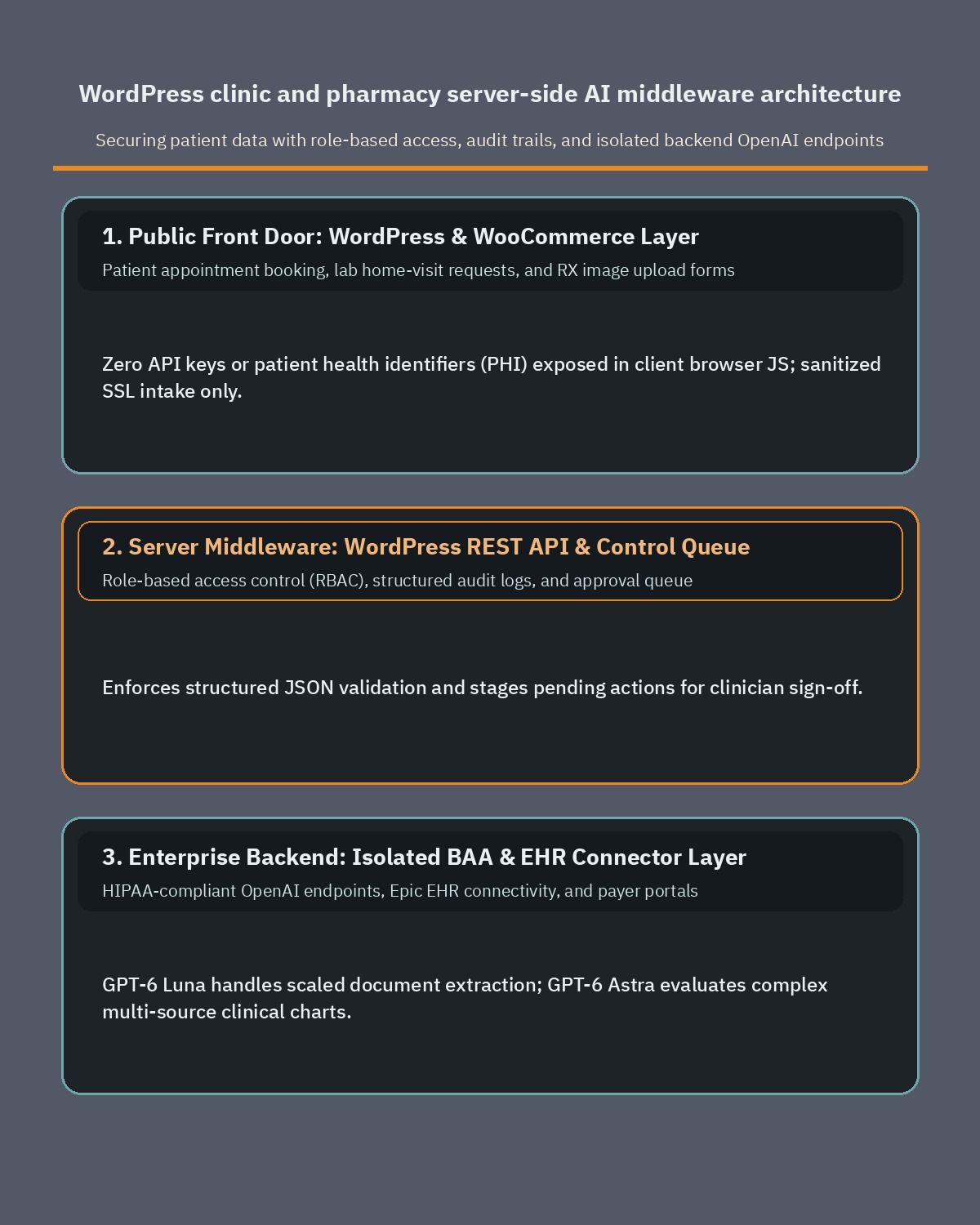
For diagnostic centers running or planning a medical lab website on WordPress, online pre-approval requests for costly diagnostic panels or imaging scans often arrive with physician referral letters and insurance membership numbers. If those intake fields are captured as unstructured text or dumped into standard WordPress tables, your administrative staff or downstream agent has to spend extra steps cleaning and validating the request before checking payer coverage.
The same principle applies to e-commerce healthcare verticals. When a business launches a pharmacy website with WooCommerce to handle prescription fulfillment and chronic medication refills, or builds an optical store website on WooCommerce where customers submit pupillary distance measurements, lens prescriptions, and vision insurance claims, the public storefront must never blend directly into back-office clinical or insurance automation without an isolated middleware layer.
Architecture checklist for WordPress and WooCommerce healthcare sites
Based on our engineering standards at heshamsaad.com, we recommend four concrete architectural rules before connecting any WordPress healthcare site to automated back-office workflows:
- Separate public marketing and booking from protected clinical records: Use WordPress for service discovery, doctor profiles, educational content, and initial appointment slot selection. Never store unencrypted clinical charts, diagnostic results, or long-term insurance attachments inside default
wp_postsorwp_postmetadatabase tables. - Keep API keys and patient payloads strictly on the server side: Never embed OpenAI API keys, session tokens, or patient health data inside client-side browser JavaScript. Any communication between your intake portal and an external AI or EHR service must execute inside hardened server-side middleware.
- Enforce structured validation on custom REST endpoints: When capturing insurance pre-approval requests, register custom server-side endpoints via
register_rest_routethat validate member IDs, policy numbers, and clinical attachment formats before placing the task into an encrypted backend queue. - Build mandatory staff approval queues and audit logs: Mirror the safety pattern used by OpenAI’s healthcare partners. Route prepared tasks into a role-restricted staff review dashboard (such as
Clinic Portal > Prior Authorizations > Pending Review) where a licensed clinician or authorization specialist inspects the drafted fields and clicks approve before any external payer portal submission takes place.
Designing this separation between a fast, SEO-friendly WordPress front end and a secure, audit-logged clinical middleware layer requires careful database and API planning. Our WordPress development services help clinics, diagnostic labs, pharmacies, and optical retailers across the region build custom portals that keep patient data protected while preparing their operations for modern AI workflows.
If you are evaluating how to connect your clinic booking flow, lab requisition intake, or WooCommerce pharmacy checkout with structured back-office automation without compromising patient privacy or regional compliance, book a free consultation with our engineering team to review your current website architecture and map out a safe implementation plan.
Frequently asked questions
What do OpenAI computer-use agents for healthcare actually do?
OpenAI computer-use agents for healthcare are specialized artificial intelligence agents released on November 16, 2026 across the OpenAI API, ChatGPT for Healthcare, and ChatGPT for Clinicians. Instead of only answering chat prompts, these agents view computer screens, move cursors, click buttons, and type data across disconnected electronic health record systems and insurer portals. They automate repetitive tasks like prior authorizations, referrals, appeals, discharge planning, and durable medical equipment orders under human oversight.
How does GPT-6 Astra compare with GPT-6 Luna on HealthAdminBench?
According to OpenAI disclosures from November 16, 2026, GPT-6 Astra achieved 94.3 percent of available rubric points on HealthAdminBench under maximum reasoning effort. GPT-6 Luna scored 91.8 percent on the same healthcare administration benchmark developed alongside Stanford researchers. While Astra delivers slightly higher rubric accuracy for complex edge cases, Luna operates at roughly 8.5 cents per task, making it approximately 98 percent cheaper for high-volume administrative workflows.
Are OpenAI healthcare computer-use agents safe to run without clinician review?
No, these computer-use agents are designed to operate with mandatory human-in-the-loop oversight rather than autonomous clinical execution. OpenAI reported that GPT-6 Astra earned a 99 percent clinical safety rating across 325 reviewed electronic health record inbox tasks, and chart connectivity such as Epic remains read-only. In production deployments like Ambience Healthcare, the agent pauses and waits for explicit clinician sign-off whenever it encounters ambiguous records or prior authorization submissions.
Which healthcare organizations and platform controls are included in this release?
OpenAI announced production pilots and integrations with CVS Health, Cigna Healthcare, Abridge, Ambience Healthcare, and Assort. The platform update adds over 20 healthcare plugins, read-only electronic health record chart connectivity including Epic, role-based access controls, and structured audit logs for compliance tracking. Enterprise healthcare customers can also operate under Business Associate Agreements for HIPAA compliance, and OpenAI does not use enterprise healthcare data to train its foundation models.
How should WordPress clinics and pharmacies prepare their websites for healthcare agents?
WordPress clinics, medical labs, pharmacies, and optical stores should keep public appointment booking and prescription intake forms strictly separated from protected patient health records. Developers must never store patient records in default WordPress database tables or expose OpenAI API keys inside browser JavaScript. Instead, teams should route intake requests through server-side REST middleware with role-based access controls, structured audit logs, and a human approval queue before any external portal action runs.