
هذا المقال متوفر باللغة العربية — اقرأ بالعربية
Building a high-converting cosmetics skincare store website WooCommerce platform in the Middle East and North Africa requires far more than installing a multipurpose fashion template and uploading bottle photography. Beauty shoppers in Riyadh, Dubai, and Cairo rarely buy foundation, concealer, or active serums from text-only dropdown menus. When a storefront fails to show undertone accuracy, skin-type suitability, active ingredient pairing rules, and guaranteed shelf life, mobile visitors abandon their carts and return to asking repetitive questions over Instagram direct messages or WhatsApp.
For indie beauty founders, dermatology clinics launching retail lines, cosmetic importers, and multi-brand retailers, manual social selling hits an operational ceiling fast. Answering hundreds of daily chats about whether a niacinamide serum layers safely under a retinol cream or which foundation shade matches warm olive skin drains staff hours and caps daily order volume. Moving those buyers onto a structured self-service catalog means translating human consultation logic directly into your database taxonomy, variation swatches, bundle containers, and checkout fulfillment rules.
This guide walks through the technical architecture required to engineer a specialized WordPress development foundation for beauty e-commerce in MENA. You will learn how to model global shade and skin-concern taxonomies, configure 3-step routine bundle builders, enforce First-Expired-First-Out (FEFO) batch tracking via the WooCommerce REST API, route heat-sensitive formulas to chilled couriers, and keep bilingual Arabic-English mobile product pages rendering in under 2.5 seconds.
Why Generic Retail Templates Fail a Cosmetics Skincare Store Website WooCommerce Build
Most off-the-shelf e-commerce templates treat every variable product like a cotton t-shirt sold in three sizes and four basic colors. Applying that layout to a cosmetics skincare store website WooCommerce catalog creates immediate conversion friction because cosmetics and dermatological products carry multi-dimensional selection criteria that flat select boxes cannot communicate.
When a shopper evaluates a liquid foundation line with 30 shades, a raw HTML dropdown reading “110 Ivory, 220 Beige, 310 Sand” forces them to guess both depth and undertone. Without visual color circles, real-skin smear textures, and an undertone sub-filter (warm, cool, neutral, or olive), customers either hesitate to buy or order the wrong shade. In cosmetics retail, opened color products cannot be restocked for hygiene and regulatory reasons, turning every shade mismatch into a total margin write-off.
Skincare catalogs suffer from an equally costly failure mode when templates bury formulation details inside unstructured description paragraphs. A shopper dealing with post-acne hyperpigmentation and dehydrated skin needs to filter by skin concern, active concentration, pregnancy safety, and morning versus evening application order. If your catalog structure cannot surface those attributes on collection grids and product cards, your customer support team remains trapped in manual consultation loops.
- Undertone blindness on mobile grids: Standard dropdown menus hide whether a concealer or lipstick leans warm, cool, or neutral, forcing mobile shoppers to open another browser tab to search for social media swatch videos.
- Unindexed local attributes: Stores that paste ingredient lists and skin types into per-product custom text boxes cannot generate SEO-friendly filtered landing pages or dynamic routine recommendations.
- Active ingredient clashes: Selling high-strength exfoliating acids alongside prescription-strength retinoids without structured compatibility warnings increases buyer irritation complaints and product return requests.
- Heavy unoptimized galleries: Multi-purpose themes often load full-resolution variation galleries for every single shade on initial page load, pushing mobile load times past 5 seconds on cellular connections.
Selecting one of the fastest WooCommerce themes for Arabic stores gives you a clean DOM starting point, but true conversion engineering happens in how you structure product taxonomies, variation metadata, and bundle workflows underneath the theme layer.
Shade Swatches, Skin-Type Taxonomies, and Structured Product Data
According to the official WooCommerce documentation on managing product taxonomies, attributes created globally under Products > Attributes in the WordPress dashboard are automatically registered as custom WordPress taxonomies prefixed with pa_. By contrast, custom attributes added locally inside an individual product edit screen are saved as serialized post meta, meaning they cannot be queried efficiently across archive filters, exposed in navigation menus, or synchronized cleanly across bilingual catalogs.
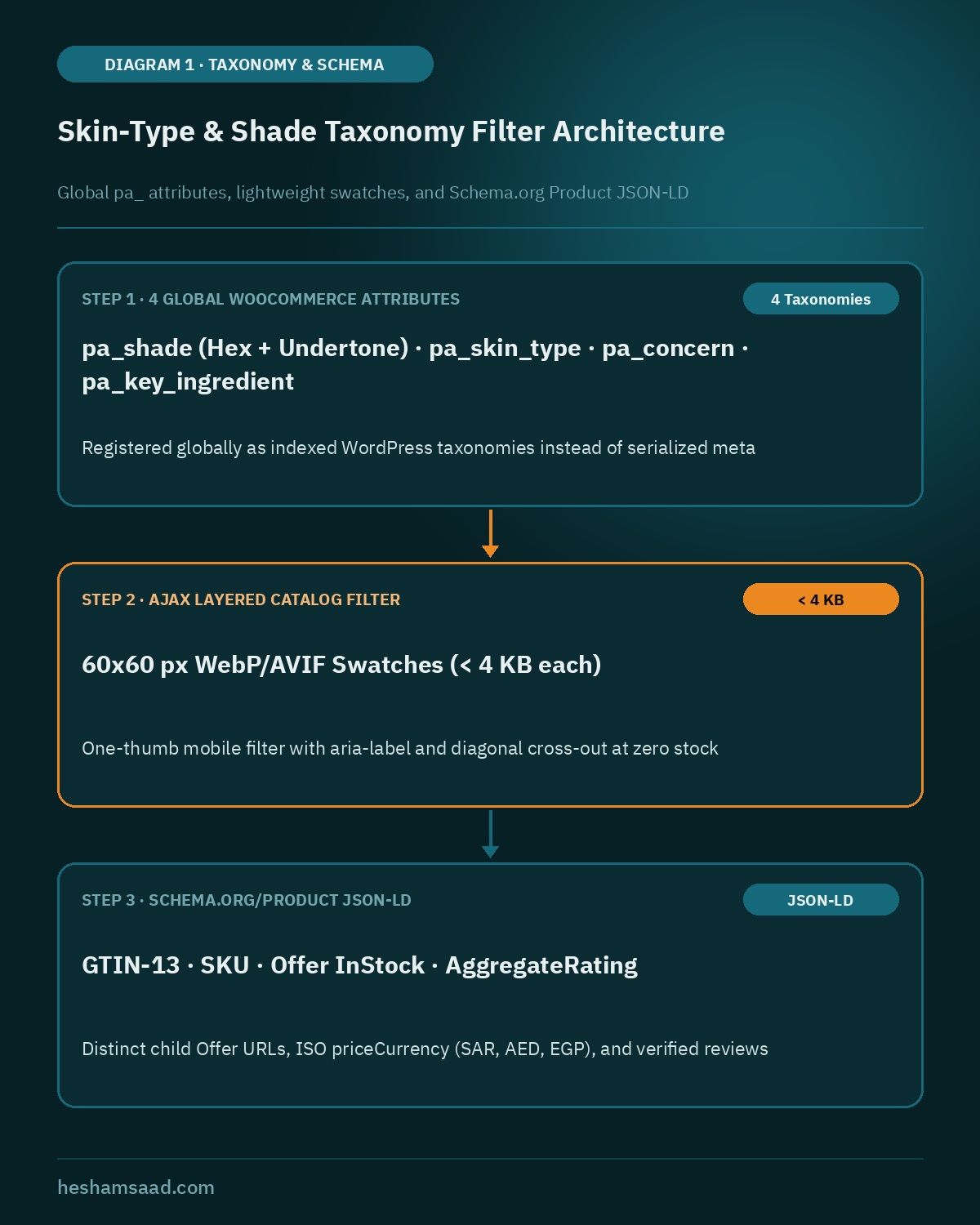
To build a responsive makeup shade swatch filter WordPress shoppers can use with one thumb, register four foundational global attribute taxonomies before importing your SKU catalog: pa_shade for color cosmetics, pa_skin_type (oily, dry, combination, sensitive, normal), pa_concern (acne, hyperpigmentation, barrier repair, fine lines, redness), and pa_key_ingredient (niacinamide, hyaluronic acid, L-ascorbic acid, retinol, ceramides).
For color cosmetics, enrich each term inside pa_shade with custom term meta that stores a primary hex code, an optional secondary hex or shimmer badge for duochrome finishes, an undertone classification (Warm, Cool, Neutral, Olive), and a 60×60 pixel WebP texture thumbnail showing the actual cream or powder swipe. On the product archive and single product templates, render these terms as accessible button pills with a clear aria-label and a diagonal cross-out state whenever a specific variation ID drops to zero stock.
| Attribute / Data Layer | WooCommerce Slug / Key | Storage Type | Storefront UI Presentation | Schema.org / Search Role |
|---|---|---|---|---|
| Makeup Shade | pa_shade | Global Taxonomy + Term Meta | Visual hex circle or 60×60 px WebP texture swatch with undertone filter tabs | Maps to variation color and distinct child Offer URLs |
| Skin Type Suitability | pa_skin_type | Global Taxonomy | Multi-select pill filter in catalog drawer and badge above product title | Generates indexable attribute archive pages when needed |
| Primary Skin Concern | pa_concern | Global Taxonomy | Goal-based navigation menu links and routine matcher quiz criteria | Supports semantic internal linking across treatment categories |
| Active Ingredient | pa_key_ingredient | Global Taxonomy | Filterable tag list paired with concentration percentage in product summary | Enables ingredient-led search filtering and conflict checks |
| Barcode & Regulatory ID | _global_unique_id / _sku | Product / Variation Meta | Printed on packing slips and verified product detail tabs | Populates gtin13 and sku in schema.org/Product |
Mapping Beauty Variations to Schema.org Product Markup
Search engines and shopping feeds rely on structured data to distinguish a 30 ml serum from a 50 ml refill or a foundation in shade 220 Warm Beige from shade 340 Cool Mocha. Following the official Schema.org Product specification, every purchasable variation in your beauty catalog should expose a distinct identifier set in JSON-LD.
Specifically, populate the sku field with your internal warehouse code, the gtin13 (or gtin8 / gtin14 matching your GS1 barcode format) field with the manufacturer barcode printed on the outer carton, and the brand object with the exact brand name. Inside the nested offers object (typed as Offer), output the numeric price, the three-letter ISO priceCurrency (such as SAR, AED, or EGP), and the exact availability URI (https://schema.org/InStock or https://schema.org/OutOfStock). When verified buyers submit shade-matched or skin-type-tagged reviews, output the aggregateRating node containing ratingValue and reviewCount so rich snippets display accurate star ratings in search results.
Preventing Active Ingredient Conflicts on Product Pages
Structured taxonomies also let you protect customers from chemical irritation before checkout. By mapping terms inside pa_key_ingredient to simple compatibility rules in custom term meta, your single product template and cart drawer can display an automatic layering advisory. For example, if a customer adds a 2% salicylic acid leave-on toner and a 1% retinol night treatment to the same cart, a lightweight server-side notice can advise alternating them on separate evenings rather than applying both in the same nighttime routine.
Routine Bundle Builders and Replenishment Upsells
Single-item cosmetic orders rarely generate healthy unit economics once you deduct paid social acquisition costs and courier fees across Riyadh, Jeddah, Dubai, or Cairo. Skincare shoppers, however, naturally buy in regimens rather than isolated bottles. Implementing a skincare routine bundle builder WooCommerce flow turns a single cleanser shopper into a higher-value regimen buyer while simplifying their daily routine.
The official WooCommerce Product Bundles extension, priced at $79/year on WooCommerce.com with a 30-day money-back guarantee, provides the exact container architecture needed for multi-step beauty regimens. Instead of creating static pre-packed gift boxes that tie up warehouse stock in rigid cardboard sleeves, Product Bundles lets you create a virtual parent bundle container linked to existing simple or variable child products.
A proven conversion structure for MENA skincare brands is the 3-Step Daily Routine Builder consisting of Step 1: Cleanser, Step 2: Active Treatment Serum, and Step 3: Broad-Spectrum SPF 50. Using WooCommerce Product Bundles, you can configure Step 1 to allow the buyer to pick either a foaming salicylic cleanser (for oily skin) or a hydrating ceramide milk cleanser (for dry skin), lock Step 2 to a targeted brightening niacinamide serum, and let the buyer choose between an invisible fluid SPF 50 or a tinted mineral SPF 50 in Step 3.
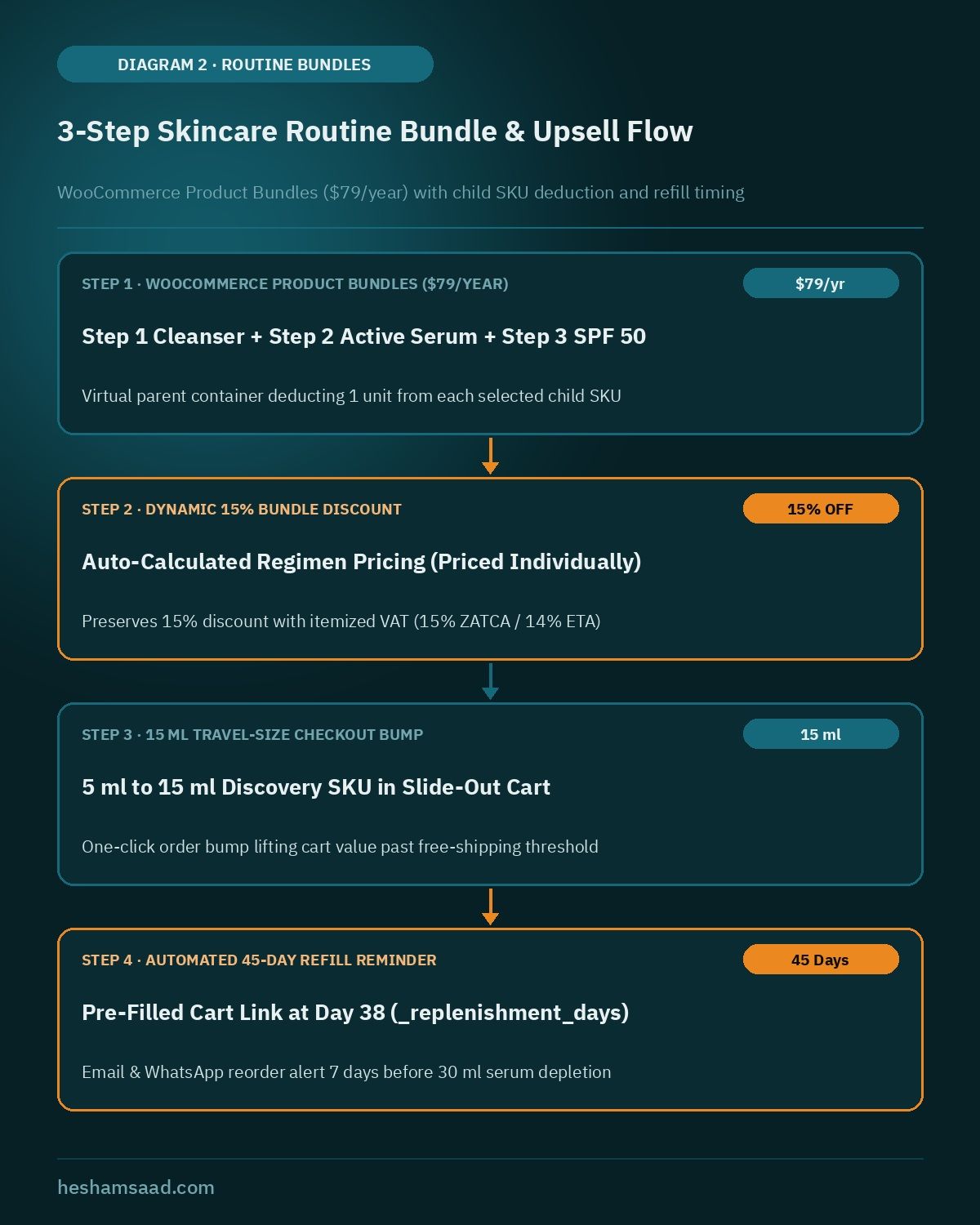
Within the extension settings, choose the auto-calculated pricing mode (Priced Individually enabled on child items) and apply a 15% bundle-level discount across all three steps. This ensures that if the customer selects a slightly higher-priced tinted SPF variation in Step 3, the total bundle price scales dynamically while preserving the 15% regimen incentive. When the order completes, WooCommerce deducts 1 unit from each selected child SKU in real time, preventing overselling across individual product pages and routine bundles.
Mini Travel-Size Checkout Bumps and Refill Timing
Beauty shoppers are frequently cautious about committing to a full-size 50 ml cream or a new lipstick family before testing the texture on their own skin. Offering 5 ml to 15 ml travel-size or discovery-size SKUs as a one-click order bump inside the slide-out cart drawer solves two problems at once: it nudges cart totals past your free shipping threshold and seeds future full-size purchases.
Once a customer receives their order, retention depends on timing your replenishment reminder to match real consumption rates rather than sending random weekly blast discounts. Store an estimated consumption duration in days on every skincare variation (_replenishment_days). A 30 ml daily serum dispensed at two drops morning and night typically lasts 45 days, whereas a 150 ml cleanser lasts closer to 60 days and spot treatments last 30 days. Trigger an automated reorder email or WhatsApp notification 7 days before the predicted depletion date (at day 38 for a 45-day serum) with a pre-filled cart link so the customer can restock before their bottle runs dry.
Tax and Invoice Compliance for Bundled Cosmetics
When selling bundled routines in Saudi Arabia (15% VAT under ZATCA e-invoicing rules) or Egypt (14% VAT under ETA electronic receipt standards), your bundle configuration must align with how your warehouse prints commercial invoices. WooCommerce Product Bundles allows you to toggle whether child items remain visible and priced individually on the checkout and tax invoice or collapse under the parent container price. Keeping child items itemized with their discounted unit prices ensures every barcode scanned at customs or audit checkpoints reconciles cleanly. Review our dedicated breakdown of WooCommerce VAT setup for Egypt and Saudi Arabia to configure tax rounding and invoice line items accurately.
Batch, Expiry (FEFO), and Cold-Chain Courier Routing in MENA
Cosmetics and dermo-cosmetic skincare products are regulated consumer goods with strict shelf-life limits, Period After Opening (PAO) symbols (such as 6M or 12M), and mandatory lot traceability under the Saudi Food and Drug Authority (SFDA), the Egyptian Drug Authority (EDA), and the UAE Ministry of Industry and Advanced Technology. Standard First-In-First-Out (FIFO) inventory assumptions break down when an importer receives two shipments of a European sunscreen with different manufacturing batch dates.
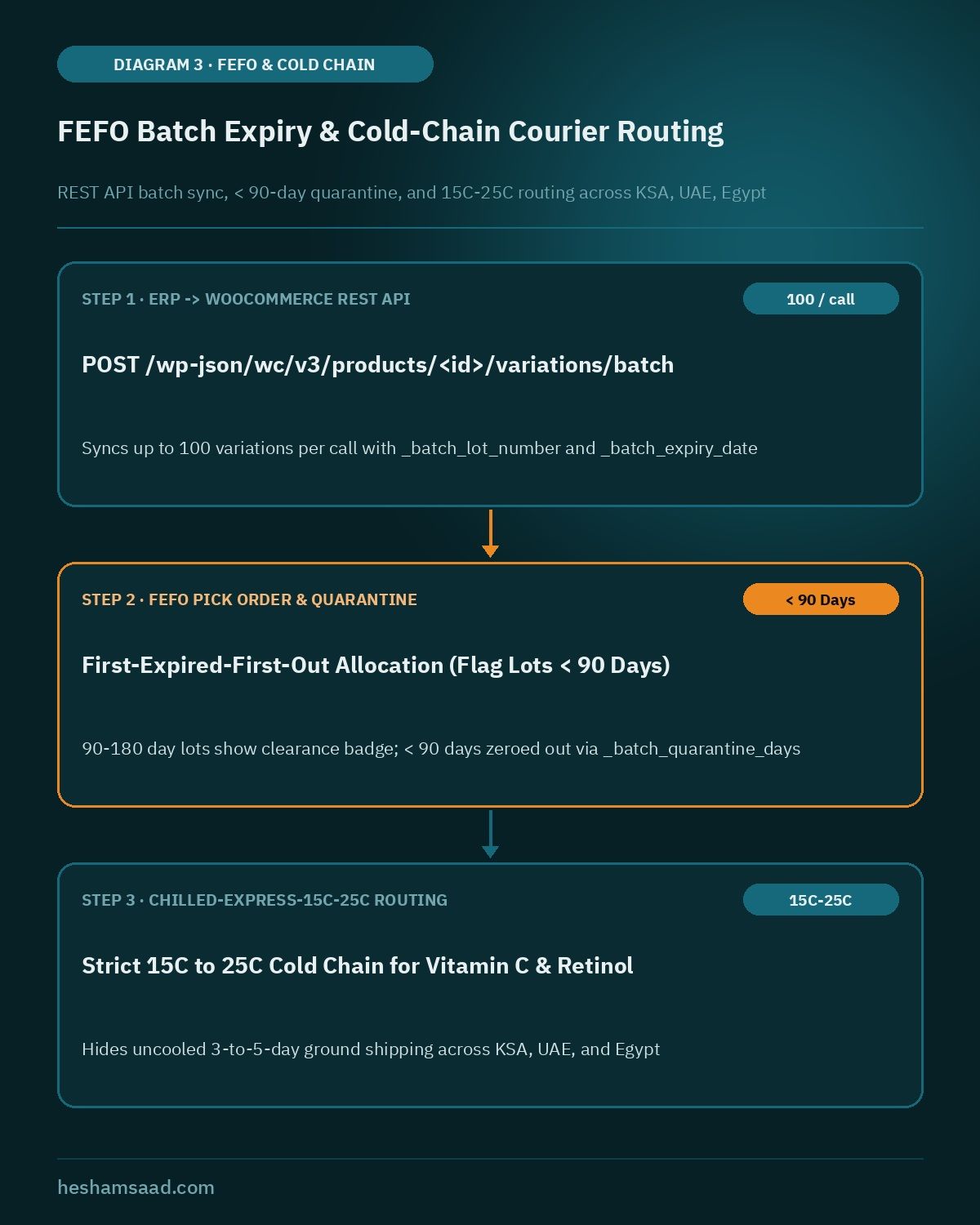
Implementing batch expiry tracking WooCommerce MENA operations can rely on requires synchronizing lot metadata between your warehouse management system (WMS) or ERP and WooCommerce variations. According to the official WooCommerce REST API documentation (woocommerce.github.io/), the batch product variations endpoint (POST /) accepts up to 100 created, updated, or deleted variation objects in a single HTTP request and supports an array of custom key-value objects inside the meta_data property.
By syncing three standardized keys inside meta_data for the currently active picking batch on each variation, your storefront and packing slips stay aligned with physical warehouse shelves:
_batch_lot_number: The alphanumeric manufacturer batch code (for example,LOT-2026-04B) printed on the bottom of the bottle and injected into the WooCommerce order item meta at checkout for recall traceability._batch_expiry_date: The ISO-8601 expiration date (for example,2028-03-31) used by your First-Expired-First-Out (FEFO) fulfillment rule to allocate the earliest expiring sellable batch first._batch_quarantine_days: A threshold integer (typically set to90days) that automatically removes short-dated units from standard checkout allocation once remaining shelf life drops below three months.
When remaining shelf life on a batch enters the 90-to-180-day window, a scheduled daily cron job can surface a transparent “Clearance Batch: Best Before [Date]” badge on the product page with an automatic markdown, while any batch dropping under 90 days is zeroed out of sellable online inventory and flagged for warehouse write-off.
Beyond expiration dates, climate is a direct threat to skincare product integrity across the Gulf and Egypt. Ambient summer temperatures inside uncooled delivery vans in Riyadh, Dammam, Dubai, or Upper Egypt routinely exceed 45 degrees Celsius. At those temperatures, L-ascorbic acid (pure vitamin C) oxidizes rapidly from clear to dark orange, retinoids lose potency, probiotic emulsions separate, and wax-based lipsticks melt inside their tubes.
| Formulation Category | WooCommerce Shipping Class Slug | Thermal Sensitivity | Courier & Packaging Rule | Dispatch Cut-Off Policy |
|---|---|---|---|---|
| Pressed Powders, Brushes, & Tools | ambient-standard-beauty | Low (stable up to 40C) | Standard padded carton via regional road or air courier | Dispatched 6 days a week |
| Emulsions, Cleansers, & Creams | insulated-priority-beauty | Moderate (15C to 30C target) | Reflective thermal pouch liner + priority next-day city courier | Hold inter-city road dispatch on pre-weekend afternoons |
| Pure Vitamin C, Retinol, & Peptides | chilled-express-15c-25c | High (strict 15C to 25C cold chain) | Cold-chain courier van or insulated gel-pack express box | Never dispatch before weekend courier hub closures |
| Aerosol Thermal Waters & SPF Sprays | ground-hazmat-aerosol | Pressurized canister limit (50C max) | Domestic ground-only courier routing (excluded from air freight) | Requires ground zone validation at checkout |
To prevent heat-damaged deliveries, create dedicated WooCommerce shipping classes matching the table above and hook a lightweight conditional filter into woocommerce_package_rates. Whenever a customer’s cart contains at least one product assigned to chilled-express-15c-25c, hide standard 3-to-5-day uncooled economy shipping methods and route the entire order through temperature-controlled express delivery with an insulated gel-pack fee included. Pair this logic with structured WooCommerce shipping zones for Egypt and the Gulf and automated label generation through WooCommerce courier plugins for Egypt and Saudi Arabia so warehouse staff never accidentally hand a heat-sensitive serum over to an uncooled standard ground truck.
Bilingual Arabic RTL Swatch UX and Mobile LCP Performance
Over 80% of direct-to-consumer cosmetics traffic in Saudi Arabia, Egypt, and the UAE arrives on mobile phones, often triggered by short-form video ads on TikTok, Instagram Reels, or Snapchat. A bilingual Arabic beauty store WooCommerce architecture must simultaneously serve natural Arabic copy for benefit explanations and usage routines while preserving international Latin terminology for INCI (International Nomenclature of Cosmetic Ingredients) scientific names and universal shade numbers.
According to WPML and WooCommerce Multilingual documentation (wpml.org/documentation/), global product attributes (pa_*) are configured as translatable taxonomies whose terms, variations, and stock levels stay synchronized across languages. In practice, that means when an Arabic shopper buys the last unit of shade 220 Warm Sand / 220 بيج دافئ on the /ar/ storefront, WooCommerce Multilingual immediately marks that exact variation out of stock on the /en/ URL without requiring duplicate SKU entries.
When designing the Arabic Right-to-Left (RTL) product template in Gutenberg, pay special attention to three layout details that routinely break on poorly localized beauty stores:
- CSS logical properties for swatch grids: Replace hardcoded
margin-leftandpadding-rightrules with CSS logical properties (margin-inline-start,padding-inline-end) anddisplay: flex; gap: 0.5rem;so circular shade swatches, undertone filter pills, and sticky “Add to Routine” bars mirror cleanly in RTL without overlapping badges. - Bilingual INCI ingredient accordions: Use native Gutenberg
wp:detailsblocks for “Full Ingredients (INCI)”, “How to Layer”, and “Clinical Results” sections. Inside the Arabic ingredient accordion, keep the standard Latin INCI ingredient list enclosed in a<div dir="ltr">container below an Arabic summary of the key active benefits so dermatologically savvy shoppers can verify exact chemical names without distorted bidirectional punctuation. - RTL transactional email alignment: Configure the WooCommerce Multilingual email header and table alignment settings so Arabic order confirmations, batch lot details, and routine usage instructions align right-to-left in mobile mail clients.
Visual richness cannot come at the expense of Core Web Vitals. According to Google’s web.dev documentation on Largest Contentful Paint (web.dev/articles/lcp), a page delivers a “Good” user experience only when LCP occurs within 2.5 seconds or less at the 75th percentile of page loads across mobile and desktop devices (between 2.5 and 4.0 seconds needs improvement, and above 4.0 seconds is poor). Web.dev breaks LCP down into four distinct sub-parts: Time to First Byte (TTFB), Resource Load Delay, Resource Load Duration, and Element Render Delay.
Beauty product pages most frequently fail the 2.5-second threshold because of Resource Load Delay and Resource Load Duration. If a foundation product has 28 shades and your template eagerly loads 28 high-resolution gallery images plus 28 uncompressed 80 KB PNG swatch circles before rendering the hero product image, mobile 4G browsers choke on network contention.
To keep mobile LCP reliably under 2.5 seconds, serve pure CSS hex color circles wherever possible, and compress textured swatch thumbnails to 60×60 pixel WebP or AVIF files weighing under 4 KB each. Ensure the primary product variation hero image is discoverable directly in the initial HTML markup with fetchpriority="high" and zero loading="lazy" attribute, while lazy-loading below-the-fold before-and-after clinical galleries and review photos. For a deeper server and asset tuning checklist, see our guide on how to speed up WordPress Arabic sites. If your current catalog struggles with slow variation switching or broken RTL filters, when you hire a WooCommerce developer with MENA beauty store experience, you can resolve both taxonomy queries and frontend payload bottlenecks in one sprint.
This-Week Cosmetics & Skincare Store Launch Readiness Checklist
Before spending budget on influencer campaigns or paid social traffic for a new product drop, run your staging site through this four-part operational readiness audit this week:
- Audit SKU attributes and Schema.org Product output: Verify under Products > Attributes that
pa_shade,pa_skin_type,pa_concern, andpa_key_ingredientare registered as global taxonomies (not local serialized text fields) and that every variation outputs a validsku,gtin13barcode, price currency, andInStock/OutOfStockavailability URI inschema.org/ProductJSON-LD. - Test a 3-step routine bundle transaction end to end: Build one Cleanser + Active Serum + SPF 50 container in WooCommerce Product Bundles with an automated 15% discount, place a test order with a variable tinted SPF shade, and confirm that child SKU inventory deducts accurately and itemized VAT lines match your ZATCA or ETA invoice format.
- Validate REST API batch expiry metadata and chilled courier routing: Push a test payload to
POST /containingwp-json/ wc/ v3/ products/ <id>/ variations/ batch _batch_lot_numberand_batch_expiry_date, verify that lots under 90 days of remaining shelf life are blocked from standard fulfillment, and confirm that adding a vitamin C or retinol SKU forces the cart into yourchilled-express-15c-25cshipping class. - Benchmark bilingual RTL layout and 4G mobile LCP: Switch to the
/ar/product page on a throttled 4G mobile profile, confirm that swatch grids, undertone pills, and LTR INCI ingredient lists insidewp:detailsaccordions render cleanly without horizontal scroll, and verify that Largest Contentful Paint stays below 2.5 seconds.
If you are preparing to migrate a growing cosmetics brand or dermatology clinic retail line from social DMs or a rigid template onto a custom WooCommerce architecture, book a free consultation to review your SKU taxonomy structure, routine bundle rules, and ERP batch integration roadmap before you launch.
Frequently asked questions
How do I set up shade swatches and skin-type filters in WooCommerce without slowing down category pages?
Register shade, undertone, skin type, and skin concern as global product attributes under the WooCommerce attributes menu so WordPress indexes them as custom taxonomies with the pa prefix. Store hex color codes and small WebP or AVIF texture thumbnails on each term rather than loading full variation galleries on archive grids. This lets shoppers filter foundation shades and serums instantaneously while keeping database queries and page payloads light.
Can customers pick their own shade or cleanser type inside a three-step skincare routine bundle?
Yes, the official WooCommerce Product Bundles extension allows you to combine simple and variable products inside one parent bundle container. You can lock fixed items like a daily sunscreen while letting the customer choose their preferred cleanser formula or tinted moisturizer shade from filtered variation dropdowns. Inventory deducts automatically from each individual child SKU whenever a completed routine bundle order is placed.
How does First-Expired-First-Out batch tracking work between a warehouse system and WooCommerce?
Your warehouse system pushes lot numbers and expiry dates into variation metadata fields through the WooCommerce REST API batch endpoint. When an order arrives, fulfillment logic allocates units from the earliest expiring active batch and prints that specific lot code on the warehouse packing slip. Any batch crossing the ninety-day remaining shelf-life threshold is automatically excluded from normal checkout allocation.
How should a beauty store handle shipping for heat-sensitive skincare actives in Gulf and Egyptian summers?
Assign unstable formulas such as pure vitamin C, retinoids, and probiotic creams to a dedicated chilled express shipping class inside WooCommerce. Configure your checkout rules so any cart containing an item from this class automatically routes to temperature-controlled courier services and hides standard multi-day road delivery options. You can also restrict weekend dispatch so active serums never sit in uncooled transit depots.
Why do bilingual cosmetics stores often fail Largest Contentful Paint targets on mobile networks?
Beauty product pages frequently load dozens of uncompressed swatch images, multiple Arabic and Latin webfont files, and heavy third-party JavaScript widgets before rendering the main hero image. Serving lightweight WebP or AVIF swatch thumbnails, preloading the primary product image with high fetch priority, and deferring non-essential scripts keeps mobile Largest Contentful Paint under the two point five second threshold on cellular connections.
References
- WooCommerce Official Plugin Documentation
- WooCommerce Documentation: Managing Product Categories, Tags and Attributes
- WooCommerce Product Bundles Extension Documentation and Pricing
- WooCommerce REST API v3 Technical Documentation
- Schema.org Product Structured Data Specification
- web.dev: Largest Contentful Paint (LCP) Core Web Vitals Thresholds
- WPML and WooCommerce Multilingual Official Documentation




Add your first comment to this post