
هذا المقال متوفر باللغة العربية — اقرأ بالعربية
When retail founders and e-commerce managers evaluate Shopify vs WooCommerce MENA options for a new storefront or platform migration, looking only at the advertised monthly subscription price leads to expensive surprises over a three-year operating horizon. A store operating in Riyadh, Cairo, or Dubai faces very different unit economics from a store in North America or Western Europe, where native platform payment processing and single-language checkouts come standard.
In the Middle East and North Africa, profitability over 36 months depends on how your platform handles local payment gateways like Mada, Paymob, and HyperPay, how much control you have over Cash on Delivery (COD) verification and bilingual Arabic-English checkout flows, and whether your monthly app stack compounds as order volume grows. Before committing to a three-year roadmap, compare the full architectural and financial picture alongside realistic WordPress website development and maintenance costs so your margin model reflects every transaction fee, hosting tier, and localization requirement.
Why the Shopify vs WooCommerce MENA Decision Comes Down to 36-Month Unit Economics
Launching a store over a weekend is appealing, which is why many D2C brands start by looking at SaaS entry tiers. According to official pricing from Shopify, the core plans are structured across three levels: the Basic plan costs $39 per month when billed monthly or $29 per month when billed annually; the Grow plan (formerly the Shopify plan) costs $105 per month billed monthly or $79 per month billed annually; and the Advanced plan costs $399 per month billed monthly or $299 per month billed annually. On the surface, paying $29 to $79 per month sounds far cheaper than commissioning a custom e-commerce build.
The financial equation changes once you examine how payments, apps, and currency conversion work across the region. When calculating the real Shopify vs WooCommerce 3 year cost, three structural cost drivers separate a hosted SaaS subscription from an open-source WooCommerce store running on managed cloud hosting:
- Third-party payment gateway surcharges: Whenever a store does not use Shopify Payments to process online card transactions, Shopify charges an additional third-party transaction fee of 2.0% on the Basic plan, 1.0% on the Grow plan, and 0.6% on the Advanced plan. Because Shopify Payments is officially supported in the United Arab Emirates but is not available in Saudi Arabia or Egypt, every online Mada, Visa, Mastercard, or Meeza transaction processed through an external gateway in Saudi Arabia or Egypt triggers this extra platform fee on top of your payment processor’s standard rate.
- Compounding monthly app subscriptions: Features that MENA merchants treat as baseline requirements—bilingual Arabic and English storefront translation, conditional COD surcharges, SMS or WhatsApp order confirmation, and localized tax invoicing—typically require paid third-party apps on Shopify. Many of these apps charge recurring monthly fees that scale up automatically as your monthly order count or translated word volume increases.
- Zero platform transaction fees on WooCommerce: As documented in the official WooCommerce core documentation, both WordPress and the core WooCommerce plugin are open-source and free to license, with a 0% platform transaction surcharge regardless of which regional payment gateway you connect. Your budget goes toward managed hosting, annual plugin licenses, and engineering rather than a percentage tax on your gross online card revenue.
Understanding how those two cost curves diverge requires modeling your cumulative expenses across 36 months rather than looking at month one in isolation. SaaS minimizes upfront capital expenditure in exchange for variable revenue-linked fees, whereas WooCommerce requires planned upfront engineering and predictable infrastructure costs while protecting your gross margin as transaction volume scales.
3-Year Total Cost of Ownership Breakdown: Starter vs Scaling MENA Stores
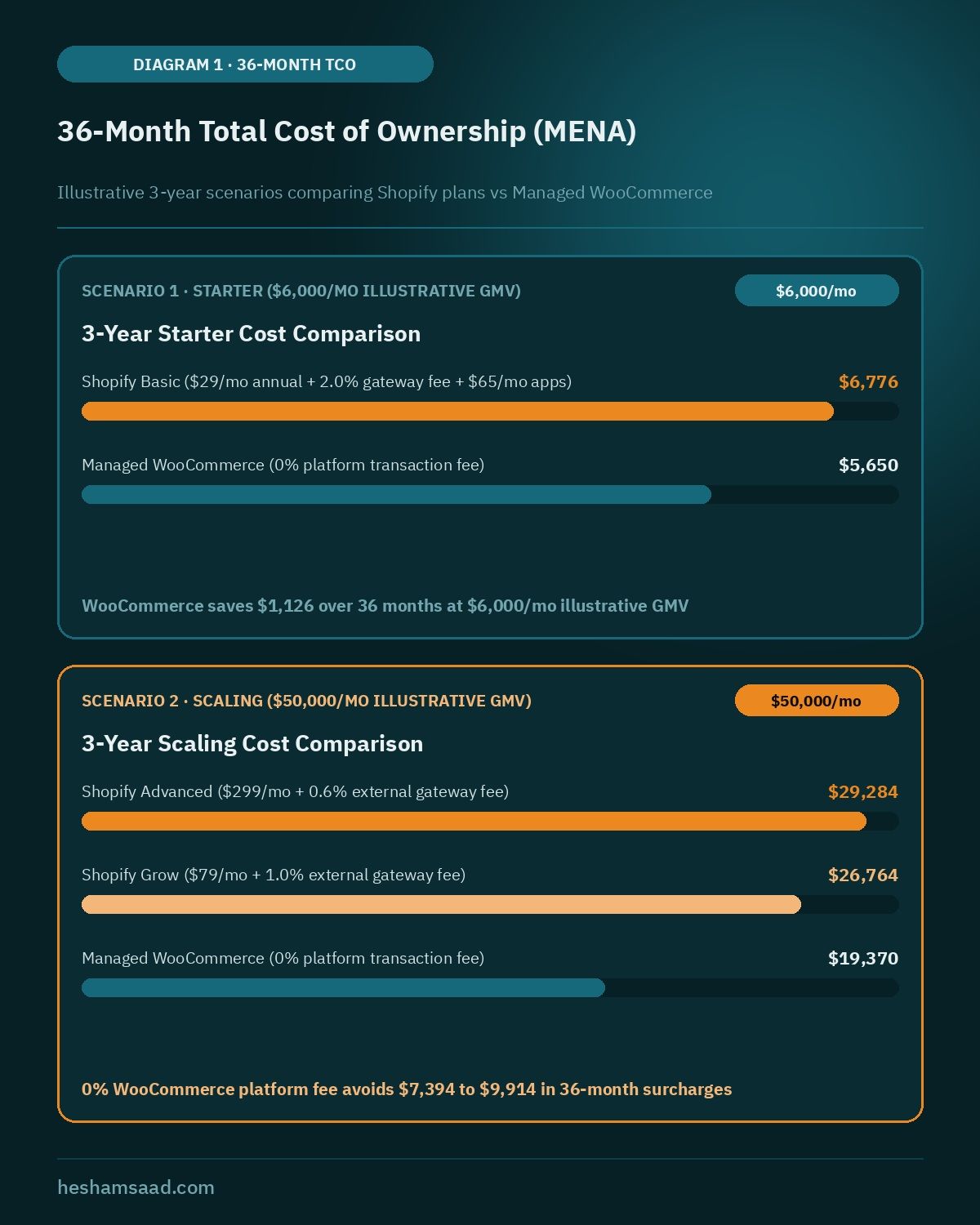
To make this comparison concrete, let us model two illustrative 36-month operating scenarios for a store operating in Saudi Arabia or Egypt (or a UAE store routing transactions through a regional external payment processor). Because your payment processor’s underlying merchant discount rate (such as Mada, Paymob, or HyperPay card processing fees) applies equally on either platform, the table below isolates the platform-controlled costs over 36 months. All GMV figures, online payment splits, app budgets, hosting rates, and development retainers below are labeled as illustrative modeled scenarios designed to reflect typical regional operations:
- Illustrative Scenario A (Starter Tier: $2,000 to $10,000/month GMV): Modeled at $6,000/month total GMV ($216,000 over 36 months), where 60% of revenue ($3,600/month or $129,600 over 36 months) is paid online via external card gateways and 40% ($2,400/month) is settled via Cash on Delivery (which is exempt from Shopify’s third-party gateway surcharge).
- Illustrative Scenario B (Scaling Tier: $30,000 to $100,000+/month GMV): Modeled at $50,000/month total GMV ($1,800,000 over 36 months), where 75% of revenue ($37,500/month or $1,350,000 over 36 months) is paid online via external card or digital wallet gateways and 25% ($12,500/month) is settled via Cash on Delivery.
| 36-Month Cost Component (Illustrative Scenarios) | Starter: Shopify Basic (Annual Billing) | Starter: Managed WooCommerce | Scaling: Shopify Grow (Annual Billing) | Scaling: Shopify Advanced (Annual Billing) | Scaling: Managed WooCommerce |
|---|---|---|---|---|---|
| Core Platform Subscription (36 Months, Official Rates) | $1,044 ($29/mo billed annually) | $0 (Open-source core license) | $2,844 ($79/mo billed annually) | $10,764 ($299/mo billed annually) | $0 (Open-source core license) |
| Managed Cloud Hosting, Backups & CDN (36 Months) | Included in subscription | $1,260 (Illustrative $35/mo) | Included in subscription | Included in subscription | $5,040 (Illustrative $140/mo high-concurrency) |
| Third-Party Gateway Surcharge (Official % on Online Card GMV) | $2,592 (2.0% on $129,600 online GMV) | $0 (0% platform surcharge) | $13,500 (1.0% on $1,350,000 online GMV) | $8,100 (0.6% on $1,350,000 online GMV) | $0 (0% platform surcharge) |
| Paid Apps / Annual Plugin Licenses (36 Months) | $2,340 (Illustrative $65/mo for RTL, COD, VAT apps) | $750 (Illustrative $250/yr for WPML, VAT, courier plugins) | $7,920 (Illustrative $220/mo for high-volume apps & connectors) | $7,920 (Illustrative $220/mo for high-volume apps & connectors) | $1,350 (Illustrative $450/yr for WPML & commercial extensions) |
| Initial Store Setup / Build & Ongoing Developer Maintenance | $800 (Illustrative initial theme & app setup) | $3,640 (Illustrative $2,200 build + $40/mo maintenance) | $2,500 (Illustrative custom theme & app configuration) | $2,500 (Illustrative custom theme & app configuration) | $12,980 (Illustrative $6,500 custom build + $180/mo retainer) |
| Estimated 36-Month Total Cost of Ownership | $6,776 | $5,650 | $26,764 | $29,284 | $19,370 |
The numbers reveal an important structural pattern across both growth stages. Even after factoring in realistic budgets for managed cloud hosting, annual commercial plugin renewals, an upfront custom store build, and an ongoing maintenance reserve, WooCommerce saves an estimated $1,126 over three years in the illustrative Starter scenario and $7,394 to $9,914 in the illustrative Scaling scenario.
How App Bloat and Tier Upgrades Compound on Hosted Plans
Looking closely at the Scaling columns in the table highlights a mathematical threshold that catches many regional merchants off guard: the crossover point between Shopify Grow ($79/month billed annually with a 1.0% third-party transaction fee) and Shopify Advanced ($299/month billed annually with a 0.6% third-party transaction fee). Upgrading from Grow to Advanced adds $220 per month in fixed subscription cost while reducing your third-party transaction surcharge by 0.4 percentage points. Divide $220 by 0.004 and you find the exact break-even point: $55,000 per month in online card GMV processed through external gateways.
In our illustrative Scaling scenario at $50,000 total monthly GMV with 75% online card payments ($37,500 per month in online gateway volume), upgrading to Advanced actually costs $2,520 more over 36 months ($29,284 versus $26,764) because card volume has not yet passed the $55,000 monthly threshold. Once your store scales to $100,000 per month in online card GMV ($3,600,000 over 36 months), however, Shopify’s third-party gateway surcharge alone reaches $36,000 on the Grow plan or $21,600 on the Advanced plan—money deducted straight from your contribution margin before you pay a single riyal, pound, or dirham toward hosting or marketing.
App subscriptions follow a similar escalation curve. A store that starts with a $15 monthly translation app, a $19 COD verification app, a $15 local tax invoice app, and a $16 reviews or bundle app ($65 per month total) quickly discovers that once monthly orders cross 1,000 or 2,500, those same apps move into higher usage tiers totaling $200 to $300 per month. Over 36 months, rental fees for basic utility features easily surpass the cost of building or licensing permanent functionality on WordPress.
What You Actually Pay for on a Managed WooCommerce Stack
WooCommerce is never free to operate professionally, and treating it as a zero-budget hobby project is the fastest way to suffer slow load times or plugin conflicts. Instead of paying a percentage of your revenue to a platform vendor, you allocate a predictable fixed budget across three operational pillars: dedicated managed WooCommerce hosting with server-level page caching and Redis object caching, annual licenses for vetted plugins (such as WPML for bilingual management), and experienced engineering oversight.
Because your hosting and plugin licenses do not charge a percentage of your sales, your platform cost ratio drops sharply as revenue grows. Working with a specialist when you hire a WooCommerce developer for your store ensures that custom checkout rules, regional courier APIs, and bilingual templates are coded cleanly inside a lightweight child theme rather than stacked together with twenty conflicting third-party plugins.
Local Payment Gateways, COD Verification, and Tax Compliance in Saudi Arabia, Egypt, and the UAE
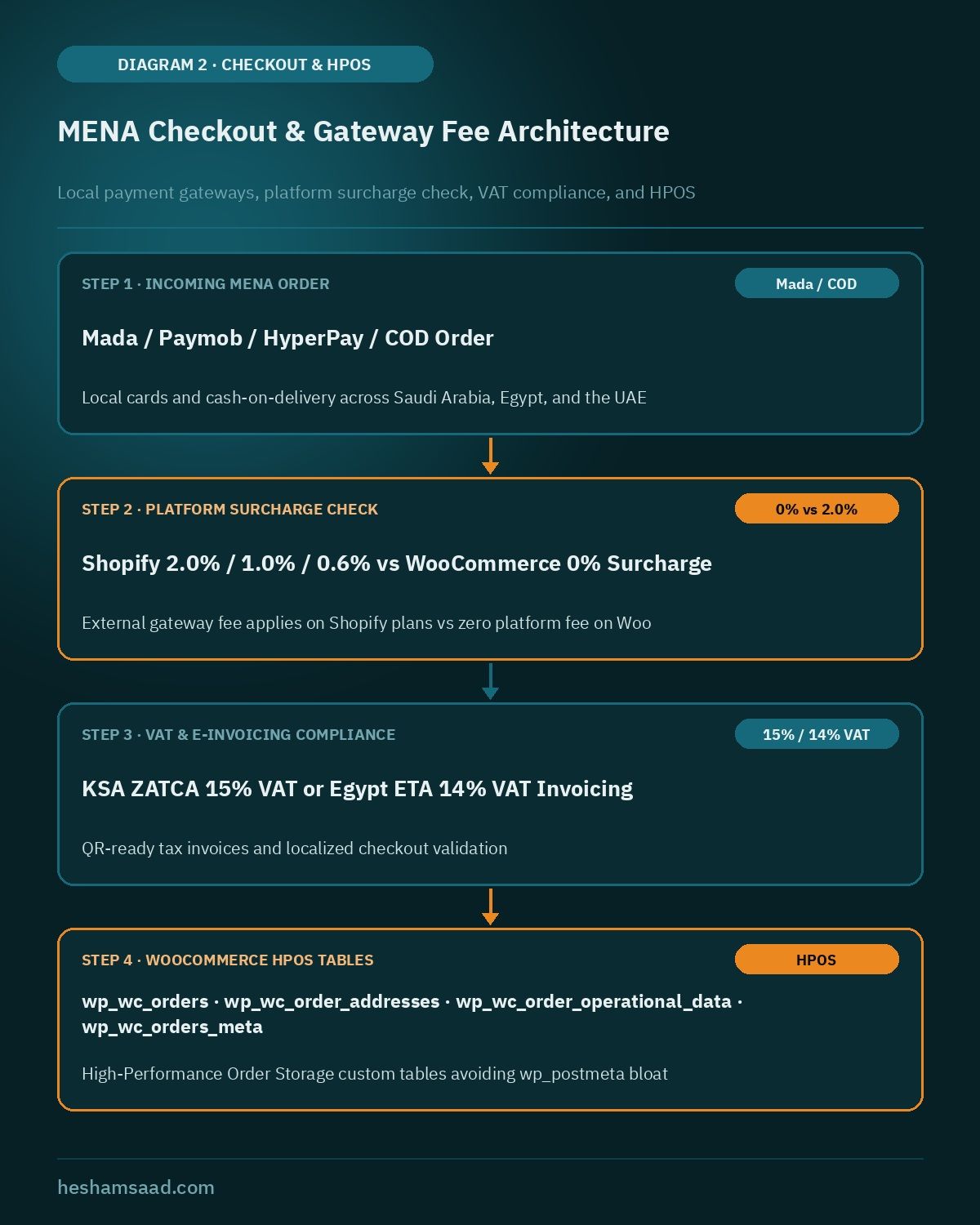
Checkout conversion in MENA depends on presenting familiar local payment rails in the right order without adding friction or hidden redirects. When comparing WooCommerce vs Shopify Mada Paymob fees and checkout behavior, the distinction lies in how each platform treats regional payment processors and how much control you have over the checkout page itself.
In Saudi Arabia, supporting the Mada national debit network is mandatory for domestic e-commerce conversion, typically connected through regional processors such as HyperPay, PayTabs, or Tap. In Egypt, merchants rely heavily on Paymob or Fawry to accept domestic Visa and Mastercard cards, Meeza national debit cards, and mobile wallets. In the UAE, merchants can qualify for Shopify Payments to avoid the 2.0%, 1.0%, or 0.6% external gateway surcharge on standard cards, though UAE brands that route transactions through a unified regional gateway contract covering both Saudi Arabia and Egypt still encounter third-party fee considerations on their non-UAE storefronts.
On WooCommerce, official payment extensions from Paymob, HyperPay, PayTabs, and Tap integrate directly into the checkout workflow with zero platform surcharge. More importantly, WooCommerce allows your engineering team to control the exact presentation of those payment methods—such as displaying the Mada badge as the primary default option for Saudi IP addresses or placing local mobile wallet fields inline without bouncing the buyer to an unbranded external URL.
Cash on Delivery Rules, OTP Verification, and Shipping Zone Logic
While card and digital wallet adoption continues to climb across the Gulf and Egypt, Cash on Delivery remains an essential payment option for first-time shoppers and secondary cities. Unmanaged COD, however, creates fake orders, failed doorstep deliveries, and tied-up inventory. Because Shopify classifies COD as a manual payment method, it does not charge its third-party percentage fee on COD orders, but standard Shopify plans restrict direct modification of the checkout steps.
To protect unit economics on COD orders, MENA operations teams typically enforce four conditional rules at checkout:
- Dynamic COD handling fees: Adding a transparent cash collection fee (for example, an illustrative 15 SAR or 35 EGP courier COD surcharge) that is automatically waived if the customer switches to Mada, Apple Pay, or Paymob online payment.
- Cart value and category restrictions: Hiding the COD option automatically when an order exceeds a high-risk threshold, contains personalized items, or ships to remote areas with high return-to-origin rates.
- Phone format validation and OTP verification: Verifying that Saudi mobile numbers match the
+966 5X XXX XXXXformat or Egyptian numbers match+20 1X XXXX XXXXand requiring a one-time passcode via SMS or WhatsApp before moving the order status from pending verification to warehouse fulfillment. - Granular city and district shipping matrices: Mapping neighborhood-level delivery tiers and courier SLA rules using custom WooCommerce shipping zones for Egypt and the Gulf so customers select from standardized city dropdowns rather than typing free-text addresses that break courier airway bill generation.
On WooCommerce, all four rules can be implemented directly through native checkout hooks or lightweight custom plugins without upgrading to an enterprise SaaS license or paying per-order app fees.
Saudi ZATCA, Egyptian ETA VAT Invoicing, and High-Performance Order Storage (HPOS)
Tax compliance in Saudi Arabia and Egypt requires more than printing a generic receipt with a percentage tax line. Storefronts selling in Saudi Arabia must issue 15% VAT invoices that comply with ZATCA e-invoicing standards (including TLV-encoded QR codes displaying seller name, VAT registration number, timestamp, invoice total, and VAT total), while Egyptian merchants managing 14% VAT and corporate B2B sales need customizable tax registration fields and integration pathways with the Egyptian Tax Authority (ETA) portal. Implementing WooCommerce VAT and e-invoicing compliance for Egypt and Saudi Arabia gives your finance team full ownership over invoice numbering sequences, credit notes, and bilingual PDF layouts.
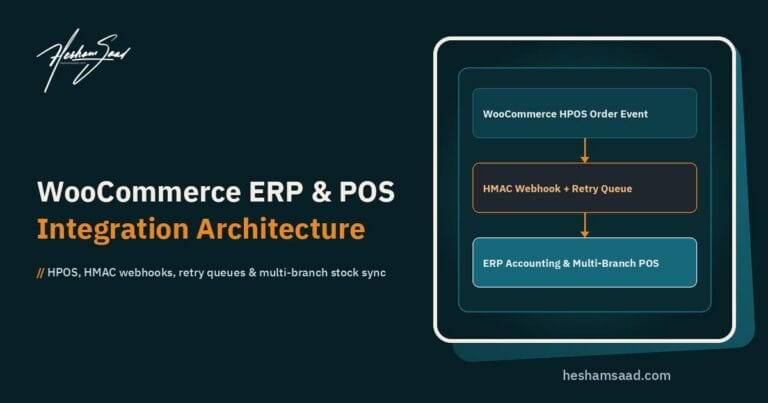
A common historical criticism of WooCommerce was that storing thousands of orders alongside blog posts and pages inside WordPress’s default wp_posts and wp_postmeta database tables caused slow order queries during peak sales events. According to official WooCommerce documentation, High-Performance Order Storage (HPOS)—enabled by default for all new installations since WooCommerce 8.2—solves this bottleneck by moving order data into four dedicated, purpose-built relational database tables:
wp_wc_ordersfor core transaction records including order IDs, timestamps, tax totals, currency, and status.wp_wc_order_addressesfor indexed billing and shipping address records.wp_wc_order_operational_datafor internal checkout state, cart hashes, and fulfillment flags.wp_wc_orders_metafor custom order metadata such as ZATCA QR payloads, courier tracking numbers, and payment gateway transaction references without bloatingwp_postmeta.
With HPOS active, high-volume MENA stores handling Ramadan or White Friday flash sales can insert orders, filter fulfillment queues, and export tax reports rapidly while maintaining clean relational boundaries for automated database backups.
Bilingual Arabic RTL Checkout Control, Technical SEO, and Full Data Ownership
Most growing brands in Saudi Arabia, Egypt, and the UAE operate bilingual storefronts where shoppers switch between Arabic and English depending on product category, device setting, or search query. Any serious Arabic RTL ecommerce platform comparison must inspect what happens beyond the homepage banner: how product attribute filters, cart drawers, checkout form labels, validation errors, and transactional emails behave in right-to-left (RTL) layout mode, and how search engines index both language versions.
Arabic RTL Storefronts, Block Checkout Templates, and Core Web Vitals
In Arabic, visual hierarchy, directional icons, form input alignment, and typography spacing require dedicated CSS logical properties (dir="rtl") and clean Arabic web fonts such as Cairo, Tajawal, or IBM Plex Sans Arabic. When you build with purpose-engineered WooCommerce themes for Arabic RTL stores and the WordPress Block Editor (documented in the official WordPress Block Editor Handbook at developer.wordpress.org/block-editor/), you control both the HTML template files (such as single-product.html and page-checkout.html) and the conditional asset loading per locale.
That architectural control directly affects mobile speed and conversion. Google’s official Core Web Vitals guidelines at web.dev/articles/lcp specify that a page must achieve a Largest Contentful Paint (LCP) of 2.5 seconds or less to deliver a good user experience, broken down across four sub-parts: Time to First Byte (TTFB), resource load delay, resource load duration, and element render delay. On many bilingual Shopify stores, third-party translation apps and currency-switcher widgets load external JavaScript bundles that intercept and rewrite DOM text after the page begins rendering, adding element render delay on mid-range mobile devices over 4G connections.
On a properly configured WooCommerce store, Arabic and English templates render server-side directly from the database. You can preload your primary hero image with fetchpriority="high", serve self-hosted WOFF2 Arabic font subsets only when the active locale is ar, strip unused CSS from the checkout template, and keep LCP consistently under the 2.5-second benchmark.
Bilingual URL Structures, Hreflang Architecture, and REST API Portability
Organic search visibility in Arabic and English requires strict technical control over your URLs, canonical tags, and language annotations. As detailed in the official WPML documentation (wpml.org/documentation/), configuring WooCommerce Multilingual with WPML allows you to structure languages in clean subdirectories (such as example.com/ar/ and example.com/en/), translate product and category slugs independently in each language, and output reciprocal, self-referencing rel="alternate" hreflang tags automatically in the document head or XML sitemaps. You can also avoid aggressive geo-IP redirects that block search engine crawlers from indexing your Arabic or English catalog pages—a core principle of bilingual WordPress SEO for Arabic and English sites.
Beyond search rankings, platform choice determines who owns your store’s underlying data layer and integration bandwidth. According to the official WooCommerce REST API v3 documentation (woocommerce.github.io/woocommerce-rest-api-docs/), every WooCommerce installation exposes standardized endpoints under /wp-json/wc/v3/—including /wp-json/wc/v3/orders, /wp-json/wc/v3/products, and /wp-json/wc/v3/webhooks—authenticated via HTTP Basic Auth consumer keys and secured on webhook deliveries (`order.created`, `order.updated`, `product.updated`) with an X-WC-Webhook-Signature HMAC-SHA256 header.
Because you own the server and database, there are no platform-imposed API rate throttling tiers when syncing 50,000 SKUs with a regional ERP (such as Odoo, SAP Business One, or Microsoft Dynamics) or pushing real-time fulfillment payloads to local 3PL warehouses. And for brands planning a Shopify to WooCommerce ownership migration after outgrowing SaaS fee structures, you can export your complete product catalog, customer records, and historical orders into WooCommerce HPOS tables, map 301 server redirects from Shopify’s rigid /products/ and /collections/ paths to preserve SEO equity, and send a one-click password reset prompt so existing customers access their historical accounts without friction.
When Shopify Wins vs When WooCommerce Wins: A MENA Decision Matrix
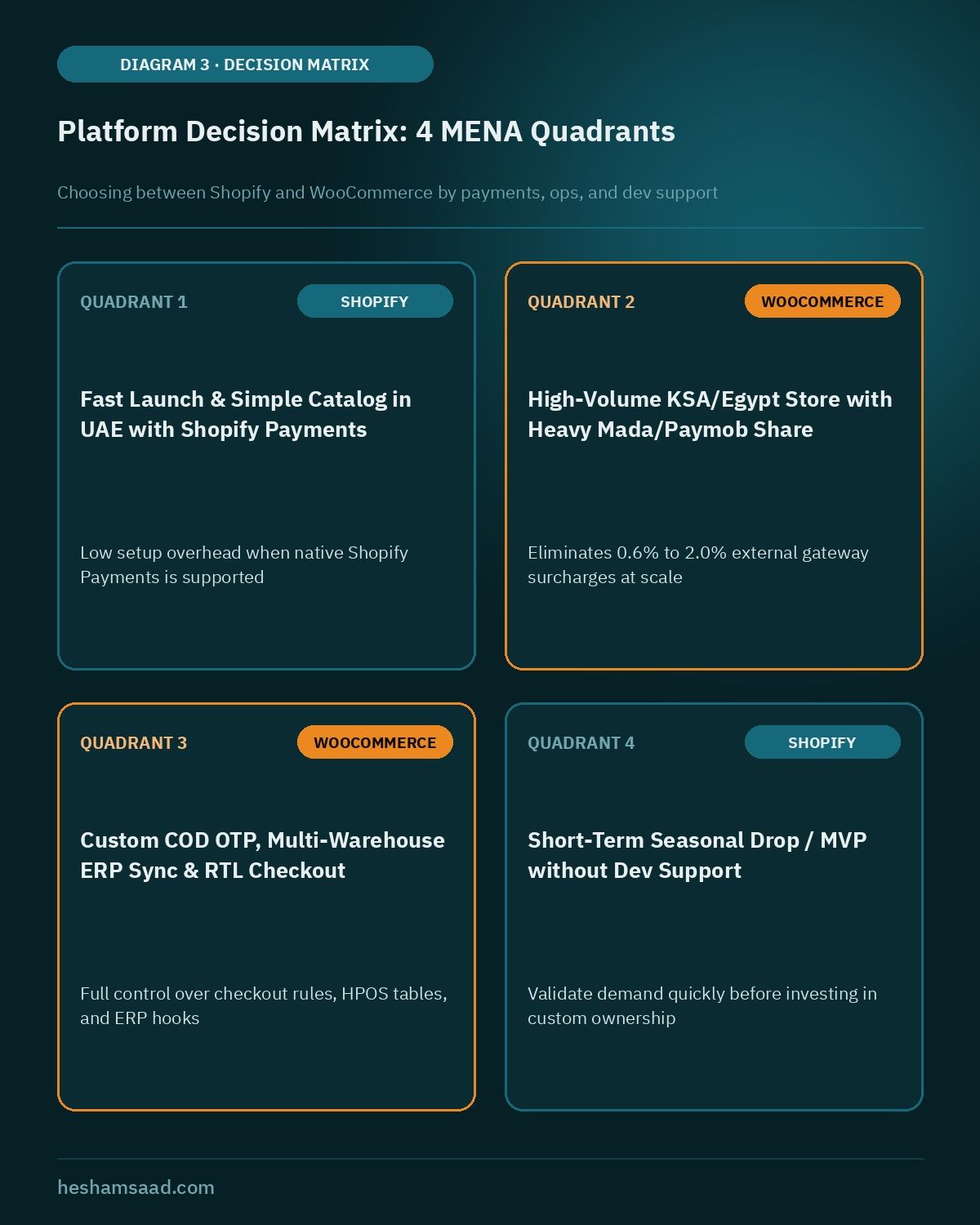
Neither platform is universally right for every merchant. Making a sound capital allocation decision means matching the platform to your team’s operating model, geographic revenue split, and technical roadmap over the next 36 months. Use the decision matrix below to evaluate where your brand fits:
| Decision Criterion | When Shopify Wins | When WooCommerce Wins |
|---|---|---|
| Primary MENA Market & Payment Rails | UAE-registered entities able to use native Shopify Payments with minimal external gateway surcharges. | Saudi Arabia, Egypt, and multi-country MENA stores routing cards through Mada, Paymob, HyperPay, Tap, or PayTabs with 0% platform surcharge. |
| 36-Month Cost Structure | Early-stage or seasonal stores prioritizing low upfront setup cost over long-term variable transaction fees. | Growing D2C and retail brands ($6,000 to $100,000+/mo GMV) optimizing 36-month unit economics by eliminating platform percentage fees and app creep. |
| Checkout & COD Workflow Control | Standard card or simple unconditional COD checkout requiring no custom field logic. | Custom COD handling fees, SMS/WhatsApp OTP confirmation, district-level shipping dropdowns, and B2B wholesale tiers. |
| Bilingual Arabic RTL & SEO Architecture | Single-language storefronts or simple bilingual catalogs using standard theme translations. | Heavy Arabic and English organic SEO strategies requiring custom URL slugs, WPML hreflang control, and sub-2.5s mobile LCP optimization. |
| ERP, Warehouse & Database Ownership | Cloud-only workflows using off-the-shelf connectors within standard API rate limits. | Full MySQL and HPOS database ownership, custom REST API v3 / webhook ERP synchronization, and complete code portability. |
Choose Shopify if:
- You are launching a short-term product validation test or a lean single-market UAE storefront that qualifies for Shopify Payments and does not incur external gateway surcharges.
- Your catalog has straightforward product variations, you do not need custom COD verification or localized tax invoice customization, and you prefer an all-in-one vendor bill with zero server management or developer involvement.
Choose WooCommerce if:
- You sell in Saudi Arabia, Egypt, or across multiple MENA countries where third-party payment gateway surcharges (2.0%, 1.0%, or 0.6%) and escalating monthly app fees will erode thousands of dollars in margin over 36 months.
- You need tailored Arabic RTL user journeys, district-level shipping rules, automated COD risk filtering, ZATCA or ETA VAT compliance, or direct ERP synchronization backed by professional WordPress and WooCommerce development services.
This-Week Platform Selection & Cost Audit Checklist
Before signing an annual SaaS contract or approving an e-commerce development scope, run your numbers through this five-step audit with your finance and operations leads this week:
- Calculate your 36-month online card GMV and gateway surcharge impact: Project your conservative and target monthly revenue over 36 months, separate expected online card/wallet orders from Cash on Delivery orders, and multiply the online card portion by Shopify’s 2.0% (Basic), 1.0% (Grow), or 0.6% (Advanced) external gateway surcharge if your store operates in Saudi Arabia, Egypt, or uses non-native regional processors.
- List your mandatory Arabic RTL, COD, and tax checkout rules: Document every checkout rule your operations team needs on day one—including Arabic RTL form alignment, phone number format checks, conditional COD handling fees, SMS/WhatsApp OTP verification, and Saudi ZATCA QR or Egyptian ETA tax invoice fields—and verify whether each rule requires a recurring paid app on Shopify versus native configuration on WooCommerce.
- Audit your 36-month app stack and mobile LCP budget: Add up the monthly cost of every required app at your projected year-two and year-three order volumes, and test how many external JavaScript files those apps inject into the storefront against Google’s 2.5-second Largest Contentful Paint benchmark.
- Verify ERP, inventory, and regional courier integration requirements: Confirm how your warehouse software, accounting system, and local couriers (such as Aramex, SMSA, Bosta, or Mylerz) exchange order status webhooks, city codes, and stock levels, and check whether direct access to WooCommerce REST API v3 endpoints and HPOS database tables simplifies your architecture.
- Score your long-term data ownership and SEO portability needs: Decide whether owning your database, custom bilingual URL structures, and server-level caching configuration is strategic for your brand’s valuation and multi-country expansion over the next three years.
If you want an objective technical and financial review of your 36-month storefront numbers—or a clear migration roadmap from an existing hosted store to a fast, bilingual WooCommerce architecture—book a free consultation and we will audit your payment gateway fees, Arabic RTL checkout requirements, and hosting stack together.
Frequently asked questions
How does the three-year cost of Shopify compare to WooCommerce for a MENA store?
Shopify usually costs less in the first few months because hosting and security are bundled into one monthly plan, while WooCommerce requires an upfront budget for store development and managed hosting. Over three years, however, WooCommerce often delivers a lower total cost of ownership for growing regional brands because it adds no platform transaction surcharges and avoids compounding monthly app fees.
Why do Saudi and Egyptian stores pay extra gateway surcharges on Shopify?
Shopify charges an additional third-party transaction fee whenever a store processes online card payments through an external payment gateway instead of Shopify Payments. Because Shopify Payments is not supported in Saudi Arabia or Egypt, merchants in those markets must connect regional gateways like Mada, Paymob, or HyperPay and pay the platform surcharge on every online card order, whereas WooCommerce never charges a platform fee.
Which platform gives better control over Arabic RTL layouts and bilingual SEO?
WooCommerce provides deeper control over Arabic right-to-left typography, checkout field order, and bilingual URL structures when paired with a translation plugin like WPML. You can customize every checkout form step, host localized fonts locally to meet Core Web Vitals targets, and manage clean language subdirectories with full access to your server rules. Shopify supports Arabic themes and subfolders, but restricts checkout customization on standard plans.
When is Shopify the better choice for a MENA ecommerce brand?
Shopify is the stronger choice when your priority is launching a standard catalog quickly without managing web hosting, security patches, or a developer retainer. It works particularly well for lean retail teams based in the United Arab Emirates that qualify for Shopify Payments, use standard shipping rules, and do not need custom cash on delivery verification or direct database access.
Can I migrate my products, customers, and SEO URLs from Shopify to WooCommerce later?
Yes, you can export your products, customer records, and historical order data from Shopify and import them into WooCommerce while preserving your search rankings through server URL redirects. Moving to WooCommerce gives you full ownership of your database, High-Performance Order Storage tables, and REST API endpoints, although customer passwords cannot be exported and require a password reset prompt after launch.
References
- Shopify Official Pricing: Basic, Grow, and Advanced Plan Subscription and Third-Party Transaction Fees
- WooCommerce Official Documentation: Core Plugin Architecture and Store Setup
- WooCommerce Documentation: High-Performance Order Storage (HPOS) Custom Database Tables
- WooCommerce REST API v3 Technical Reference: Orders, Products, and Webhook Endpoints
- WPML Official Documentation: WooCommerce Multilingual, Directory URLs, Hreflang, and RTL Configuration
- Google web.dev: Largest Contentful Paint (LCP) Core Web Vitals Thresholds and Optimization
- WordPress Block Editor Handbook: Block Templates and Storefront Customization


Add your first comment to this post