هذا المقال متوفر باللغة العربية — اقرأ بالعربية
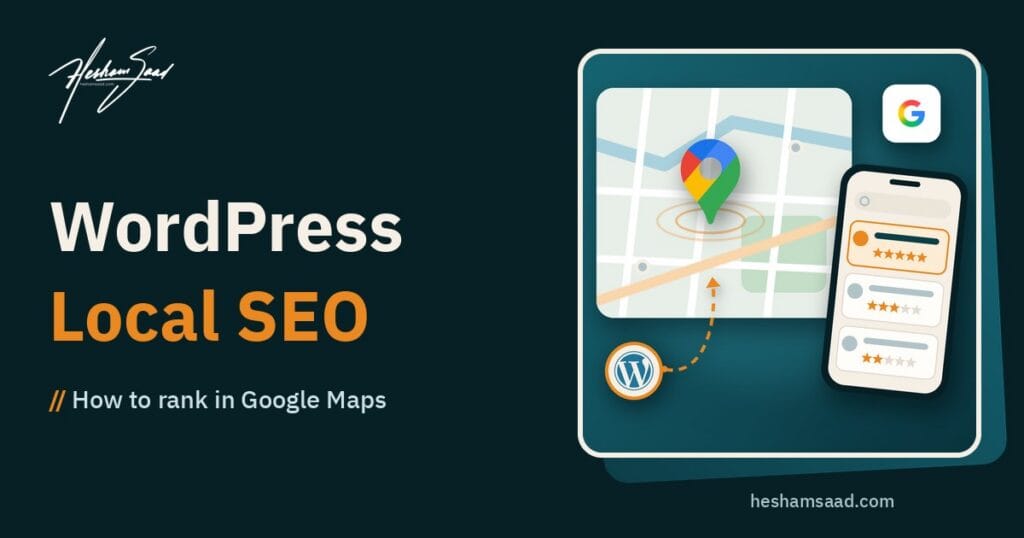
If your customers come to you, or you go to them, most of your new business probably starts with a search like “dentist near me” or “car service in Maadi” on a phone. WordPress local SEO is the work that helps your site and your Google Business Profile show up for those searches, in the map results and in the regular results under them. This guide is for clinics, agencies, workshops, salons and shops in Egypt, Saudi Arabia and the Gulf that already run WordPress, or plan to, and want more calls and visits from their own area.
This is not a general SEO pitch. If you are still deciding whether to bring in outside help for the whole site, read our guide on deciding whether to hire an SEO agency for your WordPress site first. Here we stay practical: the details on your profile, the pages on your site, the markup behind them, reviews, and the mistakes that keep good local businesses out of the map pack.
How Google picks local results, and what your site controls
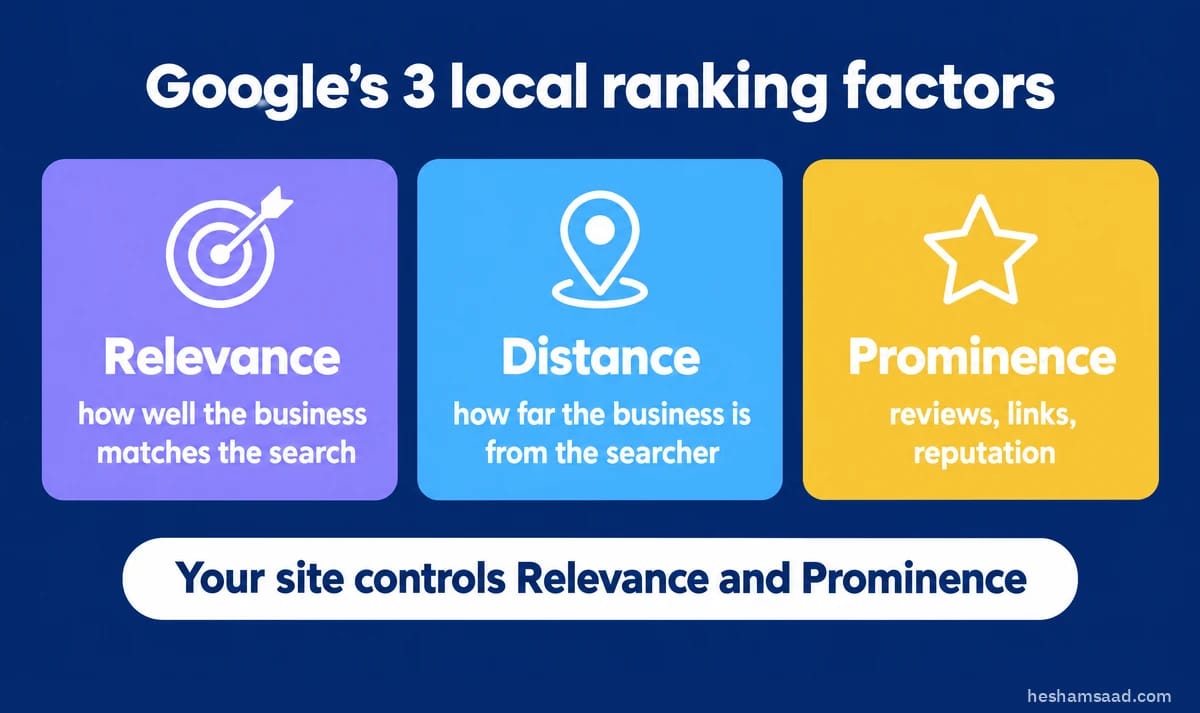
Google says local results are mainly based on three things: relevance, distance and prominence. Relevance is how well your Business Profile matches what someone searched for. Distance is how far you are from the searcher, or from the location Google assumes for them. Prominence is how well known the business is, and Google lists the number of websites linking to you and the number of reviews you have as part of that signal.
Google is also clear that there is no way to request or pay for a better local ranking. So the job is not a trick. It is giving Google complete, consistent and believable information, then earning links and reviews from real customers. Your WordPress site touches all three factors:
- Relevance: service pages that say exactly what you do, in the words customers use, in Arabic and English.
- Distance: you cannot move your clinic, but you can make sure the address and service area Google has are precise and correct.
- Prominence: a site worth linking to, local press or partner mentions, and a steady flow of genuine reviews.
NAP consistency: the boring part that decides a lot
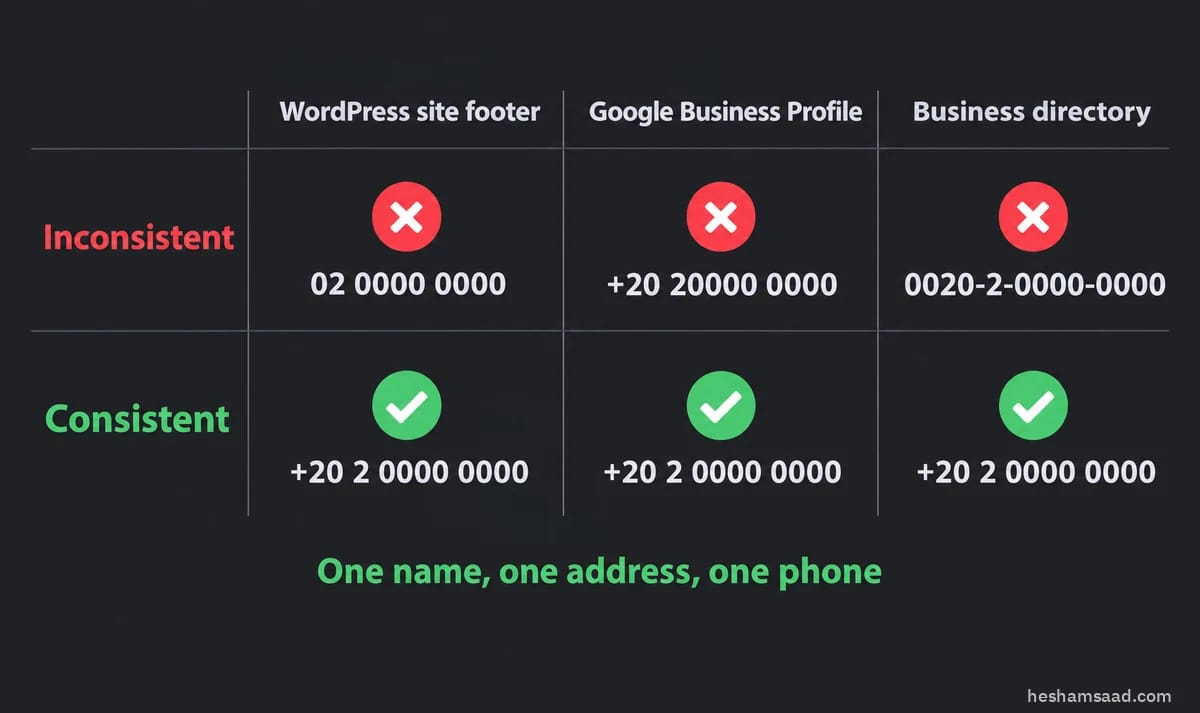
NAP stands for name, address and phone. Local SEO people repeat it because inconsistent details are one of the most common problems we find on MENA business sites. The clinic is “Dr. Ahmed Dental Center” on the sign, “Ahmed Dental Clinic” on the website footer, and something else again on an old directory listing. Google’s own guidelines ask you to represent your business as it is consistently represented in the real world, across signage, stationery and other branding.
| Detail | Where it must match | Common mistake we see |
|---|---|---|
| Business name | Sign, website header and footer, Business Profile, invoices | Adding “best” or a district name to the profile name |
| Address | Contact page, footer, profile, schema markup | Arabic address on one page, a different English spelling on another |
| Phone | Header, contact page, profile, WhatsApp button | An old mobile number still on the site after a change |
| Hours | Contact page, profile, schema markup | Ramadan or summer hours updated on the profile only |
A few practical rules for WordPress sites:
- Put the address and phone in real text, not inside an image or a slider. Search engines and screen readers both need to read it.
- Keep the details in one place, such as a theme option, a site settings block or a reusable pattern, so the footer, contact page and schema all pull the same values.
- Write phone numbers with the country code (+20 for Egypt, +966 for Saudi Arabia) at least in the markup. Google’s LocalBusiness documentation asks for the country code and area code in the telephone property.
- When you change something, change it everywhere in the same week: site, profile, social pages and the directories you control.
Google Business Profile and your WordPress site
Your Business Profile is what appears in the map pack and on Google Maps. Your site supports it and gives Google more context. The two should describe the same business, with the same details, and link to each other.
Name and categories
Google’s guidelines say the profile name should reflect your real-world name, as used on your storefront, website and stationery. Adding marketing taglines, service keywords or location words that are not part of the real name is not permitted and can get the profile suspended. One rule matters a lot in our region: Google lists repeating the same business name in multiple scripts or languages as not acceptable, even if your sign shows both. So pick the name customers actually know, Arabic or English, and use it.
For categories, Google asks you to use as few as possible, as specific as possible, and to complete the sentence “this business IS a” rather than “this business HAS a.” A dental clinic is a dentist, not a dentist plus a pharmacy plus a parking lot.
Address or service area
If customers visit you, list your real address. If you go to customers (a maintenance company, a mobile car wash, a home nursing service), Google treats you as a service-area business: you should hide the address and set a service area. You can set up to 20 service areas by city, postal code or similar, and Google says the overall area should not extend beyond about two hours of driving from your base. Hybrid businesses, like a workshop that also offers roadside help, can show the address and a service area together.
Two traps catch MENA businesses often. A rented virtual office that you do not actually operate from is not eligible for a profile. And a desk in a co-working space only counts if it has clear signage, receives customers during business hours, and is staffed by your team during those hours.
Website link, phone and verification
Link the profile to the page on your site that represents that location: the homepage for a single branch, or the specific location page if you have several. Google asks for a phone number that connects to that location and is under your direct control, and recommends a local number over a central call center where possible.
Verification options are chosen by Google and depend on your business type, region and other details. They can include phone or text, email, a video recording or a live video call. Plan for video: have the sign, the equipment and something only staff can access ready to show. Performance data is only available for verified profiles, which is one more reason not to leave a profile half done.
What WordPress local SEO looks like on the site itself
The profile gets you on the map. The site gives Google the detail behind the profile and convinces the person who clicks. These are the pages that matter most.
A contact page that does real work
- Full name, address and phone in text, matching the profile exactly.
- Opening hours, including how you handle Fridays, holidays and Ramadan.
- Directions people in your city actually use: the nearest metro station, a well-known landmark, the floor and the parking situation.
- A map. The Maps Embed API is free with unlimited requests, though it needs an API key; many sites simply use the embed code from Google Maps. Either way, the map is for people, so keep the text address too.
- A clear way to call, book or send a WhatsApp message on mobile.
Service pages that name the place honestly
A page called “Teeth whitening” that never mentions where you are leaves relevance on the table. A page titled “Teeth whitening in Nasr City” that explains the procedure, the visit, your team and how to get there is useful to a local searcher. Mention the area where it is natural, in the title, the opening and the contact section, not in every sentence.
Location pages done right
If you have three branches, build three location pages, one per real branch, each with its own address, phone, hours, photos, team and directions, and link each Business Profile to its own page. What you should not do is create twenty near-identical pages for every district in Cairo or Riyadh where you have no office. Google’s spam policies name this pattern directly: multiple pages targeted at specific regions or cities that funnel users to one page are listed as an example of doorway abuse.
| Useful location page | Doorway page |
|---|---|
| One real branch with a staffed address | A district where you have no presence |
| Unique hours, team, photos and directions | The same text with the city name swapped |
| Linked from its own Business Profile | Exists only to catch a search phrase |
A service-area business can still have one page per real service and explain the areas it covers on those pages and on the contact page. That serves customers without pretending to have offices you do not have.
Arabic and English local pages
Customers in Cairo, Jeddah or Dubai search in both languages, often with different words. An English searcher may type “pediatric clinic Sheikh Zayed” while an Arabic searcher uses a different term for the same service and writes the district in Arabic. Write the Arabic page for Arabic searchers, with the Arabic district names and the Arabic address, rather than translating the English line by line. The technical side, including hreflang and URL structure, is covered in our guide to making Arabic and English versions of a WordPress site rank side by side.
Local business schema on WordPress
Structured data tells Google, in a machine-readable way, what your contact page already says. Google’s LocalBusiness documentation lists two required properties, name and address, and recommends others, including geo (with at least five decimal places of precision), openingHoursSpecification, telephone and url, where the URL is the working page of that specific location. It also advises using the most specific subtype you can, such as Dentist rather than plain LocalBusiness.
Before you paste any code from this guide into your site, read how to add code snippets safely.
Many SEO plugins have a local business module, and Google itself notes that a CMS plugin may be the easiest route. If you prefer a small snippet in a child theme or a site plugin, it can look like this. Replace every value with your real details, and check first that your SEO plugin is not already printing the same type, so you do not ship two conflicting blocks.
add_action( 'wp_head', function () {
    if ( ! is_page( 'contact' ) ) {
        return;
    }
    $data = array(
        '@context'  => 'https://schema.org',
        '@type'     => 'Dentist',
        'name'      => 'Example Dental Clinic',
        'url'       => 'https://example.com/contact/',
        'telephone' => '+20 2 0000 0000',
        'address'   => array(
            '@type'           => 'PostalAddress',
            'streetAddress'   => '10 Example Street',
            'addressLocality' => 'Nasr City',
            'addressRegion'   => 'Cairo',
            'addressCountry'  => 'EG',
        ),
        'geo'       => array(
            '@type'     => 'GeoCoordinates',
            'latitude'  => 30.05123,
            'longitude' => 31.34567,
        ),
    );
    echo '<script type="application/ld+json">' . wp_json_encode( $data ) . '</script>';
} );
One rule people break all the time: Google supports review markup for local businesses only on sites that capture reviews about other local businesses. Marking up the testimonials on your own clinic site as an aggregateRating for your clinic does not qualify. After you deploy, test the page in the Rich Results Test, then check it with URL Inspection in Search Console. If you have not connected it yet, our walkthrough on connecting Search Console to WordPress and reading its reports covers it. Keep expectations realistic: Google does not guarantee that structured data will produce any special display.
Reviews: ask often, ask everyone, never pay
Reviews feed prominence, and they are what a hesitant customer reads before calling. Google’s tips page suggests asking customers to leave reviews through a Google link or a QR code you can create from your profile, replying to reviews, and valuing honest feedback, since a mix of positive and negative reviews often feels more trustworthy.
The rules are strict, and they are the part that gets local businesses in trouble:
- Offering anything in exchange for a review (a discount, a free session, a gift) is prohibited, including offers to change or remove a negative review.
- Selectively asking only happy customers, or discouraging negative reviews, is not allowed.
- Pushing staff to collect a set number of reviews, or reviews that mention a specific employee, is also on Google’s list of things merchants should not do.
- Reviews must reflect a genuine experience. Bought reviews and reviews from people who never visited are fake engagement and get removed.
What works in practice is a routine. A clinic sends the review link in the follow-up WhatsApp message after every appointment. A shop prints the QR code on the receipt. An agency adds the link to the project handover email. Then someone replies to every review within a few days, in the language the customer wrote in, without turning the reply into an advert. That routine is easier when patients book online, which is what a WordPress booking website sets up for clinics and salons.
Measure what local search brings you
The Business Profile performance report shows views, the search terms people used to find you, calls, direction requests, website clicks, messages and bookings where they apply. Google notes that the searches metric updates at the start of each month and that performance data includes interactions from both organic results and Google Ads.
- Add a tagged link (UTM parameters) as the profile’s website URL, so your analytics can separate profile visits from other organic traffic.
- In Search Console, filter queries by your city or district names in both languages and watch which pages earn those clicks.
- Track calls and WhatsApp clicks from the contact page as conversions. For most service businesses that is the number that matters, more than rankings.
Common local SEO mistakes on MENA sites
- Stuffing the profile name with services or districts.
- Listing a virtual office or a relative’s flat as the business address.
- One page that lists thirty neighbourhoods in a paragraph.
- Address and phone only inside an image or a page builder slider.
- An English site with no Arabic address, or an Arabic page with the old phone number.
- Duplicate profiles created by different staff over the years, left unmerged.
- Review requests that come with a discount code.
Do it yourself or get help?
A single-branch business with a decent site can handle most of this in a few focused days. Bring in help when the site itself is the problem, or the setup has grown beyond one location.
| Situation | Usually DIY | Usually worth help |
|---|---|---|
| One branch, site is fine | Profile, NAP, contact page, reviews | Schema check only |
| Several branches | Collecting branch details | Location page template and per-branch schema |
| Arabic and English site | Writing the copy | Language setup and page mapping |
| Slow or outdated theme | Little you can fix alone | A rebuild with local pages planned in |
If you need location pages, clean markup and a contact page that converts built into the site from the start, see our WordPress builds for clinics, shops and service businesses. If you are not sure where your local setup stands, a short free call to review your profile and site is a good first step.
Frequently asked questions
Do I need a separate page for every city I serve?
No. Build a page for each real branch. If you travel to customers, set the service areas in your Business Profile and describe the areas you cover on your service and contact pages. Near-identical city pages that funnel to one page are listed by Google as doorway abuse.
Can a business without a shopfront appear in Google Maps?
Yes, as a service-area business with the address hidden and a service area set. It needs a real base you operate from; virtual offices are not eligible.
Should my profile name be in Arabic or English?
Use the name customers know and that appears on your sign and documents. Google does not accept the same name repeated in two languages or scripts in the profile name, so choose one.
Will LocalBusiness schema put me in the map pack?
Not on its own. Schema helps Google understand your details, but local ranking still depends on relevance, distance and prominence, and Google does not guarantee any rich result from markup.
A final word
Local SEO rewards boring consistency: one name, one address, one phone, a site that says plainly what you do and where, and a habit of asking every customer for an honest review. Get those right on your WordPress site and your profile, and you give Google every reason to show you to the people closest to your door.
References
- Google Business Profile Help: Tips to improve your local ranking on Google
- Google Business Profile Help: Guidelines for representing your business on Google
- Google Business Profile Help: Manage your service areas
- Google Business Profile Help: Verify your business on Google
- Google Business Profile Help: Tips to get more reviews
- Google Maps: Prohibited and restricted content policy
- Google Business Profile Help: Understand your Business Profile performance
- Google Search Central: Local Business structured data
- Google Search Central: Spam policies for Google web search
- Schema.org: LocalBusiness
- Google Rich Results Test
- Google Maps Platform: Maps Embed API usage and billing
- WordPress Developer Resources: wp_head hook