هذا المقال متوفر باللغة العربية — اقرأ بالعربية
When planning a solar energy website WordPress build for Saudi Arabia, the UAE, or Egypt, generic agency themes quickly fall short of how renewable energy buyers evaluate engineering capability. As Safya, senior WordPress and WooCommerce architect at heshamsaad.com, I see engineering-led companies lose qualified industrial and residential inquiries because their websites treat photovoltaic systems like static brochure items. Solar buyers need sizing clarity, component transparency, and fast site-survey scheduling before they commit to an engineering call.
Whether you operate as a solar EPC contractor, a photovoltaic system integrator, an agricultural solar water pumping supplier, or a residential installation brand, your website acts as a pre-sales engineering filter. Commercial factory owners, farm operators, and villa developers rarely convert on a vague contact form that only asks for a name and phone number. They expect verifiable technical documentation, realistic capacity estimates, and proof of completed megawatt or kilowatt-peak installations across comparable grid environments.
Building on custom WordPress engineering allows renewable energy firms to pair editorial authority with specialized interactive workflows in one unified system. Unlike closed website builders that restrict custom post taxonomies and form logic, WordPress gives your engineering and sales teams ownership over calculators, PDF repositories, bilingual Arabic and English pages, and optional e-commerce kit sales. The official WordPress documentation provides a durable foundation for structuring custom content models that scale as your project portfolio grows.
What a solar energy website WordPress platform must handle
A high-performing solar panel company website MENA businesses trust has to bridge two very different buyer journeys on the same domain. On one side, B2B procurement officers and farm owners research three-phase inverter compatibility, mounting wind-load tolerances, and payback projections before shortlisting an EPC contractor. On the other side, villa owners and off-grid cabin buyers often want straightforward capacity guidance, turnkey site-survey booking, or direct online ordering for smaller battery and pumping kits.
Much like the structural requirements behind a construction company website built on WordPress, an EPC platform must present engineering credibility before asking for a meeting. Visitors evaluate your technical depth within seconds based on how clearly you categorize sectors, display real component specifications, and explain utility interconnection rules. Every page should guide the buyer from initial curiosity toward an actionable engineering milestone.
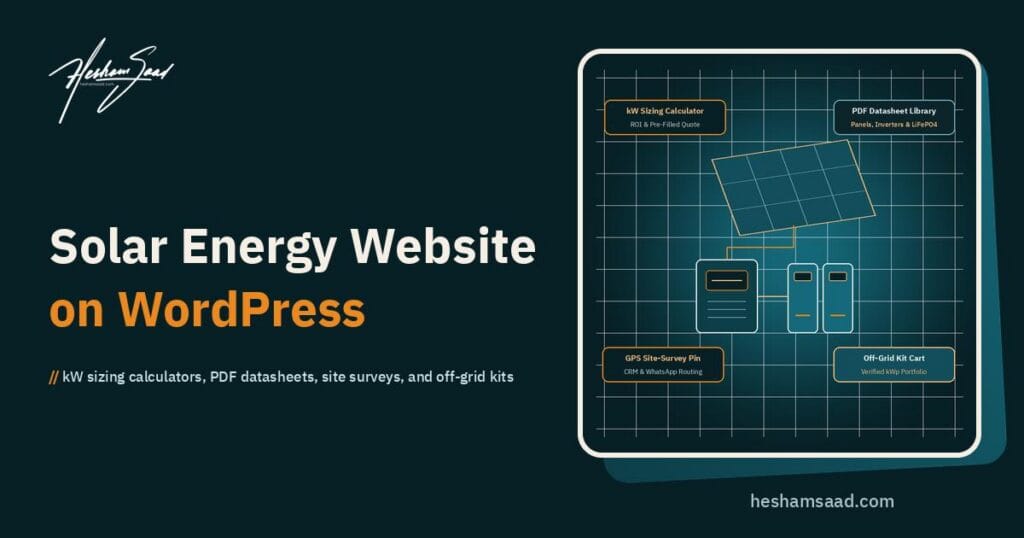
To serve Saudi, Emirati, and Egyptian solar markets effectively, your architecture should cover six operational pillars from day one:
- Interactive kW system sizing and ROI estimation backed by store-configurable tariff assumptions rather than hardcoded figures.
- Dedicated sector landing pages covering residential rooftops, commercial and industrial (C&I) plants, agricultural solar pumping, and solar carports.
- A searchable technical datasheet library hosting verified PDF specification sheets, warranty documents, and certification records.
- A filterable project portfolio indexed by sector, city or governorate, and verified kWp installed capacity.
- A multi-step site-survey intake flow capturing location pins, electrical phase, and utility bills for CRM or WhatsApp routing.
- Optional WooCommerce catalog functionality for standardized off-grid kits, standalone inverters, and charge controllers.
Separating these workflows inside clean WordPress modules prevents marketing updates from breaking engineering tools. Your content team can publish bilingual case studies and policy guides in the Block Editor while your engineering team maintains calculator coefficients and PDF specifications in dedicated admin screens.
Interactive solar ROI and kW sizing calculators
Prospects arriving on a solar contractor website almost always carry the same opening question: how many kilowatts does my roof or facility need, and how long before the installation offsets its cost. Deploying a dedicated solar ROI savings calculator WordPress module answers that question immediately while qualifying the visitor before your engineers spend time on manual spreadsheets.
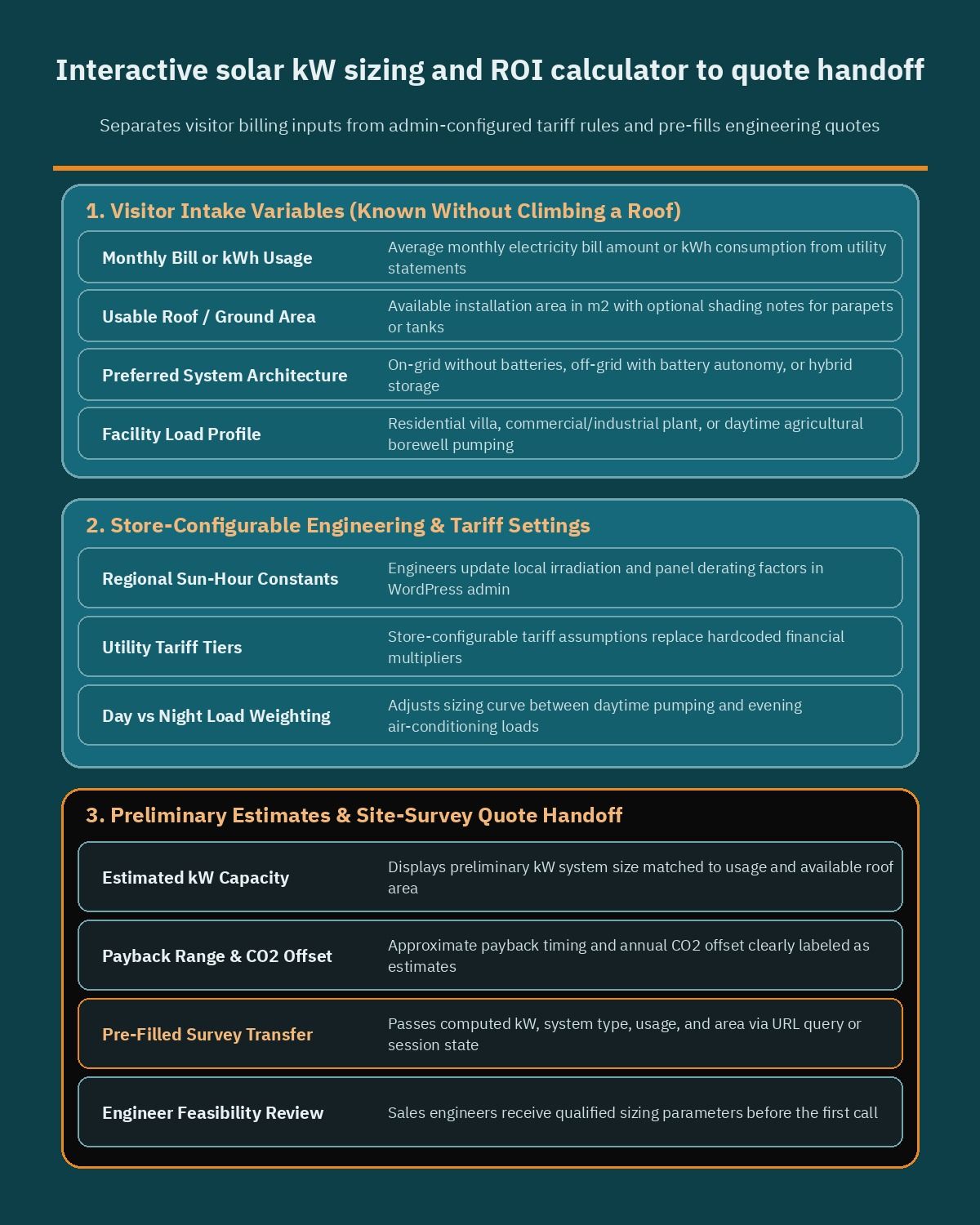
Generic calculator plugins rarely match solar engineering math because they treat energy generation as a flat discount multiplier. A reliable WordPress sizing tool separates user-supplied inputs from engineering assumptions stored in an admin settings panel. That separation ensures your sales engineers can update regional sun-hour constants, panel degradation allowances, or utility tariff tiers without asking a developer to edit theme code.
Essential calculator inputs and system type choices
Keep the front-end calculator focused on figures a property owner or facility manager actually knows without climbing onto a roof. Asking for azimuth angles or inverter string voltages on step one causes abandonment, whereas familiar billing and space metrics invite completion. Your intake screen should capture three primary variables:
- Monthly electricity bill amount or average monthly kWh consumption taken directly from recent utility statements.
- Usable roof or ground installation area in square meters, with optional shading notes for nearby parapets or water tanks.
- Preferred system architecture: grid-tied on-grid without batteries, fully off-grid with battery autonomy, or hybrid storage combining grid backup and lithium banks.
Including an optional selector for residential, commercial, or agricultural pumping load profiles lets the calculation engine adjust daytime versus nighttime consumption weighting. For example, an agricultural borewell pump running primarily during peak daylight hours requires a very different sizing curve than a residential villa running evening air conditioning on hybrid batteries.
Configurable outputs and pre-filled quote handoff
Once the visitor submits those inputs, the calculator displays clear preliminary outputs: estimated system size in kW, an approximate range for payback timing, and projected annual CO2 offset. Every output must carry clear language stating that tariff assumptions, sizing formulas, payback ranges, and component warranties are store-configurable estimates subject to on-site engineering verification rather than fixed financial promises.
The highest-converting step happens immediately below the results panel. Instead of forcing the visitor to start over on a generic contact page, a primary button transfers the computed kW size, system type, monthly usage, and area parameters via URL query arguments or session state into your quote intake form. When your sales engineer opens the lead notification, they already see what the prospect calculated and can validate feasibility on the first phone call.
Structured sector architecture and technical PDF datasheet libraries
Solar integrators serve vastly different buyer profiles across residential neighborhoods, industrial zones, and agricultural regions. Crowding every service onto one long homepage dilutes search relevance and forces industrial plant managers to scroll past villa package banners. Instead, organize your offering into distinct sector architectures built with reusable WordPress Block Editor templates and custom post types.
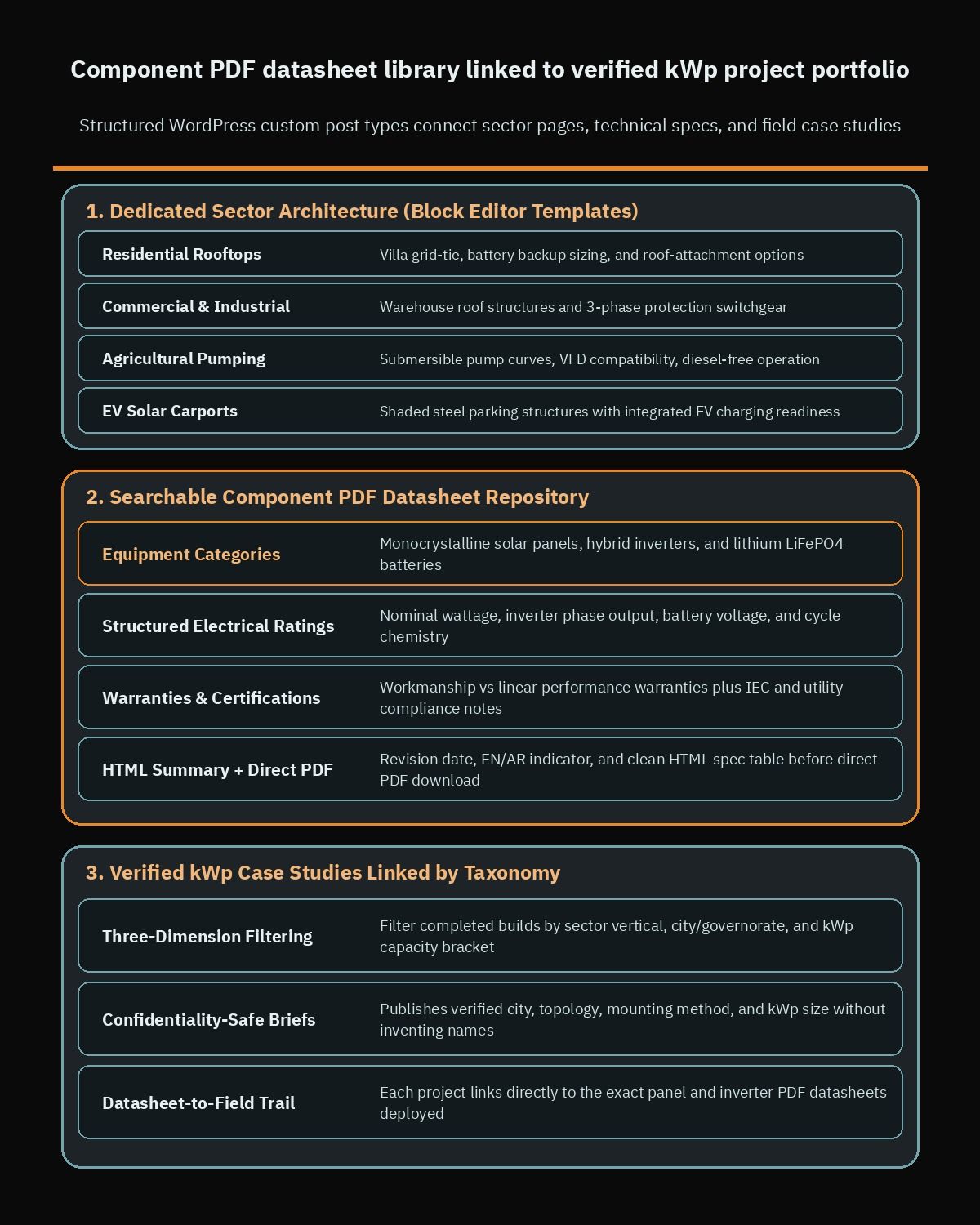
Treating sector pages and technical documents as structured records mirrors how an architecture firm website built on WordPress organizes project disciplines alongside engineering deliverables. Each sector page speaks directly to its target buyer using the terminology, regulatory considerations, and system topologies that matter to their facility.
Dedicated sector pages for MENA solar verticals
Structure your primary navigation around four core solution verticals so commercial, agricultural, and residential visitors land in the right technical context immediately:
- Residential rooftop systems covering villa grid-tie installations, battery backup sizing, and aesthetic roof-attachment options.
- Commercial and industrial (C&I) plants addressing warehouse roof structures, daytime peak-load shaving, and three-phase protection switchgear.
- Agricultural solar water pumping detailing submersible pump curves, variable frequency drive (VFD) compatibility, and remote farm operation without diesel fuel.
- EV solar carports combining shaded parking structures, structural steel foundations, and integrated electric vehicle charging readiness.
Each sector template can dynamically pull relevant case studies and approved hardware specifications via taxonomy terms. When your engineering team approves a new C&I string inverter or carport mounting rail, tagging it under the appropriate sector updates related landing pages automatically without manual copy-pasting.
Searchable PDF datasheet repository and compliance records
Engineering consultants, bankability auditors, and B2B procurement departments rarely approve a proposal without reviewing manufacturer datasheets first. Uploading unorganized PDF files into the standard media library creates broken links and outdated spec versions over time. A dedicated Datasheet custom post type turns component documentation into a searchable engineering asset.
Index each record by equipment category, manufacturer brand, capacity class, and revision year so buyers can filter monocrystalline solar panels, hybrid inverters, and lithium LiFePO4 batteries in seconds. Each entry should store structured metadata fields alongside the downloadable PDF file:
- Component category and electrical ratings such as nominal wattage, inverter phase output, or battery voltage and cycle chemistry.
- Manufacturer warranty terms presented strictly from verified datasheet documents, distinguishing product workmanship coverage from linear performance guarantees.
- Compliance and testing certifications listed on the official manufacturer spec sheet, such as international IEC standards or regional utility pre-qualification notes where applicable.
- Version date and language indicator so engineers always download the latest Arabic or English specification sheet without confusion.
To keep media storage lean and SEO clean, avoid embedding heavy multi-megabyte PDFs inside iframes on product or sector pages. Present a crisp HTML specification summary table built with native list blocks or structured grid columns, followed by a direct download button linked to the verified PDF file.
Verified kWp portfolios and B2B solar EPC lead generation workflows
A credible B2B solar EPC lead generation website proves field execution through verifiable engineering details rather than generic stock photography. Industrial owners in Riyadh, Dubai, or Cairo want to confirm that your crew has already commissioned systems under comparable desert dust, ambient heat, and utility synchronization rules. Every completed project entry should read like an engineering brief rather than a marketing flyer.
In WordPress, storing completed installations as a custom Project post type with strict custom fields enforces data consistency across every new entry. Instead of writing freeform paragraphs where key numbers get omitted, your project managers fill out uniform attributes before publishing any case study.
Filterable case studies by sector, city, and verified kWp capacity
Allow visitors to filter your project archive across three practical dimensions: sector vertical, city or governorate, and installed kWp capacity bracket. A poultry farm owner looking for a solar pumping reference should be able to isolate agricultural installations within two clicks, inspect the mounting structure, and see the verified kWp array size alongside the inverter family deployed.
Where client confidentiality agreements restrict naming an industrial facility, publish the verified city, system topology, mounting method, and kWp capacity without inventing client names or unverified yield percentages. Linking each case study directly to the component PDF datasheets used in that build gives technical evaluators an immediate trail from field installation back to manufacturer specs.
Multi-step site-survey intake and CRM or WhatsApp routing
Once a buyer validates your technical portfolio, converting that interest into a booked site survey requires collecting actionable site data without overwhelming the visitor. Replacing a single long form with a progressive three-step intake sequence keeps completion rates steady on mobile devices while capturing everything your surveyor needs before driving out.
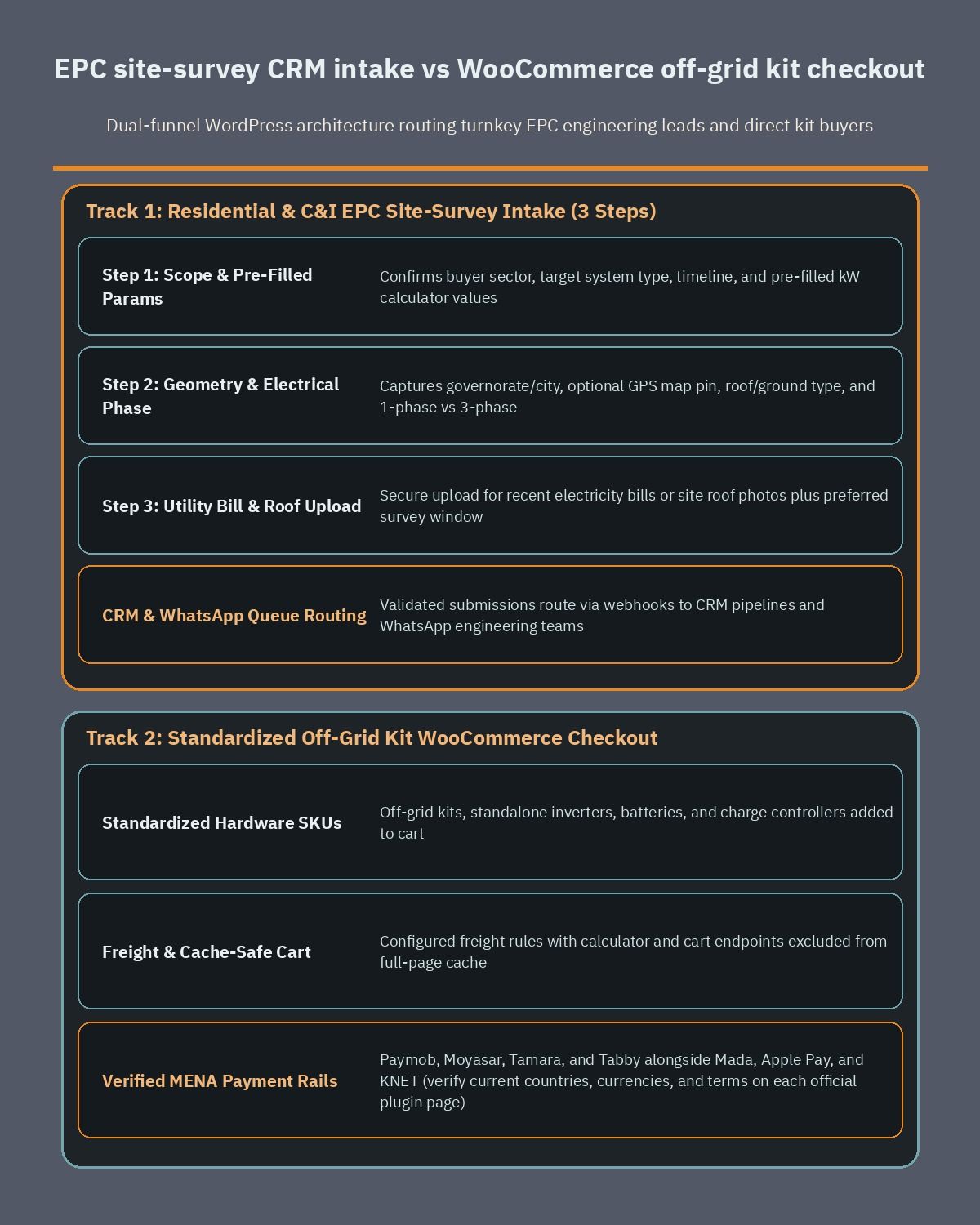
- Step one confirms project scope and pre-filled calculator parameters, capturing the buyer sector, target system type, and preferred timeline.
- Step two captures site geometry and electrical supply details: governorate or city, an optional map GPS pin, roof or ground mounting type, and whether the site runs on single-phase or three-phase electrical supply.
- Step three provides a secure upload field for recent electricity utility bills or site roof photos, followed by preferred contact method and survey time window.
On submission, WordPress should validate file types and sizes strictly, store uploaded utility bills outside public directory indexes or via authenticated links, and route structured lead payloads via webhook to your CRM. For MENA sales desks that coordinate field engineers on messaging apps, triggering an automatic notification summary to your team WhatsApp Business inbox ensures fast follow-up while keeping the full audit trail inside your CRM.
Optional WooCommerce catalogs for off-grid kits and regional payment gateways
Not every solar buyer needs a multi-week EPC engineering tender. Farm suppliers, desert camp operators, and remote site managers frequently purchase pre-engineered off-grid solar kits, standalone hybrid inverters, MPPT charge controllers, and LiFePO4 battery modules directly online. Adding WooCommerce to your WordPress site lets you capture direct hardware orders alongside high-value engineering leads.
Much like configuring technical SKUs on an electronics store website powered by WooCommerce, solar hardware product pages must pair clear electrical compatibility warnings with clean checkout steps. Following the official WooCommerce documentation, you can structure variable products for different inverter kVA ratings or battery capacities while linking each SKU directly to its PDF datasheet in your technical library.
Many solar equipment distributors weigh WordPress against hosted SaaS storefronts when planning hybrid B2B and retail operations. Reviewing the trade-offs in WooCommerce versus Shopify shows why solar firms favor WordPress: hosted platforms isolate blog, calculator, and custom taxonomy logic from checkout workflows, whereas WooCommerce shares one database with your kW sizing calculators, datasheet repository, and site-survey forms.
Regional payment gateways and split-payment verification
When selling standalone off-grid kits, inverters, and charge controllers across MENA, checkout trust depends on offering familiar local card networks, digital wallets, and flexible installment options. WooCommerce integrates with established regional checkout plugins, including Paymob for WooCommerce, Moyasar, Tamara Checkout, and Tabby Checkout.
Depending on your merchant onboarding agreement and enabled payment methods, these gateways can support local card rails such as Mada and KNET, mobile wallets including Apple Pay, and split-installment plans for higher-ticket solar hardware kits. Offering clear payment badges only for the methods active on your approved merchant account prevents checkout surprises.
Before finalizing your e-commerce architecture or advertising specific payment options to buyers, merchants should verify current supported countries, supported settlement currencies, WooCommerce version compatibility, and merchant onboarding terms directly on each provider official plugin page. Checking Paymob for WooCommerce, Moyasar, Tamara Checkout, and Tabby Checkout documentation at the start of your build avoids last-minute compliance delays during store launch.
Because solar hardware shipments involve heavy battery banks and fragile glass modules, pair WooCommerce checkout with clear shipping zones, weight-based freight classes, and warehouse pickup options. For oversized palletized orders that exceed standard courier limits, a “Request Freight Quote” cart mode lets commercial buyers submit a bill of materials without triggering an incorrect courier rate.
Multilingual performance and structured data for renewable energy WordPress development
Bilingual visibility in Arabic and English is non-negotiable for renewable energy WordPress development targeting MENA buyers. Facility engineers and international EPC partners often search technical part numbers and kWp terms in English, while residential homeowners, farm operators, and local procurement managers compare providers and submit site-survey forms in Arabic.
Maintaining true language parity means mirroring not just headlines, but also calculator labels, error validations, PDF datasheet metadata, and WooCommerce checkout notices. Leaving an Arabic calculator displaying English unit warnings or unflipped right-to-left (RTL) progress bars undermines buyer confidence during the exact moment they consider sharing utility bills.
Fast mobile performance across Arabic and English catalogs
Site engineers and field supervisors frequently inspect datasheets and submit survey coordinates over mobile connections at construction sites or rural farms. Applying proven practices to speed up WordPress Arabic sites ensures both RTL Arabic and LTR English pages load rapidly without layout shifts.
Keep page payloads lean by compressing project photography into modern image formats, loading Arabic and Latin font subsets selectively, and serving downloadable PDF datasheets on demand rather than pre-loading document viewers. Configure server-level page caching carefully so static sector pages and case studies serve instantaneously while dynamic calculator endpoints, multi-step survey nonces, and WooCommerce cart fragments bypass full-page cache.
Clean Gutenberg FAQPage schema for search visibility
Solar buyers ask specific technical and commercial questions before contacting an installer, making structured FAQ sections valuable for both user clarity and search visibility. Implementing the Schema.org FAQPage type through a native Gutenberg FAQ block keeps your JSON-LD markup synchronized with the exact text visible on the page.
Follow the Google Search FAQPage structured data guidelines strictly: include only questions and answers that appear visibly to the user, avoid promotional calls to action inside schema text, and never duplicate identical JSON-LD blocks via multiple SEO plugins. Keeping one clean FAQ block per post or service page ensures search engines parse your bilingual answers without validation errors.
Budgeting drivers and briefing your WordPress engineering team
Software budgets for solar EPC and equipment platforms vary widely based on engineering depth rather than page count alone. A simple brochure site with five static pages requires far less engineering effort than a bilingual WordPress platform connecting custom kW sizing math, hundreds of indexed datasheets, CRM webhooks, and WooCommerce hardware checkout. Understanding the core scope drivers helps you brief an agency accurately and prioritize phase-one deliverables.
- Calculator logic complexity: whether your sizing tool uses single-tariff residential math or multi-sector models with configurable sun-hour tables, battery autonomy formulas, and quote form pre-filling.
- Custom post types and filtering: building structured archives for sector pages, PDF datasheet repositories, and filterable kWp case studies with clean Block Editor templates.
- Site-survey intake and integrations: implementing multi-step validation, secure utility bill uploads, map pin pickers, CRM API webhooks, and WhatsApp notification routing.
- Optional WooCommerce store scope: configuring off-grid kit variations, freight shipping rules, and integrating regional gateways such as Paymob, Moyasar, Tamara, or Tabby after verifying merchant eligibility.
- Bilingual Arabic and English parity: translating UI strings, verifying RTL styling across calculators and checkouts, and tuning mobile caching for both languages.
Before requesting proposals, prepare a concise technical brief covering your target regions, whether you will sell hardware kits online or focus purely on EPC lead generation, and sample spreadsheets of your sizing assumptions. If your roadmap includes custom kit pricing, freight rules, or gateway integrations, it pays to hire a dedicated WooCommerce developer who understands both B2B lead flows and regional payment compliance.
Ready to map out your solar EPC platform, kW sizing calculator, and bilingual catalog architecture without guesswork? Book a free WordPress architecture consultation with our team at heshamsaad.com to review your sector structure, datasheet workflows, and phase-one engineering plan.
Frequently asked questions
How does a solar kW sizing calculator work on WordPress?
A WordPress solar sizing calculator collects monthly electricity bills or kWh usage, usable roof or land area, and system type such as on-grid, off-grid, or hybrid battery storage. It applies store-configurable tariff assumptions and derating factors to produce an estimated kW capacity, payback range, and CO2 offset projection. Those computed values pre-fill the quote form so engineering teams receive qualified project parameters rather than blank inquiries.
How should a solar EPC company organize PDF datasheets and completed kWp projects?
Solar contractors should separate technical component catalogs from project case studies using structured WordPress custom post types and taxonomies. The datasheet library organizes monocrystalline panels, hybrid inverters, and lithium LiFePO4 batteries with downloadable PDF specification sheets, configurable warranty terms, and certification records. Completed projects are indexed separately by sector, city, and verified kWp capacity so commercial procurement teams can audit comparable installations quickly.
What details should a solar site-survey booking form collect before engineering dispatch?
An effective solar site-survey form captures the property governorate or GPS pin, roof or mounting structure type, and whether the facility uses single-phase or three-phase electrical supply. Including a utility bill upload field helps engineers verify historical consumption before visiting the site. Routing validated submissions automatically to a CRM pipeline or WhatsApp engineering queue speeds up feasibility checks and scheduling.
Can one WordPress site sell off-grid solar kits alongside custom EPC services?
Yes, adding WooCommerce lets solar suppliers sell standardized off-grid kits, inverters, and charge controllers online while keeping large commercial EPC contracts in a consultation workflow. Regional checkout plugins including Paymob for WooCommerce, Moyasar, Tamara Checkout, and Tabby Checkout can support Mada, Apple Pay, KNET, and split installments. Merchants should verify current supported countries, currencies, and terms on each official plugin page first.
How do you keep a bilingual Arabic and English solar WordPress site fast for mobile visitors?
Fast bilingual solar sites rely on clean Block Editor markup, compressed component photography, and serving PDF datasheets separately from core page payloads. Separate RTL and LTR stylesheets, object caching, and excluding interactive calculator or cart endpoints from full-page cache prevent bottlenecks on mobile networks. Matching visible Gutenberg FAQ content with a single FAQPage schema block keeps search metadata consistent across both languages.
References
- WordPress Block Editor Handbook
- WordPress Official Documentation
- WooCommerce Official Documentation
- Schema.org FAQPage Specification
- Google Search Central FAQPage Structured Data Guidelines
- Paymob for WooCommerce Official Plugin Page
- Moyasar for WooCommerce Official Plugin Page
- Tamara Checkout Official Plugin Page
- Tabby Checkout Official Plugin Page