هذا المقال متوفر باللغة العربية — اقرأ بالعربية
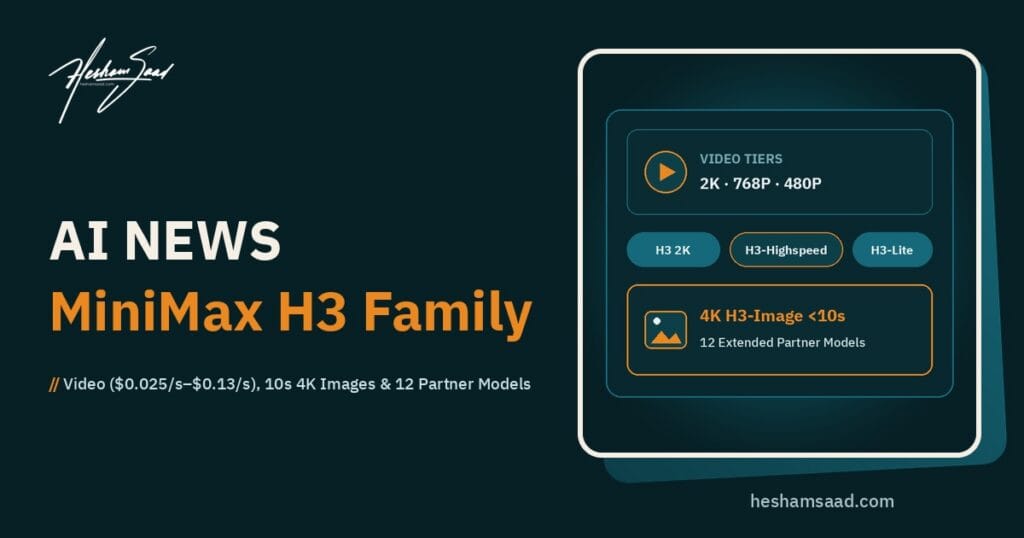
The MiniMax H3 Family announced on November 26, 2026 turns what started as a single open-weight multimodal video model into a tiered commercial production stack. Instead of forcing e-commerce teams and creative agencies to pay flagship compute rates for early storyboard drafts or simple social media variations, MiniMax separated its architecture into distinct cost and latency tiers across video and 4K imagery, while integrating 12 external partner and community models into the ecosystem.
For online stores and digital agencies across the Middle East and North Africa, the announcement changes how product media budgets work. With video generation dropping as low as $0.025 per second on first-party H3-Lite and $0.022 per second on Nunchux AI partner endpoints, alongside 4K reference-guided product images starting around $0.034 under promotional pricing, high-volume visual merchandising is now cheap enough for daily catalog operations on WooCommerce.
What changed in the MiniMax H3 Family release
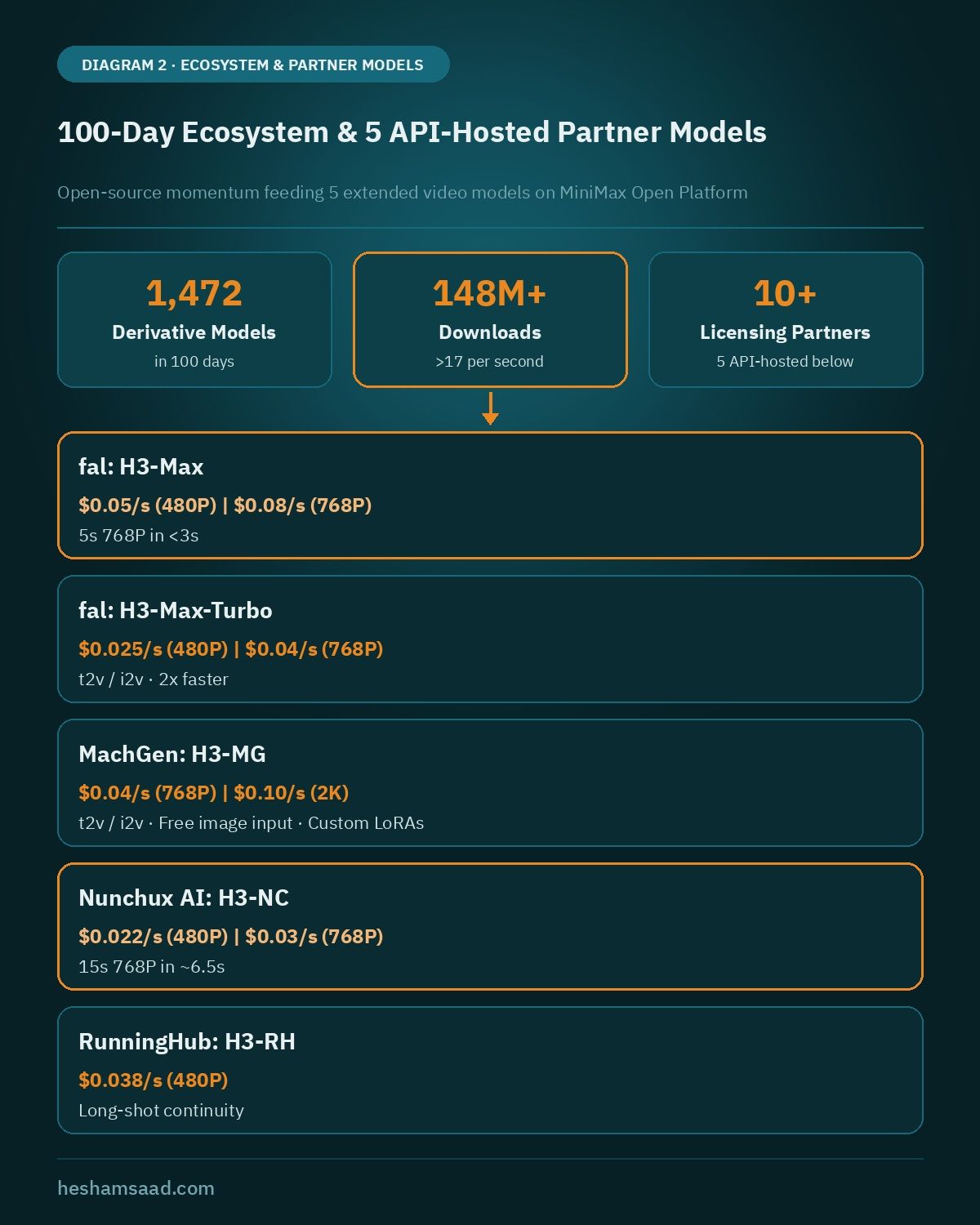
To understand why this release matters for production engineering, look at the timeline leading up to November 26, 2026. MiniMax originally announced MiniMax H3 on July 31, 2026 and published the model weights on August 2, 2026. More than three months later, on November 11, 2026 (under a license dated November 10, 2026), the company released MiniMax H3-Image. Across the first 100 days after open-sourcing H3, external developers created 1,472 derivative models on GitHub and Hugging Face, accumulating more than 148 million total downloads at an average pace exceeding 17 downloads every second, alongside more than 10 global licensing partnerships.
That open-source momentum attracted commercial platforms and academic laboratories alike. According to MiniMax, organizations and research groups actively building on the H3 architecture include NVIDIA, Tencent, Alibaba, fal, Suno, HeyGen, Pika, Creatify, MIT, the National University of Singapore (NUS), and The Hong Kong Polytechnic University. Rather than leaving those third-party acceleration layers fragmented across separate repositories, MiniMax consolidated the ecosystem into an accessible lineup across the MiniMax Open Platform, MiniMax Code, Hailuo AI, GitHub, and Hugging Face.
From an engineering perspective, this mirrors the shift we saw when evaluating open-weight decision models for automated workflows: a single heavyweight checkpoint is rarely the right tool for every step of a business pipeline. By introducing MiniMax H3-Highspeed and MiniMax H3-Lite beside the flagship MiniMax H3 model, and pairing MiniMax H3-Image with MiniMax H3-Image Highspeed, the platform lets developers route cheap exploratory drafts to fast quantized or distilled tiers while reserving full 2K multi-step generation for final hero assets.
Flagship video tiers, API specs, and legacy Hailuo comparison
The first-party video catalog now splits into three primary generation endpoints plus two specialized companion services for 2K regeneration and prompt context processing. Every primary tier supports text-to-video (t2v), image-to-video and first-and-last-frame controls (i2v and fl2v using 0, 1, or 2 anchor frames), and multimodal reference generation (ref mode) with native stereo audio.
MiniMax H3, Regeneration, and multimodal reference limits
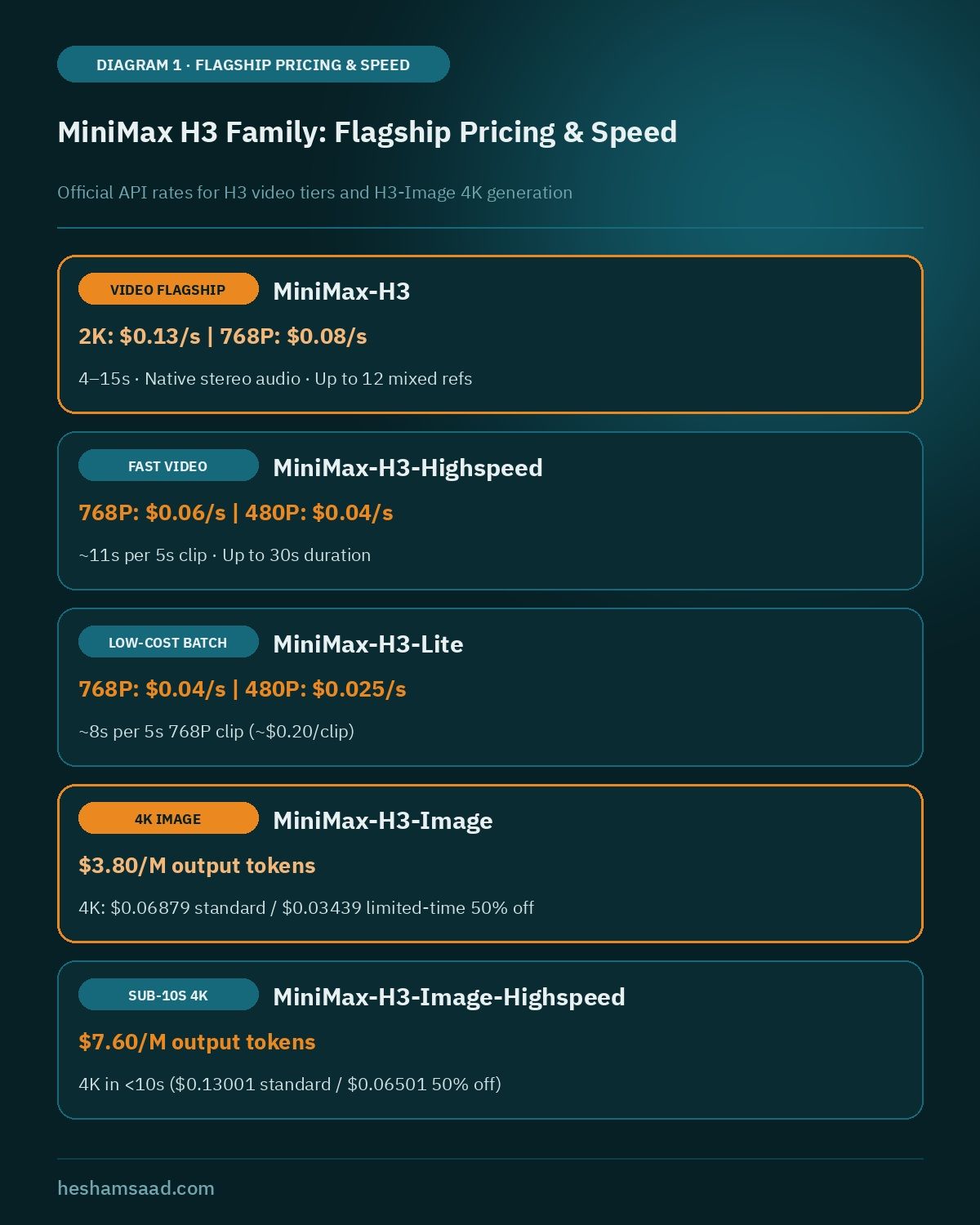
The flagship MiniMax-H3 endpoint targets commercial campaigns where visual fidelity, accurate multi-step edits, and unified text, image, video, and stereo audio context take priority over raw speed. On the pay-as-you-go API, 2K video costs $0.13 per second for output video and $0.13 per second for input video, while 768P video costs $0.08 per second for both output and input video. The first 5 input images in a request are free, and each additional image beyond 5 costs $0.04. Audio input is always free, and the boolean parameter generate_audio defaults to true so clips arrive with synchronized stereo sound unless you explicitly set it to false for silent storefront loops.
According to the official video generation documentation, MiniMax-H3 produces clips between 4 and 15 integer seconds per call. In reference generation mode, a single request can combine up to 9 reference images, up to 3 video clips lasting 2 to 15 seconds each (capped at 15 seconds of total input video duration), and up to 3 audio clips lasting 2 to 15 seconds each (also capped at 15 seconds total), up to a combined ceiling of 12 mixed files. Prompts accept up to 7,000 characters, individual files are capped at 50 MB for video, 30 MB for images, and 15 MB for audio, and the overall HTTP request body cannot exceed 64 MB. Because rendering high-resolution video with stereo audio takes compute time, the API uses an asynchronous three-step flow: submit the payload to receive a task_id, poll the task status endpoint, and download the finished MP4 from content.url.
To prevent teams from paying $0.13 per second on 2K renders that might get rejected during creative review, MiniMax offers MiniMax-H3-Regeneration. You can generate initial cuts at 768P ($0.08/s), pick the winning take, and pass it to MiniMax-H3-Regeneration to upscale and regenerate the clip into 2K at $0.05 per second of output video, $0.05 per second of input video, and $0.025 per extra image after the first 5 free. Keep in mind that the API bills original input materials again separately during regeneration. If your pipeline also uses MiniMax-H3-Context-IR for context token processing, it bills at $0.90 per million input tokens and $3.60 per million output tokens.
H3-Highspeed and H3-Lite vs legacy Hailuo 2.3
For daily commercial production and batch social media catalogs, MiniMax-H3-Highspeed outputs 768P video at $0.06 per second and 480P video at $0.04 per second (matching rates for input video), with extra images beyond the first 5 free billed at $0.03 each. On official benchmarks, a 5-second clip finishes in roughly 11 seconds on average, clips up to 15 seconds render in under 1 minute, and the model supports extended durations up to 30 seconds across t2v, i2v, fl2v, and multimodal ref modes.
At the entry level, MiniMax-H3-Lite handles rapid concept exploration and high-volume variant testing. It charges $0.04 per second at 768P and $0.025 per second at 480P for output and input video, plus $0.02 per image after the first 5 free. On supported hardware configurations, MiniMax-H3-Lite renders a 5-second 768P clip in about 8 seconds for approximately $0.20 in video output charges, with volume discounts available for enterprise commitments.
Comparing these numbers against legacy models on the exact same MiniMax pricing sheet shows how far per-second economics have moved. Legacy MiniMax-Hailuo-2.3 charges a flat $0.28 for a 6-second 768P clip ($0.0467/s) and $0.56 for a 10-second clip ($0.056/s), while Hailuo-2.3-Fast charges $0.19 for 6 seconds and $0.32 for 10 seconds at 768P. By contrast, a 6-second clip on MiniMax-H3-Lite costs $0.15 at 480P or $0.24 at 768P, undercutting standard Hailuo-2.3 while adding multimodal video, image, and audio references alongside native stereo sound generation.
Synchronous 4K image generation and hard e-commerce limits
While video generation runs asynchronously, both MiniMax-H3-Image and MiniMax-H3-Image-Highspeed run on synchronous REST endpoints compatible with the standard OpenAI SDK: POST /v1/images/generations for text-to-image and POST /v1/images/edits for reference-guided image editing. A single API call can request 1 to 10 output images, accept 1 to 16 reference images on the edit endpoint, stream individual images back as they finish, and return files in JPEG (the default), PNG, or WebP formats. Prompts support up to 32,000 characters, equivalent to roughly 4,096 tokens when prompt enhancement is disabled; enabling H3-Image-Context-IR prompt enhancement costs $2.30 per million input tokens.
Resolution flexibility is a major strength for responsive web design. Both models default to 4K (4096×4096) and offer preset 1K (1024×1024) and 2K (2048×2048) areas, or custom WIDTHxHEIGHT dimensions anywhere between 655,360 and 20,000,000 total pixels across aspect ratios ranging from 1:3 to 3:1. In practice, a WordPress developer can request exact 16:9 hero banners at 5472×3072 (4K) or 2720×1536 (2K) without cropping square outputs afterwards.
Pricing for the image tier is metered by tokens rather than flat per-image buckets, which keeps lower-resolution thumbnails cheap while rewarding batch efficiency:
- MiniMax-H3-Image (Standard): Runs at 1.5x to 2x the speed of comparable mainstream image models at 50% to 70% of their cost. Token rates are $2.30 per million input text tokens, $1.50 per million input image tokens, and $3.80 per million output image tokens. Under MiniMax illustrative single-image calculations, a 1K text-to-image render costs $0.02179, a 2K render costs $0.02333, and a 4K render costs $0.06879 ($0.03439 during the limited-time 50% discount for outputs of 16,600,000 pixels or larger). A 4K edit using 1 reference image costs $0.07312 ($0.03656 promo), while a 4K edit combining 3 reference images costs $0.07914 ($0.03957 promo).
- MiniMax-H3-Image-Highspeed: Generates full 4K images in under 10 seconds (3x to 4x faster than mainstream models in the same quality tier). Token rates remain $2.30 per million input text tokens, while input image tokens double to $3.00 per million and output image tokens double to $7.60 per million. Single-image illustrative costs are $0.03529 for 1K t2i, $0.03622 for 2K t2i, $0.13001 for 4K t2i ($0.06501 promo), $0.13673 for a 4K edit with 1 reference ($0.06837 promo), and $0.15407 for a 4K edit with 3 references ($0.07703 promo).
However, store owners must account for three hard technical limitations explicitly documented by MiniMax: the image endpoints do not support preview images, masked edits (inpainting masks), or transparent backgrounds. If you run an online boutique and want to place a perfume bottle onto a marble counter using three reference photos, POST /v1/images/edits handles the composite scene directly. If you need an isolated transparent PNG cutout of that bottle for a category grid card, you cannot generate an alpha channel natively and must pass the output through a background-removal script before importing it into WooCommerce.
| Model Name | Supported Resolutions | Official API Pricing | Generation Speed & Duration | Best E-Commerce Use Case |
|---|---|---|---|---|
| MiniMax-H3 | 2K, 768P | 2K: $0.13/s out & in 768P: $0.08/s out & in Images >5: $0.04 each | 4s to 15s integer clips; async polling workflow | Hero campaign videos, multi-step edits, full 12-file multimodal refs |
| MiniMax-H3-Regeneration | 768P to 2K upscale | $0.05/s out & in Images >5: $0.025 each (inputs re-billed) | 4s to 15s clips regenerated from 768P H3 outputs | Cost-effective 2K finishing after approving 768P cuts |
| MiniMax-H3-Highspeed | 768P, 480P | 768P: $0.06/s out & in 480P: $0.04/s out & in Images >5: $0.03 each | ~11s for 5s clip; <1 min up to 15s; max 30s clips | Daily product reels, 30s social ads, catalog batch video |
| MiniMax-H3-Lite | 768P, 480P | 768P: $0.04/s out & in 480P: $0.025/s out & in Images >5: $0.02 each | ~8s for 5s 768P clip (~$0.20 video output cost) | High-volume prompt testing, A/B hooks, storyboard drafts |
| MiniMax-H3-Image | 1K, 2K, 4K (up to 20MP) | Text: $2.30/M, In Img: $1.50/M, Out Img: $3.80/M ($0.06879 4K t2i; $0.03439 promo) | 1.5x to 2x mainstream speed; synchronous REST | 4K catalog lifestyle banners, 16-image reference product composites |
| MiniMax-H3-Image-Highspeed | 1K, 2K, 4K (up to 20MP) | Text: $2.30/M, In Img: $3.00/M, Out Img: $7.60/M ($0.13001 4K t2i; $0.06501 promo) | Under 10 seconds for 4K output (3x to 4x speed) | Interactive design sessions, urgent campaign hero imagery |
Extended partner models and the 12-model ecosystem
What sets this release apart from standard vendor API updates is that MiniMax invited external infrastructure providers to optimize, distill, and fine-tune the base weights, then hosted five of those partner video models directly on the MiniMax Open Platform with unified billing. All five API-hosted partner endpoints support text-to-video, image-to-video, first-and-last-frame generation, and multimodal reference generation with free audio input.
| Partner & Model ID | Resolutions | Per-Second Video Pricing | Image & Input Video Billing | Key Speed & Workflow Advantage |
|---|---|---|---|---|
| fal: MiniMax-H3-Max | 768P, 480P | 768P: $0.08/s 480P: $0.05/s | In video: $0.143/s (768P), $0.0553/s (480P); first 2 images free, then $0.074/image | Generates a 5-second 768P clip in under 3 seconds |
| fal: MiniMax-H3-Max-Turbo | 768P, 480P | 768P: $0.04/s (t2v/i2v), $0.08/s (ref) 480P: $0.025/s (t2v/i2v), $0.05/s (ref) | First 2 images free; extra images $0.06 (768P) or $0.04 (480P) | Twice as fast as H3 Max; built for virtual try-ons and live commerce |
| MachGen: MiniMax-H3-MG | 2K, 768P | 2K: $0.10/s (t2v/i2v), $0.12/s (ref) 768P: $0.04/s (t2v/i2v), $0.06/s (ref) | All image inputs are completely free | Unchanged base weights with fast previews and custom LoRA style control |
| Nunchux AI: MiniMax-H3-NC | 768P, 480P | 768P: $0.03/s 480P: $0.022/s | First 5 images free; extra images $0.015 (768P) or $0.011 (480P) | Radical speed tier rendering a 15-second 768P clip in ~6.5 seconds |
| RunningHub: MiniMax-H3-RH | 480P | 480P: $0.038/s (called via model=MiniMax-H3, resolution=480P) | First 5 images free; extra images $0.04 each | Maintains character and scene continuity across long unbroken shots |
Examining Table 2 reveals clear arbitrage opportunities for developers building media tools. If you need 2K output with custom LoRA brand styling and heavy multi-image conditioning, MachGen MiniMax-H3-MG charges $0.10 per second for t2v/i2v ($0.12/s for ref) compared to $0.13 per second on first-party MiniMax-H3, and waives extra image fees completely. If you are building an interactive shopper experience such as a live virtual fitting room on a fashion site, fal: MiniMax-H3-Max delivers a 5-second 768P clip in under 3 seconds, while fal: MiniMax-H3-Max-Turbo doubles that speed at half the t2v/i2v rate ($0.04/s at 768P, $0.025/s at 480P). Meanwhile, Nunchux AI: MiniMax-H3-NC (also referred to as MiniMax-H3-Fast Radical Speed) pushes 768P generation down to $0.03 per second ($0.022/s at 480P) and finishes a full 15-second 768P spot in roughly 6.5 seconds.
Beyond the five endpoints metered directly on the MiniMax Open Platform, the announcement showcases seven specialized ecosystem and community models built on the H3 foundation:
- HeyGen Video 1 (480P, 768P, 2K): Generates presenter-led AI avatar videos up to 30 seconds long in a single pass, synchronizing lip motion, spoken dialogue, ambient sound effects, and held product packaging.
- Creatify Boreal-H3 (768P, 1088P, 2K): Fine-tuned specifically for direct-response e-commerce advertising so product geometry, hand interactions, and on-camera talent stay consistent across cuts.
- Utopai Studios Utopai X: Focuses on cinematic production requirements, including realistic rigid-body physics, studio lighting transitions, controlled camera movement, and tight audiovisual sync.
- Suno H3 Move: Pairs generative music with video by producing music videos where vocal lip-sync and visual pacing lock onto song structure and lyrics.
- Pika H3 Flex (768P, 4K): Uses a 6-step generation pipeline that outputs 5 separate audio tracks alongside fine camera trajectory and character action controls.
- LightX2V / ModelTC MiniMax-H3 Turbo (768P): Compresses inference into just 4 or 8 diffusion steps, making it practical for engineering teams to run local self-hosted deployments on their own dedicated GPU servers.
- Akatz Labs Character Swap V1.5 (768P): Replaces an individual actor inside an existing video clip while retaining the original lighting, background scene, body motion, and facial expressions.
Community License restrictions and why MENA teams have an edge
Whenever a vendor labels a model open-source, technical leads must read the actual license file before downloading weights onto production servers. Both MiniMax-H3 (license dated August 2, 2026) and MiniMax-H3-Image (license dated November 10, 2026) are governed by Community License Agreements issued by Nanonoble Pte. Ltd., not permissive Apache 2.0 or MIT licenses.
The most important clause in both agreements is the territorial definition. Under the Nanonoble Pte. Ltd. Community License Agreement, the “Applicable Territory” is defined as worldwide excluding the European Union, the United Kingdom, the Republic of Korea, and the United States of America (collectively designated as “Excluded Territories”). Companies organized, operating, or deploying weights within those four excluded jurisdictions cannot rely on the default public license and must contact MiniMax to negotiate a separate commercial license.
This creates a rare structural advantage for digital agencies, SaaS builders, and e-commerce groups operating in Egypt, Saudi Arabia, the United Arab Emirates, and the wider MENA region. Because MENA countries sit inside the Applicable Territory, local engineering teams can legally download the open weights from Hugging Face or GitHub, deploy the 4-step or 8-step LightX2V / ModelTC MiniMax-H3 Turbo variant on local or regional GPU instances, and train proprietary LoRA adapters for regional retail brands without breaching territorial clauses.
One vital caveat applies if your agency manages international storefronts: if you deploy self-hosted inference containers inside a US, EU, UK, or South Korean cloud availability zone, or if your client is legally domiciled in an Excluded Territory, the self-hosted exception no longer applies. In those cross-border deployments, either route traffic through authorized hosted API endpoints on the MiniMax Open Platform or compare managed multimodal alternatives such as Google Genie 4 on the Gemini API and Google AI Studio where global enterprise indemnification is bundled into the cloud terms.
Designing a WordPress and WooCommerce media pipeline
Having access to 17 first-party and partner models is only valuable if your store turns them into faster page loads and higher product conversion rates. On content-heavy stores, especially high-visual verticals like a cosmetics and skincare WooCommerce store, dumping uncompressed 4K images and 50 MB raw video files directly into the WordPress media library will wreck mobile Largest Contentful Paint (LCP) and inflate bandwidth bills.
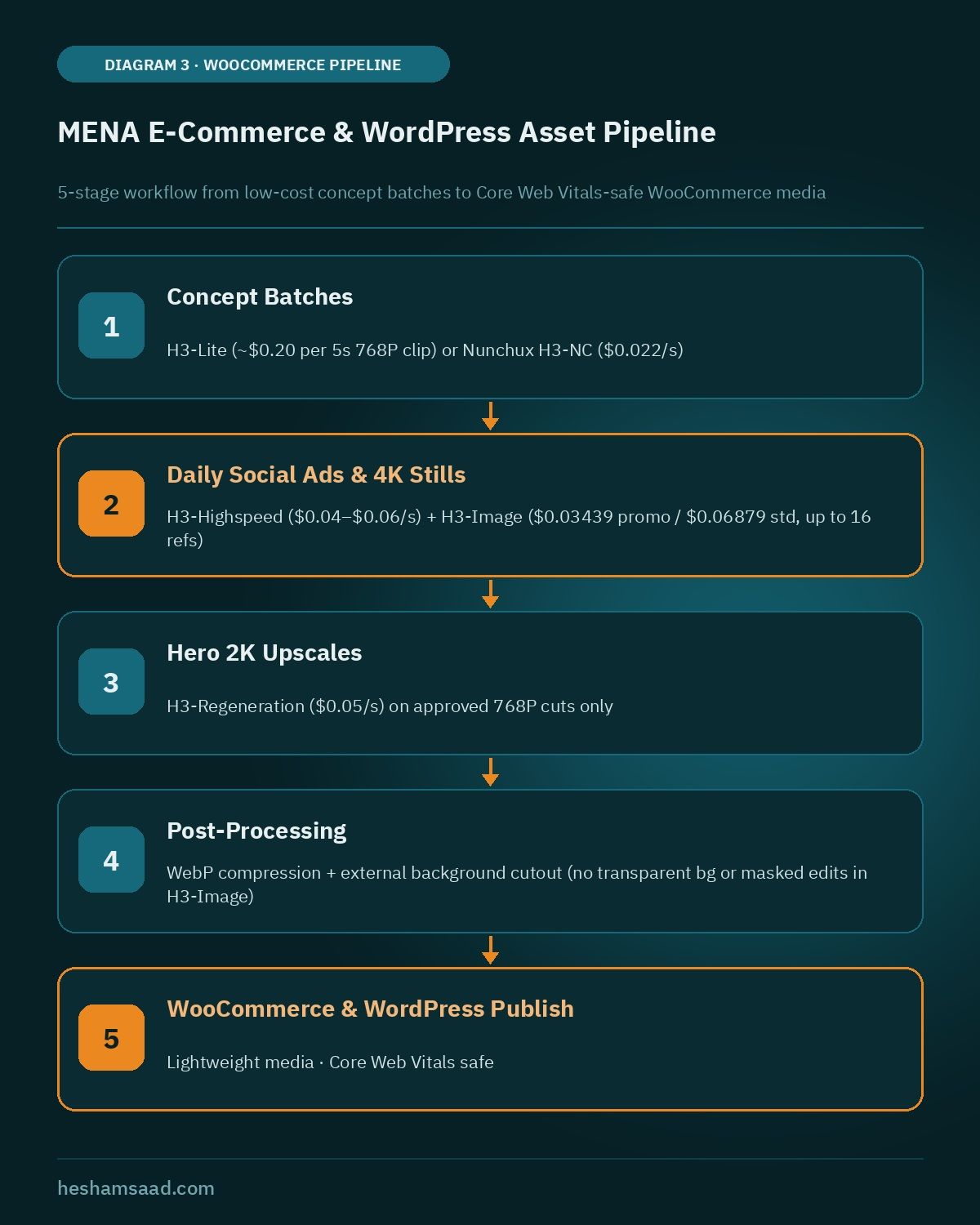
When we architect custom catalog workflows during professional WordPress development projects, we separate AI media generation into an external microservice or background WP-Cron queue that talks to the MiniMax API before optimizing files for the storefront. A production-ready WooCommerce pipeline uses four stages:
- Prompt standardization via official agent skills: Rather than guessing prompt syntax for camera motion or multi-image conditioning, install MiniMax’s official open-source prompt-writing skills directly into your coding agent (compatible with Claude Code, Codex, Cursor, Windsurf, and any SKILL.md tool). Run
npx skills add https://github.com/MiniMax-AI/MiniMax-H3 --skill h3-prompt-writingfor video andnpx skills add https://github.com/MiniMax-AI/MiniMax-H3-Image --skill h3-image-prompt-writingfor 4K image composition. - Low-cost concept filtering: When launching a new seasonal collection, generate 5-second 768P motion concepts using
MiniMax-H3-Lite($0.20 per clip in ~8 seconds) orNunchux AI: MiniMax-H3-NC($0.15 per 5s 768P clip). Merchandisers review the low-cost renders in a staging dashboard and discard weak camera angles before spending flagship budget. - Batch catalog imagery and social reels: For approved products, call
POST /v1/images/editsonMiniMax-H3-Imagewith 1 to 3 studio SKU reference photos and set the output format directly towebp. If the theme requires transparent PNG cutouts for category grids, pipe the returned image through an automated background-removal step to work around MiniMax’s lack of native alpha-channel support. Simultaneously, render 15-to-30-second product reels onMiniMax-H3-Highspeed($0.04/s to $0.06/s) or custom LoRA videos onMachGen: MiniMax-H3-MG. - 2K hero finishing and asynchronous delivery: For main landing page banners, render 768P takes on flagship
MiniMax-H3($0.08/s) with full multimodal references, then promote the single best clip to 2K usingMiniMax-H3-Regeneration($0.05/s). Transcode the finished MP4 into adaptive HLS or lightweight WebM/MP4 loops and serve them from a CDN rather than local WordPress disk storage.
Pairing this visual pipeline with structured AI content writing workflows in WordPress lets a small merchandising team publish localized English and Arabic product pages with custom 4K lifestyle visuals and synchronized stereo video clips in minutes. When evaluating platform economics in our Shopify vs WooCommerce MENA total cost comparison, owning your WordPress backend means you can wire these pay-as-you-go API endpoints directly into product edit screens without paying third-party app store markups on every generated image or video second.
Who should adopt these models, monthly cost math, and your next step
Before changing your agency or store production stack, weigh where the architecture fits and where its documented constraints require a different approach.
Who should use this stack and who should wait
Strongest fit: MENA e-commerce brands, performance marketing teams, and WordPress agencies in Egypt, Saudi Arabia, and the UAE that produce continuous volumes of product lifestyle photos, social video variations, and localized presenter clips. You benefit twice: pay-as-you-go API rates down to $0.022 per second on Nunchux H3-NC or $0.025 per second on H3-Lite keep variable media spend low, and your regional domicile falls inside the Applicable Territory if you ever decide to self-host the open weights on private GPUs.
Who should wait or pair other tools: Teams whose daily workflow depends on inpainting specific regions with mask layers or generating native transparent-background PNGs in a single API call, since MiniMax-H3-Image explicitly omits masked edits, transparent backgrounds, and preview images. In addition, engineering teams deploying self-hosted model weights on servers located in the United States, the European Union, the United Kingdom, or South Korea must pause and obtain a separate commercial license from MiniMax or stick strictly to authorized hosted platforms.
Realistic monthly cost math for a WooCommerce store
Using only official MiniMax Open Platform pay-as-you-go prices, here is what a full monthly visual production calendar costs for an active online store launching 50 new SKUs:
- 100 concept test videos (5 seconds each at 768P on MiniMax-H3-Lite): 500 total seconds at $0.04/s ($0.20 per clip), with up to 5 reference images per request included free = $20.00.
- 60 daily social and product reels (10 seconds each at 768P on MiniMax-H3-Highspeed): 600 total seconds at $0.06/s ($0.60 per clip), using up to 5 free reference images = $36.00.
- 10 flagship campaign drafts (10 seconds each at 768P on MiniMax-H3) plus five 2K upscales: 100 seconds of 768P text-to-video output at $0.08/s ($8.00), followed by regenerating the 5 best 10-second clips into 2K via
MiniMax-H3-Regeneration(50 seconds of output video at $0.05/s = $2.50, plus 50 seconds of 768P input video at $0.05/s = $2.50) = $13.00. - 300 4K text-to-image lifestyle banners on MiniMax-H3-Image: At the illustrative 4K rate of $0.03439 per image under the 50% promo ($0.06879 standard) = $10.32 promo ($20.64 standard).
- 200 4K multi-reference product edits (3 reference images each) on MiniMax-H3-Image: At the illustrative 3-reference 4K edit rate of $0.03957 promo ($0.07914 standard) = $7.91 promo ($15.83 standard).
Across 170 commercial video clips (including five 2K hero finishes) and 500 4K images, your total monthly API spend comes out to $87.23 under current 4K promotional rates, or $105.47 at standard un-discounted pricing.
What to do this week
Do not overhaul your live storefront media pipeline without testing how the models handle your specific products first. Run this three-step validation sprint over the next five days:
- Install both official prompt skills (
h3-prompt-writingandh3-image-prompt-writing) in your local code editor and run 10 multi-reference product edits againstPOST /v1/images/editswithwebpoutput at 2720×1536 (2K 16:9) and 5472×3072 (4K 16:9). - Send the exact same 5-second product motion prompt and two anchor frames across
MiniMax-H3-Lite($0.20 at 768P),MiniMax-H3-Highspeed($0.30 at 768P), andfal: MiniMax-H3-Max($0.40 at 768P, rendered in under 3 seconds) to compare packaging text legibility and native stereo audio quality. - Decide whether your catalog needs an automated background-cutout bridge between the synchronous image API and WooCommerce. If you want an experienced engineering team to build and benchmark a custom media pipeline for your store, book a free consultation and we will map out the architecture around your catalog size and budget.
Frequently asked questions
What is included in the MiniMax H3 Family release?
Announced on November 26, 2026, the release combines three first-party video tiers (MiniMax H3, H3-Highspeed, and H3-Lite) with two 4K image models (MiniMax H3-Image and H3-Image Highspeed). It also highlights 12 third-party and community models built after open-sourcing H3, which reached 1,472 derivative models and over 148 million downloads in 100 days.
How do MiniMax H3, H3-Highspeed, and H3-Lite compare on price and speed?
Flagship MiniMax H3 costs $0.13 per second at 2K and $0.08 per second at 768P for commercial multi-step video production. H3-Highspeed charges $0.06 per second at 768P and $0.04 at 480P, generating a 5-second clip in about 11 seconds. H3-Lite lowers costs to $0.04 per second at 768P and $0.025 at 480P, producing a 5-second 768P clip in about 8 seconds.
What are the main limits of MiniMax H3-Image for WooCommerce product catalogs?
MiniMax H3-Image and H3-Image Highspeed generate 1K, 2K, and 4K visuals in JPEG, PNG, or WebP and accept up to 16 reference images for editing. However, the API does not support transparent backgrounds, masked inpainting edits, or preview images. WooCommerce stores needing isolated transparent product cutouts must add a separate background-removal step after generating catalog images.
Which extended H3 partner models can you call through the MiniMax API?
The MiniMax Open Platform hosts five partner video endpoints: fal MiniMax-H3-Max ($0.05 to $0.08 per second), fal MiniMax-H3-Max-Turbo ($0.025 to $0.08 per second), MachGen MiniMax-H3-MG ($0.04 to $0.12 per second with free image input), Nunchux AI MiniMax-H3-NC ($0.022 to $0.03 per second), and RunningHub MiniMax-H3-RH ($0.038 per second at 480P). All five support text, image, and multimodal reference generation.
Can MENA businesses self-host MiniMax H3 weights under the Community License?
Yes, both MiniMax-H3 and MiniMax-H3-Image use Community License Agreements from Nanonoble Pte. Ltd. that allow commercial self-hosting worldwide except in the European Union, the United Kingdom, the United States, and South Korea. Agencies and stores operating in Egypt, Saudi Arabia, and the UAE fall inside the permitted territory, while businesses deploying in excluded regions must obtain a separate license.
References
- MiniMax Official Blog: Introducing the MiniMax H3 Family (Nov 26, 2026)
- MiniMax H3 Family Overview and Ecosystem Showcase
- MiniMax Official Blog: MiniMax H3 Multimodal Video Generation
- MiniMax Official Blog: MiniMax H3-Image Release (Nov 11, 2026)
- MiniMax Open Platform Documentation: Pay-as-You-Go API Pricing Overview
- MiniMax Open Platform Documentation: Video Generation API Guide
- MiniMax Open Platform Documentation: Image Generation and Editing API Guide
- GitHub Repository: MiniMax-AI/MiniMax-H3 Weights, License, and Agent Skills
- GitHub Repository: MiniMax-AI/MiniMax-H3-Image Weights, License, and Agent Skills
- Hugging Face Model Card: MiniMaxAI/MiniMax-H3
- Hugging Face Model Card: MiniMaxAI/MiniMax-H3-Image


Add your first comment to this post