هذا المقال متوفر باللغة العربية — اقرأ بالعربية
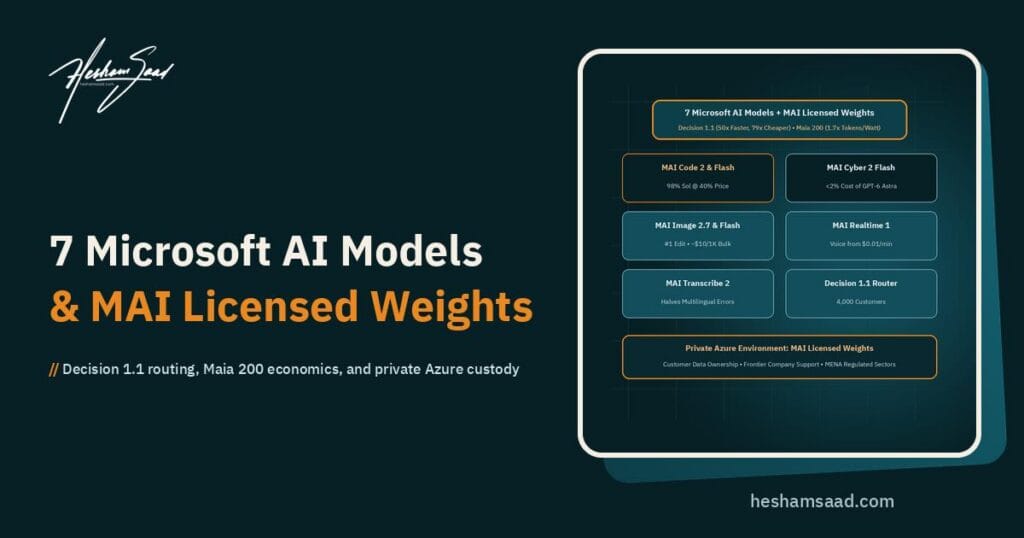
On November 17, 2026 at Microsoft Ignite, Microsoft AI introduced seven new models built for scalable price-performance alongside MAI Licensed Weights, a deployment model that lets organizations customize frontier weights on private data inside their own Azure environment. Rather than competing solely on peak reasoning benchmarks, Microsoft targeted the token bills that stop engineering and operations teams from running software agents 24-7.
For businesses comparing this release with flagship models covered in our GPT-6.2 Astra and Sol overview and our Gemini 4 Hydrogen analysis, the message is practical. Production systems in WordPress agencies, WooCommerce stores, and MENA enterprises rarely stall from a lack of raw intelligence. They stall when round-the-clock automation multiplies API spend and exposes proprietary logic on shared external endpoints.
Why Microsoft AI built seven models for 24-7 agent economics
Microsoft AI anchored the Ignite 2026 release around a familiar enterprise problem: token spend climbs sharply when teams shift from interactive chat to continuous background agents handling security scans, code updates, and customer conversations. Routing every routine call through one expensive flagship model makes 24-7 automation hard to justify.
To bring costs down without sacrificing frontier accuracy on daily tasks, Microsoft paired specialized domain models with Maia 200, its second-generation AI accelerator already running its largest models in production and delivering 1.7x more tokens per watt.
| Model or offering | Primary workload | Verified performance and pricing signal | Availability |
|---|---|---|---|
| MAI Cyber 2 Flash | 24-7 codebase defense and patching | Matches GPT-6 Astra on CyberGymE2E at under 2% cost per task; 86% lower output token price than MAI Cyber 1.1 Flash | Powers MDASH scans (~40% share, 90% retention) |
| MAI Code 2 | Everyday enterprise coding and UI | 98% of GPT-6.1 Sol at 40% price; 96% of Claude Opus 5.5 at 5% price; 64% frontend win rate over GPT-6 Sol | GitHub Copilot |
| MAI Code 2 Flash | High-volume edits and routine fixes | Matches GPT-6 Luna at 65% price and Claude Haiku 5.5 at 20% price across three coding benchmarks | GitHub Copilot and limited access preview in Microsoft Foundry |
| MAI Image 2.7 | Image editing and text-to-image | #1 on Artificial Analysis image editing, beating GPT Image 2.6 Sunburst (max) at 1/5 price; #4 text-to-image | Microsoft Foundry |
| MAI Image 2.7 Flash | High-volume image generation | World-class generation for high-volume scenarios at approximately $10 per 1,000 images | Microsoft Foundry |
| MAI Realtime 1 | Live speech-to-speech conversations | Outperforms GPT-Realtime 2.1 on external and Dynamics 365 benchmarks; starts from $0.01 per audio minute | Try in MAI Labs and register interest |
| MAI Transcribe 2 | Multilingual speech transcription | Powers Dragon Copilot Transcribe across 10M patient encounters/month; halves multilingual error rates; used by 1/3 of US physicians | Live in Dragon Copilot |
| Decision 1.1 | In-app model routing | Leads AA Decision Index ahead of Jev, Google, and OpenAI; 50x faster and 79x cheaper than GPT-Sol 6.1 | Used by 4,000 customers |
MAI Licensed Weights and enterprise control over proprietary IP
Lower API pricing does not solve data governance. Microsoft noted that enterprise leaders repeatedly push back against pouring institutional knowledge into someone else’s hosted model, while open-weight alternatives raise difficult questions about weight provenance and unpredictable behavior when tied to core company IP.
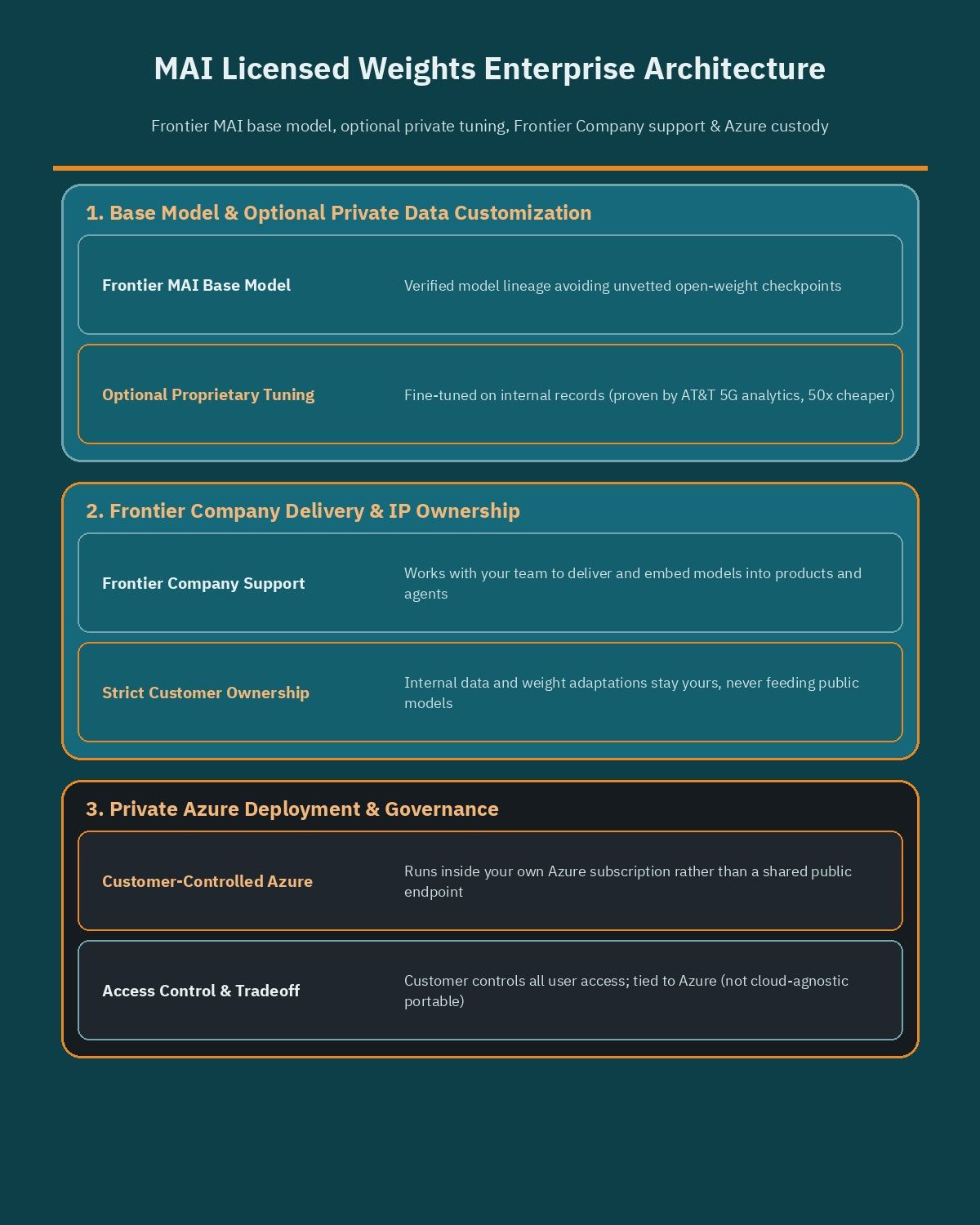
Microsoft proved out private customization earlier with Custom Models. AT&T built a MAI custom model for 5G network operation analytics that outperformed GPT-6.1 Sol at a 50x cheaper cost, and also found that Code 2 delivered frontier-level performance at a significantly lower price on complex engineering scenarios.
MAI Licensed Weights turns that pattern into a dedicated enterprise offering. Teams start with a frontier MAI model, optionally customize it on proprietary data, and run it inside their own Azure environment. You control user access, your data and weight adaptations stay yours, and Microsoft’s Frontier Company works with your team to deliver and embed the model into internal products and agents.
- Private Azure custody: Internal training records and fine-tuned weights operate inside your own Azure subscription rather than a shared public endpoint.
- Verified model lineage: Organizations avoid unvetted open-weight checkpoints while retaining control over who queries the deployed model.
- Guided integration: Frontier Company supports custom model delivery and embedding across enterprise software and agent workflows.
Everyday coding and security defense at a fraction of frontier token prices
Engineering productivity and live codebase security represent the heaviest recurring token workloads for software agencies and internal IT teams. Microsoft split these responsibilities across three models tuned for continuous execution.
MAI Code 2 and MAI Code 2 Flash for daily engineering
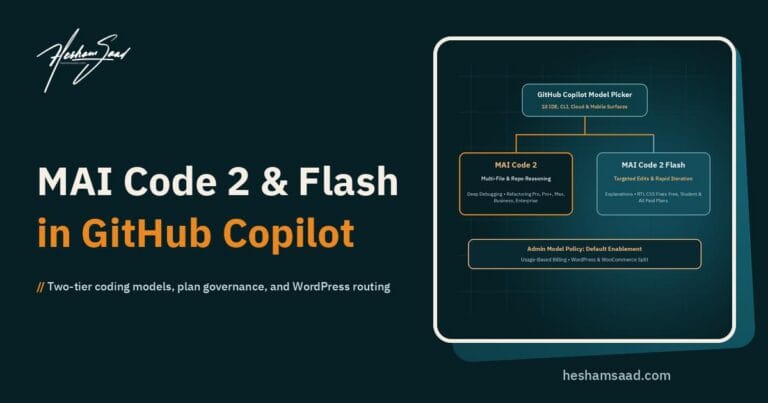
MAI Code 2 focuses on everyday enterprise development inside GitHub Copilot. Averaged across DeepSWE 1.1, Terminal Bench 2.1, SWE-Atlas, and FrontierCode v1.1, it delivers 98% of GPT-6.1 Sol’s coding quality at roughly 40% of the price, and 96% of Claude Opus 5.5’s performance at just 5% of the price.
It is also tuned for dashboards and visualizations. In a blind side-by-side frontend evaluation, developers preferred MAI Code 2 over GPT-6 Sol 64% of the time. At the same time, Microsoft stated explicitly that these models are not yet tuned for fundamental science research or very long-horizon agentic work.
For higher-volume tasks such as code explanations, targeted edits, routine fixes, and rapid iterations, MAI Code 2 Flash matches GPT-6 Luna at 65% of the price and Claude Haiku 5.5 at 20% of the price across DeepSWE 1.1, Terminal Bench 2.1, and SWE-Atlas. It is available in GitHub Copilot and in limited access preview in Microsoft Foundry.
MAI Cyber 2 Flash for continuous production defense
With attackers using cheap offensive automation, Microsoft flagged security, alignment, and containment as its top priority for agent development in 2027 and beyond. MAI Cyber 2 Flash is designed to keep monitoring and patching agents running 24-7 on live production systems.
On the CyberGymE2E benchmark, MAI Cyber 2 Flash matches GPT-6 Astra’s quality at under 2% of the cost per task. Priced 86% lower on output tokens than MAI Cyber 1.1 Flash, it builds on earlier MAI Cyber models that already power nearly 40% of MDASH scans with 90% scan retention.
Image editing, realtime voice, and multilingual transcription
Customer-facing platforms also burn budget on visual asset creation, voice bots, and audio transcription. Microsoft released four specialized media and audio models aimed at predictable unit economics.
MAI Image 2.7 and Image 2.7 Flash for catalog and creative teams
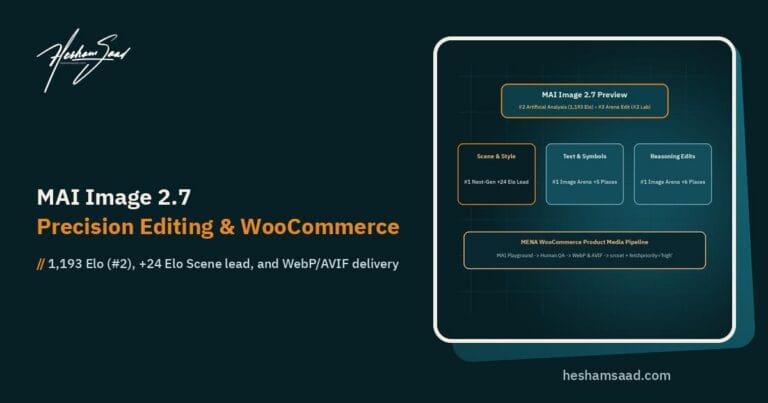
MAI Image 2.7 ranks #1 on Artificial Analysis for image editing, outperforming GPT Image 2.6 Sunburst (max) at one fifth of the price, while ranking #4 in text-to-image generation as the second-ranked lab. For bulk generation workloads, MAI Image 2.7 Flash targets roughly $10 per 1,000 images. Both models are live in Microsoft Foundry.
MAI Realtime 1 and MAI Transcribe 2 for live audio
MAI Realtime 1 is Microsoft AI’s first live speech-to-speech model for natural, low-latency voice conversations. It outperformed GPT-Realtime 2.1 across external and Dynamics 365 benchmarks and starts from $0.01 per audio minute, with testing open in MAI Labs by registration.
Meanwhile, MAI Transcribe 2 (also listed as MAI-Transcribe-2) powers 100% of doctor-patient conversation transcriptions inside Dragon Copilot Transcribe. Already used by a third of US physicians across 10 million patient encounters monthly, it halves error rates in multilingual workflows.
Decision 1.1 routing and Maia 200 infrastructure efficiency
Task-matched models only cut costs when applications route incoming requests accurately. Decision 1.1 embeds model routing directly inside apps so larger, pricier models are triggered only when a prompt truly requires them.
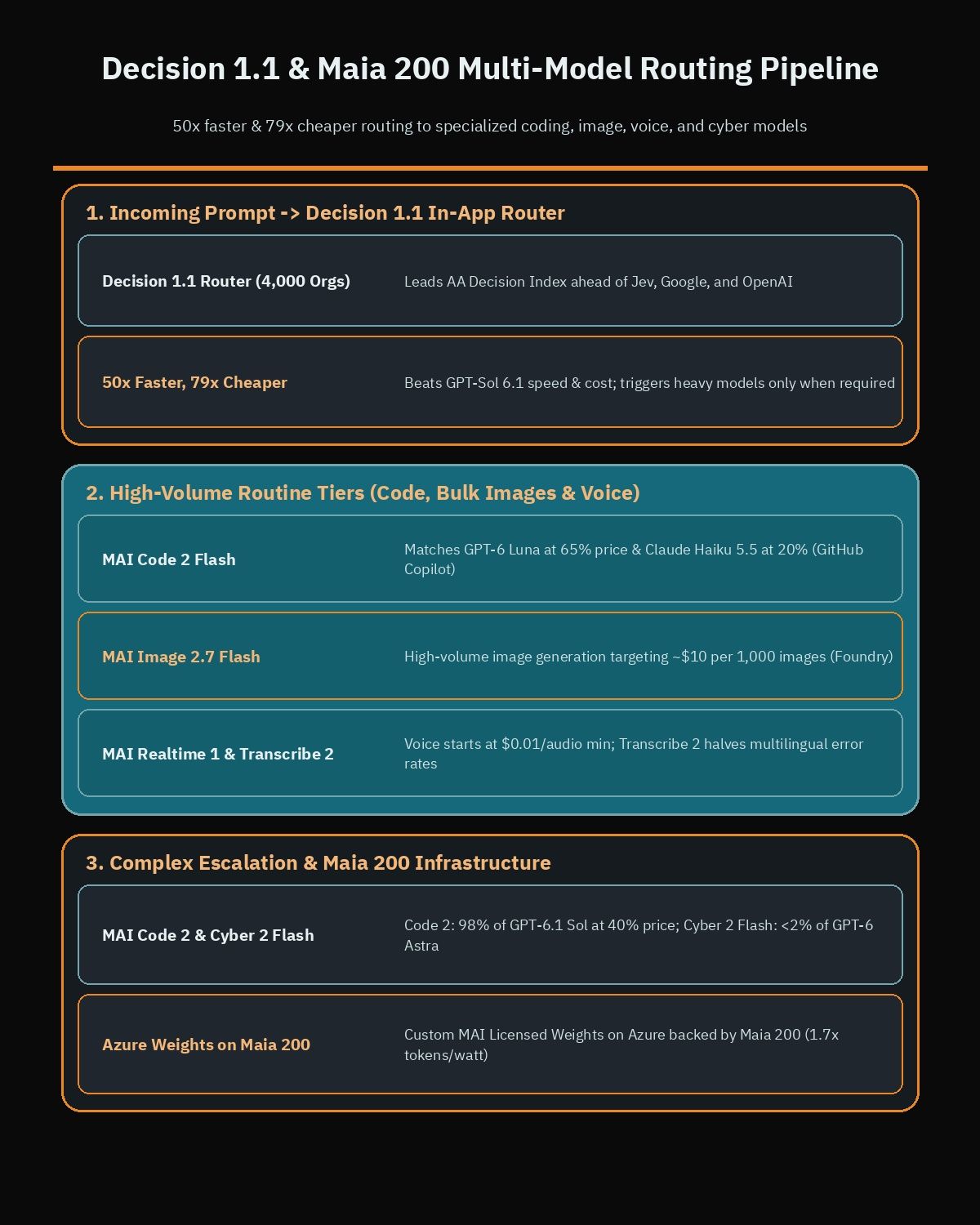
Already used by 4,000 customers, Decision 1.1 leads the AA Decision Index ahead of Jev, Google, and OpenAI while running 50x faster and 79x cheaper than GPT-Sol 6.1. Beneath the entire model family sits Microsoft’s second-generation Maia 200 accelerator, achieving 1.7x more tokens per watt in production.
Honest tradeoffs and limitations to weigh before adopting
Strong benchmark ratios do not eliminate architectural limits. Technical leads should weigh five caveats stated or implied in Microsoft’s announcement before committing production workloads:
- Not built for deep science or long-horizon autonomy: MAI Code 2 targets everyday commits and frontend UI, and Microsoft explicitly notes it is not yet tuned for fundamental science research or very long-horizon agentic work.
- Staged rollout across endpoints: MAI Code 2 Flash is in limited access preview on Microsoft Foundry, and MAI Realtime 1 currently requires registering interest in MAI Labs.
- Text-to-image placement: MAI Image 2.7 leads #1 in image editing, yet sits at #4 in text-to-image synthesis, so teams generating brand-new scenes should test outputs against alternatives.
- Azure dependency for custom weights: MAI Licensed Weights keeps customized models inside your Azure environment, which strengthens governance for Azure shops but does not offer cloud-agnostic portable weights.
- Vendor-run evaluations: Results such as the 64% frontend preference over GPT-6 Sol and Dynamics 365 voice benchmarks come from Microsoft’s internal and blind tests.
How MENA WordPress and WooCommerce agencies can apply this lineup
For agencies and store owners running WordPress and WooCommerce across Egypt, Saudi Arabia, and the UAE, these price-performance tiers map cleanly onto daily operations without requiring a complete stack rewrite.
Routing support, voice, and catalog workflows at predictable cost
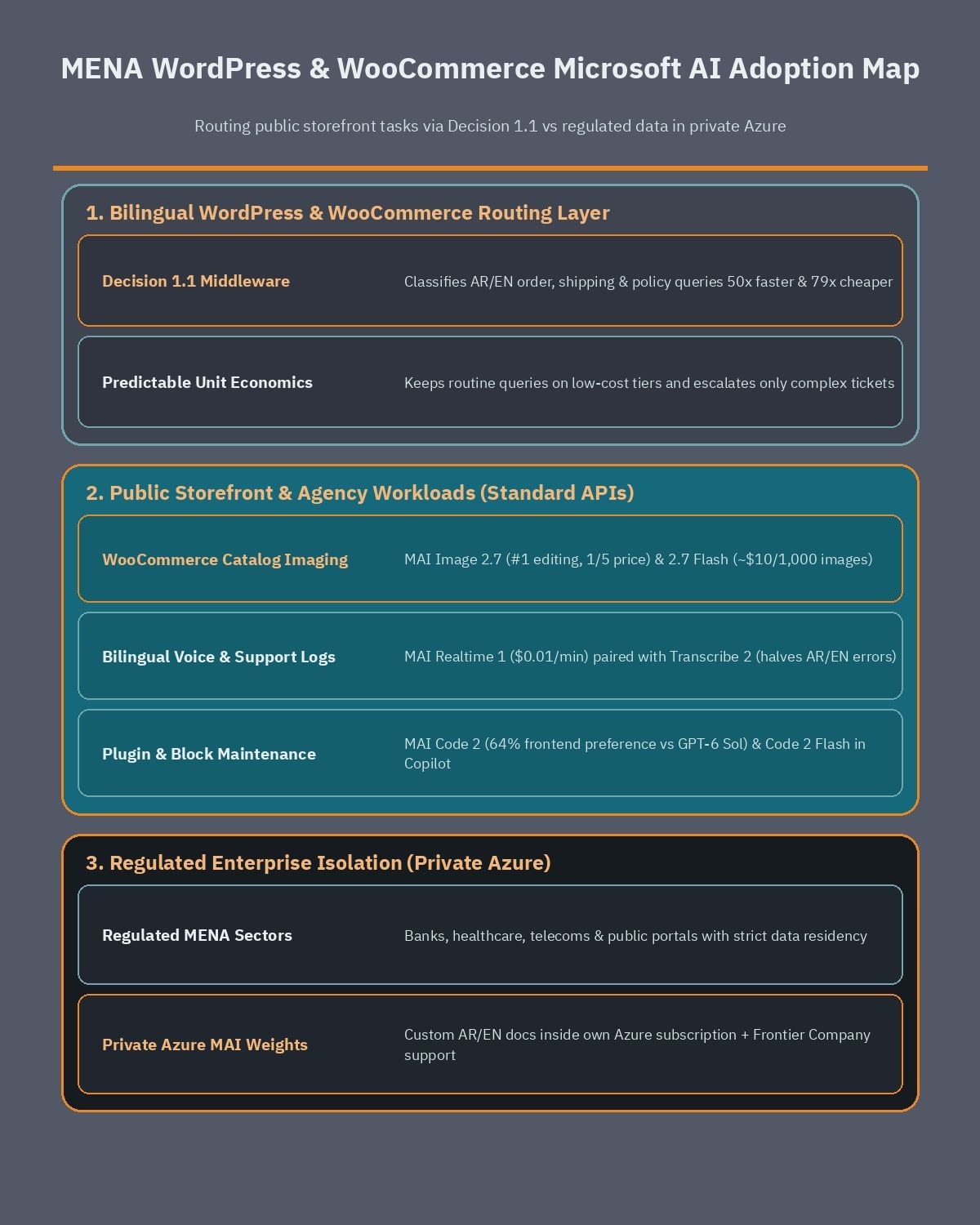
Bilingual Arabic and English sites handle thousands of repetitive order, shipping, and policy questions every week. Placing Decision 1.1 in your middleware classifies routine requests 50x faster and 79x cheaper than GPT-Sol 6.1, keeping simple queries on low-cost tiers and escalating only complex tickets.
When stores or clinics add spoken support, MAI Realtime 1 starting from $0.01 per audio minute makes interactive voice agents viable at regional budgets. Pairing voice intake with MAI Transcribe 2’s halved multilingual error rates also improves accuracy across Arabic and English service logs.
For WooCommerce catalogs with hundreds of SKUs, MAI Image 2.7 (#1 in editing) and MAI Image 2.7 Flash (~$10 per 1,000 images) make background cleanup and campaign visuals affordable. Remember to optimize, resize, and cache every generated image properly so your efforts to speed up WordPress Arabic sites stay intact, and consult a skilled WooCommerce developer before automating product media sync.
On the engineering side, agencies building custom blocks and store checkouts can test MAI Code 2 in GitHub Copilot for frontend UI work while offloading routine refactoring and bug explanations to MAI Code 2 Flash at 20% of Claude Haiku 5.5’s price.
When regulated MENA enterprises need MAI Licensed Weights
Standard e-commerce stores do not need custom weights. However, MENA banks, healthcare networks, telecoms, and public-sector portals face strict data residency rules that bar sending customer records or proprietary pricing logic to shared public APIs.
In those sectors, MAI Licensed Weights offers stronger provenance than unverified open-weight downloads. Teams running on Azure can customize a frontier MAI model on internal Arabic and English documentation, restrict access inside their own Azure subscription, and embed it into enterprise WordPress portals with Frontier Company support.
Practical checklist and next steps for your WordPress team
Before adding new AI endpoints to your WordPress stack, run through four quick checks with your technical lead:
- Split routine spend from frontier tasks: Audit existing API logs so short edits, image drafts, and support triage no longer hit flagship reasoning models.
- Introduce automated routing: Test Decision 1.1 or comparable routing rules in middleware before hardcoding a single model across WordPress plugins.
- Benchmark MAI Code 2 on frontend tickets: Compare its output on Gutenberg blocks, CSS, and WooCommerce templates inside GitHub Copilot against your current workflow.
- Confirm compliance boundaries early: Separate standard Microsoft Foundry projects from regulated clients that require Azure-hosted MAI Licensed Weights.
Choose one high-volume workflow this month, such as catalog image preparation or bilingual support routing, and measure its per-task cost on specialized tiers. If you want an engineering partner to connect AI routing, automate WooCommerce catalogs, or architect secure enterprise portals through our WordPress development services, you can book a free consultation to review your roadmap.
Frequently asked questions
What is MAI Licensed Weights and how does it protect enterprise data?
MAI Licensed Weights lets organizations take a frontier MAI model, optionally customize it on proprietary business data, and deploy it inside their own Azure environment. Access permissions stay entirely under customer control, and both internal data and model adaptations remain with the company rather than feeding shared public models, with Frontier Company supporting delivery and integration.
How does MAI Code 2 compare on price and where does it fall short?
Averaged across DeepSWE 1.1, Terminal Bench 2.1, SWE-Atlas, and FrontierCode v1.1, MAI Code 2 achieves 98% of GPT-6.1 Sol quality at 40% of the price and 96% of Claude Opus 5.5 at 5% of the price. However, Microsoft states it is built for everyday enterprise coding and frontend work, not fundamental science research or very long-horizon agentic tasks.
What do MAI Image 2.7 Flash and MAI Realtime 1 cost at scale?
MAI Image 2.7 Flash is priced for high-volume image generation at roughly 10 dollars per 1,000 images in Microsoft Foundry, while the flagship MAI Image 2.7 leads Artificial Analysis image editing at one fifth the price of GPT Image 2.6 Sunburst (max). For live speech-to-speech agents, MAI Realtime 1 starts from 0.01 dollars per audio minute.
Why use Decision 1.1 instead of sending every prompt to a flagship model?
Decision 1.1 acts as an in-app router that reserves large, expensive models only for prompts that truly need them. Used by 4,000 customers, it leads the AA Decision Index ahead of Jev, Google, and OpenAI while running 50x faster and 79x cheaper than GPT-Sol 6.1, helping WordPress and WooCommerce backends control token bills.
When should a MENA WordPress business consider MAI Licensed Weights over hosted APIs?
Most retail stores and content sites do fine with standard APIs for catalog edits, coding help, and voice triage. Regulated MENA organizations in banking, healthcare, telecom, or government-linked sectors should consider MAI Licensed Weights when strict governance requires running customized models inside their own Azure environment without sending proprietary data to shared endpoints.