هذا المقال متوفر باللغة العربية — اقرأ بالعربية
Google DeepMind introduced Gemini Robotics 2.5 on November 10, 2026, presenting the model as its most capable vision-language-action system for physical machines to date. Announced in a blog post by Carolina Parada of Google DeepMind, the release focuses on helping robots learn a wider range of dexterous skills faster while operating more safely around human workers outside research labs.
When a major AI lab publishes factory videos of humanoid robots working on European car assembly lines, business owners naturally wonder how close this technology is to commercial warehouses and everyday operations. The short answer is that the engineering progress is real, yet access remains tightly restricted to industrial partners and early research trials.
Below is a practical breakdown of what Google DeepMind actually announced, how the underlying two-model architecture functions, what happened during the Mercedes-Benz and Apptronik pilot, where the hard limits sit, and how e-commerce and WordPress site owners should view physical AI right now.
What changed in Gemini Robotics 2.5
Earlier in July 2026, DeepMind released Gemini Robotics 2, which brought whole-body control to physical robots, including humanoid platforms. The new November release pushes further on fine manipulation, learning speed, and reliability across messy real-world tasks where objects bend, shift, or require delicate force control.
According to DeepMind, the research team evaluated the new model across more than 200 distinct physical tasks. Rather than sticking to simple pick-and-place blocks on a clean tabletop, these evaluations covered three demanding categories of physical manipulation:
- Tool use: picking up and coordinating everyday hand tools, such as serving food with kitchen tongs.
- Deformable objects: handling items that change shape as the robot touches them, including tying a ribbon bow on a gift box.
- Delicate objects: performing precise, steady actions where excess pressure ruins the task, such as pipetting a liquid in a laboratory setting.
Across those evaluations, DeepMind reports a 30 percent to 100 percent higher task success rate compared to its previous baselines, depending on the specific category of work. DeepMind also states that robots running the updated model complete their assigned tasks 20 percent to 30 percent faster than before. Keep in mind that all of these percentages come directly from DeepMind internal testing rather than independent third-party audits.
Another practical change is native hardware flexibility across very different robot body types. The same core model architecture adapts to simple two-finger parallel grippers, such as the Franka Duo platform, as well as complex humanoid hands like the five-finger, 22 degree-of-freedom SharpaWave hand mounted on Apptronik Apollo 2 robots.
How the vision-language-action system works in plain terms
If you are used to text or image AI tools, robotics acronyms can sound unnecessarily complicated. In plain terms, DeepMind describes its Gemini Robotics platform as an intelligence layer made of two specialist models that cooperate as one unit, supported behind the scenes by a frontier simulation model.
The first specialist is Gemini Robotics ER, where ER stands for embodied reasoning (currently at version 2 on the model page). You can think of the ER model as the shift supervisor and planner. It looks at the workspace through the robot cameras, understands spatial relationships between objects, breaks a multi-step job into logical stages, and keeps track of what has already been completed across a long workflow.
The second specialist is the vision-language-action (VLA) model. Once the planning model decides what needs to happen next, the VLA model takes camera frames and natural language instructions and translates them directly into continuous motor commands for the robot joints, wrists, and fingers. Instead of relying on hand-coded geometric coordinates for every bolt or tray, the VLA model adjusts grip and arm trajectory on the fly as it sees the object move.
The third piece of the puzzle explains why this release moved faster than earlier robotics projects. DeepMind credits Gemini 4 Argon for accelerating much of the underlying research by acting as a simulation engine. In our view, the reason is simple: training a physical robot only through real-world trial and error is slow and expensive, because every attempt needs real hardware, real objects and people to reset the scene.
To solve that bottleneck, Gemini 4 Argon takes a real camera scene and builds a realistic digital twin of the workspace. From that starting point, DeepMind says Argon can generate thousands of varied simulated practice runs. Combining those simulated runs with a smaller set of real physical demonstrations helps the robot generalize to unfamiliar rooms and objects much faster. DeepMind notes that Argon also reviews video recordings of failed robot attempts, proposes hypotheses about why a grasp or movement failed, and helps researchers test fixes in simulation before deploying updates to physical machines.
Where robotics fits in the wider Gemini family
Google has released several specialized Gemini branches over the past year, and it helps to see how they divide responsibilities. On the software side there are general models such as Gemini 4 Carbon, the frontier model we covered in October, and multimodal models such as Gemini Omni 1.2 Flash, which work with text, code, images and audio.
Those software-first models output text, code, audio, or structured JSON inside a browser or server. By contrast, the Gemini Robotics models are built specifically for embodied intelligence, where every prediction has to respect gravity, friction, joint limits, and human proximity in three-dimensional space.
What connects the software lineup to the factory floor is Gemini 4 Argon. In this release, DeepMind describes Argon mainly as a research engine: it builds simulated training environments, helps diagnose failure videos, and leads DeepMind evaluations of whether an agentic planner refuses unsafe instructions.
At the top of that family, Gemini 4 Carbon, which Google calls its strongest model, reached general availability on November 10, 2026, with a 1,048,576-token context window for long coding and verification work.
The family also has a model built only for judgments. The Gemini Decisions API runs gemini-decision-1, which answers batches of yes or no, choice and score questions about an image, audio file or PDF, and unlike the robotics model it is open to developers through the Gemini API in beta.
Inside the Mercedes-Benz and Apptronik factory pilot
The centerpiece of the November 10 announcement is a real-world proof-of-concept conducted with robotics maker Apptronik and automaker Mercedes-Benz. Instead of keeping the robots in a lab, the partners placed Apptronik Apollo 2 humanoid robots on active automotive production lines in two European factories: Kecskemet in Hungary and Sindelfingen in Germany.
The specific factory job tested in both plants was automotive kitting. In modern car manufacturing, assembly line workers do not walk over to giant storage shelves to hunt for parts while a vehicle moves down the line. Instead, kitting teams pull individual components out of bulk supply bins and arrange them into organized sequencing containers in the exact order needed for each specific car build.
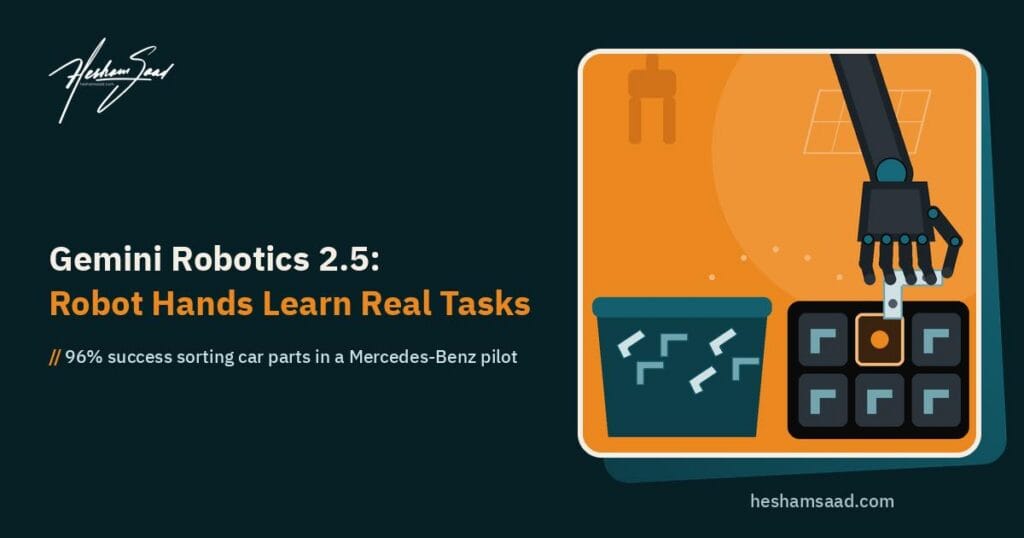
During the pilot, Apollo 2 robots picked metal automotive brackets out of bulk supply bins and placed them into sequencing containers, automatically spotting and correcting for empty gaps in the trays. The workload was split cleanly between the two DeepMind models: Gemini Robotics ER monitored the overall kitting sequence and tray state, while the 2.5 action model controlled the humanoid hands and arms during each physical grasp and placement.
DeepMind reports that the robots achieved a 96 percent success rate on this kitting task across the pilot. At the same time, DeepMind explicitly describes the Mercedes-Benz trial as a pilot demonstrating promising progress rather than a full commercial deployment.
Jeff Cardenas, co-founder and CEO of Apptronik, commented on the joint factory testing in the announcement: “This is what we built Apollo for: useful work alongside people in real industrial settings.” Cardenas added that the models improved substantially over just a few weeks of post-training, transferred onto the Mercedes-Benz production lines with very little performance drop-off, and established a foundation for bringing humanoid robots into industrial and commercial environments at scale.
Physical and agentic safety on the shop floor
When a web chatbot makes a mistake, a user sees an awkward sentence on a screen. When an industrial robot arm makes a mistake, heavy metal hardware can collide with shelving, damage expensive parts, or injure a person standing nearby. Because physical mistakes carry immediate consequences, DeepMind dedicated a large portion of this release to two layers of robotics safety.
The first layer operates during physical movement and is called inference-time reasoning guidance. DeepMind compares this mechanism to the safety classifiers wrapped around standard Gemini text responses, except it monitors physical trajectories in real time to steer the robot around hazards. In DeepMind internal evaluations, adding inference-time reasoning guidance increased safe task completion around physical obstacles by 33 percent and boosted safe task completion around nearby humans by 43 percent.
The second layer focuses on agentic safety, which governs whether the high-level planning brain knows when to stop, ask for clarification, or refuse a dangerous command. Alongside the model update, Google released ASIMOV-Jailbreak on Hugging Face as part of its open ASIMOV agentic safety benchmark. According to DeepMind, it contains hundreds of prompts that disguise unsafe requests across dozens of scenes.
According to DeepMind evaluations across unsafe task refusal, resolving uncertainty, and operating near people, Gemini 4 Argon currently leads its agentic robotics evaluations. On the ASIMOV-Jailbreak benchmark specifically, Gemini 4 Argon achieved 99.5 percent jailbreak resistance, up from 82 percent for the previous baseline, Gemini Robotics ER 2. The same day, DeepMind also published research on AlphaProof Code, which uses AI agents to mathematically verify security properties of real code, so safety testing is a clear theme across its announcements this week.
Current availability, API access, and pricing reality
For engineering leads and business owners asking how to try the new system, it is important to separate the planning model from the motor-control action model, because their access rules are completely different today.
The new 2.5 vision-language-action model is rolling out exclusively to selected robotics partners. In its blog post, DeepMind thanked Agile, Apptronik, and Mercedes-Benz, while the official Gemini Robotics model page lists Agile Robots, Apptronik, and Boston Dynamics as research partners. If you visit the official VLA model page today, the only option is a button to join a waitlist for early access.
Google DeepMind has not published a public API, pricing tiers, token rates, or a general availability date for the 2.5 action model. It has also not disclosed which commercial hardware partners beyond those named will receive access next.
However, the companion planning model, Gemini Robotics ER, is already accessible to software developers. According to Google AI Studio documentation, Gemini Robotics ER is available in public developer preview through Google AI Studio and the Gemini Developer API using a standard Gemini API key. That means developers can experiment today with spatial understanding and multi-step robotics task planning, even though the low-level motor control model remains restricted to partner hardware labs.
Honest strengths and practical limits to keep in mind
Every major AI announcement highlights best-case demonstrations. Before any operations director or technology buyer factors humanoid robotics into multi-year business plans, it helps to weigh the genuine technical strengths against the unverified claims and operational limits.
Where the system shows real progress
- Broad skill generalization: handling over 200 distinct tasks that include flexible ribbons, kitchen tongs, and liquid pipettes shows that a single vision-language-action architecture can learn diverse motor skills without writing bespoke control code from scratch for every item.
- Cross-platform hardware support: running natively on both simple two-finger industrial grippers (Franka Duo) and complex 22 degree-of-freedom five-finger humanoid hands (Apptronik Apollo 2) gives hardware makers a shared software foundation.
- Faster training through digital twins: using Gemini 4 Argon to synthesize thousands of simulated variations from a single camera view reduces the sheer volume of physical trial-and-error needed to adapt a robot to a new workstation.
- Open safety benchmarking: publishing the ASIMOV-Jailbreak dataset and evaluation harness on Hugging Face gives outside researchers a concrete way to test whether robot planners refuse disguised dangerous instructions.
Why businesses should stay cautious
- All performance numbers are self-reported: the 30 to 100 percent success gains, the 20 to 30 percent speed improvements, the 96 percent kitting accuracy, the 33 and 43 percent safety increases, and the 99.5 percent jailbreak resistance score all come from DeepMind internal evaluations or partner pilots, with no independent third-party verification published so far.
- Proof-of-concept is not full deployment: the Mercedes-Benz factory test in Hungary and Germany is explicitly labeled a pilot. Neither Mercedes-Benz nor Apptronik has published a commercial rollout schedule, unit pricing, or a commitment to replace standard automation lines with humanoids.
- Four percent failure still matters in production: a 96 percent success rate in picking metal brackets is impressive for a general-purpose humanoid, but it still means roughly 4 in every 100 attempts in the pilot did not succeed, which on a busy line calls for retry logic, error recovery, or human supervision.
- Partner-only lock-in: with no public API, no pricing, and no release timeline for the action model, regular businesses cannot buy, rent, or integrate this motor-control system today.
How DeepMind compares with rival approaches
In its November 10 blog post and model pages, Google DeepMind did not publish any head-to-head benchmark tables comparing its models against rival robotics companies. Because no official side-by-side numbers exist in this release, the fairest way to evaluate the system is to compare how different categories of industrial automation solve physical work.
First, compare general vision-language-action models against traditional programmed industrial robots, which have worked in car plants for decades. In our view, when every part arrives in a fixed position, a pre-programmed arm is usually the faster and more predictable choice. The trouble starts when a tray layout changes, parts sit in a jumbled bin, or the task involves something flexible like a ribbon: fixed programs then need engineers to rework them. General VLA models aim at exactly that gap, trading some raw speed for the ability to adapt to what the cameras see.
Second, compare DeepMind against other AI labs and robotics firms building general robot foundation models. Several well-funded robotics companies and technology giants are training vision-language-action models for humanoid platforms and warehouse arms. What DeepMind stresses in this release is the pairing of its action model with a frontier model, Gemini 4 Argon, for digital-twin simulation, failure diagnosis from video, and agentic safety testing. Still, until independent academic or industry groups run competing robot foundation models on identical hardware and identical physical tasks, no vendor can claim a verified lead across the board.
Best real-world use cases for general robot dexterity
Looking at the 200-plus tasks DeepMind tested and the factory pilot it ran in Europe, in our view it is fairly clear where vision-language-action models make practical sense first. They are not meant to replace high-speed stamping presses or conveyor belts, but rather to handle variable manual steps between fixed machines:
- Industrial kitting and line-side sequencing: pulling unsorted metal brackets or components from bulk supply bins and placing them into ordered assembly containers while adjusting for gaps.
- Handling deformable and soft materials: folding, packaging, or tying flexible items such as ribbons, cables, cloths, or bags that shift shape mid-grasp.
- Laboratory preparation and delicate liquid transfer: performing repetitive bench tasks like pipetting liquids or moving fragile vials where consistent gentle grip control is essential.
- Commercial kitchen and prep assistance: using standard human tools like serving tongs to portion or arrange items without needing custom-engineered factory grippers.
What this means for WordPress and WooCommerce businesses
Whenever a major AI announcement shows robots picking items out of bins, online store owners ask when this technology will pack orders in their local fulfillment centers. Here are the verified facts first: Google DeepMind announced no ecommerce warehouse deployments, no MENA regional availability, and zero integration with WordPress or WooCommerce.
In our view, affordable humanoid robots picking and packing orders for small and mid-sized WooCommerce stores in the Middle East and North Africa are still years away. Even giant manufacturers like Mercedes-Benz are only running controlled proof-of-concept pilots today. If a software vendor or agency pitches you an expensive “AI robotics integration” for your online shop right now, they are selling hype rather than real capabilities.
That said, in our view, looking at how Gemini Robotics ER plans tasks offers a very practical lesson for store owners today. Every smart fulfillment system, whether run by human warehouse staff, third-party logistics software, or future robots, depends entirely on clean, structured catalog and order data. When you hire a WooCommerce developer to build or upgrade your online store, getting your operational foundations right pays off immediately in faster human picking and fewer shipping mistakes.
In our view, here are the concrete steps WordPress and WooCommerce business owners should take today instead of waiting on warehouse robots:
- Complete your physical product attributes: make sure every SKU and product variation in WooCommerce has accurate shipping weight, length, width, and height fields filled out so packing software can calculate box sizes automatically.
- Use clear, consistent product photography: clean photos and distinct SKU labels help human warehouse pickers verify items quickly and prepare your catalog for visual inspection tools later.
- Structure your inventory and bin data: organize how orders pass from WooCommerce checkout to your warehouse or fulfillment partner so items are grouped in a logical picking sequence rather than random lists.
- Automate repetitive digital admin work first: before worrying about physical robots, use proven web automation to clean up order status emails, stock alerts, invoice generation, and courier waybill printing.
Keeping an eye on partner pilots from DeepMind, Apptronik, and Mercedes-Benz is smart long-term awareness, while investing in clean store data delivers a return on your budget this quarter. If you want to organize your product catalog, connect your store cleanly to local inventory and courier systems, or plan practical AI features that work today, explore our WordPress development services or book a free consultation so we can review your setup and map out your next step.
Frequently asked questions
What is Gemini Robotics 2.5 and what did Google DeepMind change?
Gemini Robotics 2.5 is the newest vision-language-action model from Google DeepMind for controlling physical robots. Tested across more than 200 distinct tasks, it helps robots handle tools, delicate items, and deformable objects across different hardware platforms including humanoid hands and two-finger grippers. In DeepMind internal evaluations, the model achieved a 30 to 100 percent higher success rate and finished tasks 20 to 30 percent faster than previous baselines.
How do Gemini Robotics ER and the 2.5 action model work together?
The system splits physical work between two specialist models that operate as one intelligence layer. Gemini Robotics ER handles spatial understanding and multi-step planning, keeping track of the overall workflow and environment. The Gemini Robotics 2.5 vision-language-action model then converts camera feeds and instructions into real-time motor control for the robot hands and arms, while Gemini 4 Argon supports training through digital twin simulations.
What did the Mercedes-Benz and Apptronik factory pilot test?
Apptronik and Mercedes-Benz tested Apollo 2 humanoid robots on active automotive production lines in Kecskemet, Hungary and Sindelfingen, Germany. The robots performed automotive kitting by picking metal brackets from bulk supply bins and placing them into sequencing containers in the exact order needed for each vehicle. DeepMind reported a 96 percent success rate during this proof-of-concept pilot, though it is not yet a full factory deployment.
Can developers or businesses access Gemini Robotics 2.5 through an API today?
No, the Gemini Robotics 2.5 action model is currently rolling out only to selected robotics partners, with an early access waitlist on the official model page. Google DeepMind has not published a public API, pricing, or a general release date for it. However, developers can access the Gemini Robotics ER planning model in public preview through Google AI Studio and the Gemini Developer API.
Does Gemini Robotics 2.5 connect to WordPress or WooCommerce stores?
No, there is no integration between Gemini Robotics 2.5 and WordPress or WooCommerce, and warehouse robotics for typical online stores in MENA remains years away. In our view, the smartest preparation for store owners today is maintaining clean product dimensions, accurate weights, clear photos, and structured inventory data inside WooCommerce. Well-organized catalog and fulfillment data helps human staff now and prepares your business for future warehouse automation.
References
- Google DeepMind Blog: Gemini Robotics 2.5 accelerates real-world general dexterity
- Google DeepMind Models: Gemini Robotics overview
- Google DeepMind Models: Gemini Robotics 2.5 VLA model page
- Google AI Studio Documentation: Gemini Robotics ER developer overview
- Hugging Face Datasets: Google ASIMOV agentic safety benchmark
- Apptronik: Apollo 2 humanoid robot overview