هذا المقال متوفر باللغة العربية — اقرأ بالعربية
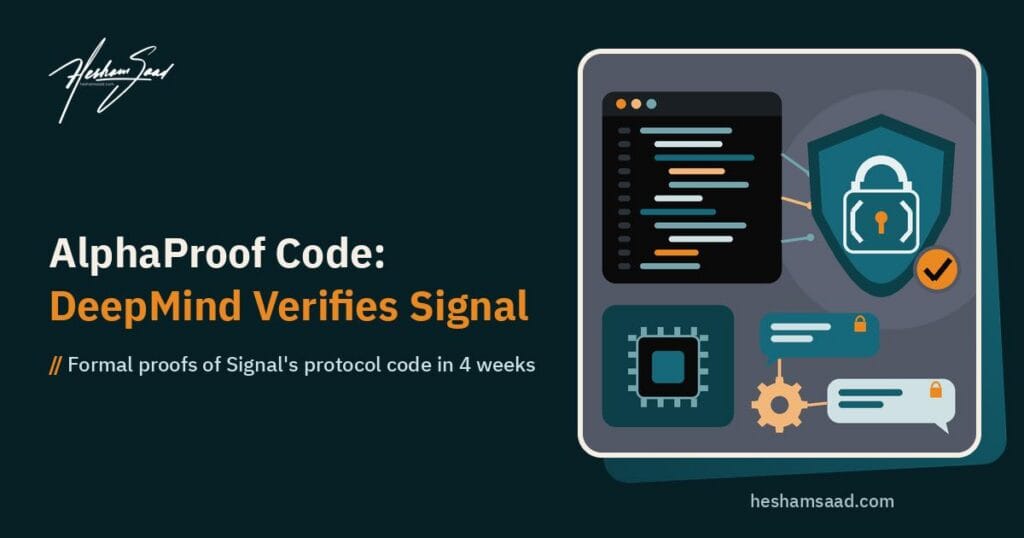
On November 10, 2026, Google DeepMind introduced AlphaProof Code, a research framework that pairs human experts with artificial intelligence agents to mathematically verify complex software at the machine-code level. In its first major demonstration, a five-person team used the framework to verify core security properties of the actual compiled code powering the Signal messaging protocol, which DeepMind notes protects billions of private conversations in apps like Signal and Google Messages.
Before looking at how the verification works, business owners and technical leads should understand what this announcement is and what it is not. DeepMind published a research milestone backed by a technical paper and open-source verification artifacts on GitHub, not a commercial product launch. There is no pricing, no public API, no sign-up page, and no availability date for businesses to buy or run it as a service.
Even though you cannot install this framework on your own servers today, the research marks an important shift in how critical software can be audited. Understanding what DeepMind proved, where its limits sit, and how mathematical proofs differ from automated bug hunting will help you make better decisions about software security and AI-generated code.
What AlphaProof Code is and how DeepMind built it
Introduced by Google DeepMind researchers Pushmeet Kohli and Swarat Chaudhuri alongside their verification team, the system is a multi-LLM agentic framework for formal verification. Instead of asking a single language model to guess whether a program is secure, the architecture divides the work like a specialized research team. Human experts work with AI models to define what needs to be proved, and a coordinated group of autonomous AI agents writes the mathematical proofs.
According to the technical paper, the framework brings together three core components. It uses a human-guided agent for writing formal specifications in the Lean proof assistant language, a formal mathematical semantics of AArch64 machine code, and a fleet of autonomous prover agents. Every candidate proof written by the agents is accepted only if Lean’s kernel checks it against the approved specification, and a gatekeeper step rejects any proof that alters the approved statements.
Because this work is a research project rather than a commercial tool, DeepMind did not release a hosted platform or disclose the compute cost of the four-week run. Instead, the team published the technical paper and open-sourced the verification artifacts on GitHub so cryptographers and researchers can inspect the proofs firsthand.
AlphaProof Code is not DeepMind’s only recent release. Gemini Robotics 2.5 applies Gemini models to physical robots, and in a pilot with Apptronik and Mercedes-Benz, DeepMind reports a 96 percent success rate sorting car parts.
Why formal verification matters and the gap between design and code
To see why security engineers care about this milestone, it helps to define formal verification in plain business terms. Standard software testing runs a program with sample inputs to check whether it crashes or produces wrong outputs in those scenarios. Formal verification uses mathematical logic to prove that code runs correctly across every condition covered by a specification, which is why DeepMind describes it as the highest standard of security assurance.
Because writing mathematical proofs for software has historically been slow and labor intensive, most protocol verification stops at the design level. Cryptographers write an abstract blueprint showing how an encryption handshake should work in theory, prove that the paper design is sound, and leave programmers to write the actual software.
As DeepMind points out, real vulnerabilities often hide in the gap between design and implementation. When a cryptographic protocol is written in source code and compiled into low-level processor instructions, subtle mistakes in memory handling, arithmetic, or state transitions can break the guarantees promised on paper. By verifying the compiled code running on devices, the researchers targeted the implementation gap directly.
How the three-step verification workflow operates
Verifying compiled production software requires millions of lines of formal logic, far more than a small human team could write by hand in a few weeks. DeepMind structured the workflow into three steps that combine human oversight with machine scale:
- Step 1, human plus model specifications reviewed by experts: Researchers worked in back-and-forth sessions with agents powered by Gemini 4 Carbon and Claude Opus 5.5 to translate Signal’s security goals into formal mathematical specifications, with an agent from a different model family reviewing drafts and human experts checking every specification.
- Step 2, proof generation by Gemini Carbon agents: Autonomous prover agents powered by Gemini Carbon wrote the mathematical proofs, generating over six million lines of Lean code (the technical paper reports about 6.5 million lines of machine-checked Lean proof code resting on roughly 26,000 lines of trusted specifications and
AArch64semantics). - Step 3, automated proof audit and human review: Agents audited the completed proof and flagged areas needing a second human look, amounting to about one percent of the codebase, while Lean automatically checked every proof for accuracy so experts could focus where human judgment matters most.
The technical paper highlights a lesson that applies well beyond cryptography: once AI makes writing proofs cheap, the hard question is deciding what to prove. Most of the five-person team’s effort over the four weeks went into writing and reviewing specifications, not into the proofs themselves.
What DeepMind proved about the Signal protocol implementation
For its verification target, DeepMind chose libsignal version v0.105.4, the reference implementation of the Signal protocol. Rather than stopping at the Rust source code, the team verified the compiled binary at the machine-code level for AArch64, the 64-bit ARM instruction set. Because the proofs apply directly to the compiled machine code, users do not need to trust the Rust compiler.
Within libsignal, the team verified one-to-one messaging sessions covering the post-quantum PQXDH handshake and the Triple Ratchet. According to the technical paper, the proofs established four core security properties:
- Forward secrecy, keeping earlier messages protected even if a device’s keys are exposed later.
- Post-compromise security, restoring protection for new messages after a temporary device compromise ends. Together with forward secrecy, this is what DeepMind means by keeping messages protected before and after a device is temporarily compromised.
- Authentication, ensuring participants are communicating with the intended party.
- Handshake secrecy, keeping the shared secret agreed during the PQXDH exchange away from attackers.
To test whether the system could catch real implementation flaws, the researchers reintroduced two real, previously fixed bugs into an isolated version of Signal’s code. In both cases, the framework produced a machine-checked proof demonstrating that the buggy version was insecure.
Four weeks versus years of traditional verification effort
Aside from verifying compiled machine code, the major headline is speed. A team of five completed the Signal verification in four weeks, work that DeepMind says historically takes expert teams years to finish.
To put that timeline in perspective, the technical paper cites two classic formal verification projects. Formally verifying the seL4 operating system microkernel took about twenty person-years of effort, while the CompCert verified C compiler took six person-years. Completing 6.5 million lines of machine-checked proofs in four weeks illustrates how autonomous agents can compress the proof-writing phase.
Ehren Kret, Chief Technology Officer of Signal, welcomed the work: “While prior formal verification work has necessarily focused on smaller scopes, this new approach enables a significant expansion.” Kret also said that using AI agents to turn live production code into valid Lean theorems is a major breakthrough, and that as AI-driven security threats grow, the verification gives Signal greater confidence that its code delivers on its privacy guarantees.
DeepMind makes two broad claims about the milestone. According to DeepMind, this is the first time AI has been used to formally verify a widely deployed cryptographic protocol at this depth, and the first time the implementation of such a widely deployed protocol has been formally verified by any method, with or without AI.
Practical strengths and current limitations to keep in mind
The primary strength of this architecture is that a wrong or invented proof step cannot pass the verifier, as long as the specification and the trusted base are right. Lean’s kernel mathematically checks every logical step against the approved specification, and the gatekeeper blocks any proof that tries to change the theorem statement.
At the same time, the technical paper and blog outline clear limits that business decision-makers and engineers should keep in mind:
- Heavy reliance on human expertise: The approach requires human-written and human-reviewed specifications plus deep Lean expertise, totaling about 26,000 lines of trusted code and semantics in this project.
- Limited protocol scope: The verification covered only one-to-one sessions in
libsignalv0.105.4 onAArch64; group messaging, sealed sender, and server-side protocols were left out of scope. - Classical security theorem: The paper notes that its computational theorem is classical, meaning it does not prove the post-quantum healing property that SPQR is designed for, and the model includes some simplifications.
- Remaining trust assumptions: While the Rust compiler is not trusted, readers must still trust Lean itself, the
AArch64semantics, the approved specifications, and contracts for cryptographic primitives and library routines. - No independent audit yet: The scope and speed claims are DeepMind’s own, and while the proofs are open on GitHub for review, no independent third-party audit of the claims has been published yet.
How proof generation compares with bug hunting and static analysis
For engineering managers comparing security approaches, it helps to see how agentic formal verification differs from existing tools. Traditional expert-team formal verification offers mathematical certainty, as with seL4 and CompCert, but taking six to twenty person-years puts it out of reach for almost all commercial projects. Conversely, fuzzing and static analysis are fast and practical for daily code checks, yet they only test sampled inputs or known patterns and cannot prove that a protocol implementation is free of logical flaws.
A third category is AI code security agents that hunt for and patch bugs. In October 2025, DeepMind introduced CodeMender, a research agent that uses static analysis, dynamic analysis, differential testing, fuzzing, and SMT solvers to find vulnerabilities and proactively rewrite code, validating patches before surfacing them for human review. Model makers are also handling cyber capability with care: Anthropic, for example, keeps strong cyber safeguards on its public model and reserves its strongest cyber use for verified organizations, as we covered in our post on Claude Fable and Mythos 5.2.
The difference comes down to bug fixing versus mathematical proof. CodeMender finds and fixes bugs, whereas this verification framework proves that compiled code meets formal mathematical properties against a specification. DeepMind notes that pairing automated defense agents like CodeMender with formal verification can help counter the speed and scale of modern cyber threats.
Where machine-checked code proofs make the most sense
Because writing and reviewing 26,000 lines of formal specifications takes specialized talent, machine-checked proofs are best suited for high-stakes foundational software rather than everyday marketing websites. In our view, with DeepMind’s own examples marked, the strongest use cases include:
- Cryptographic libraries and messaging protocols where a single state flaw exposes private data at scale.
- Payment processing and authentication libraries that protect financial transactions and identity tokens (our view).
- Medical device firmware, which DeepMind names as a future target, along with other embedded systems where software errors create physical safety risks.
- Critical infrastructure and power grid software, which DeepMind highlights as a long-term goal as the research scales.
What this research means for WordPress sites and businesses
If you run a business website or WooCommerce store, here is the plain answer: WordPress plugins, themes, PHP, and JavaScript are not covered by this research, and nothing in DeepMind’s release applies Lean verification to WordPress. However, in our view as a WordPress agency, the way DeepMind structured this project holds an important lesson for every business owner paying for web development today.
In our view, the core takeaway is about how much trust you place in AI-written code. Even Google DeepMind did not trust AI models to verify security on their own; they required human experts to approve every specification, audited flagged sections manually, and forced every line of agent output through Lean’s strict verification kernel. When freelance developers or agencies paste unreviewed AI-generated PHP into your WordPress site, there is no mathematical kernel catching hidden logic flaws.
In our view, WordPress business owners face their highest security exposure from the plugin supply chain and server-level flaws, such as the php2shell PHP vulnerability, two critical PHP flaws that put WordPress sites on unpatched servers at risk. Rather than waiting for futuristic formal proofs, we recommend protecting your business today with practical engineering habits:
- Prefer well-maintained plugins with a clear security history and avoid installing dozens of overlapping add-ons.
- Schedule a periodic WordPress security audit to inspect custom code, user permissions, and server configurations.
- Test every core and plugin update on a staging site with daily off-site backups under a structured WordPress care plan.
- Require human code review by a senior developer whenever AI coding tools are used on your project.
How to evaluate a development partner in the age of AI code
In our view, when you interview a developer or agency for your next project, you should ask how they verify AI-generated code before it reaches production. Ask whether a human engineer reviews every custom function against clear security rules, how they test checkout and authentication flows on staging, and how they keep third-party plugins to a minimum.
If you want a fast, secure site built with disciplined human engineering and clear accountability, explore our WordPress development services or book a free consultation to review your current website architecture and security posture.
Frequently asked questions
What is AlphaProof Code and is it a commercial product?
AlphaProof Code is a research framework created by Google DeepMind that combines human experts with AI agents to mathematically verify software security at the machine-code level. It is a scientific milestone and a set of open-source verification artifacts rather than a commercial product. DeepMind has not announced any pricing, public API, sign-up page, or release date for businesses to buy or use it directly.
How does AlphaProof Code verify software in three steps?
First, researchers work with AI models to translate security goals into formal mathematical specifications, and human experts review every specification. Second, autonomous prover agents powered by Gemini Carbon write over six million lines of proof code in the Lean language. Third, agents audit the proofs and flag about one percent of the codebase for a second human review, while Lean automatically checks every proof for mathematical accuracy.
What did DeepMind prove about the Signal messaging protocol?
DeepMind verified compiled AArch64 machine code for one-to-one sessions in libsignal version v0.105.4, covering the PQXDH handshake and the Triple Ratchet. The proofs confirmed forward secrecy, authentication, handshake secrecy, and post-compromise security, which protects messages before and after a temporary device compromise. When researchers reintroduced two previously fixed bugs into an isolated test copy, the system produced machine-checked proofs showing that the buggy code was insecure.
Can developers inspect or run the Signal verification proofs today?
Yes, developers and researchers can inspect the formal verification artifacts and read the technical paper because Google DeepMind published them in an open-source repository on GitHub. However, there is no hosted service or general-purpose tool you can point at your own software automatically. Using this approach requires writing thousands of lines of trusted mathematical specifications in Lean and having human experts review every statement.
Does AlphaProof Code verify WordPress plugins or PHP websites?
No, the research only verified compiled AArch64 machine code for the Signal protocol library and does not support PHP, JavaScript, or WordPress plugins. In our view, the main takeaway for WordPress site owners is that AI-generated code should never be trusted without independent verification and human review. You can protect your site today through careful plugin selection, regular security audits, staging tests, and reliable off-site backups.
References
- Google DeepMind: Introducing AlphaProof Code, a breakthrough in verifying complex software at depth
- Google DeepMind Technical Paper: AlphaProof Code, Verifying Signal’s Security at the Machine-Code Level
- GitHub: google-deepmind/code-verification Open-Source Artifacts
- Google DeepMind: Introducing CodeMender, an AI agent for code security
- Lean Programming Language and Proof Assistant