هذا المقال متوفر باللغة العربية — اقرأ بالعربية
Planning a coffee roastery website WooCommerce build for Saudi Arabia, the UAE or Egypt requires designing around freshness, repeat orders and two very different buyer groups. Specialty coffee drinkers judge your brand by roast dates, exact grind compatibility for their brewer and effortless recurring deliveries, while cafes and offices expect fast wholesale reorders at tiered kilo pricing. When a developer treats roasted beans like generic packaged groceries, you end up with fragmented stock counts, stale courier delays and abandoned mobile checkouts. Understanding how WooCommerce models subscriptions, grind variations, origin filters and wholesale portals lets you scope the right build from day one.
What a coffee roastery website WooCommerce build needs
Specialty roasters outgrow basic templates faster than general food brands because coffee has a tight shelf-life clock and high repeat purchase frequency. Just as a bakery website on WordPress balances daily production batches with pre-order cutoffs, a roastery store has to connect online orders directly to roast schedules and packing benches. If you are deciding between hosted builders and WordPress, our breakdown of WooCommerce versus Shopify explains why WooCommerce gives roasters cleaner ownership over subscription logic and regional payment integrations.
- Recurring bean subscriptions with customer self-service for pausing, skipping or changing frequency.
- Grind size selection across whole bean, espresso, V60, Chemex and Turkish without breaking roasted bag inventory.
- Structured origin attributes covering altitude, processing method, tasting notes and SCA cupping score.
- A gated B2B wholesale portal for cafes, restaurants and offices with volume tiers and bulk order forms.
- Express shipping zones matched to roast days alongside fast mobile checkout with Mada, Paymob and Apple Pay.
Recurring coffee bean subscriptions that cut churn
Subscriptions turn one-off specialty buyers into predictable weekly roasting volume. According to the official WooCommerce Subscriptions product page, it is a paid annual extension with a 30-day money-back guarantee, and supports daily, weekly, monthly or custom intervals such as every two weeks. That flexibility fits different consumption habits across MENA, for example a home brewer reordering a 250-gram bag every two weeks or an office scheduling monthly multi-kilogram deliveries.
Self-service reduces support tickets. Through the subscriber account view documented in the WooCommerce Subscriptions guide, customers can upgrade, downgrade, suspend or cancel plans, change shipping addresses and update saved cards directly inside My Account. Built-in failed-payment retry rules recover involuntary churn when a debit card hits a temporary limit, and mixed-cart support lets shoppers add a V60 dripper or ceramic server alongside a recurring bean plan in one checkout.
\n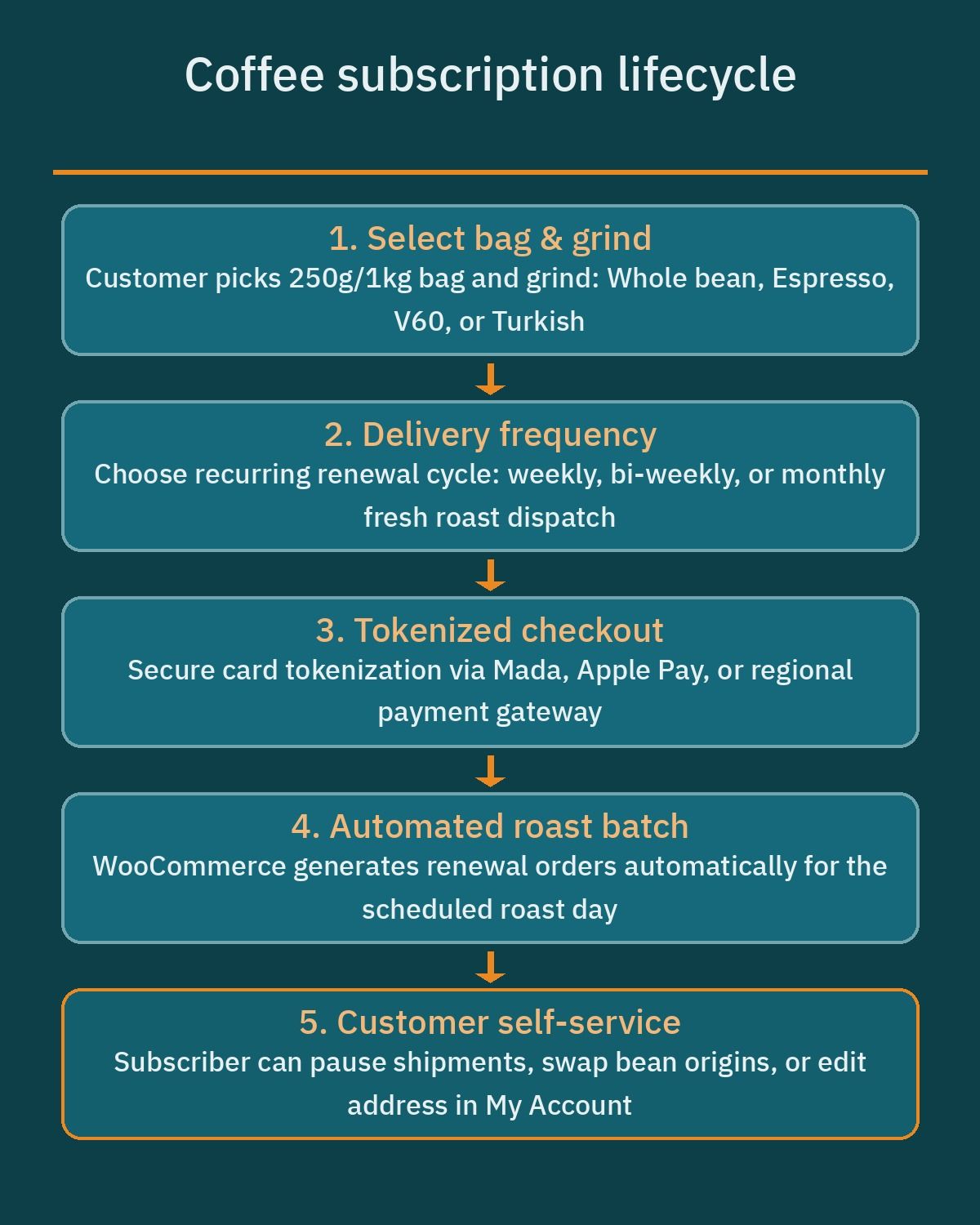
Pay close attention to payment compatibility when scoping subscriptions. Automatic renewals work only with payment gateways that support payment tokenization, while non-tokenized local methods rely on manual renewal invoices and email reminders. Your WordPress development partner should confirm with your payment provider before launch which local card rails support automated recurring charges versus invoice-based renewals.
Grind size variations, bag weights and roast dates
A common catalog mistake is creating five separate inventory variations per bag size for Whole Bean, Espresso, V60, Chemex and Turkish grind. In reality, your roastery holds roasted 250-gram, 500-gram or 1-kilogram bags in stock and grinds them to order right before sealing. If you track stock separately on every grind variation, WooCommerce tells a V60 customer you are sold out even when twenty whole-bean bags are sitting on the packing shelf.
Instead, structure inventory carefully around WooCommerce variable products or add-on selectors. Keep Bag Weight as the stocked variation attribute so inventory deducts from the roasted 250g or 1kg pool, and capture Grind Type either as a non-stock-managed attribute option or via Product Add-Ons. That keeps warehouse counts accurate while still printing the exact grind instruction on every packing slip.
Roast dates deserve equal visibility. Displaying the last roast batch date or next scheduled roast day on the product card reassures specialty buyers that bags are not sitting in a warm warehouse for months. If you sell both retail coffee and pantry staples or pastries, the batch and freshness workflows in our supermarket WooCommerce guide show how grocery catalogs handle date-sensitive items cleanly.
Bean origin attributes that help buyers choose
Coffee drinkers compare origins the way book buyers compare genres, yet many online roasteries bury tasting notes and processing methods inside long unstructured paragraphs. Using global WooCommerce attributes turns origin metadata into clean filter sidebars and comparison tables without creating unnecessary product variations.
- Origin and farm details: Single Origin versus Blend, producing country, region and farm or washing station.
- Process and altitude: Washed, Natural, Honey or Anaerobic fermentation paired with elevation in meters above sea level.
- Flavor and cup profile: Clear tasting notes, roast level and SCA cupping score when verified by your Q-grader.
- Brew suitability: Recommended filter, espresso or Turkish preparation icons so casual buyers pick confidently.
Keep attribute values normalized across your catalog. If one product lists “Ethiopia” and another lists “Ethiopian”, sidebar filters split into duplicate counts and confuse shoppers. Clean attribute taxonomy also strengthens internal search and category landing pages on bilingual Arabic and English sites.
B2B cafe wholesale portal and tiered quantity pricing
Many MENA specialty roasteries sell both direct-to-consumer bags and wholesale volume to cafes, hotels, dessert bars and corporate offices ordering multi-kilogram valve bags or case lots. Running wholesale on WhatsApp spreadsheets creates billing errors and forces staff to answer late-night stock questions. Putting wholesale inside the same WooCommerce database lets approved cafes log in and order against live roasted stock.
Official solutions such as Wholesale for WooCommerce or modular suites built around WooCommerce Wholesale Prices handle separate B2B user roles, approval queues for commercial registration checks, and tiered quantity pricing by kilogram bracket. You can hide 250-gram retail promo packs from cafe accounts while showing wholesale-only espresso blends, enforcing minimum case quantities and restricting bank transfer or Net-invoice terms strictly to vetted B2B roles.
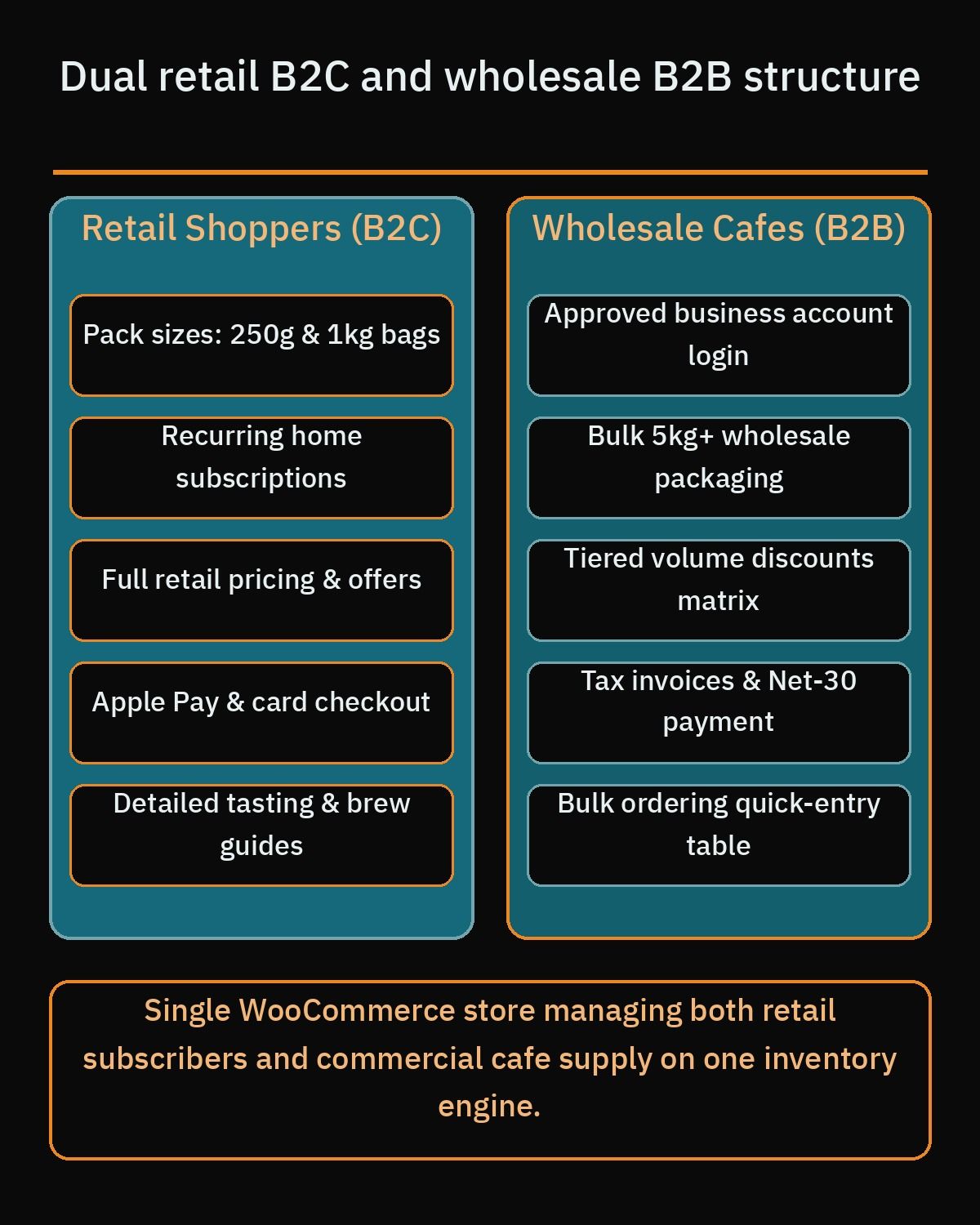
Include a fast tabular reorder form for returning baristas. A cafe manager restocking multiple blends does not want to click through separate product pages one by one; a single-screen matrix where they enter kilo counts per blend makes bulk reordering much faster.
Fresh roast express shipping zones
Roasted coffee loses peak aromatics quickly if parcels sit in non-air-conditioned transit hubs over the weekend. Organize WooCommerce Shipping Zones around express next-day coverage for your home city, temperature-controlled regional couriers across major Saudi, UAE or Egyptian urban centers, and clear dispatch cutoff banners tied to your roast schedule.
For example, if your roastery roasts on Sundays and Wednesdays, state clearly at checkout that orders placed before 11:00 ship the same roast cycle, while Thursday orders dispatch with Sunday’s fresh batch rather than waiting in a courier depot on Friday. To connect local shipping methods cleanly, see our guide on WooCommerce courier plugins for Egypt and Saudi Arabia alongside our framework for WooCommerce shipping zones in Egypt and the Gulf.
Mada, Paymob, Apple Pay and mobile checkout speed
Retail coffee shoppers frequently browse and reorder from their phones. Integrating Moyasar for WooCommerce or Paymob for WooCommerce gives Saudi, UAE and Egyptian shoppers familiar local payment rails including Mada debit cards, Visa, Mastercard, mobile wallets and Apple Pay. Remember that Mada acquiring and Apple Pay require full HTTPS across your site plus hosting your gateway’s Apple Pay domain verification file inside the well-known server path.
Checkout friction kills impulse bag purchases faster than shipping fees. Using the block-based WooCommerce Checkout Block reduces unnecessary form fields, keeps Apple Pay express buttons prominent on mobile Safari and updates shipping rates dynamically as buyers switch zones. Pair streamlined checkout fields with the server and asset optimizations in our guide to speed up WordPress Arabic sites so bilingual shoppers move from product page to order confirmation without waiting on heavy scripts.
What drives development cost for a coffee roastery store
Roastery project budgets vary widely depending on whether you are launching a focused direct-to-consumer bean brand or unifying consumer subscriptions and cafe wholesale on one platform. The table below outlines the main cost drivers to include in your developer brief.
| Scope area | Boutique retail roastery | Subscriptions plus B2B cafe platform |
|---|---|---|
| Catalog and attributes | Focused origin lineup with bag size and grind options | Full single-origin archive, roast schedule tags and tasting filters |
| Subscriptions | One-time sales or basic recurring bundle | WooCommerce Subscriptions with skip, pause and grind swaps |
| Wholesale B2B | Handled manually outside the site | Approved cafe roles, 5kg tiered pricing and fast bulk order form |
| Shipping and fulfillment | Standard city zones and one courier plugin | Roast-cutoff rules, express city zones and B2B pallet/van routing |
| Payments and mobile | Paymob or Moyasar standard checkout | Mada, Apple Pay express checkout, tokenized renewals and invoice terms |
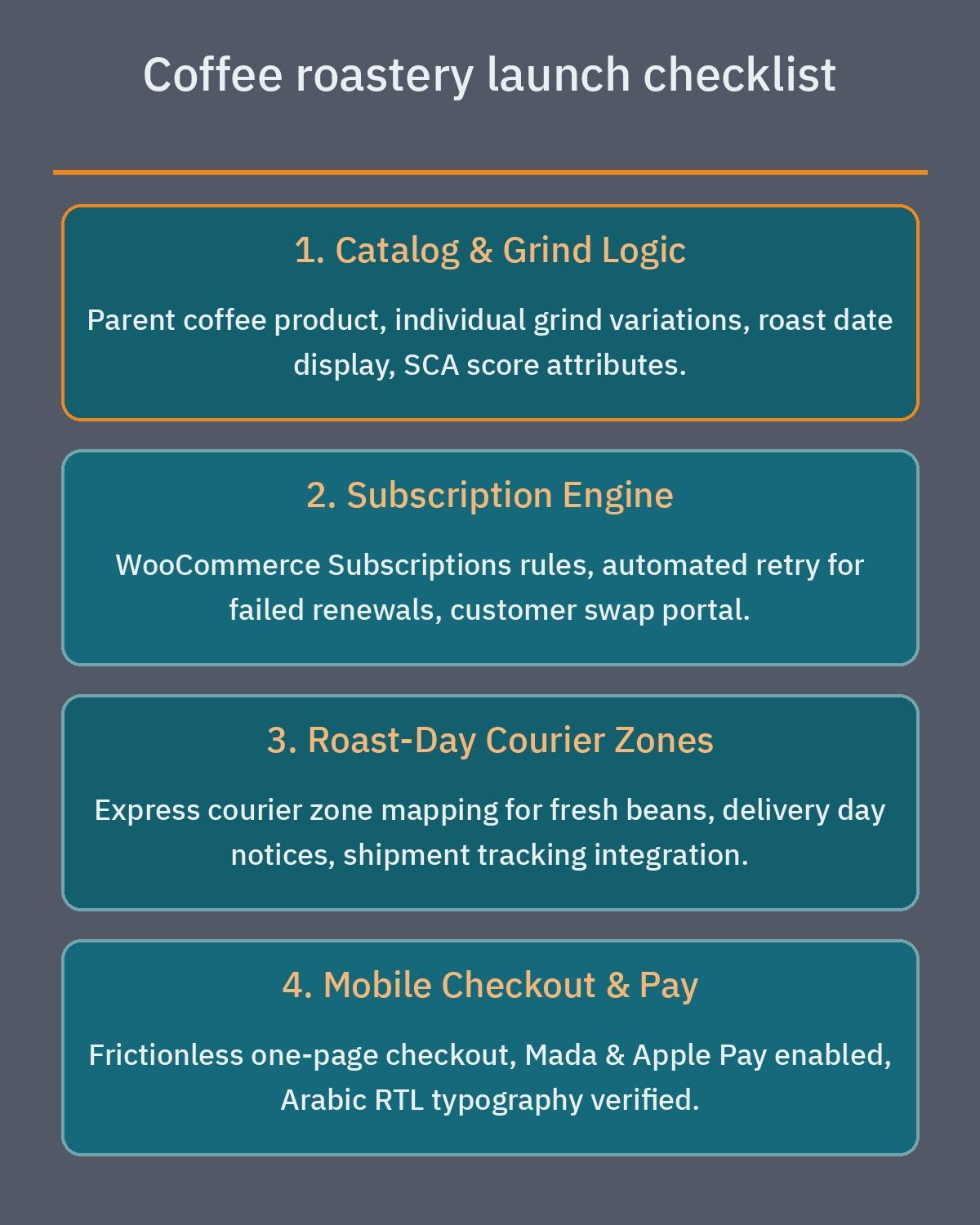
Before requesting build quotes for a coffee roastery website WooCommerce launch, prepare a one-page brief listing your active origins, bag weights, grind options, roast days and whether cafes need tiered wholesale logins at launch or in phase two. When that brief is ready, book a free consultation with our team so we can review your subscription gateway compatibility, wholesale pricing rules and mobile checkout architecture before development begins.
Frequently asked questions
How should a WooCommerce roastery track stock across multiple grind types?
Track stock by bag weight such as 250g or 1kg rather than creating separate stocked variations for every grind type. Capture Whole Bean, Espresso, V60, Chemex or Turkish grind using a non-stock attribute or Product Add-Ons selector so all orders pull from one roasted bag pool and print the grind clearly on packing slips.
Can customers pause or skip weekly and monthly coffee subscriptions themselves?
Yes, WooCommerce Subscriptions lets subscribers manage active plans directly inside My Account. Customers can pause, suspend, upgrade, downgrade or update their shipping address and payment card without contacting support, while supporting weekly, bi-weekly, monthly or custom roast delivery cycles and automatic payment retries.
Can retail shoppers and wholesale cafes share one WooCommerce store?
Yes, wholesale plugins such as Wholesale for WooCommerce or WooCommerce Wholesale Prices run B2B and retail buyers on one catalog. Approved cafe accounts see tiered kilo discounts, 5kg wholesale bags, minimum order rules and invoice payment options, while retail visitors see standard consumer pricing and subscriptions.
What is required to accept Mada, Paymob and Apple Pay on WooCommerce?
Your store needs an active merchant account with a regional gateway such as Moyasar or Paymob, Mada acquiring enabled on your account, full HTTPS across the domain and an Apple Pay domain verification file hosted on your server. Also confirm whether your chosen gateway supports tokenized cards for automatic subscription renewals.
How do roasteries prevent coffee bags from sitting in courier hubs over the weekend?
Pair WooCommerce Shipping Zones for express next-day city delivery with clear roast-day cutoff notices at checkout. Publishing your fixed roast and dispatch days tells buyers when late-week orders ship with the next fresh roast batch instead of waiting in warm regional transit hubs over the weekend.
References
- WooCommerce Subscriptions, WooCommerce Marketplace
- Introduction to WooCommerce Subscriptions, WooCommerce Documentation
- Variable Product Documentation, WooCommerce
- Product Add-Ons for WooCommerce, WooCommerce Marketplace
- Wholesale for WooCommerce Documentation, WooCommerce
- WooCommerce Wholesale Prices, WordPress.org
- Setting up Shipping Zones, WooCommerce
- Moyasar for WooCommerce, WordPress.org
- Paymob for WooCommerce, WordPress.org
- WooCommerce Checkout Block Documentation, WooCommerce