هذا المقال متوفر باللغة العربية — اقرأ بالعربية
Customers booking a residential cleaner or requesting a commercial facility proposal in Saudi Arabia, the UAE, or Egypt rarely want to wait half a day for someone on WhatsApp to ask how many bedrooms they have. A well-structured cleaning services website WordPress build turns those repetitive pre-sale questions into a guided online flow that calculates labor hours, checks crew availability in the caller’s district, and collects payment or qualifies a site visit automatically.
Cleaning businesses rarely sell a single service. An hourly maid agency, a deep-cleaning and sofa-steam crew, a pest-control team, and a B2B facility-management contractor all have distinct pricing rules, equipment needs, and approval steps. Forcing every inquiry through one generic contact form leaves dispatchers sorting incomplete messages while ready-to-pay homeowners book elsewhere.
Planning a cleaning services website WordPress architecture
Before installing plugins or laying out landing pages, divide your site into two conversion paths: self-serve residential checkout and commercial or post-construction RFQ intake. Homeowners booking a four-hour maid visit, mattress sanitization, or kitchen deep clean expect transparent pricing, an open arrival window, and fast mobile checkout. Facility managers, compound supervisors, and general contractors expect scope checklists, safety credentials, site inspection booking, and formal VAT proposals.
This split workflow explains why growing operators in the Gulf and Egypt choose a custom WordPress development architecture paired with WooCommerce over closed SaaS store platforms. Hosted storefronts handle fixed-price physical goods well, as explained in our WooCommerce vs Shopify comparison, whereas cleaning operations depend on labor-hour formulas, district travel buffers, crew calendars, and B2B tender portals inside your own database.
Structure your navigation so each audience reaches its booking path in one click:
- Residential service pages: Dedicated pages for regular housekeeping, deep cleaning, sofa and carpet steam care, AC duct sanitization, and pest control feeding into the instant estimator.
- Recurring plan hub: A clear overview explaining weekly, biweekly, and monthly maid subscriptions, rescheduling cutoffs, and team consistency.
- Commercial and handover portal: Sector pages for offices, residential compounds, retail spaces, clinics, and post-construction cleanup anchored by a structured RFQ and inspection scheduler.
- Coverage and compliance pages: City district directories, staff vetting policies, equipment standards, and Arabic plus English VAT invoicing terms.
Building an instant price and duration estimator
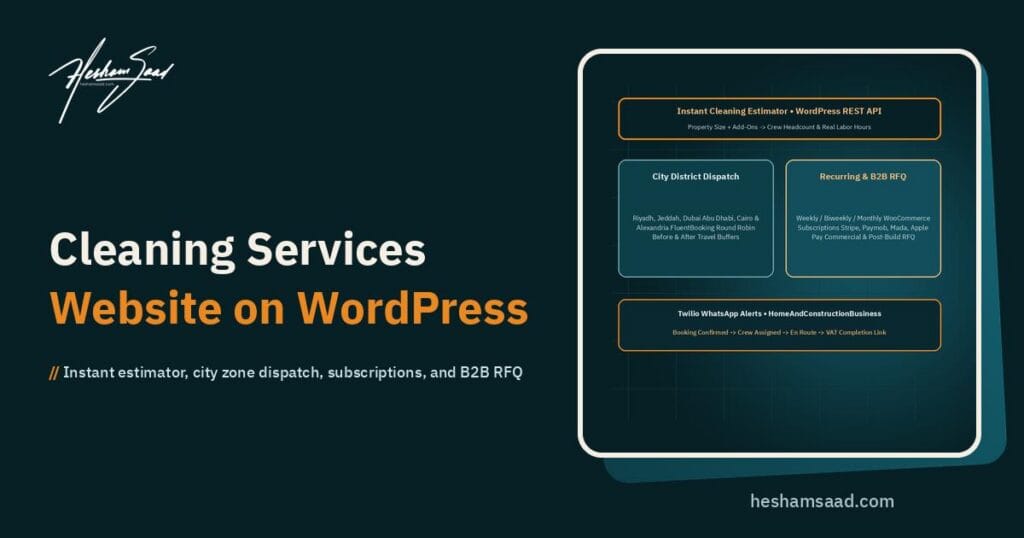
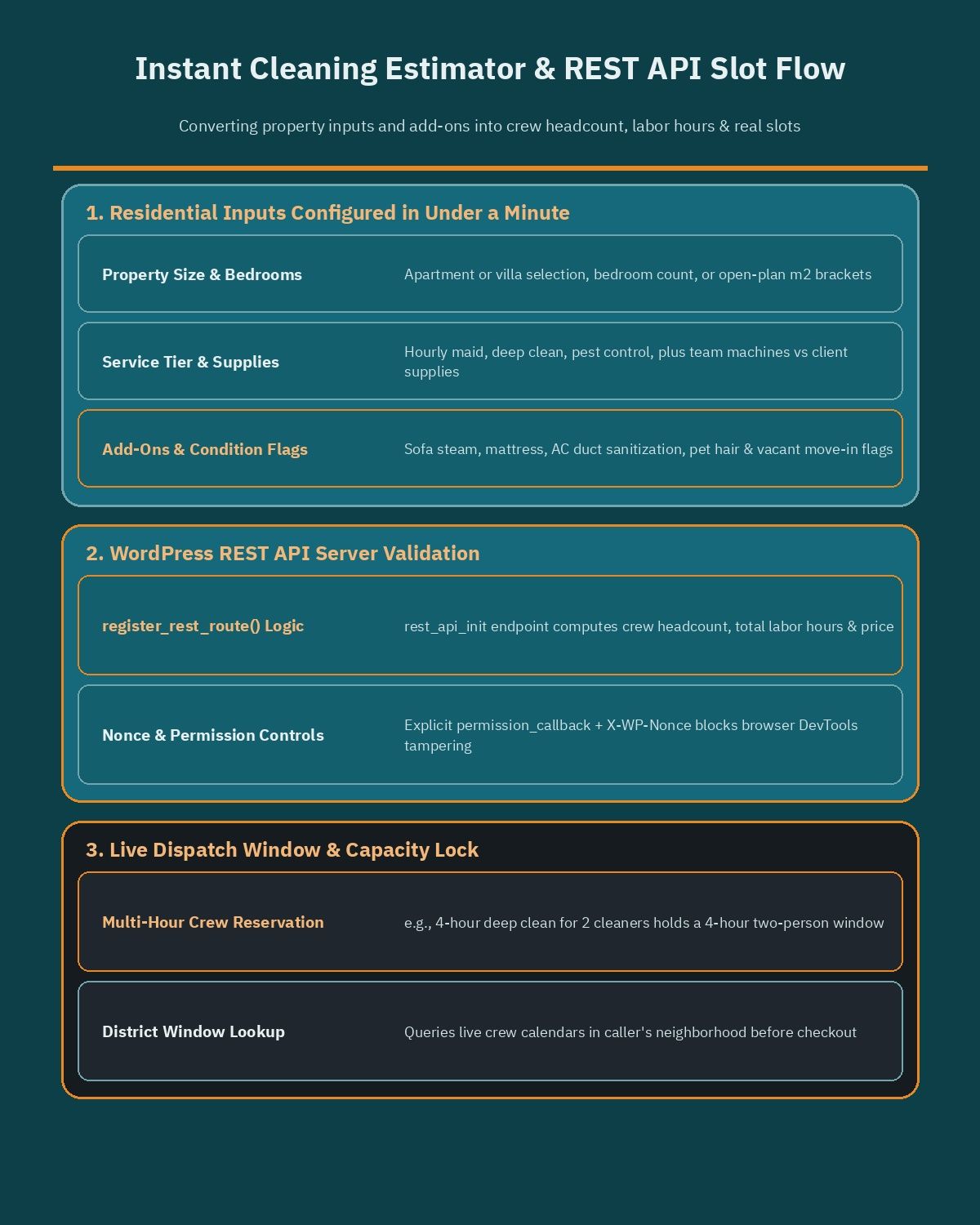
Static price lists fail in cleaning because a three-bedroom apartment takes very different labor than a villa with marble stairs, post-renovation dust, and heavy upholstery. An instant estimator lets the customer configure their scope in under a minute while calculating two operational numbers your dispatchers need: crew headcount and total service hours.
Inputs that determine crew size, hours, and add-ons
Keep estimator inputs plain so a homeowner can answer without measuring rooms. Start with the service category, because standard maid visits, deep cleans, post-construction debris removal, and pest treatments use different time formulas and equipment kits.
- Property footprint: Apartment or villa selection with bedroom count, or approximate square-meter brackets for open-plan homes and small offices.
- Crew and supply options: Cleaner count for hourly packages, plus whether the team brings vacuum units, steam machines, and cleaning agents or uses client supplies.
- Targeted add-ons: Seat-based sofa steam cleaning, mattress extraction, balcony pressure washing, oven and fridge degreasing, AC duct sanitization, or preventive pest control.
- Condition flags: Simple toggles for pet hair, post-event cleanup, or vacant move-in status so extra labor hours are added before payment.
Connecting estimator math to WordPress REST API and booking slots
Many sites build a JavaScript calculator that emails an unverified quote instead of reserving real capacity. If a homeowner selects a four-hour deep clean requiring two cleaners at 10:00 AM, the scheduler must hold a four-hour window on a two-person crew calendar rather than a generic thirty-minute slot.
Using custom endpoints built on the WordPress REST API via register_rest_route() on rest_api_init, your front-end calculator validates pricing on the server and checks live crew availability. Every custom endpoint must declare an explicit permission_callback (such as __return_true for public quote lookups or capability checks for internal dispatch updates) and pair browser session requests with an X-WP-Nonce header so visitors cannot alter prices in browser developer tools before checkout.
Service-zone and district dispatch rules for MENA cities
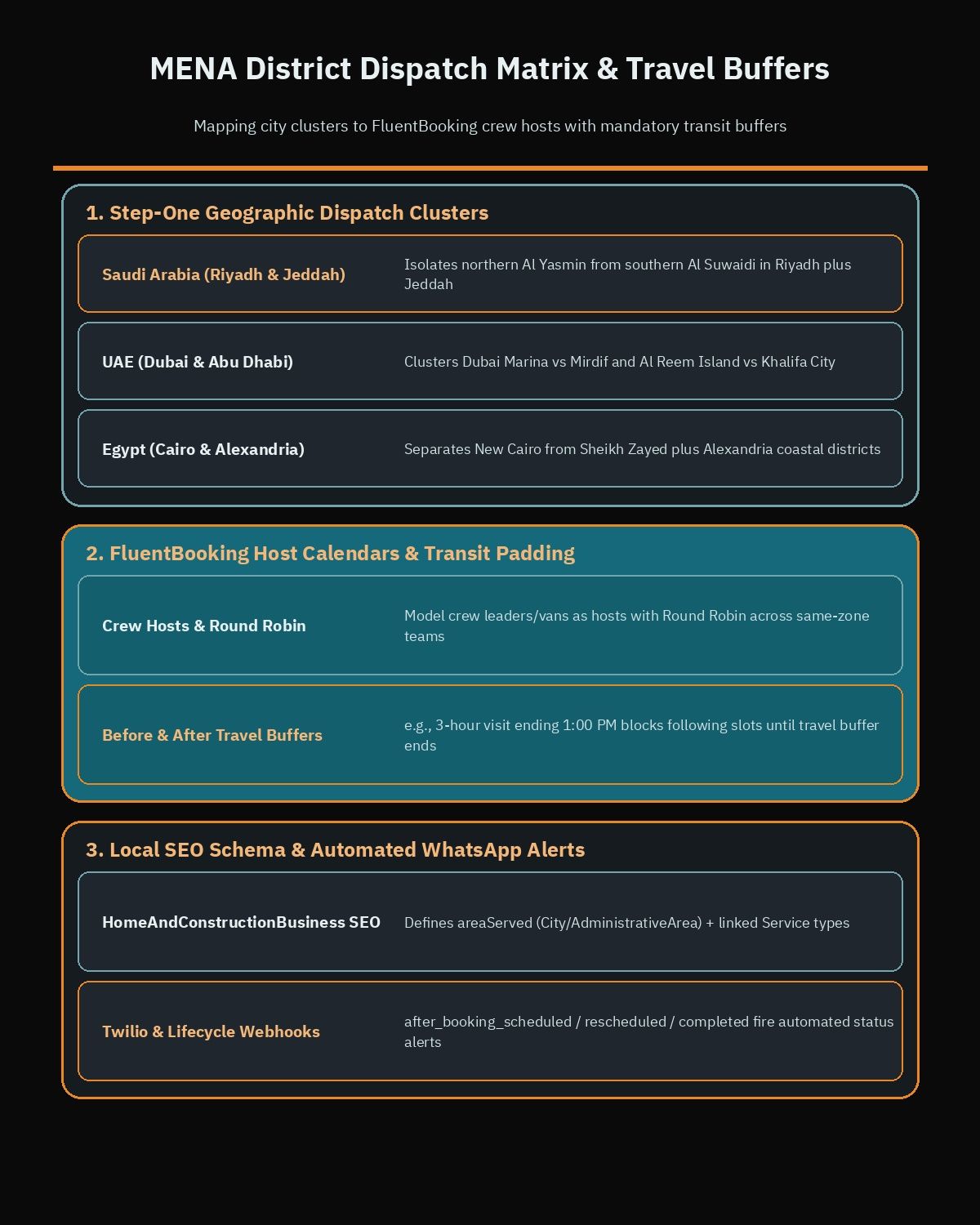
Traffic across major MENA metro areas breaks naive calendar booking. A crew finishing a morning job in Al Yasmin in northern Riyadh cannot reliably reach Al Suwaidi in the south thirty minutes later, and a team in New Cairo cannot cross town to Sheikh Zayed between two four-hour visits. The same geographic split shapes scheduling between Dubai Marina and Mirdif, across Al Reem Island and Khalifa City in Abu Dhabi, and along Alexandria’s coastal districts.
Your booking layer needs geographic zone grouping and travel buffers before any slot is displayed. First, divide each city into dispatch clusters so visitors pick their city and neighborhood at step one, filtering which crew calendars can serve that address. Second, enforce mandatory preparation and transit padding around every booked visit.
Inside FluentBooking, you can model crew leaders or mobile teams as individual hosts, apply Round Robin distribution across teams serving the same district cluster, and set dedicated before and after buffer times under each event’s Availability and Limits settings. When a three-hour maid visit ends at 1:00 PM, an automatic sixty-minute post-visit buffer blocks the next slot until 2:00 PM so the van has realistic transit and equipment-reset time.
| Service line | Primary pricing logic | Dispatch and buffer rule | Booking and billing path |
|---|---|---|---|
| Hourly maid service | Hours multiplied by cleaner count and supply tier | City district cluster with fixed travel buffer between visits | Instant slot selection plus card or recurring subscription checkout |
| Deep cleaning and sofa steam | Bedrooms or square meters plus per-item upholstery add-ons | Half-day or full-day block for specialized machine crew | Instant deposit or full WooCommerce checkout linked to slot |
| Pest control treatment | Property size, pest category, and follow-up warranty visit | Licensed technician calendar with safety prep notes | Instant booking with pre-visit checklist and VAT receipt |
| Post-construction cleanup | Square meters, debris stage, glass and facade access | Dedicated multi-person handover crew and supervisor walk-through | RFQ form plus site-visit booking and staged B2B invoicing |
| Commercial facility contracts | Headcount, shift schedule, consumables, and SLA frequency | Fixed site team outside public residential pool | B2B tender intake, inspection booking, and monthly billing |
One-time bookings vs recurring cleaning subscriptions
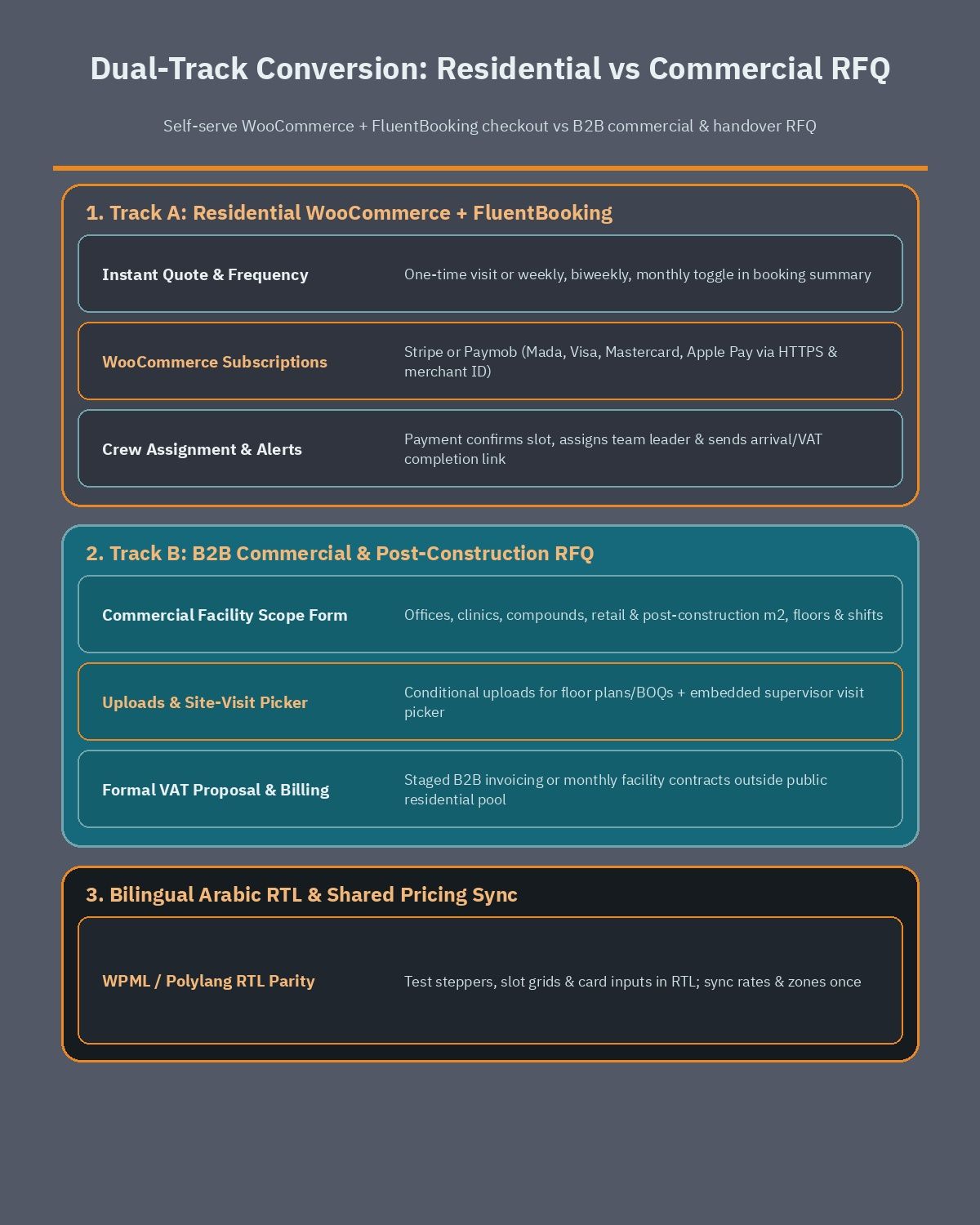
Single visits acquire new households, while recurring weekly, biweekly, or monthly plans build predictable revenue. Supporting both options on one home cleaning booking website WordPress platform means presenting the frequency toggle directly inside the booking summary instead of hiding plans on an isolated page.
Structuring weekly, biweekly, and monthly plans with WooCommerce Subscriptions
While FluentBooking Pro handles recurring appointment series natively, companies that need automated card renewals, frequency switching, and consolidated WooCommerce VAT records often pair FluentBooking’s WooCommerce module with WooCommerce Subscriptions. WooCommerce runs as an on-site billing engine inside your WordPress database, managing renewal dates, subscription statuses, and customer self-service pauses from My Account.
Publish clear subscription terms before checkout. Spell out any minimum commitment, the cutoff window for penalty-free rescheduling, and whether the same crew stays assigned across renewals so support tickets stay low.
Payment tokenization with Stripe, Paymob, Mada, and Apple Pay
Automatic subscription renewals rely on payment tokenization: the gateway converts the card into a secure reference token during the initial Customer-Initiated Transaction so WooCommerce Subscriptions can charge scheduled Merchant-Initiated renewals without storing raw card data on your server. FluentBooking Pro integrates natively with Stripe, and routing events through its WooCommerce module opens support for regional WooCommerce payment gateways.
In the UAE, supported merchant accounts commonly use Stripe or regional gateways with tokenization. In Saudi Arabia and Egypt, the official Paymob for WooCommerce plugin supports local cards, Mada in Saudi Arabia, Visa, Mastercard, and Apple Pay, alongside a subscription and tokenization module when provisioned on your merchant profile. Verify two technical prerequisites before launching recurring wallets: Apple Pay requires HTTPS and server-side domain verification, and recurring Mada or Apple Pay charges depend on gateway-level activation for your specific merchant ID. When syncing custom estimator metadata with tokenized renewals and VAT lines, working with a specialist when you hire a WooCommerce developer prevents renewal failures on live cards.
Commercial facility cleaning website and post-construction RFQ portal
Corporate office managers, retail chains, gated compounds, and fit-out contractors rarely pay for facility contracts by card online. A strong commercial facility cleaning website separates B2B procurement from residential bookings and mirrors the intake process operations directors expect.
Replace generic contact boxes with a structured Request for Quote portal covering commercial scopes:
- Facility profile: Building category (office, medical clinic, warehouse, residential compound, retail showroom, or new handover site), total floor area, and floor or unit count.
- Scope and shift schedule: Daily janitorial staffing, evening deep cleans, facade glass washing, AC duct hygiene, pest-control compliance, or post-construction snagging cleanup.
- Document uploads: Optional fields for floor plans, tender BOQs, or handover timelines, using conditional logic to separate post-construction briefs from ongoing facility contracts.
- Site-visit booking: An embedded supervisor inspection picker at the end of the RFQ form so qualified prospects lock in a walk-through immediately.
Because post-construction and fit-out crews partner closely with builders and design studios, keep your B2B presentation consistent with those adjacent trades. Our guides to a construction company website on WordPress and an interior design website on WordPress show how contractors and studios review partner sites, including safety documentation, equipment capabilities, and formal VAT-compliant invoicing workflows.
Crew assignment and WhatsApp status notifications
Customer questions spike on appointment morning when homeowners or building managers do not know if a crew is confirmed or in transit. Linking booking status changes in WordPress to automated WhatsApp alerts eliminates most routine check-in calls.
FluentBooking offers native Twilio integration for SMS and WhatsApp alerts, while FluentBooking Pro adds webhooks firing on lifecycle events such as after_booking_scheduled, after_booking_rescheduled, booking_schedule_cancelled, and booking_schedule_completed. Connecting those payloads to automation middleware or approved WhatsApp templates supports four practical updates:
- Booking confirmed: Dispatched right after checkout with the reference ID, date, arrival window, district address, and preparation checklist.
- Crew assigned: Sent before the visit confirming the assigned team leader and scheduled arrival window.
- Crew on the way: Triggered when a supervisor marks the visit en route so the homeowner or compound gatehouse prepares access.
- Completion checklist: Sent after sign-off summarizing completed rooms or add-ons, a VAT invoice link, and a quick rebooking prompt.
Bilingual Arabic RTL UX and local SEO structure
An effective maid service scheduling MENA platform must handle Arabic and English with equal polish. Across Saudi Arabia, the UAE, and Egypt, residential households frequently book in Arabic on mobile devices while corporate procurement teams or expat tenants switch to English, requiring identical estimator accuracy and mirrored navigation in both directions.
When setting up WPML or Polylang, test every Right-to-Left layout element inside your calculator and calendar widgets. Bedroom steppers, progress bars, time-slot grids, neighborhood selectors, and card inputs often misalign under RTL stylesheets when margins are hard-coded for left-to-right layouts. Synchronize shared data such as service durations, zone IDs, and WooCommerce pricing across languages so your team updates rates once.
Speed on cellular connections directly affects mobile checkout completion. Heavy hero videos and oversized before-and-after galleries stall interactive estimators; apply the optimizations in our guide to speed up WordPress Arabic sites so quote widgets stay responsive on mid-range phones.
To strengthen neighborhood search rankings, pair city service pages with structured data modeled on Schema.org HomeAndConstructionBusiness. Because it inherits from LocalBusiness and Organization, you can define areaServed using City and AdministrativeArea entries alongside linked Service objects specifying serviceType values such as deep cleaning, AC duct sanitization, and pest control.
What drives the budget for a cleaning website build
Two WordPress cleaning site quotes can vary significantly because cost tracks operational logic rather than page count. Five technical choices determine build effort:
- Estimator logic vs fixed packages: Fixed packages deploy quickly, whereas a REST API estimator calculating crew size, labor hours, and machine add-ons dynamically requires custom engineering.
- Single zone vs multi-city dispatch: One shared calendar is simple; district clusters across Riyadh, Jeddah, Dubai, Abu Dhabi, Cairo, and Alexandria with per-crew buffers and Round Robin routing add configuration and QA scope.
- One-time checkout vs recurring tokenization: Standard card checkout takes less setup than WooCommerce Subscriptions with Stripe or Paymob tokenization, Apple Pay domain verification, and Mada renewal testing.
- Residential only vs hybrid B2B portal: Adding commercial RFQ intake, file uploads, inspection scheduling, and VAT invoicing workflows expands form and CRM scope.
- Bilingual RTL parity and WhatsApp webhooks: Full Arabic RTL plus English synchronization and automated dispatch alerts require dedicated testing beyond a single-language build.
Your next step is to document your active residential services, the add-ons that change crew hours, your exact city dispatch districts, your payment gateway setup, and whether you run B2B facility contracts alongside home visits. Bring that operational list to a free consultation so we can map your plugin stack and booking architecture, or review our WordPress development service to see how we deliver custom service platforms.
Frequently asked questions
Why use an instant price estimator instead of a standard contact form?
An instant estimator converts property size, bedroom count, service tier, and add-ons like sofa steam or AC duct sanitization into calculated labor hours and crew size before checkout. Pairing that logic with custom WordPress REST API endpoints checks real slot availability immediately, reducing manual WhatsApp quoting and capturing ready-to-book residential customers.
How do I prevent cleaning crews from double-booking across distant city districts?
Group neighborhoods into realistic dispatch clusters at step one so customers only see teams covering their zone, such as northern versus southern Riyadh or New Cairo versus Sheikh Zayed. Inside FluentBooking, assign crew calendars using Round Robin distribution and enforce mandatory before and after buffer minutes to protect travel time.
Can I offer recurring cleaning subscriptions with Stripe, Paymob, Mada, and Apple Pay?
Yes, WooCommerce Subscriptions handles weekly, biweekly, and monthly billing schedules using tokenized payment methods stored by compatible gateways rather than saving raw cards on your server. Stripe supports tokenization directly, while Paymob for WooCommerce supports Mada and Apple Pay once your merchant profile has recurring tokenization and HTTPS domain verification enabled.
Should commercial and post-construction cleaning use the same checkout as home visits?
No, corporate offices, residential compounds, and post-construction contractors require custom scoping rather than fixed residential cart checkout. Route B2B inquiries through a dedicated Request for Quote portal that collects facility area, shift frequency, uploaded floor plans, and a scheduled supervisor site visit before issuing a formal VAT proposal.
How can WordPress send automated WhatsApp updates when a crew is dispatched?
FluentBooking includes built-in Twilio support and lifecycle webhooks for scheduled, rescheduled, cancelled, and completed bookings. Connecting those webhook events to your operations middleware or WhatsApp messaging templates lets you automate confirmation details, crew dispatch alerts, and post-visit completion checklists without manual follow-up from your dispatch desk.