هذا المقال متوفر باللغة العربية — اقرأ بالعربية
Building an auto parts website WooCommerce store for Egypt or the Gulf is an engineering exercise in data accuracy before it is a design project. Garages, fleet managers and car owners do not browse spare parts the way they browse fashion or gadgets. They arrive with a specific vehicle year, a 17-character chassis code or an oily OEM number stamped on a worn component, and one wrong fitment costs you a heavy return shipment and a lost workshop account. Before you approve a proposal from an agency or freelancer, you need to know how WooCommerce handles vehicle fitment, cross-reference search, freight shipping classes and core deposits.
What an auto parts website WooCommerce build must handle
A general ecommerce template breaks quickly when applied to aftermarket or genuine spare parts. A distributor in Riyadh, Dubai or Cairo often manages tens of thousands of SKUs across suspension, braking, filtration, cooling and body panels. If you are still weighing platforms, our comparison of WooCommerce versus Shopify explains why open database control and custom checkout rules make WordPress attractive for complex catalogs.
Your store also serves two distinct buyers on the same domain. Retail car owners want guided vehicle selection, Arabic and English product titles, clear compatibility badges and installment options at checkout. Independent workshops and spare-parts traders want instant SKU search, bulk stock visibility, clear lead times for special-order items and reliable courier or freight delivery to industrial areas.
- Chained vehicle selection by Year, Make, Model and engine or trim when relevant.
- Flexible part-number search that matches OEM codes, supplier references and stripped punctuation.
- Shipping rules that separate a lightweight oil filter from a heavy transmission or bulky bumper.
- Clear rules for out-of-stock, backorder and special-order items sourced from regional warehouses.
- Documented return policies, especially for electrical sensors and remanufactured core deposits.
Year, Make and Model vehicle fitment search
The fastest way to stall a parts site is storing every car model and production year as standard WooCommerce product attributes. Standard attributes work well when a shirt comes in a few sizes or an electronics store on WooCommerce filters phones by storage and color. In automotive parts, a single brake pad or shock absorber can fit dozens of vehicle combinations across multiple model years, so a large catalog quickly multiplies term-relationship rows and slows down category pages.
Dedicated fitment plugins avoid this bottleneck by using custom vehicle tables and chained AJAX dropdowns. Plugins in the official WordPress directory such as YMM Hero for WooCommerce and Year Make Model Search for WooCommerce store vehicle mappings separately from core post meta and support CSV bulk imports. When a buyer selects 2019, Toyota, Camry in the header bar, the store filters category pages and search results down to confirmed compatible parts and shows a compatibility table on each product page.
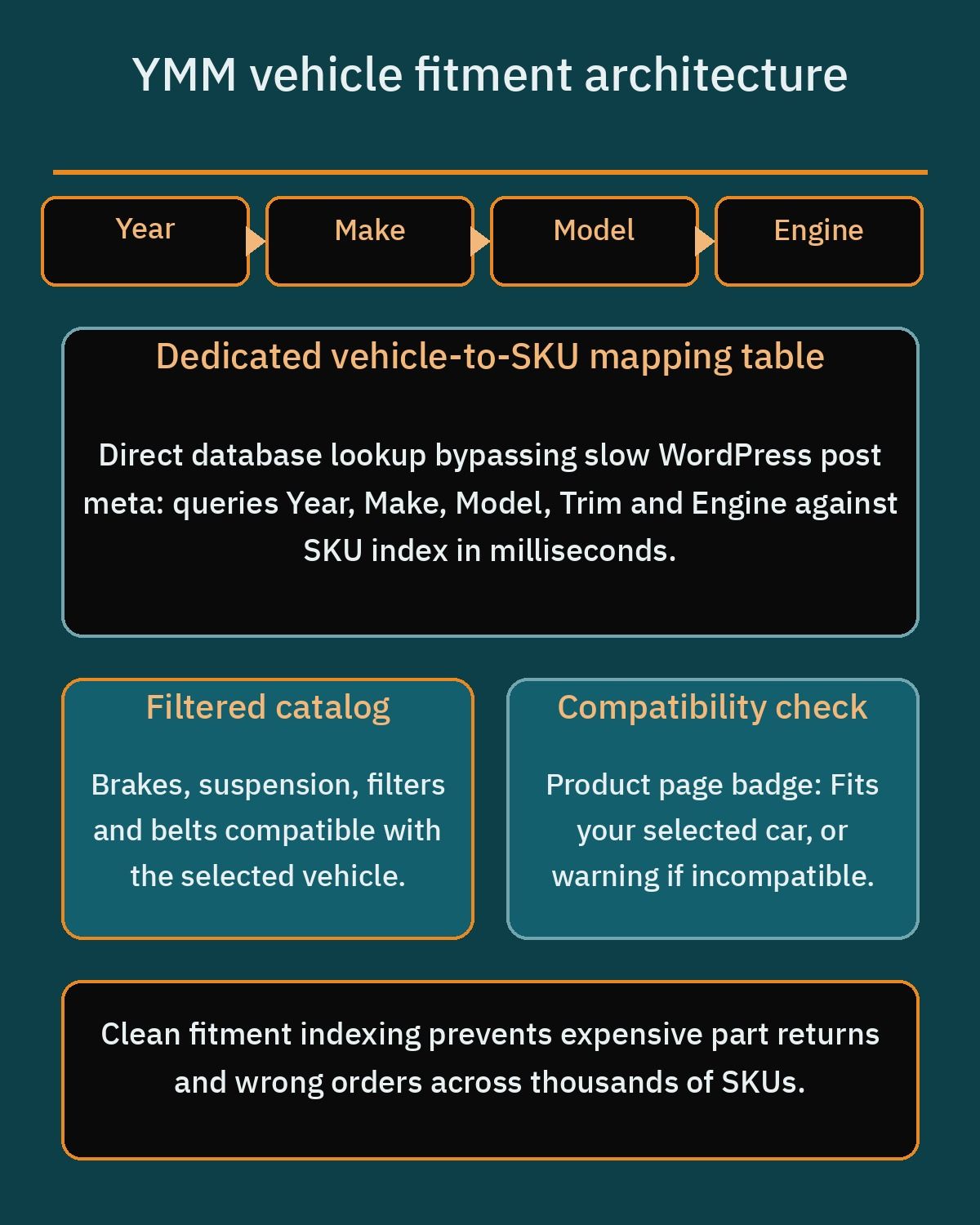
When scoping fitment with your WordPress development partner, ask how universal items are handled. Engine oil, wiper connectors, detailing chemicals and workshop tools do not belong to a single car, so your fitment filter must include a universal flag that keeps these items visible or lets shoppers toggle fitment off with one click. Also verify that selected vehicles persist in the browser session so a garage mechanic does not have to re-enter the car model on every page load.
VIN lookup integration and GCC market realities
Workshop buyers frequently ask for search by the 17-character Vehicle Identification Number because two cars of the same model year can carry different brake calipers, radiator fans or suspension arms depending on factory plant and regional trim. Decoders such as the free NHTSA vPIC API decode standardized 17-character VINs into make, model year, body class and engine displacement, and plugins like Motors VIN Decoder connect WordPress sites to public VIN endpoints.
However, public US-oriented VIN databases have real coverage gaps across GCC-spec, Japanese domestic and European vehicles common in Egypt, Saudi Arabia and the UAE. A public API may identify the model family and engine size while missing the exact regional cooling package or brake rotor diameter. Commercial parts-data APIs improve trim-level matching, though they carry ongoing licensing fees that only pay off at high order volume. If you also operate vehicle listings alongside parts sales, our guide on car dealership websites on WordPress covers how vehicle specs and inquiry workflows align.
For many regional distributors, the practical solution is a two-tier lookup. Pair automatic VIN-to-YMM decoding where supported with a quick chassis verification bar that lets a buyer enter the VIN alongside the part request before paying, or send it directly to your counter team for quick manual confirmation on high-ticket drivetrain and body components.
OEM and aftermarket cross-reference part numbers
In spare parts ecommerce, search by code converts at a much higher rate than browsing menus. A buyer rarely types “front ceramic brake pads” when they already have an OEM code or an aftermarket equivalent from Bosch, Denso, Mahle or KYB. The catch is formatting: one mechanic searches with hyphens and spaces, another types a continuous string, and a third searches the previous superseded OEM number.
Default WordPress search ignores custom fields and struggles with SKU punctuation. Your developer should index SKU, OEM numbers, superseded codes and aftermarket cross-references in dedicated normalized fields where hyphens and spaces are stripped on both indexing and query time. That way, searching either formatted or unformatted part numbers returns the exact match plus verified OEM or aftermarket alternatives on the same result card.
Catalog architecture for high SKU counts
Auto parts catalogs break standard store assumptions because of sheer row count and relationship density. According to WooCommerce product management documentation, store owners can organize items as simple products, variable products or grouped kits, and keeping that structure disciplined directly affects database speed. Using variable products makes sense when a part genuinely shares one listing with two or three clear options, such as left versus right side or standard versus heavy-duty spring rate, rather than packing twenty unrelated vehicles into variations.
Performance depends heavily on how your catalog is organized and cached. Every extra global taxonomy filter or unindexed search query slows down page generation, especially on bilingual Arabic and English sites. Following proven practices to speed up WordPress Arabic sites and structuring clean category URLs as outlined in our WooCommerce SEO guide keeps both Google indexing and mobile browsing responsive as your SKU count scales.
- Keep top-level categories organized by vehicle system such as Engine, Braking, Suspension, Cooling, Electrical and Body.
- Use separate simple products for distinct OEM and aftermarket brands so each part carries its own SKU, barcode, weight and stock feed.
- Enable High-Performance Order Storage (HPOS) and schedule incremental ERP or accounting CSV syncs during off-peak hours instead of full catalog overwrites.
Freight and regional courier shipping rules
Flat-rate shipping fails immediately in auto parts. A spark plug set ships cleanly in a padded courier bag across Cairo, Riyadh or Dubai, while a steel bumper, windshield, car battery or exhaust assembly triggers volumetric surcharges, pallet handling or hazardous-goods rules that domestic express couriers refuse.
Start by combining WooCommerce Shipping Zones with Product Shipping Classes. Assign every SKU to a clear physical tier such as Small Parcel, Medium Box, Heavy Mechanical, Oversized Body Panel or Hazardous Battery/Fluid. Then configure Table Rate Shipping for WooCommerce using weight, dimensional thresholds and shipping class priority rules so an oversized bumper in the cart overrides small-parcel courier pricing and routes the order to freight or branch pickup.
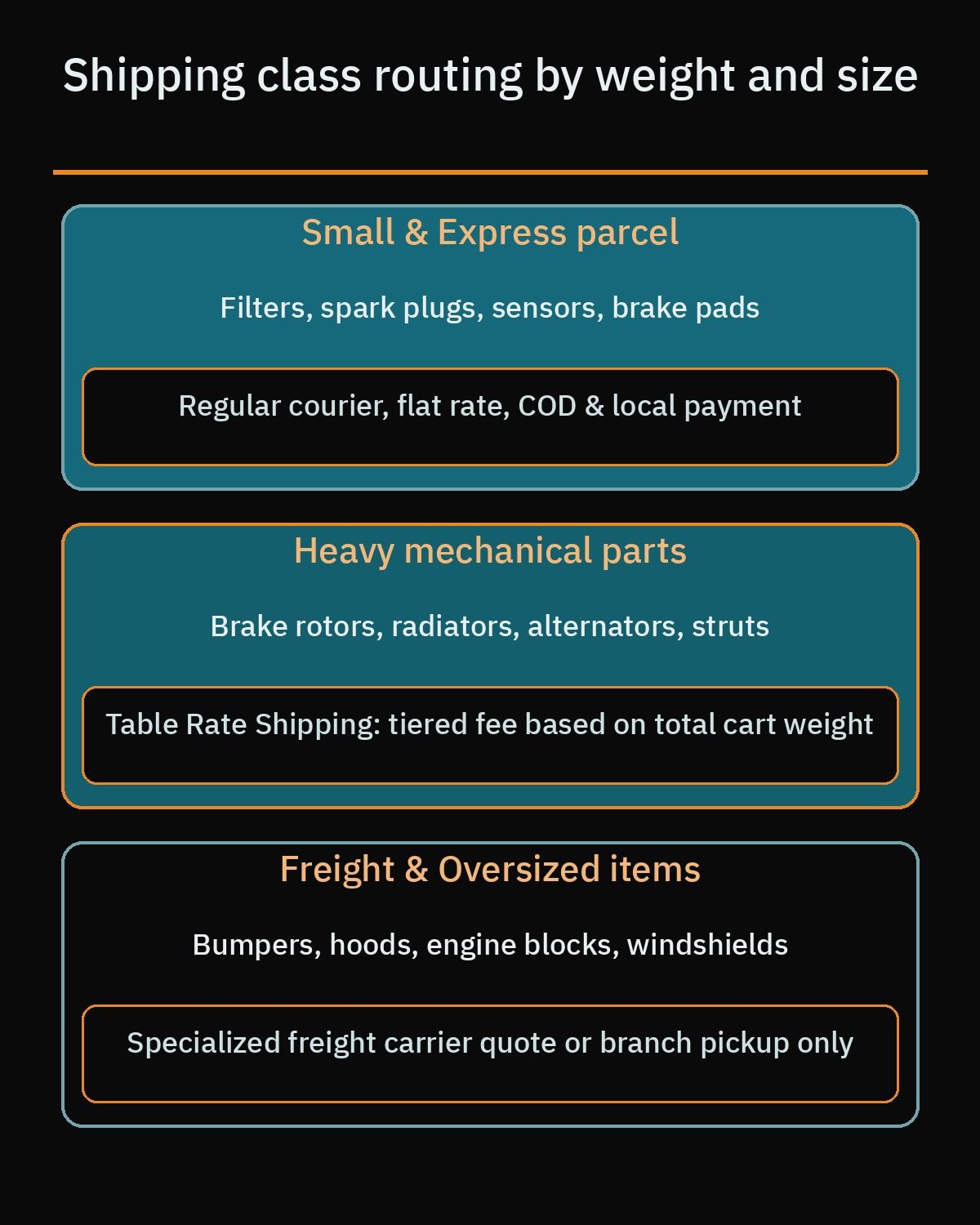
In Egypt and the Gulf, regional geography adds another layer. Major cities receive next-day courier vans, whereas remote governorates, industrial zones and cross-border GCC orders often require freight-forwarder handoff or scheduled truck routes. Our breakdown of WooCommerce shipping zones for Egypt and the Gulf explains how to order zones from narrowest city match to broadest region so customers never hit the wrong carrier rate.
Out-of-stock parts, special orders and core deposits
Even a large distributor cannot stock every sensor, trim clip and gearbox mount across decades of vehicle models. How your store handles zero-stock SKUs determines whether a workshop orders from you or calls the competitor down the street.
Backorders, restock alerts and special supplier orders
WooCommerce includes three native stock modes: Do not allow backorders, Allow but notify customer, and Allow silently. For genuine OEM parts sourced on request from a master importer within a few business days, using Allow, but notify customer paired with a visible dispatch lead-time note sets honest expectations on the product, cart and checkout screens. For discontinued or erratic aftermarket lines, keep backorders off and install Back In Stock Notifications so mechanics can subscribe for automated email alerts the moment a container clears customs.
Managing core deposits and part returns
Remanufactured alternators, starter motors, steering racks, turbochargers and brake calipers often carry a refundable core charge that workshops receive back when they return the old unit. Core WooCommerce does not track refundable deposits natively, so stores typically model the deposit using Product Add-Ons as a mandatory fee line or as a linked deposit fee added automatically to the cart, accompanied by clear inspection rules for cracks or stripped housings.
For regular fitment mistakes and warranty claims, Returns and Warranty Requests for WooCommerce lets buyers submit RMA requests directly from their account with photos of the part number and packaging. Be explicit in your policy about sealed electrical components, ECUs and sensors, which most parts distributors mark as non-returnable once the factory seal is broken.
Local payments, installments and cash on delivery rules
Payment flexibility matters because repair bills are rarely planned. In Egypt and across GCC markets, integrating Paymob for WooCommerce supports local and international cards alongside mobile wallets, while Tamara Checkout for WooCommerce lets eligible retail shoppers split larger mechanical or tire purchases into interest-free installments while you still settle upfront through your merchant agreement.
Cash on delivery remains common for local workshop runs, yet allowing unrestricted COD on every SKU creates costly failed deliveries. Restrict COD by shipping class and order total so small local courier orders can pay at the garage door, while heavy freight shipments, special-order OEM imports and core-deposit assemblies require prepayment or a verified deposit before dispatch.
What drives development cost on an auto parts store
Agencies quote wide ranges for spare parts builds because two stores that look identical on the homepage can have completely different data and fulfillment complexity behind the scenes. The table below maps the main scoping factors you should clarify before asking for quotes.
| Scope area | Lean aftermarket store | Full distributor and workshop build |
|---|---|---|
| Catalog size and sync | Focused aftermarket catalog managed via CSV uploads | Large multi-brand catalog synced via scheduled ERP or POS API |
| Vehicle fitment | Chained YMM dropdowns via WordPress.org plugin | YMM plus trim/engine data and VIN verification flow |
| Part search | Indexed SKU and OEM number matching | Normalized OEM, superseded and multi-brand cross-references |
| Shipping logic | Zone rates plus 2 or 3 shipping classes | Table Rate Shipping for freight, volumetric rules and branch pickup |
| Special workflows | Standard stock and backorder notices | Core deposit tracking, RMA portal and B2B workshop tiers |
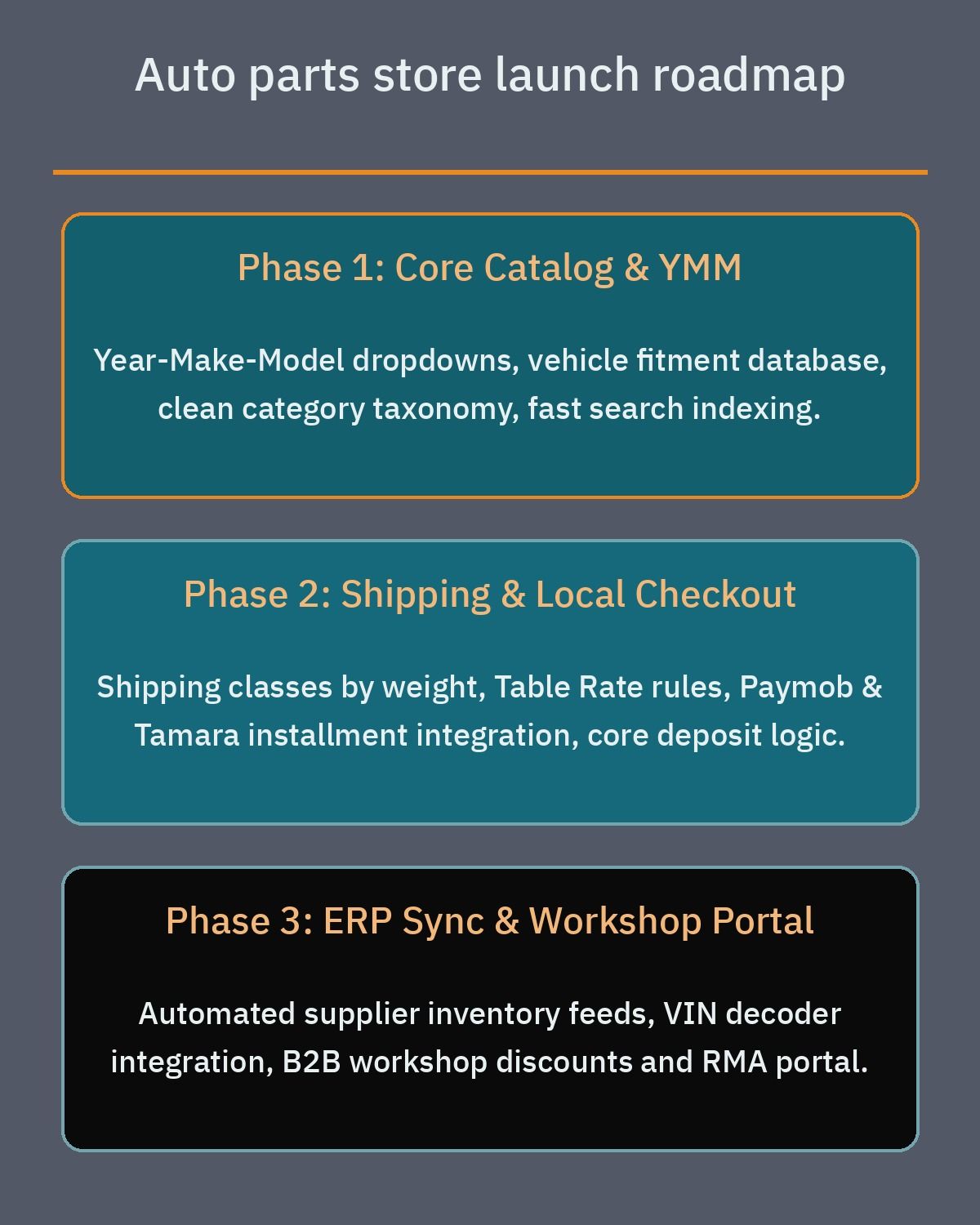
If you are planning an auto parts website WooCommerce project or upgrading an existing catalog that slows down under heavy SKUs, start by auditing your part spreadsheet: verify how many SKUs carry clean OEM numbers, vehicle compatibility columns and accurate weights. Once those columns are ready, book a free consultation with our team to map your fitment database, shipping classes and payment rules into a realistic build scope before a single plugin is installed.
Frequently asked questions
Should vehicle fitment use WooCommerce attributes or a YMM plugin?
Use a dedicated YMM plugin that stores vehicle fitment in separate database tables rather than standard WooCommerce attributes. Standard attributes create heavy database joins when thousands of SKUs map to dozens of model years. Dedicated fitment tables keep chained Year, Make and Model dropdowns fast and simplify bulk CSV updates.
Does free VIN lookup work reliably for cars in Egypt and the Gulf?
Free public decoders like the NHTSA vPIC API identify standard 17-character VINs for basic make, year and engine details, yet they often miss GCC-spec, Japanese or European trim variations common in MENA. Pairing basic VIN decoding with a quick chassis verification step before shipping high-ticket parts prevents wrong-fitment returns.
How does WooCommerce calculate shipping when small filters and heavy bumpers are in one cart?
Assign each SKU to a WooCommerce Shipping Class such as Small Parcel, Heavy Mechanical or Oversized Body, then apply Table Rate Shipping priority rules inside your Shipping Zones. When a cart mixes light items with a bulky bumper or battery, class priority routes the whole shipment to freight or branch pickup.
Can we offer Paymob and Tamara while limiting Cash on delivery?
Yes, you can run Paymob for cards and wallets alongside Tamara installments while restricting Cash on delivery by shipping class or order total. Most distributors allow COD only on small local courier deliveries and require online prepayment or a deposit for heavy freight and special-order OEM parts.
How should an auto parts store handle core deposits and electrical returns?
Track refundable core charges on remanufactured alternators, racks or calipers as a mandatory add-on fee with clear return inspection rules. Pair that with an RMA workflow such as Returns and Warranty Requests for photo verification, and state clearly at checkout that opened electrical sensors and control units are non-returnable.
References
- YMM Hero Year Make Model Search for WooCommerce, WordPress.org
- Year Make Model Search for WooCommerce, WordPress.org
- vPIC Vehicle API Documentation, NHTSA
- Managing Products Documentation, WooCommerce
- Variable Product Documentation, WooCommerce
- Setting up Shipping Zones, WooCommerce
- Product Shipping Classes, WooCommerce
- Table Rate Shipping for WooCommerce, WooCommerce Marketplace
- Back In Stock Notifications, WooCommerce Marketplace
- Product Add-Ons for WooCommerce, WooCommerce Marketplace
- Returns and Warranty Requests for WooCommerce, WooCommerce Marketplace
- Paymob for WooCommerce, WordPress.org
- Tamara Checkout for WooCommerce, WordPress.org