هذا المقال متوفر باللغة العربية — اقرأ بالعربية
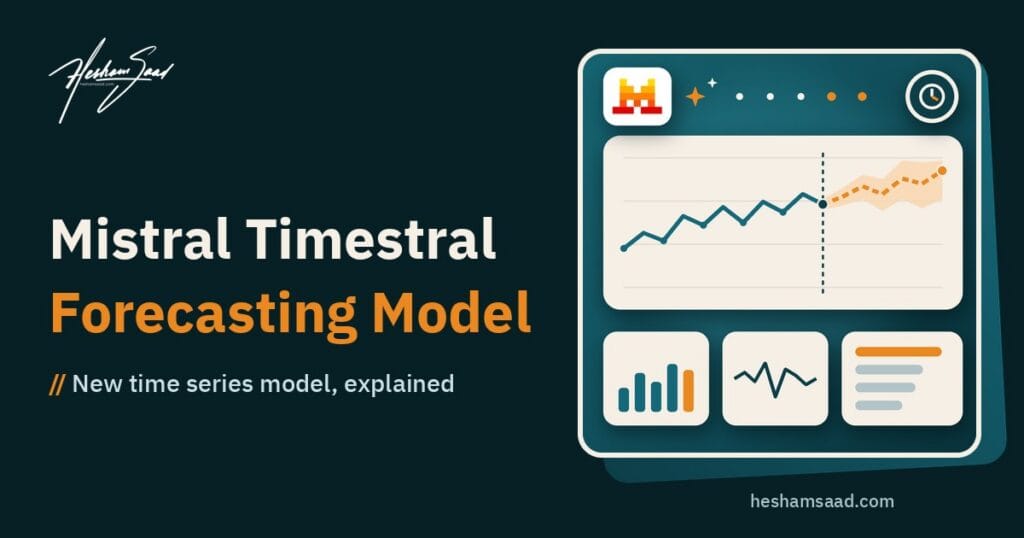
Mistral Timestral is the first family of time-series forecasting models from Mistral, released on October 15, 2026. It is not a chatbot and it does not write text. It takes numbers recorded over time, such as daily sales, hourly website visits or sensor readings, and predicts what comes next, along with how uncertain that prediction is. If you run an online store, a restaurant group or any business that plans stock and staff around demand, this release is more relevant to you than most language model launches this year.
Below you will find what Mistral actually announced, how Timestral compares with Chronos-2, TimesFM and Falcon, where it is strong and where it is limited, and what it can realistically do for a WooCommerce store or a business website. Every figure here comes from Mistral’s official announcement unless we say otherwise.
What Mistral Timestral is
Timestral is what researchers call a time series foundation model. The idea is borrowed from language models: instead of training a new model from scratch for every dataset, you pre-train one model on a large and varied collection of series, and it learns patterns such as trends, weekly cycles and seasonal peaks that carry over to data it has never seen. Mistral calls this zero-shot forecasting.
That matters because the classic tools work differently. Methods like ARIMA or linear regression are usually fitted to a single series and only learn from that series’ own history. Deep learning models such as PatchTST can learn across many related series, but, as Mistral points out, they are typically still trained per dataset, so what they learn does not transfer to a new domain.
The key facts at a glance
- Type: time series foundation model.
- Sizes: four models with 5M, 28M, 123M and 209M parameters, all sharing the same architecture and training recipe.
- Context length: 32,768 time steps.
- Output: probabilistic forecasts as 21 quantiles, not a single number.
- Inputs: multivariate targets, past-only covariates and known-future covariates, including categorical ones.
- Hardware: no GPU needed for inference.
- Deployment: on-prem, VPC or air-gapped.
- Licence: modified MIT.
- Code: Mistral has published a GitHub repository for running it on your own data, and says a technical report with full results will follow.
What is new compared with older forecasting tools
Four features stand out, and each one maps to a real business problem.
Multivariate forecasting
Timestral can model related series together. Mistral’s example is a pump whose vibration, temperature and pressure affect each other. In a shop, the equivalent might be orders, site visits and ad spend, which rarely move independently.
Probabilistic output
Instead of saying “you will sell 120 units next week”, it gives a range of quantiles. That lets you plan for the bad case and the good case, not just the average. For stock planning, the range is often more useful than the middle number.
Categorical covariates
Some inputs are categories, such as the day of the week or whether a machine is running, idle or under maintenance. Timestral takes these directly instead of forcing them into numbers that imply an order they do not have. For a store, think of “sale day” versus “normal day”.
Known-future covariates
Some drivers are known in advance: a holiday calendar, a planned promotion, a weather forecast. Timestral can condition on them, so a planned spike is expected rather than treated as a surprise. Mistral’s covariate-aware attention is designed so the model can use a holiday calendar without leaking a target’s own future into its forecast.
Benchmarks: how Timestral ranks
Mistral evaluated Timestral on the three main public forecasting benchmarks: GIFT-Eval, TIME and fev-bench. According to the announcement:
- The 209M model ranks first on all three benchmarks among pre-trained, zero-shot models, across all five metrics Mistral reports (GIFT-Eval GMean MASE and GMean WQL, TIME GMean MASE and GMean CRPS, and fev-bench SQL skill score).
- It beats the previous state of the art with about two-thirds of the parameters.
- Results come from a single checkpoint, with no ensembling, and were submitted to the GIFT-Eval and TIME leaderboards.
- GIFT-Eval was compared against 83 pre-trained, zero-shot entries, TIME against 35 leaderboard entries and fev-bench against 37.
One caution: these are Mistral’s own published results on public benchmarks. Independent leaderboard confirmation and the technical report are still to come, so treat the ranking as strong but fresh.
Timestral vs Chronos-2, TimesFM and Falcon
Timestral enters a field that already has well-known open models. Chronos comes from Amazon Science, and TimesFM is Google Research’s time series foundation model. Mistral names Chronos-2, TimesFM-3 and Falcon-2.0 directly in its comparison.
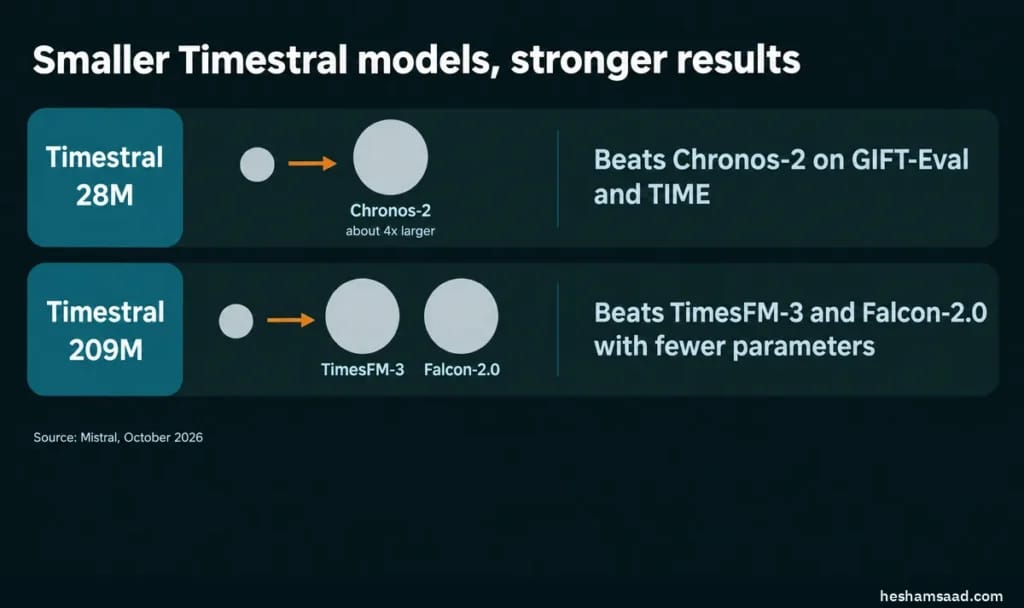
| Claim from Mistral | What it means |
|---|---|
| Timestral 28M beats Chronos-2 on GIFT-Eval and TIME | Chronos-2 is about four times larger, so the small Timestral is far cheaper to run for similar or better accuracy. |
| Timestral 209M beats TimesFM-3 and Falcon-2.0 | It does so with fewer parameters than either. |
| Every Timestral size sits on the Pareto front | For each model size, Mistral says no public model forecasts better. |
What this comparison does not tell you is how each model behaves on your data. Benchmarks average across many domains. A model that wins overall can still lose on a narrow series like a single restaurant’s Friday lunch orders. If you are choosing a TimesFM alternative or deciding on Timestral vs Chronos-2, run each one on a few months of your own history and compare the errors before committing.
Speed and cost: forecasting on a plain CPU
This is the most practical part of the release. Mistral reports that on a standard server CPU with 8 threads, forecasting one day ahead from three weeks of 15-minute history takes:
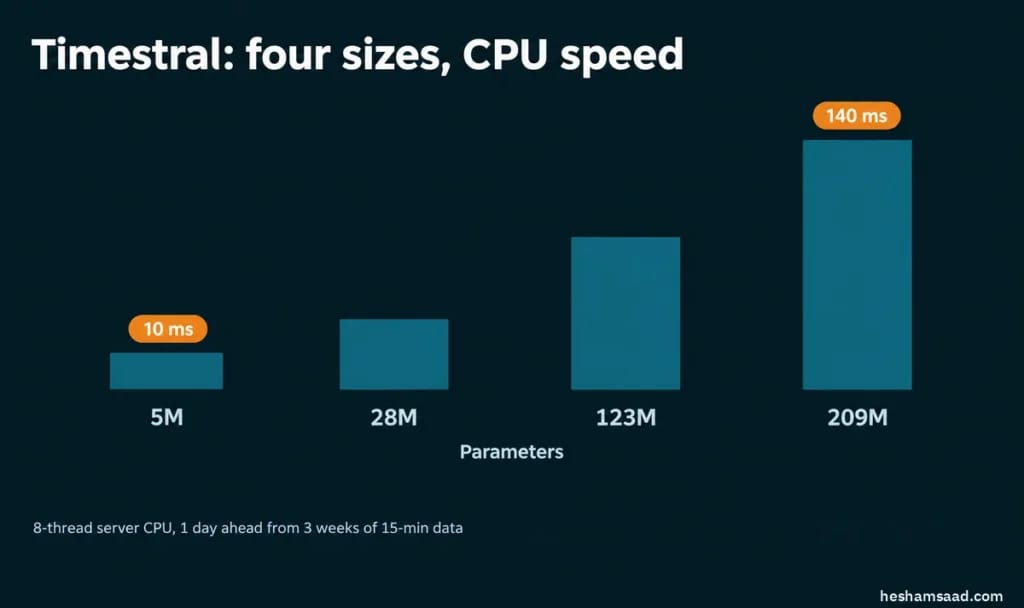
- 10 ms with the 5M model.
- 140 ms with the 209M model.
The 28M model is five times faster than the 209M model, and the 123M model comes within 0.2% of the 209M score at three quarters of its latency. In plain terms, you do not need to rent GPU servers to forecast. A normal VPS or an existing backend server can handle it, which keeps costs low for small and mid-size businesses.
Fine-tuning through Mistral Forge
Benchmarks measure general performance, and Mistral is open about the fact that production data can look very different and shift over time. For that, Timestral is available through Mistral Forge, the same training pipeline Mistral uses for its language models. Forge supports zero-shot use, architectural extensions such as domain-specific covariates, fine-tuning on private data, and control over the training mix. The full pipeline can run on a client’s own hardware, including air-gapped setups, which matters for companies that cannot send sales or operational data to an outside cloud.
If you are weighing other models you can run on your own servers, our breakdown of Meta’s open weights coding model Muse Spark Open covers what self-hosting it takes and how it compares with its rivals.
Pros and cons of Mistral Timestral
Pros
- Top published results on GIFT-Eval, TIME and fev-bench at a small size.
- Runs on CPU, so hosting costs stay low.
- Four sizes let you trade accuracy for speed.
- Handles multiple related series, categories and known future events such as holidays or promotions.
- Gives uncertainty ranges, which helps with stock and staffing decisions.
- Modified MIT licence and on-prem deployment keep your data in your hands.
Cons and limits
- It is brand new. The technical report is not out yet, and leaderboard results were only just submitted.
- The licence is a modified MIT, so read the terms in the repository before commercial use rather than assuming standard MIT.
- It is a numerical model. It does not explain itself in words unless you pair it with a language model, as Mistral suggests in its agent workflow example.
- You still need clean historical data. A store with a few weeks of patchy orders will not get reliable forecasts from any model.
- Setting it up takes developer work: data export, a small service to run the model, and a way to show results.
Best use cases for AI demand forecasting for ecommerce
Mistral’s own examples focus on industry and finance, but the same strengths apply to everyday businesses in Egypt, Saudi Arabia and the wider region.

- Stock planning for online stores: forecast weekly demand per product category, with Ramadan, White Friday or salary days as known-future covariates.
- Restaurant and cafe demand: predict orders per branch per hour to plan prep and staff shifts, using the day of the week as a category.
- Website traffic: forecast visits to plan hosting capacity before a campaign.
- Delivery volume: estimate parcels per day to book courier pickups in advance.
- Cash flow: project daily revenue ranges to plan purchases.
- Server monitoring: flag unusual spikes in errors or load before they turn into downtime.
What Timestral means for your WordPress site or business
Timestral is not a WordPress plugin, and there is no official WooCommerce integration from Mistral. What it offers is a fast, low-cost forecasting engine that a developer can connect to your store’s data.
A realistic setup for a WooCommerce store looks like this:
- Export daily or hourly order totals per product or category from WooCommerce.
- Run Timestral on a small server, since it does not need a GPU.
- Add known events, such as planned sales and public holidays, as future covariates.
- Send the forecast ranges back to a simple dashboard in the WordPress admin, or to a weekly email for the owner.
The forecasts can then feed real decisions: how much stock to reorder, how many delivery slots to book with your courier, and when to scale your hosting. If you already ship through a courier integration, our guide to WooCommerce courier plugins for Egypt and Saudi Arabia covers the shipping side that demand forecasts would plan around.
If you want forecasting built into your store, from data export to an admin dashboard, our WordPress development team can scope it with you. You can also book a free consultation to check whether your data is ready for it.
Frequently asked questions
Is Mistral Timestral free to use?
Mistral released it under a modified MIT licence with a public GitHub repository. Check the licence text in the repository for any conditions before commercial use.
Do I need a GPU to run Timestral?
No. Mistral says it does not need a GPU at inference and reports 10 to 140 ms per forecast on an 8-thread server CPU, depending on model size.
Which Timestral size should I start with?
The 28M model is a sensible start: Mistral says it beats Chronos-2 on GIFT-Eval and TIME and is five times faster than the 209M model. Move up to 123M or 209M if your tests show a real accuracy gain.
Can Timestral plug straight into WooCommerce?
Not out of the box. It needs a small integration that exports your order history, runs the model and returns the forecast to your dashboard.