هذا المقال متوفر باللغة العربية — اقرأ بالعربية
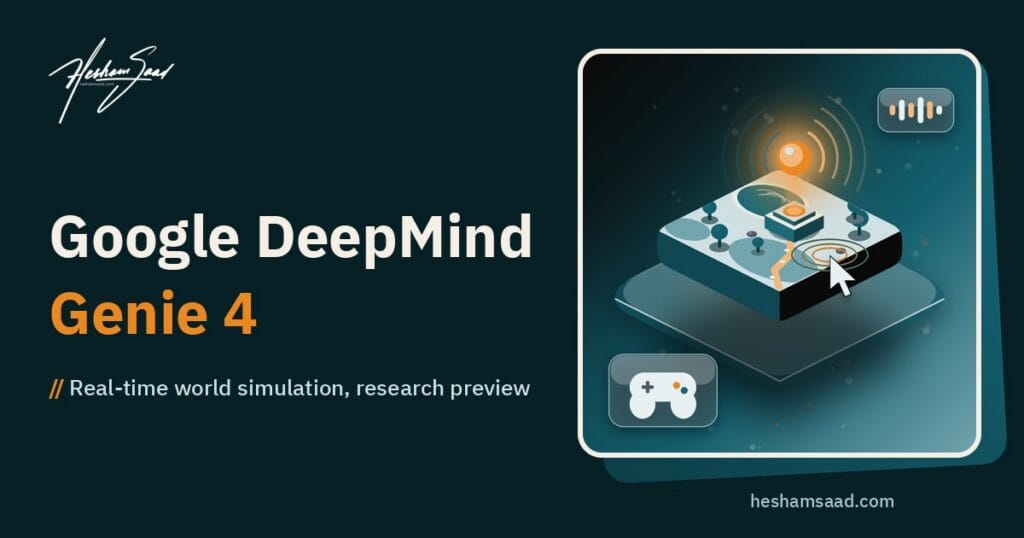
Google DeepMind has announced Genie 4, a new world model that simulates an interactive world in real time and, for the first time in this line, generates the sound of that world as well. DeepMind says it brings a new level of realism to real-time interactive simulation, and it is natively multimodal: music-like audio, ambient noises and spoken dialogue are produced together with the picture. The announcement is dated October 27, 2026, and Genie 4 starts as a research preview for trusted testers, so you cannot simply sign up and use it today.
For a business owner or a WordPress site owner, Genie 4 is not a tool you install. It is a signal about where interactive visuals, product previews and training simulations are heading. In this post we explain what Genie 4 is, what changed, how it compares with Genie 3 and with ordinary AI video, the pros and cons, who can use it and when, the limits Google admits, and what it means for a WordPress site. Everything below comes from Google’s official pages. Google has not published a price, a resolution, a frame rate or a session length for Genie 4, so we do not guess any of them.
What Genie 4 is
A world model is a system that predicts how an environment changes when something happens in it. A video generator produces a clip from a prompt and then stops. A world model keeps going: you press keys to move, you type a sentence to change the scene, and the model generates what comes next frame after frame. DeepMind’s own summary of the idea is simple: you set an event in motion, and Genie 4 simulates what happens next, how the world responds, how it sounds, and how the people in it move, react and speak.
Genie 4 is built on the Gemini family. According to DeepMind, Gemini Omni anchors the simulation in real-world appearance and behavior, while other Gemini models supply the reasoning that helps keep a simulation coherent from one moment to the next. In the research sections of the announcement, Gemini 3.8 Flash acts as a guiding agent in the loop, and DeepMind also shows early experiments that pair Genie 4 with Gemini 4 Argon and Gemini Robotics.
What changed in Genie 4
DeepMind groups the update into four capabilities. These are Google’s descriptions, shown through its own demo recordings, so treat them as claims to test when access opens.
- Real-time shaping of the world: you can use natural language to change the weather, move the camera or add a new person or object while the simulation runs. Gemini adapts your prompt to the surrounding scene and also monitors the scene between your inputs so the world keeps progressing in a consistent way. Users steer with standard keyboard controls for movement and camera.
- More realistic physics and human action: DeepMind says Genie 4 simulates real-world physics such as aerodynamics and collisions, and calls the simulation of people its most dramatic leap, with characters that move naturally, react to their surroundings and can be steered in real time.
- Native audio: Genie 4 is described as the first real-time world model to generate audio natively. Every world carries the ambient sound of its setting, such as wind in trees or waves on a beach, and characters can hold interactive dialogue that adapts to your input or to events in the world.
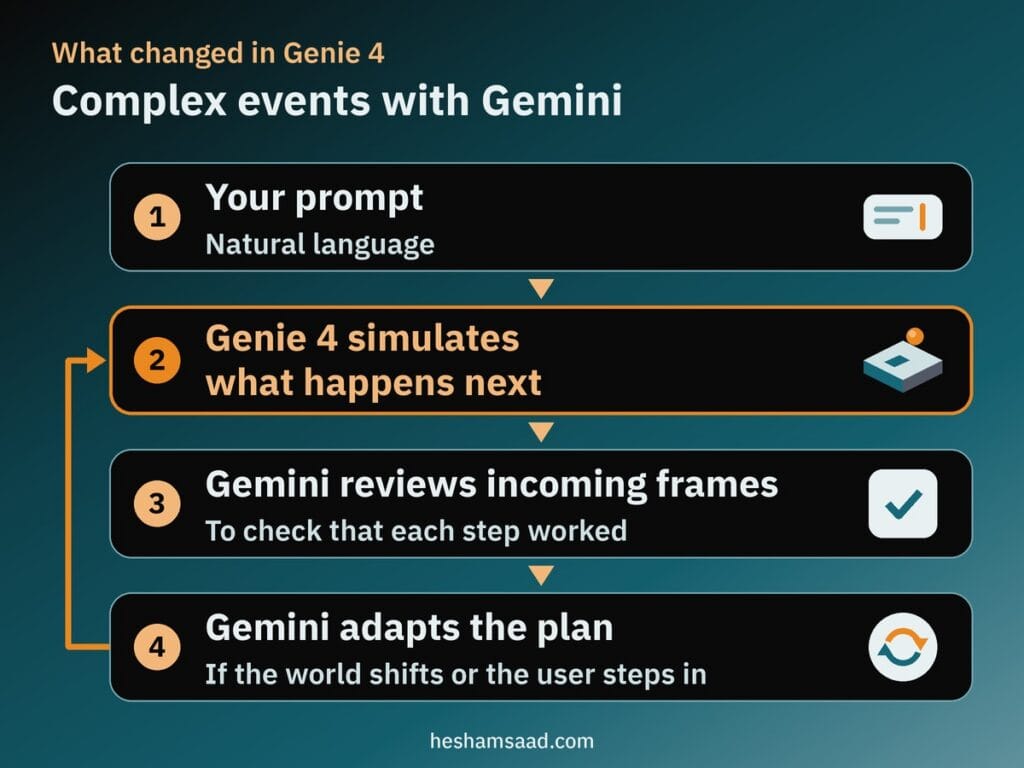
- Complex events with Gemini: Gemini continuously watches the scene, breaks a goal into steps, reviews incoming frames to check that each step worked, and adapts the plan if the world shifts or the user steps in. DeepMind’s examples include a robot arm pipetting liquid into a lab plate and a humanoid robot playing checkers.
How Genie 4 compares with Genie 3 and with AI video
The clearest comparison is with Genie 3, which DeepMind announced on August 5, 2025. Genie 3 generated worlds you could navigate in real time at 24 frames per second, kept them consistent for a few minutes at 720p, and introduced “promptable world events” such as changing the weather or adding objects and characters. Its listed limits included a small range of actions the agent could perform itself, weak handling of several agents in one world, imperfect accuracy for real locations, text that was only clear when supplied in the prompt, and a few minutes of continuous interaction.
Genie 4 keeps the real-time, promptable approach and adds three things on top: a stated step up in photorealism and movement, native audio including dialogue, and a closer link with Gemini models for multi-step events. DeepMind does not publish numbers for resolution or session length in the Genie 4 post, so we cannot say whether it beats Genie 3 on those measures. Do not assume it does.
Compared with an ordinary AI video model, the difference is control. A video model gives you a finished clip and you re-prompt to change it. Genie 4 lets you steer while it is running. The cost of that flexibility is stability, which is why DeepMind lists drift in details and object permanence as a limit. We did not compare it with world models or video tools from other companies, because there are no official like-for-like figures to put side by side, and a comparison without them would be guesswork.
Who can use Genie 4 and when
Genie 4 has started rolling out as a research preview for trusted testers. DeepMind says it is coming soon to Google AI Ultra subscribers in Project Genie, and to early access partners of the Gemini API and Google AI Studio. There is a waitlist for Genie 4 in Project Genie. DeepMind gives no date and no price in the announcement.
Project Genie is the web prototype that Google Labs opened in January 2026 for Google AI Ultra subscribers in the United States aged 18 and over. At that time it was powered by Genie 3 and offered three things: sketching a world from text or images, exploring it, and remixing other people’s worlds. If Google follows the same path, Project Genie is where most people will first try Genie 4, but that is an expectation, not a promise from Google. Check Google’s own pages for the current countries, plans and age limits before you plan around it.
Google DeepMind announced another model on the same day, Gemini 4 Carbon, which focuses on cybersecurity and long-running tasks rather than world simulation.
Safety and responsible release
DeepMind says Genie 4 has strict safety guardrails consistent with its policies for other models, was put through internal safety evaluations before the preview, and was deployed first to trusted testers to collect feedback before a wider launch. All video and audio generated by Genie 4 carries SynthID, Google’s imperceptible watermark for identifying AI-generated content in both pictures and sound. For a business, this matters if you ever publish Genie 4 material: the watermark is built in, and you should still label AI-made media honestly for your own audience.
Limits Google admits
DeepMind calls Genie 4 an early, experimental model. It can keep a coherent environment over short sessions, but visual details and object permanence can still shift or drift, especially as a simulation runs longer, after several complex prompt edits, or while you move through the scene. Complex physical interactions, the accuracy of real-time audio, legible text, spatial accuracy and long-term consistency are listed as active areas of research. In practice, that means Genie 4 is suited to exploring ideas and drafts, not to producing a final, exact result you can hand to a client without review.
Pros and cons
Here is a balanced view based on the official announcement.
- Pro, real-time steering: you change weather, camera, people and objects by typing, without waiting for a new render.
- Pro, native sound and dialogue: ambient audio and conversation come from the same model as the picture.
- Pro, Gemini in the loop: goals are split into steps and checked frame by frame, which supports multi-step scenarios.
- Pro, built-in watermark: SynthID is applied to generated video and audio.
- Con, limited access: trusted testers only for now, with no public date or price.
- Con, drift: details and object permanence can change over time, so long sessions are less reliable.
- Con, open problems: legible text, spatial accuracy and complex physics are still not solved.
- Con, no independent tests yet: every claim in the announcement is Google’s own.
Best use cases
DeepMind reports what its trusted testers are exploring. These are early experiments, not finished products.
- Creative direction: filmmakers and creative teams use Genie 4 as a quick draft mode for pre-visualization, stepping into a live scene and running several takes while changing camera angle, lighting, dialogue and action.
- Historical scenarios and photographs: photojournalists test how one archival photo can become a simulation of that place, and teams explore how events such as a flash flood or a wildfire could unfold.
- Game and interactive concepts: developers go from an idea to an explorable prototype in seconds, testing visual style and mechanics through prompts before writing engine code.
- Simulation: beyond DeepMind’s robotics research, enterprise partners are evaluating Genie 4 for fast generation of first-draft scenarios, and are still identifying gaps.
What it means for a WordPress site or a business
Genie 4 is not a WordPress plugin and nothing in the announcement mentions websites, an API price or embedding. So the honest answer is that it does not change your site today. It does point to a few things worth watching, and each one below is our own reading, not a Google claim.
- Interactive previews: if Genie 4 reaches the Gemini API and Google AI Studio, agencies could prototype a virtual showroom, a walkthrough of a space or a product demo faster. Test the idea in a draft first, because drift and text problems would show quickly on a client site.
- Concept visuals for pitches: a studio could use short generated scenes to explain an idea to a client before a real shoot. Label them as concept material, never as real photos of finished work.
- Page speed and hosting: any real-time simulation embedded on a page is heavy. Host media and streams on a service built for it and keep the page itself light. Our guide to WordPress image optimization covers the basics of keeping media from slowing a page down.
- Honest labeling: SynthID marks Genie 4 output, but your visitors will not see it. If you publish AI-generated scenes, say so on the page.
- Keep a human check: because details drift, review every generated asset before it goes live.
Our recent posts on GPT-6.1 Terra and Kimi K3.1 Pro cover two other recent AI releases in more detail. If you want an AI feature or an interactive experience planned for your own site, our WordPress development service can scope it, and you can book a free consultation to check what fits your budget. A sensible first step is to join the Project Genie waitlist if you are eligible, and test with a small, low-risk idea before you spend on any build.
Frequently asked questions
What is Genie 4?
Genie 4 is Google DeepMind’s new world model, announced on October 27, 2026. It simulates an interactive world in real time, lets you change it with text prompts, and generates audio, including dialogue, together with the picture. It builds on the Gemini family, and Google calls it an early, experimental research preview.
Who can use Genie 4 right now?
Only trusted testers. Google says it is coming soon to Google AI Ultra subscribers in Project Genie and to early access partners of the Gemini API and Google AI Studio. There is a waitlist in Project Genie. The announcement gives no release date and no price, so check Google’s pages for updates.
How is Genie 4 different from Genie 3?
Google says Genie 4 adds more realistic physics and human movement, native audio with interactive dialogue, and a closer link with Gemini models for multi-step events. Genie 3 ran at 24 frames per second in 720p for a few minutes. Google does not publish matching figures for Genie 4, so we cannot compare them.
What are the limits of Genie 4?
Google says details and object permanence can drift, especially in longer sessions, after several complex edits, or while you move through the scene. Complex physical interactions, real-time audio accuracy, legible text, spatial accuracy and long-term consistency are still open research areas. Treat results as drafts that need human review.
Is Genie 4 output marked as AI-generated?
Yes. Google says all video and audio generated by Genie 4 includes SynthID, its imperceptible digital watermark. Visitors cannot see it, so if you publish Genie 4 scenes on your site, tell your audience clearly on the page that they are AI-generated and not real footage.
Can I use Genie 4 on my WordPress site?
Not directly today. Genie 4 is not a plugin, and Google has not announced pricing or an embedding method. If it reaches the Gemini API, a developer could prototype interactive previews. Test on a draft page first and keep heavy media off your main page.