---
id: 13276
title: "Reflection Beam: The 501B Open-Weight Coding Model Now on AWS"
slug: "reflection-beam-open-coding-model"
lang: "en"
url: "https://heshamsaad.com/en/reflection-beam-open-coding-model/"
markdown_url: "https://heshamsaad.com/en/reflection-beam-open-coding-model.md"
translations: {"ar":"https://heshamsaad.com/ar/reflection-beam-open-coding-model/"}
description: "Reflection Beam explained: 501B open-weight coding model under Apache 2.0, benchmarks vs Kimi K3 and GLM, GPU needs and real AWS self-hosting costs."
author: "Omar Khaled"
date_published: "2026-10-17T08:37:01Z"
date_modified: "2026-10-18T22:42:59Z"
categories: ["AI News"]
tags: ["AI News","AWS","open-weight coding model","Reflection AI","Reflection Beam","self-hosted AI"]
featured_image: "https://heshamsaad.com/wp-content/uploads/2026/10/reflection-beam-open-coding-model-og-v2-en.jpg"
word_count: 2266
reading_time_min: 11
content_sha256: "c7c539fcaf61ad6a78106a598661d1710781e04e24ab265034c5fb9daf338589"
---
# Reflection Beam: The 501B Open-Weight Coding Model Now on AWS
Reflection Beam is the first open-weight model from Reflection AI, a US lab, and as of October 16, 2026 you can deploy it from Amazon SageMaker JumpStart in two AWS regions. It is a large open-weight coding model built for agent work: fixing GitHub issues, running terminal commands, calling tools and finishing multi-step tasks. The weights are on Hugging Face under the Apache 2.0 license, so you can run it on your own infrastructure, fine-tune it and ship it in commercial products. The catch is size. Beam has 501 billion parameters, and serving it takes a full server of top-end NVIDIA GPUs.
This article covers what Reflection and AWS actually released, how Beam compares with other open coding models, what it really costs to host on AWS (worked out from AWS's own price list), and who should and should not bother. Facts come from Reflection's announcement, the Hugging Face model cards, the AWS Machine Learning blog, the AWS What's New post and AWS pricing data. Benchmark scores are as reported by Reflection and have not been independently reproduced.
## What was released, and when
The dates matter, because the AWS announcement URL contains "2026/01", which suggests a January release. The page itself says "Posted on: Oct 16, 2026", and its metadata gives the same date. This is a fresh release.
- October 5, 2026: Reflection published "Introducing Beam: Reflection's 501B open-weight model" as a preview, with early access by waitlist and a promise to release the weights "this month".
- October 7 to 10, 2026: the BF16 repository appeared on Hugging Face on October 7, and the FP8 and NVFP4 repositories on October 10 (per Hugging Face metadata).
- October 16, 2026: AWS announced Beam on SageMaker JumpStart and published a deployment guide on its Machine Learning blog. The What's New post also says Beam was ported and optimized for AWS Trainium3.
## Reflection Beam at a glance
From the Hugging Face model card:
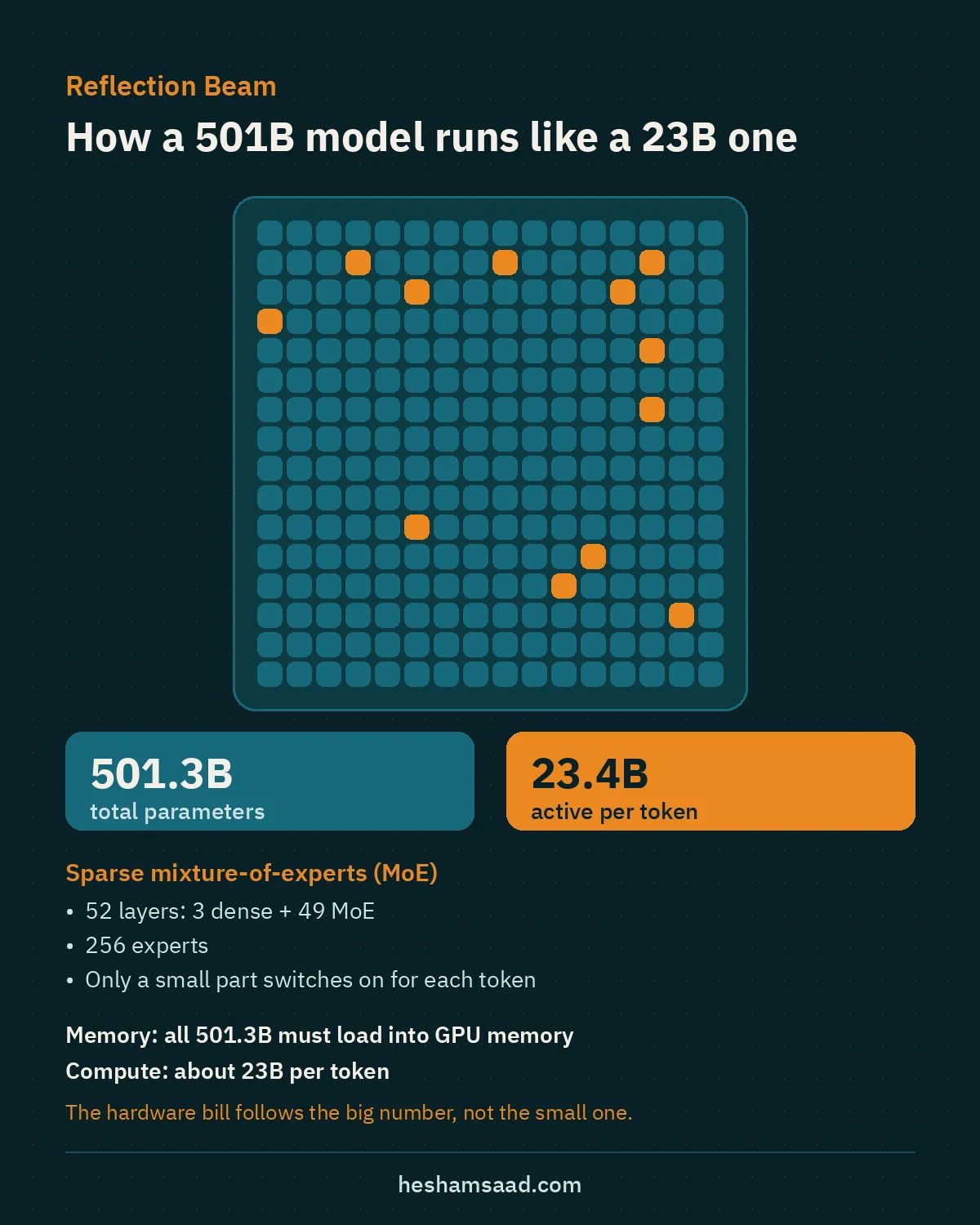
- Architecture: sparse mixture-of-experts (MoE), 501.3B total parameters and 23.4B active per token, 52 layers (3 dense and 49 MoE), 256 experts.
- Attention: gated grouped-query attention plus sliding window attention.
- Context window: 1M tokens. AWS describes it as an effective context length of 1 million tokens "as reported by Reflection".
- Input and output: text only. Developed "predominantly for English".
- Knowledge cutoff: June 30, 2026.
- Weight formats: BF16, FP8 and NVFP4, each in its own Hugging Face repository. The FP8 checkpoint was made with vLLM's llm-compressor; the NVFP4 checkpoint with NVIDIA Model Optimizer.
- License: Apache 2.0. The card says Reflection does not prohibit distillation, training other models on outputs, fine-tuning, quantization or merging.
- Reasoning control: Reflection's blog describes a reasoning effort setting; lower values give shorter answers, higher values allow longer reasoning.
A mixture-of-experts model only switches on a small part of its network for each token. That is why Beam can have 501B parameters but compute like a 23B model per token. You still have to load all 501B parameters into GPU memory, though, so the hardware bill follows the big number, not the small one.
## How Reflection Beam performs
Reflection's model card lists these scores for the BF16 version. The FP8 and NVFP4 versions land within about two points on most tests.
| Benchmark | Beam BF16 | Beam FP8 | Beam NVFP4 |
|---|---|---|---|
| SWE-bench Verified | 81.6% | 80.2% | 80.7% |
| SWE-bench Multilingual | 78.3% | 78.1% | 77.5% |
| SWE Bench Pro v1 | 66.1% | 65.9% | 65.6% |
| Terminal Bench v2.1 | 80.1% | 78.9% | 78.4% |
| LiveCodeBench | 88.3% | 88.1% | 87.4% |
| MCP Atlas | 80.8% | 81.5% | 80.5% |
| GPQA Diamond | 90.6% | 90.3% | 89.3% |
Reflection also claims Beam reaches comparable solution quality to leading open models with roughly 3 times fewer reasoning tokens, and that on advanced reasoning it matches GLM 5.2 while using 3 to 4 times less inference compute. Fewer tokens per answer means lower cost and faster replies, which matters more for agents that loop many times than a single benchmark point does.
One thing to note: the numbers in Reflection's October 5 blog post differ slightly from the final model card. For example, the blog lists 80.9% on SWE-bench Verified and the card 81.6%. Treat the model card as the current reference.
## Comparison with other open-weight coding models
Reflection placed Beam next to several open models in its own table. Here are the Terminal Bench v2.1 and SWE Bench Pro v1 figures from that table; "NR" means not reported.
| Model | Terminal Bench v2.1 | SWE Bench Pro v1 |
|---|---|---|
| Reflection Beam | 80.1 | 65.5 |
| GLM 5.2 | 81.0 | 62.1 |
| GLM 5.3 | 88.2 | NR |
| Kimi K3 | 88.3 | NR |
| Qwen 3.8 Max | 86.6 | 67.7 |
| DeepSeek V4.1 Flash | 90.6 | NR |
| Nemotron 3 Ultra | 56.4 | 46.4 |
Reflection is honest about the ranking: it calls Beam "competitive with larger open models like GLM 5.2 and approaching Qwen 3.8-Max", and says frontier open models like Kimi K3 "remain ahead on raw capability". Its pitch is efficiency, not first place.
Facts from each rival's own Hugging Face model card help put size and licensing in context:
- Kimi K3 (Moonshot AI): 2.8T total and 104B activated parameters, text, image and video input, 1M token context, released under the custom Kimi K3 License.
- DeepSeek V4.1 Flash: a multimodal MoE with 552B backbone parameters, up to 1M tokens of context, MIT license.
- GLM 5.3 (Z.ai): released under its own GLM license rather than a standard open source license.
- Qwen3-Coder-Next: 80B total and 3B activated parameters, 262,144 tokens of native context, Apache 2.0. Far smaller and far cheaper to host than Beam.
- Mistral Devstral 2 (123B): 256k context, Modified MIT License.
So Beam sits in an interesting spot: Apache 2.0 like Qwen3-Coder-Next, with a 1M context like Kimi K3 and [DeepSeek V4.1 Flash](https://heshamsaad.com/en/deepseek-v4-1-flash-harness/), at a size between them. We looked at another US open release, Meta's model, in our [Muse Spark Open review](https://heshamsaad.com/en/meta-muse-spark-open/), which is worth reading alongside this one.
For comparison with a closed option: OpenAI's official price list shows `gpt-6.1-sol` at $2 per million input tokens and $10 per million output tokens. With a closed API you pay per token and nothing while idle. With a self-hosted AI coding model you pay for the servers by the hour whether they are busy or not.
## Running Beam on AWS: paths and GPU requirements
AWS's guide describes three ways to serve Beam:
1. SageMaker JumpStart real-time endpoint: the managed path, with AWS's container and an HTTPS endpoint. Available at launch in US East (N. Virginia) and US East (Ohio).
2. JumpStart on SageMaker HyperPod Inference: the managed container on a Kubernetes (Amazon EKS) cluster you control.
3. SGLang or vLLM on HyperPod: when you need your own runtime, quantization or parallel layout.
On hardware, AWS is specific:
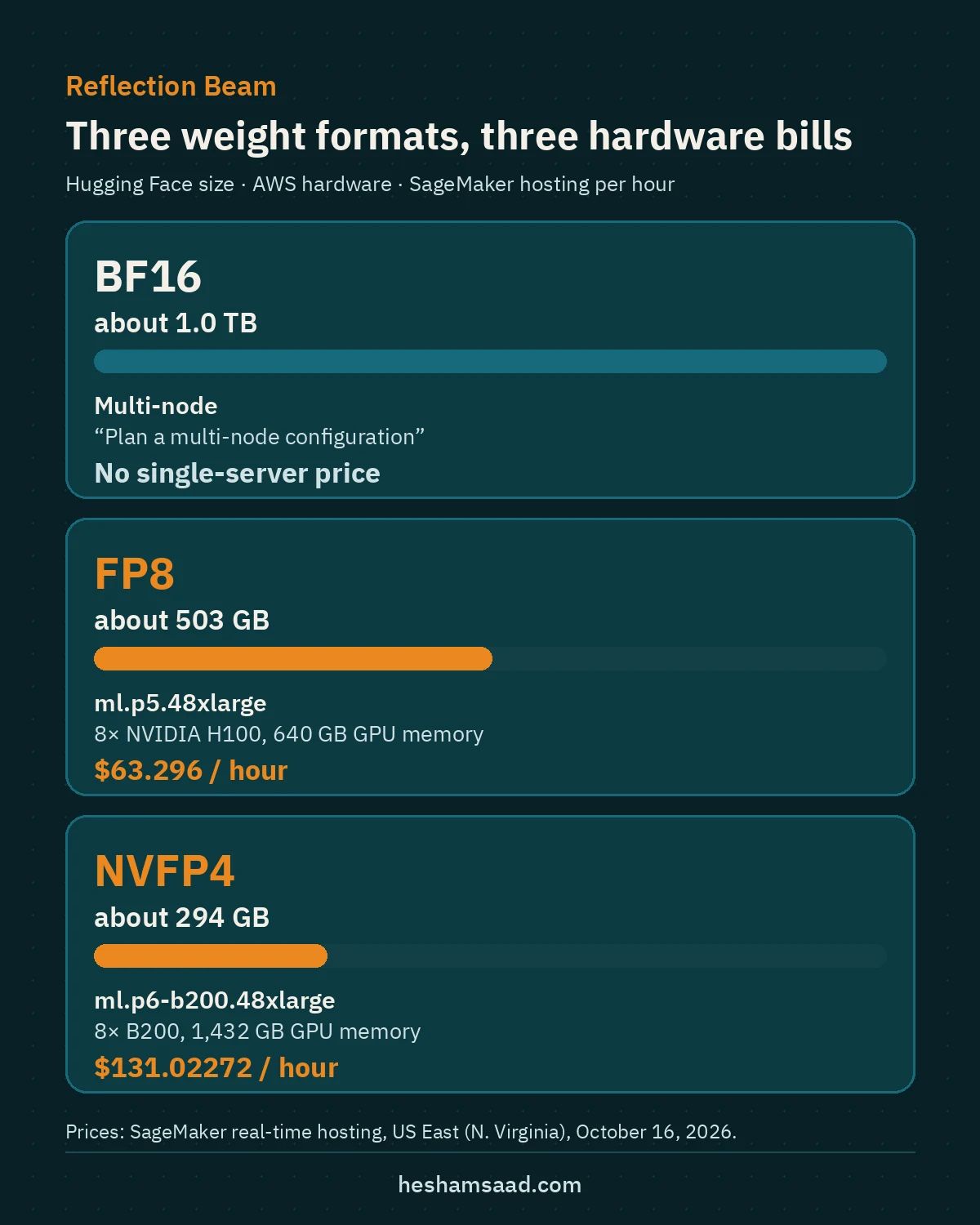
- FP8: ml.p5.48xlarge (8 NVIDIA H100, 640 GB GPU memory) or ml.p5e.48xlarge and ml.p5en.48xlarge (8 H200, 1,128 GB).
- NVFP4: ml.p6-b200.48xlarge (8 B200, 1,432 GB).
- BF16: "plan a multi-node configuration", since it has the largest memory requirement.
The Hugging Face storage figures explain why: the BF16 repository is about 1.0 TB, FP8 about 503 GB and NVFP4 about 294 GB. FP8 on a single H100 server leaves only around 137 GB for KV cache and runtime overhead, which limits long contexts and concurrency. AWS recommends calculating memory for weights, KV cache and overhead, then confirming with a load test.
## What it costs to self-host: the math
These figures come straight from AWS's public price list for SageMaker real-time hosting and EC2 on-demand Linux, US East (N. Virginia), checked on October 16, 2026. They exclude storage, data transfer, taxes and discounts such as Savings Plans.
| Instance (8 GPUs) | SageMaker hosting per hour | EC2 on-demand per hour |
|---|---|---|
| p5.48xlarge (H100) | $63.296 | $55.04 |
| p5en.48xlarge (H200) | $72.795 | $63.296 |
| p6-b200.48xlarge (B200) | $131.02272 | $113.9328 |
Running one instance all month (730 hours):
- FP8 on ml.p5.48xlarge: $63.296 × 730 = $46,206.08 per month
- FP8 on ml.p5en.48xlarge: $72.795 × 730 = $53,140.35 per month
- NVFP4 on ml.p6-b200.48xlarge: $131.02272 × 730 = $95,646.59 per month
Running only during office hours (8 hours × 22 working days = 176 hours):
- ml.p5.48xlarge: $63.296 × 176 = $11,140.10 per month
- ml.p6-b200.48xlarge: $131.02272 × 176 = $23,060.00 per month
For scale: at gpt-6.1-sol's list price, $46,206 buys about 4.6 billion output tokens ($46,206 ÷ $10 per million). Self-hosting only wins on cost when your agents keep the GPUs busy most of the time, or when you must keep code and data inside your own account.
Two gaps in the price data: we found no on-demand SageMaker hosting or EC2 price for p5e.48xlarge in either region, and no ml.p6-b200.48xlarge hosting price for US East (Ohio). AWS mentions Trainium3 but publishes no Beam instance size or price for it yet.
## Pros and cons
### Strengths
- Apache 2.0, with fine-tuning, distillation and commercial use all allowed.
- Strong scores on SWE-bench Verified, Terminal Bench and MCP Atlas, with a claimed reasoning token saving.
- 1M token context for large codebases.
- Managed deployment on AWS from day one, plus SGLang and vLLM paths.
- Your code never leaves your own AWS account.
### Weaknesses
- Expensive to host: about $46,000 a month at minimum for one always-on SageMaker endpoint.
- Text only, mainly English.
- Not the top scorer; Kimi K3, GLM 5.3 and DeepSeek V4.1 Flash lead on Terminal Bench in Reflection's own table.
- Only two AWS regions at launch.
- Technical report still "coming", so independent checking is limited for now.
## Who Reflection Beam fits, and who it does not
It fits: engineering teams already on AWS who must keep source code in their own account, companies running coding agents around the clock where GPUs stay busy, and teams that want to fine-tune an open-weight coding model on their own codebase under a permissive license.
It does not fit: freelancers, small agencies and most small businesses. If you build or maintain a few sites, a hosted coding assistant or a pay-per-token API is far cheaper. A smaller open model such as Qwen3-Coder-Next is a more sensible first step if you want to run something yourself.
## What it means for WordPress sites and businesses
For a typical WordPress business, Beam is not something you install. It is infrastructure for development teams. The practical effect is indirect: more capable open coding models push down the cost of AI coding tools, and agencies with strict client data rules gain a real self-hosted option.
If you are exploring AI for your own site, start where the cost is low. Our guide on how to [build a WordPress site with AI](https://heshamsaad.com/en/build-wordpress-site-with-ai/) covers the tools that work today without a GPU bill. For custom plugins, integrations or agent workflows tied to your site, our [WordPress development](https://heshamsaad.com/en/wordpress-development/) service can help you pick the right model and setup. If you are not sure whether self-hosting makes sense for you, book a [free consultation](https://heshamsaad.com/en/free-consultation/).
## FAQ
### Is Reflection Beam really open source?
The weights are released under Apache 2.0, a permissive open source license, and the card allows fine-tuning, distillation and commercial use. Training data is not released.
### Is this a new release or an old one?
New. Reflection announced it on October 5, 2026, the weights arrived on Hugging Face on October 7 to 10, and AWS's announcement is dated October 16, 2026 despite "2026/01" in its URL.
### Can I run Beam on one GPU?
No. AWS lists 8 GPU servers: H100 or H200 for FP8 and B200 for NVFP4. BF16 needs more than one server.
### Which AWS regions support it?
At launch, SageMaker JumpStart offers Beam in US East (N. Virginia) and US East (Ohio).
### Does it support Arabic?
Reflection says Beam was developed predominantly for English and does not publish Arabic results, so test it yourself before relying on it for Arabic text.
### Can I use SGLang or vLLM?
Yes. AWS's guide covers both on SageMaker HyperPod Inference, and the FP8 checkpoint was made with vLLM's llm-compressor.
### Is it cheaper than a closed API?
Only at high, steady usage. One always-on ml.p5.48xlarge costs about $46,206 a month, which equals about 4.6 billion output tokens at gpt-6.1-sol's list price.
## References
- [Introducing Beam, Reflection](https://reflection.ai/blog/introducing-beam)
- [Beam 1.0 501B A23B model card (BF16), Hugging Face](https://huggingface.co/reflection/Beam-1.0-501B-A23B)
- [Beam 1.0 FP8 checkpoint, Hugging Face](https://huggingface.co/reflection/Beam-1.0-501B-A23B-FP8)
- [Beam 1.0 NVFP4 checkpoint, Hugging Face](https://huggingface.co/reflection/Beam-1.0-501B-A23B-NVFP4)
- [Introducing Reflection Beam on AWS, AWS Machine Learning Blog](https://aws.amazon.com/blogs/machine-learning/introducing-reflection-beam-an-open-weight-model-for-agentic-coding-on-aws/)
- [Beam on SageMaker JumpStart and AWS Trainium, AWS What's New](https://aws.amazon.com/about-aws/whats-new/2026/01/reflection-beam-on-sagemaker-jumpstart-and-aws-trainium/)
- [Amazon SageMaker AI pricing](https://aws.amazon.com/sagemaker/ai/pricing/)
- [Amazon EC2 On-Demand pricing](https://aws.amazon.com/ec2/pricing/on-demand/)
- [Amazon EC2 P5 instances](https://aws.amazon.com/ec2/instance-types/p5/)
- [Amazon EC2 P6 instances](https://aws.amazon.com/ec2/instance-types/p6/)
- [Kimi K3 model card, Hugging Face](https://huggingface.co/moonshotai/Kimi-K3)
- [DeepSeek V4.1 Flash model card, Hugging Face](https://huggingface.co/deepseek-ai/DeepSeek-V4.1-Flash)
- [GLM 5.3 model card, Hugging Face](https://huggingface.co/zai-org/GLM-5.3)
- [Qwen3-Coder-Next model card, Hugging Face](https://huggingface.co/Qwen/Qwen3-Coder-Next)
- [Devstral 2 123B model card, Hugging Face](https://huggingface.co/mistralai/Devstral-2-123B-Instruct-2512)
- [OpenAI API pricing](https://platform.openai.com/docs/pricing)