---
id: 14985
title: "Pet Store Website WooCommerce: MENA Pet Retail Guide"
slug: "pet-store-website-woocommerce"
lang: "en"
url: "https://heshamsaad.com/en/pet-store-website-woocommerce/"
markdown_url: "https://heshamsaad.com/en/pet-store-website-woocommerce.md"
translations: {"ar":"https://heshamsaad.com/ar/pet-store-website-woocommerce/"}
description: "Plan a pet store website WooCommerce build for MENA retail with species filters, food subscriptions, vet diet verification, and split shipping."
author: "Safya"
date_published: "2026-11-15T18:00:25Z"
date_modified: "2026-11-15T18:00:25Z"
categories: ["WooCommerce"]
tags: ["MENA E-commerce","Pet Store","WooCommerce","WooCommerce Subscriptions","WordPress"]
featured_image: "https://heshamsaad.com/wp-content/uploads/2026/11/pet-store-website-woocommerce-pet-store-og-en.jpg"
word_count: 3504
reading_time_min: 18
content_sha256: "ca720e026e0f5edc8ed89164ef2047083384faf6e62203c8c162b5d2421b4b9c"
---
# Pet Store Website WooCommerce: MENA Pet Retail Guide
## What a pet store website WooCommerce build must handle
Building a profitable pet store website WooCommerce platform in Saudi Arabia, the UAE, or Egypt requires far more operational planning than launching a standard apparel or gift shop. Pet supply retailers manage a catalog where a single customer basket can contain a heavy sack of clumping cat litter, a tray of wet food cans, a frozen raw meat meal that must stay chilled in summer traffic, an engraved ID tag, and a restricted veterinary renal diet. If your e-commerce store treats all of these products identically at search, checkout, and dispatch, either your courier margins disappear on heavy freight or pet owners abandon their carts because they cannot find the right formula for their animal.
Unlike general retail shoppers who browse casually by color or style, pet owners shop by strict biological and medical parameters. A customer buying food for a sterilized indoor cat with urinary sensitivity has zero interest in scrolling through puppy kibble or bird seed. When businesses invest in professional [WordPress and WooCommerce development](https://heshamsaad.com/en/wordpress-development/), the goal is to turn complex veterinary and pet retail workflows into a fast, intuitive shopping experience that remembers each pet in the household.
Many catalog and fulfillment challenges in pet retail mirror the high-volume SKU management and unit-weight pricing required for a [WooCommerce supermarket website](https://heshamsaad.com/en/supermarket-website-woocommerce/), combined with medical verification rules and temperature-controlled delivery windows. Before selecting themes or installing plugins, store owners and veterinary retail managers should map out the six distinct product categories that share space in a modern pet store:
- Dry kibble across multiple bag weights: Offered in store-configurable sizes ranging from small trial pouches to bulk breeder sacks, requiring clear per-kilogram unit price indicators and recurring refill options.
- Wet food pouches, cans, and trays: Sold both as individual flavor testers and as multi-can value cases that must deduct accurately from a shared unit inventory pool.
- Heavy clumping, crystal, and pellet litter: Low-price, high-weight sacks that quickly erode courier profitability unless isolated into dedicated weight-tiered shipping classes.
- Frozen fresh and raw pet meals: Perishable rations that cannot enter standard domestic courier networks and require insulated local cold-chain delivery or refrigerated branch collection.
- Clinical veterinary therapeutic diets: Specialized formulas for renal, urinary, hepatic, digestive, or dermatological conditions that require veterinary authorization before dispatch.
- Grooming supplies, habitats, and personalized accessories: High-margin add-ons such as harnesses, aquariums, flea and tick preventatives, and custom-engraved collar tags.
## Structuring multi-species taxonomies, dietary filters, and bag weight variants
The fastest way to lose a pet owner on mobile is forcing them to scroll through dozens of duplicate product cards where the only difference is whether a kibble bag weighs a few kilograms or comes in a bulk sack. Native WooCommerce product taxonomies and Variable Products solve this problem when you separate navigational hierarchy from filterable product attributes under Products > Categories and Products > Attributes.
### Mapping species, life stages, and clinical dietary attributes
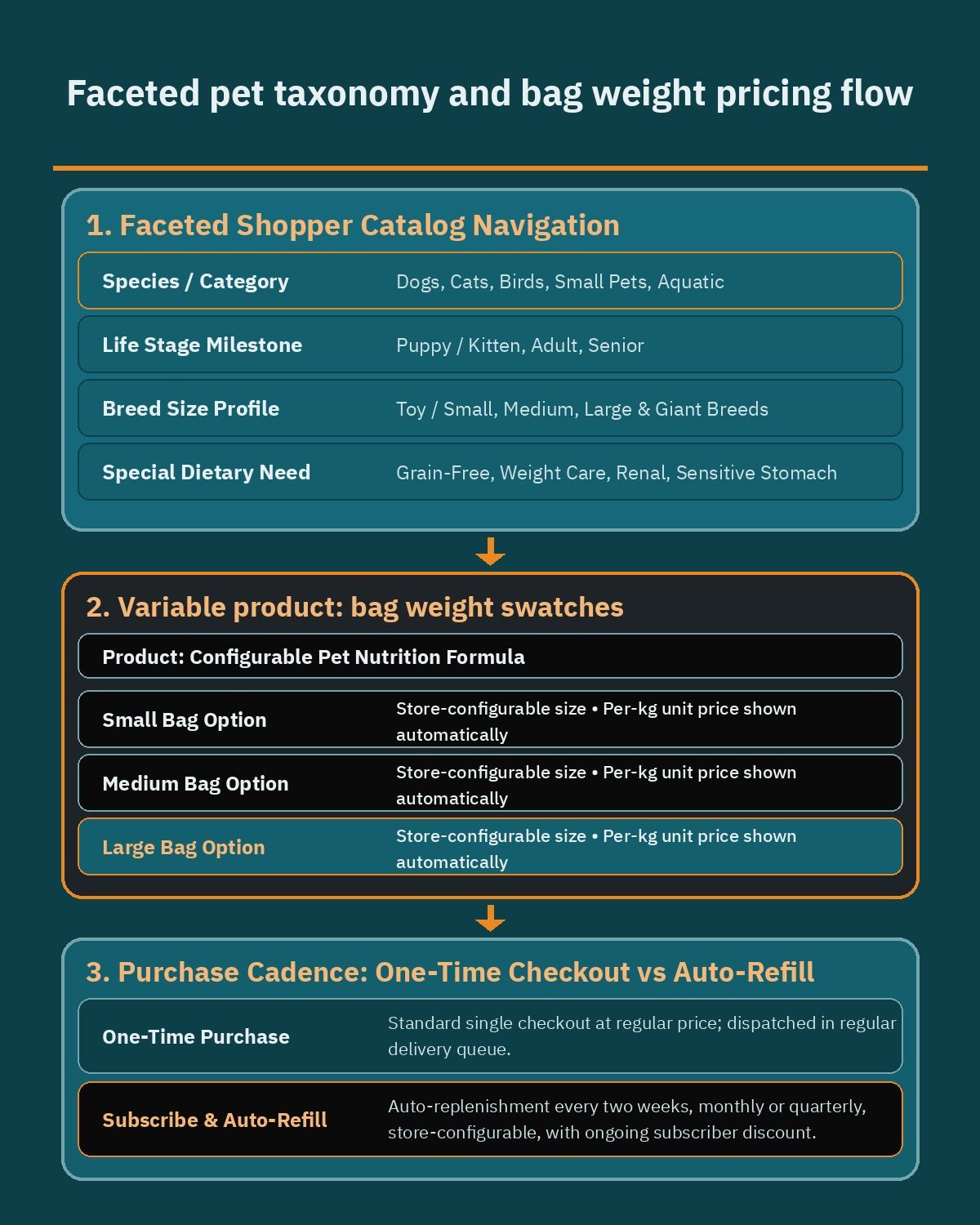
Start by defining primary animal species as top-level product categories or primary taxonomy facets: dogs, cats, birds, small pets (such as rabbits, hamsters, and guinea pigs), and aquatic pets (freshwater and marine fish or reptiles). Inside each species, avoid creating deeply nested sub-categories for every possible combination of age and health condition. Instead, assign structured global attributes so shoppers can layer multiple faceted filters simultaneously on a single archive page.
- Life stage attribute: Puppy or kitten starter, junior, adult maintenance, mature senior, and pregnant or lactating mother formulas.
- Breed size attribute: Toy and mini breeds, medium breeds, large breeds, and giant breed kibble shapes designed for specific jaw sizes and bite mechanics.
- Dietary and health need attribute: Grain-free, urinary tract care, hypoallergenic or hydrolyzed protein, sensitive digestion, sterilized weight control, hairball care, and joint mobility support.
- Primary protein source attribute: Salmon, lamb, chicken, duck, turkey, insect protein, or vegetarian specialty diets for pets with documented food allergies.
When a shopper selects "Cats" alongside "Adult," "Urinary Care," and "Grain-Free," faceted search queries the indexed attribute tables and updates the product grid immediately without full page reloads. You can also allow registered customers to save a basic pet profile in their account so returning shoppers see pre-filtered catalog recommendations matching their pet's species and age.
### Configuring bag weight variations and per-kilogram unit pricing
Every dry food formula should exist as a single WooCommerce Variable Product rather than separate catalog entries for each bag size. By creating a global Weight attribute with store-configurable terms matching your supplier packaging (for example, 1.5kg, 3kg, 10kg, or 15kg bags), you keep all customer reviews, nutritional tables, and feeding guidelines consolidated on one authoritative URL.
Each weight variation in WooCommerce stores its own SKU, exact barcode, stock quantity, physical shipping dimensions, and price. On the product page, replace default dropdown menus with clear button swatches that display both the total bag price and the dynamically calculated per-kilogram unit cost. Showing pet owners that a larger sack lowers their cost per kilogram encourages higher average order values while reducing warehouse picking frequency.
## Automating repeat kibble and litter orders with recurring subscriptions
Pet food and cat litter are high-frequency consumables with predictable depletion rates. A household with two adult cats or a large dog buys the exact same kibble formula and litter brand on a regular cycle. Relying on that customer to remember to reorder before the bag runs empty invites them to buy from a competing marketplace or neighborhood shop whenever they run low.
Implementing the official WooCommerce Subscriptions extension lets you offer an automated replenishment option right next to the standard one-time purchase button on eligible consumable products. Much like the recurring delivery workflows used on a [WooCommerce coffee roastery website](https://heshamsaad.com/en/coffee-roastery-website-woocommerce/), pet supply subscriptions succeed when the customer feels in complete control of their delivery cadence rather than locked into a rigid contract.
Merchants can configure flexible billing and shipping intervals that match how fast different households consume supplies, alongside optional store-configurable subscriber pricing perks that reward loyalty. To minimize support tickets and failed deliveries, your subscription implementation should include these practical customer and warehouse features:
- Store-configurable delivery intervals: Let shoppers choose recurring schedules such as every two weeks, monthly, or quarterly depending on their pet size and storage space.
- Self-service skip and pause buttons: Allow pet owners to skip their next scheduled box or pause renewals from their mobile account dashboard when they travel or still have unopened food at home.
- Easy formula and weight switching: Enable subscribers to upgrade from a puppy or kitten formula to an adult maintenance diet, or switch bag sizes within an active subscription without canceling and starting over.
- Automated pre-renewal notifications: Send an automated email or WhatsApp/SMS alert a few days before a recurring charge processes so the customer can add one-time treats, flea drops, or toys to their upcoming shipment.
- Stock reservation alerts: Monitor inventory levels on top-selling subscription SKUs so purchasing managers reorder stock before scheduled recurring renewals trigger out-of-stock exceptions.
## Building a veterinary prescription gate for clinical pet diets
Many pet stores in the MENA region operate alongside veterinary clinics or distribute clinical therapeutic diets formulated for specific medical conditions, such as struvite stone dissolution, chronic renal insufficiency, endocrine disorders, or severe food allergies. Selling these veterinary-exclusive diets openly without verifying that a licensed veterinarian recommended them creates clinical risks for the animal and can violate distributor agreements or local veterinary retail regulations.
You can enforce a structured compliance gate in WooCommerce using WooCommerce Product Add-Ons or custom checkout validation rules tied to a dedicated "Veterinary Diet" product tag. This workflow closely resembles the prescription verification process used on a [WooCommerce pharmacy website](https://heshamsaad.com/en/pharmacy-website-woocommerce/), adapted for companion animal healthcare and veterinary clinic records.
When a shopper views or checks out with a gated therapeutic diet, the store requires them to complete one of three store-configurable verification methods before the order can move to warehouse picking:
1. Direct prescription upload: The customer uploads a photo or PDF of a signed veterinary prescription or discharge sheet directly on the product page or checkout screen using a required file upload field.
2. Attending clinic and veterinarian lookup: If the customer does not have a paper copy on hand, they enter their pet's name, the prescribing veterinary clinic name, and the clinic contact number so your in-house vet team can verify the authorization directly.
3. Pre-approved clinic patient ID: For veterinary hospital groups running their own WooCommerce store, existing clients enter their patient file number, which validates against an approved dietary flag in the customer account profile with an expiration date.
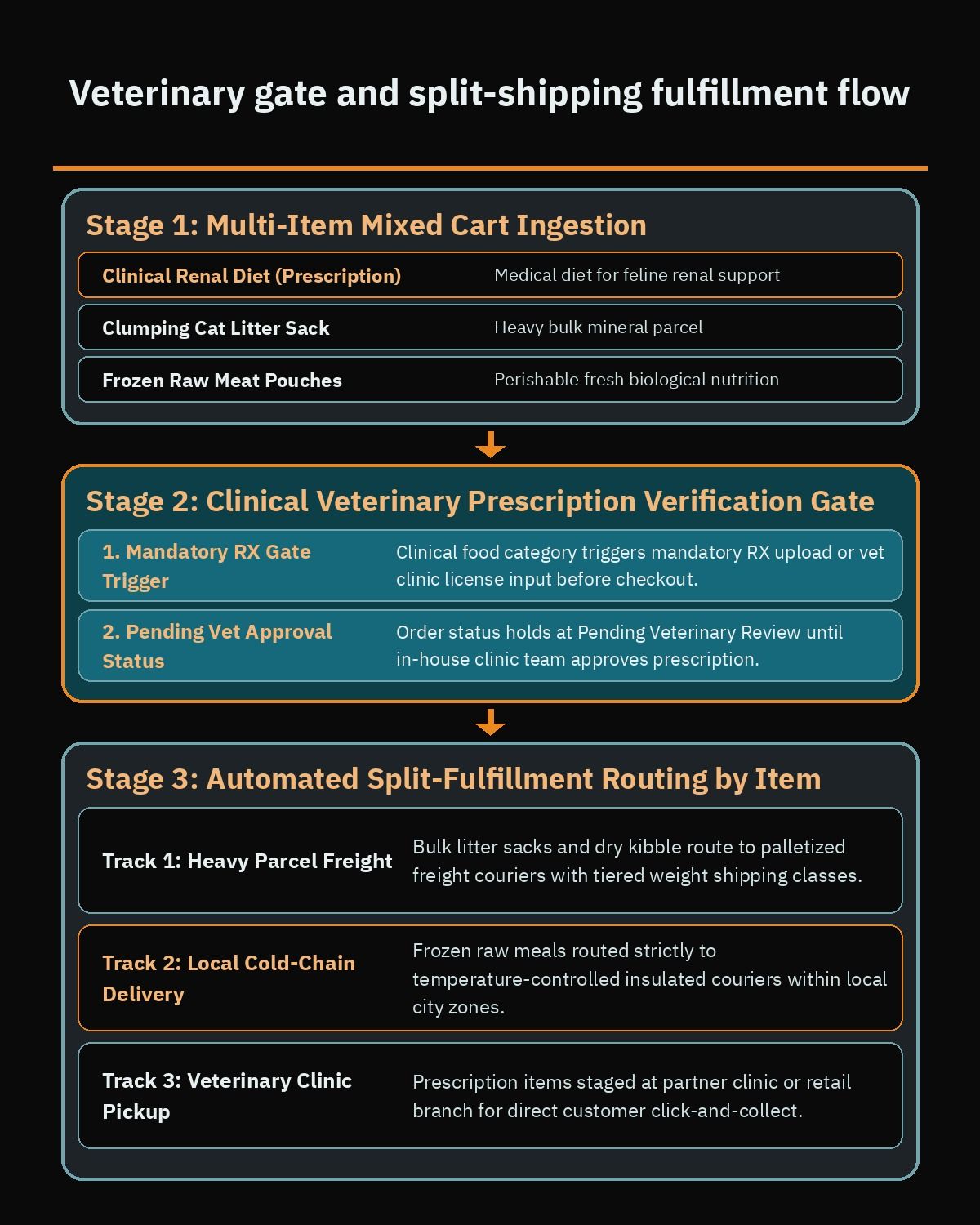
Orders containing clinical diets automatically enter a custom order status (such as "On Hold: Pending Vet Review") rather than dropping straight into the warehouse packing queue. Once your licensed veterinary supervisor reviews the uploaded file or confirms the prescription, they approve the order for dispatch and can optionally save the authorization expiration date on the customer profile so recurring therapeutic food subscriptions renew smoothly during the approved treatment window. Because veterinary pharmacy and therapeutic feed regulations vary across jurisdictions, merchants should always confirm local compliance requirements with a qualified legal or regulatory advisor.
## Managing heavy litter freight, cold-chain raw meals, and clinic pickup
Shipping logistics can make or break a pet supply e-commerce business. If you offer a flat shipping fee across your entire catalog without accounting for package weight and temperature control, a single order containing three large bags of bentonite cat litter and a box of frozen raw dog food will wipe out your gross margin on the sale. Configuring granular rules under WooCommerce > Settings > Shipping prevents margin leakage while giving customers accurate delivery options.
### Splitting heavy dry freight from insulated cold-chain delivery
Start by creating distinct WooCommerce shipping classes for each logistical profile: Standard Dry Goods, Heavy Bulk Freight (for large kibble sacks, litter bags, and glass aquariums), and Cold-Chain Frozen Meals. Pair these classes with a well-planned regional zone hierarchy; you can follow our guide on [setting up WooCommerce shipping zones in Egypt and the Gulf](https://heshamsaad.com/en/woocommerce-shipping-zones-egypt-gulf/) to map urban neighborhoods, secondary cities, and remote provinces accurately.
When a customer adds heavy litter bags to their cart, your shipping rules calculate tiered weight-based surcharges or adjust the free-shipping threshold so heavy freight costs are covered transparently. For domestic parcel dispatch and automated waybill printing, connecting your store through [WooCommerce courier plugins for Egypt and Saudi Arabia](https://heshamsaad.com/en/woocommerce-courier-plugins-egypt-saudi/) lets your warehouse print shipping labels and push weight data directly to regional carriers.
Frozen fresh and raw pet food requires a stricter rule set. Because frozen meals cannot travel in unrefrigerated courier trucks across long intercity routes, checkout validation should restrict the Cold-Chain shipping class to specific metropolitan postal zones served by your own refrigerated vans or specialized temperature-insulated local couriers. If a customer outside your cold-chain coverage zone adds a frozen product to their cart, the checkout page displays a clear notice explaining which cities support chilled delivery and offers dry or freeze-dried alternatives.
### Enabling express local dispatch and veterinary clinic pickup
When a pet owner runs out of puppy milk replacer, litter, or prescription recovery food, waiting several days for standard parcel shipping is not an option. For customers inside covered metropolitan neighborhoods where your local fleet or on-demand courier partners operate, you can offer a store-configurable rapid same-day or express local dispatch option for in-stock items ordered before your daily cutoff time.
Alongside home delivery, enabling native WooCommerce Local Pickup under WooCommerce > Settings > Shipping > Local Pickup is ideal for pet retail chains and veterinary clinics with physical branches. Customers can order heavy bags or chilled therapeutic diets online and select their nearest clinic or store location for collection, saving on heavy freight charges while giving your in-store staff an opportunity to build a personal relationship with the pet owner.
## Increasing basket value with care bundles, seasonal reminders, and engraved tags
Because baseline dry kibble and litter brands face stiff price competition, profitable pet stores rely on curated bundles, multi-packs, and personalized accessories to lift overall order margins. Using the official WooCommerce Product Bundles extension lets you package complementary items together while maintaining accurate item-level stock tracking in your warehouse.
Instead of creating static bundle SKUs that require pre-packing inventory on warehouse shelves, virtual product bundles deduct stock directly from each individual child SKU only when a customer completes a purchase. High-performing merchandising formats for pet stores include:
- New puppy and kitten starter kits: Combine a starter kibble bag, stainless steel bowls, a training pad pack or litter box with scoop, a teething toy, and a grooming brush in a single customizable bundle where shoppers pick their preferred color and flavor.
- Pick-and-mix wet food cases: Let cat and dog owners build a custom multi-can tray (for example, choosing twelve cans across four protein flavors) at a bundled case price while deducting exact quantities from each flavor's inventory.
- Pet birthday and adoption celebration boxes: Package grain-free treats, plush toys, and a festive bandana with an optional gift message field.
- Coat-specific grooming tool bundles: Pair deshedding rakes, nail clippers, ear cleaners, and gentle shampoos tailored to long-haired or double-coated breeds.
- Engraved ID collar tags with WooCommerce Product Add-Ons: Add custom text fields directly on collar and tag product pages so customers can enter their pet's name and owner phone number, complete with character limits, font selection, and an optional store-configurable engraving fee.
- Seasonal flea, tick, and deworming refill prompts: Configure automated post-purchase reminders timed to the preventative dosage cycle so pet owners can reorder topical drops or chewables before protection lapses during warmer months.
## Configuring regional payment gateways and one-tap mobile reordering
Most pet supply orders happen on a smartphone while the owner stands in the kitchen checking the food bin or visits the veterinary clinic. If your mobile checkout requires tedious address typing or lacks trusted local payment methods, conversion rates drop sharply. Your checkout architecture should combine regional payment gateways with a fast repeat-order dashboard.
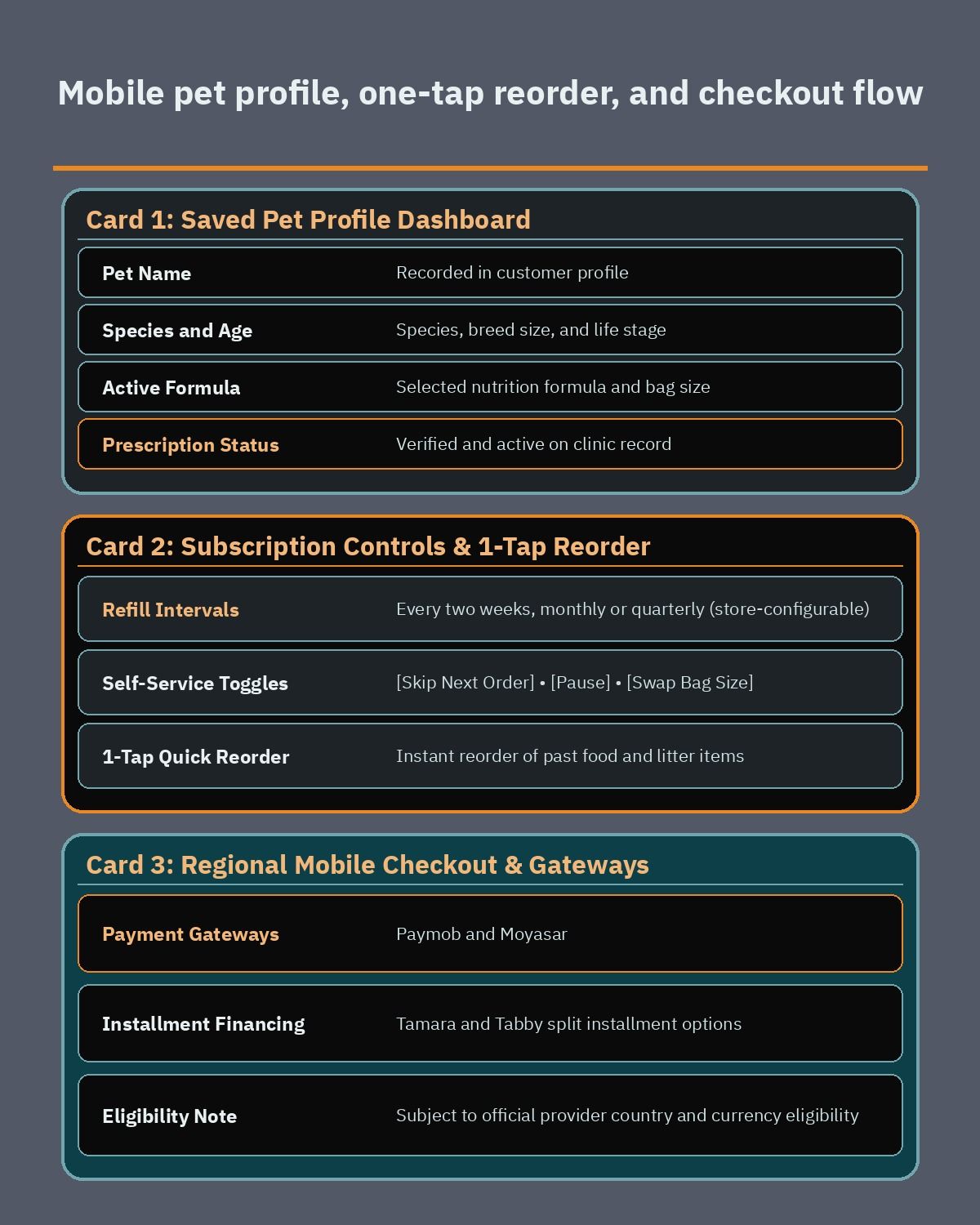Across MENA pet retail markets, shoppers expect trusted local debit networks, mobile wallets, cards, and installment options at checkout. Depending on your store registration and gateway eligibility, you can evaluate official WordPress plugins including Paymob for WooCommerce, Moyasar, Tamara Checkout, and Tabby Checkout to offer local payment cards, Mada, Apple Pay, and split-payment plans for higher-ticket purchases such as large aquariums, automatic self-cleaning litter boxes, or bulk food orders.
Gateway rules, recurring tokenization support for subscriptions, and installment eligibility vary by merchant category and country. Always check Tabby current supported countries and currencies on its official plugin page before planning your integration, and verify regional gateway and payment-method rules for Paymob, Moyasar, and Tamara on their official pages to confirm which payment methods support automated recurring subscription charges versus one-time checkout.
Even when a customer prefers not to commit to an automated subscription, you can make repeat purchasing effortless by customizing the WooCommerce My Account dashboard for mobile users. Putting a prominent "Reorder Again" panel at the top of the account screen displays the shopper's previously purchased kibble bag weight and litter brand, allowing them to rebuild their standard cart with a single tap and check out in seconds using saved delivery addresses and express mobile wallets.
## What drives development cost and how to brief your WooCommerce team
When pet shop owners and veterinary groups compare e-commerce platforms, they often discover that hosted SaaS builders become expensive or restrictive once you layer on prescription verification queues, split cold-chain shipping rules, per-kilogram unit pricing, and bilingual Arabic/English catalogs. You can review our detailed [WooCommerce vs Shopify comparison](https://heshamsaad.com/en/woocommerce-vs-shopify/) to see how full code ownership and custom checkout rules affect long-term operating costs for specialized MENA retailers.
In a custom WooCommerce pet store build, the total development investment is driven by workflow complexity and external system integrations rather than decorative theme animations. The primary cost drivers include:
1. Catalog data migration and attribute normalization: Cleaning supplier spreadsheets so thousands of SKUs map cleanly into species, life stage, breed size, dietary tags, and unified variable weight products with accurate barcodes.
2. ERP, POS, or veterinary clinic software synchronization: Connecting online stock levels and branch pickup availability with your retail point-of-sale system or veterinary practice management database so walk-in clinic sales do not cause online overselling.
3. Custom prescription verification and cold-chain checkout logic: Building the file upload interface, staff approval queue, expiration tracking for clinical diets, and postal-zone validation for frozen raw food delivery.
4. Bilingual RTL and LTR user experience: Designing fast faceted search, mobile account dashboards, and automated subscription notifications in both Arabic and English so every filter, weight swatch, and feeding table reads naturally in both directions.
Before approaching a development team, prepare a clear brief that lists your total SKU count, which products require recurring subscriptions or veterinary prescription checks, how you currently ship heavy litter versus chilled food, and which accounting or POS system runs in your branches. If you want an experienced technical partner to review your catalog structure and fulfillment rules, book a [free consultation](https://heshamsaad.com/en/free-consultation/) so we can map out a practical, step-by-step architecture for your pet store.
## Frequently asked questions
How do recurring pet food and cat litter subscriptions work in WooCommerce?You can use the official WooCommerce Subscriptions extension to offer store-configurable delivery intervals such as biweekly, monthly, or quarterly schedules on dry kibble, wet food pouches, and cat litter. Pet owners can log into their customer account to skip a shipment, pause deliveries while traveling, switch bag weights, or update their saved payment card without contacting support. Merchants can also configure optional subscriber pricing rules to reward recurring orders.
How should I organize a WooCommerce catalog for multiple pet species and dietary needs?Structure your catalog using WooCommerce categories and custom product attributes for animal species, life stage, breed size, and clinical or lifestyle dietary needs such as grain-free, urinary care, or sensitive digestion. Pair those attributes with WooCommerce Variable Products so all bag weight options stay on a single product page with clear per-kilogram unit pricing. Shoppers can then combine multiple filters at once without browsing through duplicate listings.
Can WooCommerce verify veterinary prescriptions before selling clinical pet diets?Yes, you can add a prescription verification gate on regulated clinical diets using WooCommerce Product Add-Ons or custom checkout fields. Customers either upload an image or PDF of their signed veterinary prescription or provide their attending clinic details and vet phone number for staff confirmation. The store holds the order in a pending verification status until your veterinary team approves the diet for warehouse dispatch, subject to local regulatory rules.
How do I handle shipping for heavy cat litter bags and frozen raw pet meals in the same cart?You can configure WooCommerce Shipping Zones and distinct shipping classes to separate heavy dry freight from temperature-insulated local cold-chain items. Heavy litter sacks calculate tiered weight-based courier fees, while frozen raw meals restrict checkout to local postal zones served by refrigerated vans or insulated express bikes. You can also enable WooCommerce Local Pickup so pet owners can collect chilled or clinical items directly from your veterinary clinic or retail branches.
Which payment gateways and mobile features help pet owners reorder supplies faster?Integrating regional plugins such as Paymob for WooCommerce, Moyasar, Tamara Checkout, and Tabby Checkout lets shoppers pay with local debit networks, mobile wallets, cards, or installment plans after you verify each provider's current supported countries and currencies. Pairing those gateways with a one-tap reorder button inside the mobile My Account dashboard allows returning pet parents to refill their exact bag weight and litter brand in seconds.