---
id: 14121
title: "Microsoft Copilot Harness: Features, Preview Access, Pricing and What It Means for WordPress"
slug: "microsoft-copilot-harness"
lang: "en"
url: "https://heshamsaad.com/en/microsoft-copilot-harness/"
markdown_url: "https://heshamsaad.com/en/microsoft-copilot-harness.md"
translations: {"ar":"https://heshamsaad.com/ar/microsoft-copilot-harness/"}
description: "Microsoft Copilot harness is in public preview in Foundry: features, 9 regions, free runtime until Dec 1, sandbox pricing and what it means for WordPress."
author: "Omar Khaled"
date_published: "2026-10-28T17:33:59Z"
date_modified: "2026-10-28T17:33:59Z"
categories: ["AI News"]
tags: ["AI News"]
featured_image: "https://heshamsaad.com/wp-content/uploads/2026/10/microsoft-copilot-harness-og-en.jpg"
word_count: 2702
reading_time_min: 14
content_sha256: "fac0f1ab15f08c7b22834f5957a6275eab2ed2f46a1481976a4fb3f3e82d1a3f"
---
# Microsoft Copilot Harness: Features, Preview Access, Pricing and What It Means for WordPress
Microsoft has announced the Microsoft Copilot harness in Foundry Agent Service, in public preview as of October 28, 2026. Microsoft describes it as a way to build agents that reason, use tools and complete long-running tasks. The harness is the engine that runs agents inside Microsoft's own Copilot products, and it is now offered as an optional, fully managed runtime for agents you build in Microsoft Foundry. The main announcement was written by Tina Schuchman, corporate vice president for Foundry, and Vladimir Fedorov, chief technology officer of GitHub, and a companion post on the Foundry blog adds the preview details and the first prices, and points to the Learn limits page for the regions.
This is a platform release, not a new model, so it is easy to dismiss. It is worth a careful read anyway, because many agencies and in-house teams are building AI agents for support, content and internal workflows, and the harness is the part that decides how reliable those agents are. In this post we explain what a harness is, what Microsoft announced, how it fits with Foundry and Copilot Studio, what it will cost, where it runs, the pros and cons, the best use cases, and what it means for a WordPress site. Everything below comes from Microsoft and GitHub pages, and we say clearly where Microsoft has not published something.
## What a harness is, in plain words
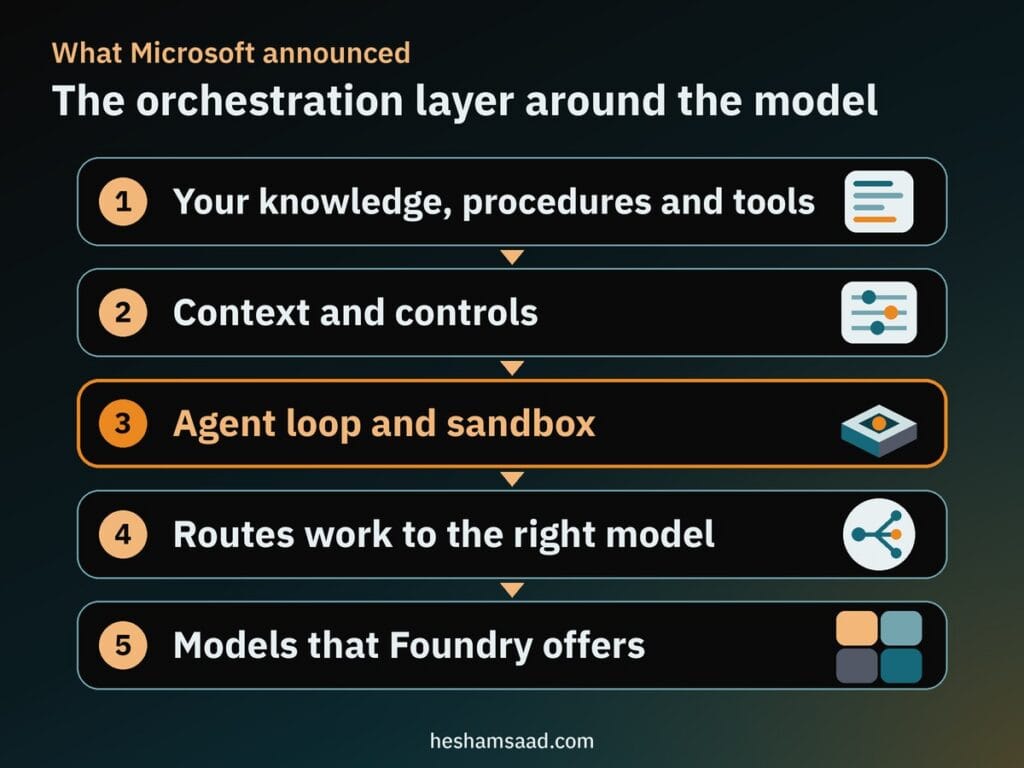
Microsoft describes the harness as the orchestration layer around the model. It gives an agent the right instructions, context, execution environment and controls to do meaningful work. In practice, and this is our plain-words reading, the harness decides what the model sees, which tools it can call and how a long task continues from step to step.
Microsoft says a good harness supports open standards such as MCP, agent skills and agent plugins, and that its platforms remain open and interoperable. MCP is a common way for agents to connect to tools.
## What Microsoft announced
According to the main announcement, the harness was built by GitHub engineers and adopted company-wide at Microsoft. It already powers Copilot Code, Copilot Studio, the GitHub Copilot app, the command-line tool, VS Code and more. Microsoft cites millions of users and hundreds of use cases without evidence, so treat that as a company claim. The new part is that developers can now use the same harness inside Foundry Agent Service without maintaining it.
- Managed by Microsoft: Microsoft runs the agent loop and the sandbox. You bring the knowledge, the procedures and the tools that make the agent yours.
- Four building blocks: reusable skills, connected tools (supported Foundry tools and MCP tools, with the authentication and approvals you configure), execution and delegation to built-in subagents, and source-controlled agent definitions that you can keep next to your application code.
- Built-in harness tools: the Learn documentation lists file read, file write, shell, web fetch and subagents, all enabled by default unless you turn them off.
- Multi-model, with limits: the main blog post says the harness supports more than 20 frontier models plus bring your own key, and routes work to the right model. In the Foundry preview, the Learn limits page says models must support reasoning and tool calling, and bring your own model is not supported. Microsoft has not published the list of models.
- Faster runtime: the harness runtime was recently ported to Rust, which Microsoft says reduced session overhead and time to first token. GitHub's engineering blog separately describes a rewrite of the Copilot runtime into more than 800,000 lines of Rust. Both are the companies' own claims. GitHub's post says performance improved by orders of magnitude, and Microsoft's announcement gives no figures for the Foundry offering.
## How it fits with Foundry and Copilot Studio
The Foundry documentation is clear on one point that is easy to miss: the harness is an optional managed runtime for prompt agents, not for hosted agents. A prompt agent is defined by configuration, meaning a model, instructions and tools, and you call it through the Responses API. You select the harness when you create the agent, and you cannot switch an existing agent to it during the initial preview. Each request needs a conversation, and each conversation gets its own workspace for files and execution state. Microsoft advises storing important outputs in Foundry Files or another durable service.
The announcement lists three approaches: prompt agents without the harness, prompt agents with the harness, and hosted agents. The Learn page says to use the harness when your prompt agent needs supported multi-step tool, skill, file or command workflows and you want Foundry to operate the runtime, and to use a hosted agent when you need to own the framework, orchestration, middleware, runtime policy, dependencies or process model. The same announcement says long-running resilience for hosted agents is generally available this week, which is a separate feature.
Copilot Studio is a different product. Its documentation describes a GitHub Copilot harness for building agents in Copilot Studio, with natural language authoring still labeled preview, usage billed in Copilot Credits, and no customer data sent to the GitHub Copilot service. The October 28 announcement is about Foundry, so read each product's pages separately.
## Pricing, dates and regions: what Microsoft has published
Unlike most platform announcements, this one comes with a price list, though only for part of the bill. The Foundry blog post gives these terms.
- Status: public preview as of October 28, 2026. The Learn page adds that previews come without a service-level agreement and that Microsoft does not recommend them for production workloads.
- Billing start: billing for the harness begins on December 1, 2026, with consumption-based pricing. Harness runtime usage is free before that date.
- Sandbox prices from December 1: USD 0.0994 per vCPU-hour for compute and USD 0.0118 per GiB-hour for memory. Microsoft says prices may vary by region and agreement.
- Still billed separately: model inference and any separately billed tools and connected services keep their own charges, before and after December 1.
- Regions: the Learn limits page lists nine preview regions: Australia East, Canada Central, Central US, Germany West Central, Japan East, Sweden Central, UK South, West Europe and West US.
For readers in the Middle East and North Africa, note that none of those nine regions is in the Middle East or Africa. A company with data residency rules should check where its agent will run before planning a pilot.
## What Microsoft has not published
Even with those prices, important gaps remain.
- The model list: the more than 20 models are not named, and the page does not say how many of them work in the preview.
- Benchmarks: there are no benchmark or speed figures for the Foundry offering. The Rust performance claims are not quantified in the announcement.
- A cost estimate: the sandbox size is managed by Foundry and CPU and memory are not customer-configurable, so we cannot turn the two unit prices into a monthly cost for a typical agent. Model token prices are a separate bill.
- General availability: there is no date for leaving preview, and no service-level agreement during the preview.
- Prices outside the two meters: the announcement does not say whether other meters will be added after December 1.
## Pros and cons
Here is a balanced view based on what Microsoft has published.
- Pro: less to maintain. You do not have to build and keep up the execution machinery around the model.
- Pro: transparent unit prices. Two published sandbox rates and a free runtime until December 1 make a low-risk trial possible.
- Pro: open standards. Support for MCP, skills and Foundry tools means what you build can be reused.
- Pro: governance in the platform. Foundry roles, agent identity and network egress controls (itself a preview) apply to harness agents.
- Con: preview limits. No service-level agreement, no production recommendation, and a subset of regions that excludes the Middle East.
- Con: no bring your own model. The preview supports only models that Foundry offers, with reasoning and tool calling.
- Con: missing features. Foundry Memory is not supported, the sandbox cannot be tuned and strict function schemas are not supported.
- Con: unclear total cost. Compute is priced, but model usage and tools are billed on top, and no benchmark shows how much work an agent finishes per dollar.
## Best use cases
These are our expectations from the documentation, not tested results.
- Research and analysis agents: Microsoft's quickstart for the harness builds a web research agent, which fits web fetch, file and skill tools.
- Coding and file workflows: the harness comes from GitHub's developer tools and includes file and shell tools.
- Long multi-step tasks: skills and subagents suit work that needs several stages.
- Internal business agents: support, document and data workflows that need company identity and governance, in a supported region.
## How it compares with other options
The announcement does not compare the harness with products from other companies, and we will not invent a comparison. What we can say is how the choices differ in kind. You can use a model provider's own agent tools, which tie you to that provider's models. You can write your own harness, which gives full control and a permanent maintenance job. You can use an open-source agent framework, which is flexible but leaves hosting and governance to you. Microsoft's offer sits between the last two: a maintained harness and managed hosting, in exchange for building on Azure and Foundry and accepting preview limits. Inside Microsoft's own range, hosted agents remain the path for teams that need to own the loop.
Model choice matters because the best model changes often. In recent weeks we covered [GPT-6.1 Terra](https://heshamsaad.com/en/gpt-6-1-terra/) and [Kimi K3.1 Pro](https://heshamsaad.com/en/kimi-k3-1-pro/), and a team that hard-codes one model into its agents has to rework them each time a better one arrives. Keep in mind that the preview limits you to models Foundry offers, not any model you bring.
## What it means for a WordPress site or a business
The Copilot harness is not a WordPress plugin, and the announcement never mentions WordPress. It does not change your site today. It matters if you plan to put an AI agent next to your site, and each point below is our own reading, not a Microsoft claim.
- Agents are a build decision: if you want a support assistant, a content helper or an order-status bot for a WordPress or WooCommerce site, the harness and the model affect reliability and cost more than the chat window does. Ask any vendor which harness and models they use.
- Keep site access narrow: an agent that can edit your site is a security risk. Give it a dedicated user with the least permissions it needs, work on a staging copy first and require a human to approve publishing or settings changes. Our [WordPress security audit](https://heshamsaad.com/en/wordpress-security-audit/) guide shows what to review.
- Treat it as a trial for now: the preview has no service-level agreement and Microsoft does not recommend it for production. A pilot on one low-risk task before December 1 costs only model and tool usage, based on the published terms.
- Plan for the bill after December 1: set a usage cap and an alert before an agent goes live, because sandbox compute and memory are billed by the hour.
- Check the region: if your customers' data must stay in the Gulf or in Africa, the preview regions do not cover it yet.
If you want an AI assistant, a support workflow or a safer update routine planned for your own site, our [WordPress development](https://heshamsaad.com/en/wordpress-development/) service can scope it, and you can book a [free consultation](https://heshamsaad.com/en/free-consultation/) to talk it through.
## Questions to ask before you adopt it
Because this is a preview, a short checklist is more useful than a verdict. First, confirm that your Foundry project is in one of the nine supported regions and that your chosen model supports reasoning and tool calling there. Second, check whether the tools you need, such as web search or MCP servers, are available in that region and model. Third, set a budget for model and tool usage, since the free harness runtime ends on December 1. Fourth, decide where outputs will be stored, because the workspace belongs to the conversation and is not a durable store. Finally, run a small pilot on one low-risk task, measure the cost and the error rate yourself, and only then decide whether to widen it.
## Limits and what we do not know yet
Besides the gaps listed above, the Learn limits page shows several constraints. Foundry Memory is not supported. Strict function schemas are not supported, and only text, image and file input over HTTP is accepted, with no audio and no WebSocket. Microsoft also warns that networking, tool and service support can be narrower than for prompt agents in general, and that unsupported fields return an error instead of being ignored. We will update this post when Microsoft publishes more.
## Frequently asked questions
What is the Microsoft Copilot harness?It is the orchestration layer around an AI model: the instructions, context, execution environment and controls that let an agent do real work. Microsoft built it with GitHub engineers and uses it in Copilot Code, Copilot Studio and the GitHub Copilot app. On October 28, 2026 it became available in public preview as an optional managed runtime for prompt agents in Foundry Agent Service.
Can I use any model with it in Foundry?No. Microsoft's main blog says the harness supports more than 20 frontier models plus bring your own key. In the Foundry preview, Microsoft Learn says models must support reasoning and tool calling, and bring your own model is not supported. Microsoft has not published the list of supported models, so check your project region in Foundry first.
How much does the Copilot harness cost in Foundry?Harness runtime is free until December 1, 2026. From that date billing is consumption based, at USD 0.0994 per vCPU-hour for sandbox compute and USD 0.0118 per GiB-hour for memory. Microsoft says prices may vary by region and agreement. Model inference and separately billed tools and connected services are charged on top, before and after that date.
When and where can I use it?It is in public preview as of October 28, 2026, with no service-level agreement, and Microsoft does not recommend preview features for production workloads. It runs in nine regions: Australia East, Canada Central, Central US, Germany West Central, Japan East, Sweden Central, UK South, West Europe and West US. Microsoft has not given a date for general availability.
Is this the same as the GitHub Copilot harness in Copilot Studio?They are related but not the same offer. Copilot Studio documents its own GitHub Copilot harness, with natural language authoring still labeled preview, usage billed in Copilot Credits, and no customer data sent to the GitHub Copilot service. The October 28 announcement is about Foundry, where the harness is an optional runtime for prompt agents, so read each product's documentation separately.
What does it mean for my WordPress site?Nothing changes on your site today, and the announcement never mentions WordPress. It matters if you plan an AI agent for support or content. Ask which harness and models a vendor uses, give any agent the least access it needs, test on a staging copy and keep a human approval step before changes go live. Treat the preview as a trial, not production.
## References
- [The Official Microsoft Blog: Introducing the Microsoft Copilot harness](https://blogs.microsoft.com/blog/2026/10/28/introducing-the-microsoft-copilot-harness-unlocking-the-potential-of-truly-multi-model-agentic-work/)
- [Microsoft Foundry Blog: Introducing the Microsoft Copilot harness in Foundry Agent Service](https://devblogs.microsoft.com/foundry/microsoft-copilot-harness-in-foundry)
- [Microsoft Learn: Quotas and limits for Microsoft Foundry Agent Service](https://learn.microsoft.com/azure/foundry/agents/concepts/limits-quotas-regions)
- [Microsoft Learn: Use the Microsoft Copilot harness with prompt agents](https://learn.microsoft.com/azure/foundry/agents/how-to/use-tools-skills-copilot-harness)
- [Microsoft Learn: Agents powered by the GitHub Copilot harness in Copilot Studio](https://learn.microsoft.com/en-us/microsoft-copilot-studio/agents-experience/overview)
- [Microsoft Learn: Manage costs for agents powered by the GitHub Copilot harness](https://learn.microsoft.com/en-us/power-platform/admin/manage-usage-github-copilot-harness)
- [Microsoft Learn: What is Microsoft Foundry Agent Service](https://learn.microsoft.com/en-us/azure/foundry/agents/overview)
- [The GitHub Blog: Migrating the GitHub Copilot runtime to Rust](https://github.blog/ai-and-ml/generative-ai/migrating-the-github-copilot-runtime-to-rust-using-copilot/)