---
id: 13193
title: "How to Hire a WooCommerce Developer for Your MENA Online Store"
slug: "hire-woocommerce-developer"
lang: "en"
url: "https://heshamsaad.com/en/hire-woocommerce-developer/"
markdown_url: "https://heshamsaad.com/en/hire-woocommerce-developer.md"
translations: {"ar":"https://heshamsaad.com/ar/hire-woocommerce-developer/"}
description: "Planning to hire a WooCommerce developer for Egypt or Saudi? Scope factors, portfolio checks for checkout, RTL, payments, shipping, and clean ownership."
author: "Safya"
date_published: "2026-10-16T17:00:00Z"
date_modified: "2026-10-22T17:13:41Z"
categories: ["WooCommerce"]
tags: ["Hire WooCommerce Developer","Online Store Handover","WooCommerce Agency","WooCommerce Developer Egypt","WooCommerce Developer Saudi Arabia","WooCommerce Store Cost"]
featured_image: "https://heshamsaad.com/wp-content/uploads/2026/10/hire-woocommerce-developer-og-v2-en.jpg"
word_count: 2556
reading_time_min: 13
content_sha256: "e0b183f260ea0466a3410ca12c585574460ee2250c1dac966ba289735f4f61ec"
---
# How to Hire a WooCommerce Developer for Your MENA Online Store
Search "hire WooCommerce developer" and you will find freelancers who customize themes, agencies that rebuild entire catalogs, and marketplace sellers who paste the same pitch for every niche. For a business owner in Egypt, Saudi Arabia or the Gulf, the hard part is not finding someone. It is knowing whether you need a designer who can style product pages, a developer who can wire payments and shipping, or a small team that will own the store after launch. This guide covers what each option usually delivers, what drives the scope of a WooCommerce store project, the questions to ask before you sign, and the practical checks that show whether a portfolio store is ready for real customers.
I build and maintain WordPress and WooCommerce stores for companies across the region, and many projects start as rescues of stores that looked fine in screenshots but failed at checkout, Arabic layout or courier handoff. The checks below are the ones I would run myself. Every technical point comes from the official WooCommerce documentation or the WooCommerce plugin page on wordpress.org. If you would rather hire a WooCommerce developer as part of a team that handles store setup, Arabic content and ongoing care in one place, our [WooCommerce development](https://heshamsaad.com/en/wordpress-development/) service covers all three. The same checklist works for any provider you are comparing.
## Designer, developer or agency: what a WooCommerce store actually needs
WooCommerce is the open-source ecommerce plugin for WordPress. The plugin page describes a store that blends content and commerce: products, cart, checkout and orders on the same site that carries your pages and blog. That sounds simple until you add local payment methods, courier rules, Arabic right-to-left templates and a catalog that someone on your team must edit without breaking the layout. If you are still choosing the platform itself, read [WooCommerce vs Shopify](https://heshamsaad.com/en/woocommerce-vs-shopify/) before you brief a developer. If other sellers will open stores on your site, start with our guide to planning a [WooCommerce multivendor marketplace](https://heshamsaad.com/en/woocommerce-multivendor-marketplace/).
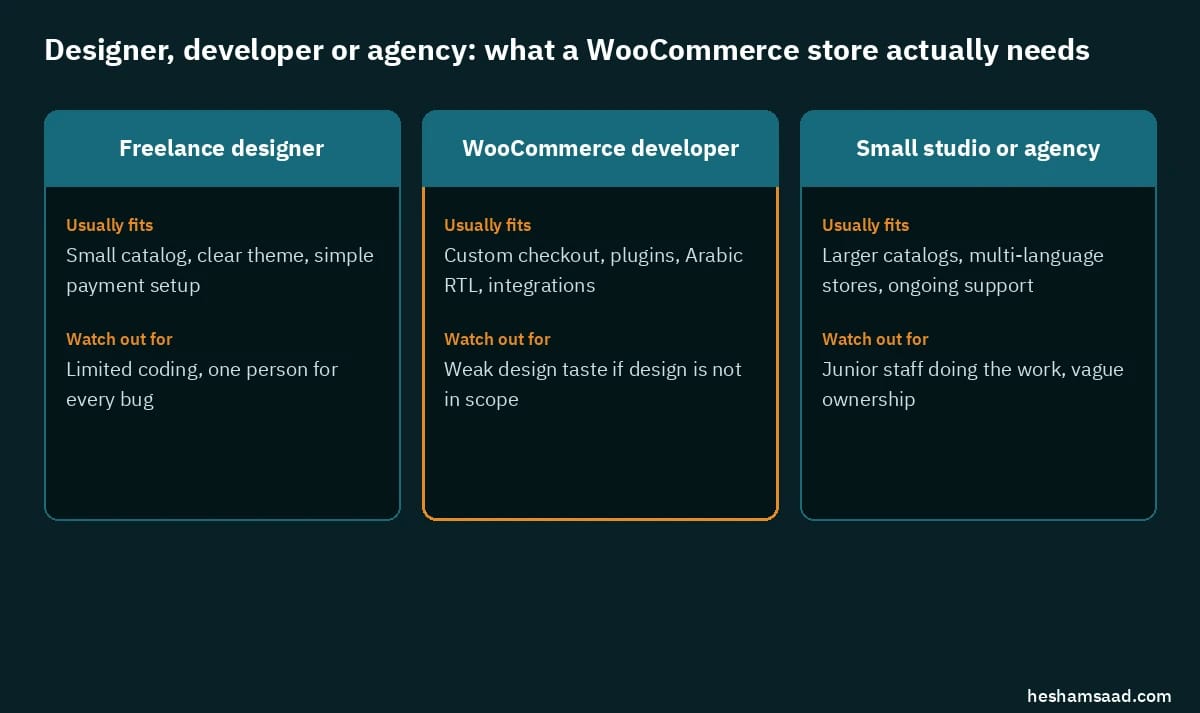
The title on a proposal often hides three different jobs:
- Theme and catalog styling: colors, fonts, product card layouts, and content entered into an existing theme.
- WooCommerce development: product types and attributes, checkout fields, payment and shipping plugins, tax or invoice rules, and custom behavior when the theme cannot do it.
- Agency or studio delivery: design, development, content, testing and a named person for support after launch.
None of these is automatically wrong. The problem starts when you pay for a full store build and receive only a theme skin. If what you mainly need is visual work for a site without a store, read the guide on when to [hire a WordPress designer](https://heshamsaad.com/en/hire-wordpress-designer/), which covers mockups, themes and handover. For a store, keep asking who will own checkout, payments and shipping.
| Option | Usually fits | Watch out for |
|---|---|---|
| Freelance designer | Small catalog, clear theme, simple payment setup | Limited coding, one person for every bug |
| WooCommerce developer | Custom checkout, plugins, Arabic RTL, integrations | Weak design taste if design is not in scope |
| Small studio or agency | Larger catalogs, multi-language stores, ongoing support | Junior staff doing the work, vague ownership |
Location still matters in three ways: working hours that match yours, real experience with Arabic typography and RTL store templates, and familiarity with the payment and courier tools your customers already trust in Egypt or Saudi Arabia. A WooCommerce developer Egypt search often means you want someone who has wired local gateways before. A WooCommerce developer Saudi Arabia search often means mada-ready checkout, Arabic invoices and shipping rules that match how you actually ship. Once the store is live, ask how they handle [WooCommerce SEO](https://heshamsaad.com/en/woocommerce-seo/), because product pages that don't rank won't sell.
## What drives WooCommerce store cost and project scope
I will not invent price ranges here. Any number quoted without seeing your catalog, payment list and shipping rules is a guess. What I can give you are the factors that move effort up or down. When two quotes for the same WooCommerce store cost look far apart, the two providers almost always understood a different scope. Use the list below to force the same brief.
- Catalog size and structure. A few simple products are less work than hundreds of variable products with attributes, images and stock rules.
- Theme path. Adapting a well-built WooCommerce-ready theme is less work than designing custom templates for shop, product, cart and checkout. WooCommerce documents store editing with the Site Editor when you use a block theme, including Cart and Checkout templates. Classic themes and page builders edit differently. Neither path is wrong, but you should know which one you are buying.
- Languages and direction. Arabic and English need translated menus, product fields, emails and templates tested in both RTL and LTR.
- Payments. Each gateway needs credentials, test mode, failed-payment cases and a clear path for refunds. Regional options are a separate decision from the core plugin.
- Shipping and couriers. Flat rates are simpler than weight rules, city zones, COD and courier plugins that create labels or tracking.
- Tax and invoices. Local tax display and invoice fields add setup and testing time.
- Integrations. ERP, accounting, WhatsApp order notes, CRM or custom APIs.
- Content and migration. Who writes product copy, who imports the old catalog, who supplies photos.
- Premium licenses. Paid themes and plugins, and whose account owns the licenses.
- Timeline, revisions and support. Tight go-live dates, unlimited change rounds and post-launch fixes all add effort.
| Factor | Lower effort | Higher effort |
|---|---|---|
| Catalog | Few simple products | Large variable catalog, stock rules |
| Checkout | One gateway, default fields | Several gateways, custom fields, COD |
| Languages | One language | Arabic and English, RTL and LTR |
| Shipping | Flat rate or local pickup | Zones, couriers, weight and COD rules |
If payments are a major part of your brief, read the guide on [payment gateways used by WooCommerce stores in Egypt and Saudi Arabia](https://heshamsaad.com/en/woocommerce-payment-gateways-egypt-saudi/) before you lock the quote. If courier handoff is in scope, the roundup of [courier plugins for Egypt and Saudi WooCommerce stores](https://heshamsaad.com/en/woocommerce-courier-plugins-egypt-saudi/) will help you name the tools you expect, instead of leaving "shipping" as a vague line item.
## Questions to ask before you hire a WooCommerce developer
Send the same short brief to two or three candidates: what you sell, how many products, which countries you ship to, which payment methods you need, and whether the store must be bilingual. Then ask each candidate these questions. The answers usually tell you more than their portfolio screenshots.
1. Will you only style a theme, or will you also configure products, checkout, payments and shipping?
2. Which theme or block theme will you use, and why that one for a WooCommerce store?
3. Can I edit products, prices, coupons and pages myself after launch? Can you show me on staging?
4. Have you built Arabic RTL WooCommerce stores? Can I see live product, cart and checkout pages in Arabic?
5. Which payment gateways and shipping methods will you set up, and who provides the merchant accounts?
6. Will you work on a staging copy until checkout is tested, or directly on the live site?
7. Which premium plugins does the store need, and whose account holds the licenses and renewals?
8. Will hosting, domain, email, analytics and payment dashboards be in my company name?
9. How do you test failed payments, out-of-stock products, coupon edge cases and mobile checkout?
10. What happens after launch: updates, backups, security and who fixes a broken checkout?
11. What will I receive at handover: admin access, staging notes, license keys, a backup and short training?
12. Who owns the custom code and design files if we stop working together?
Good developers ask you questions too: average order value, how you fulfill today, which cities generate most orders, and which steps customers abandon. If the first call is only about packages and not about your catalog and operations, take note.
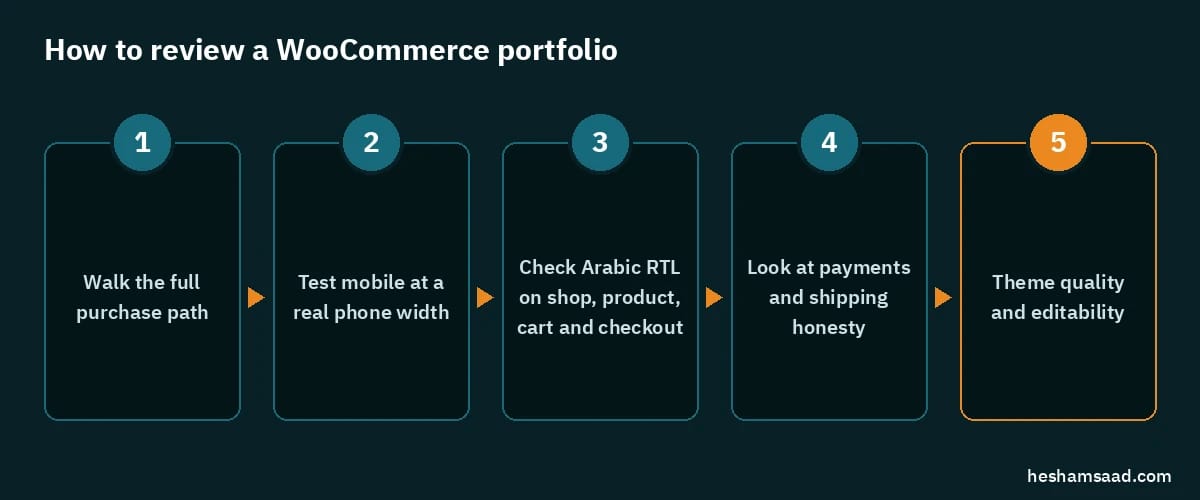
## How to review a WooCommerce portfolio
Mockups show taste. Live stores show whether cart, checkout and emails survive real use. Ask for three live stores similar to yours, ideally at least one in Arabic. Spend about fifteen minutes on each.
### 1. Walk the full purchase path
Open a product, add it to the cart, open the cart, then open checkout as far as you safely can without placing a real order. WooCommerce getting-started documentation treats products, cart, checkout and orders as the core path. If a portfolio site breaks before checkout, or hides the cart behind broken scripts, treat that as a signal. Check that HTTPS is on and that the store still looks maintained.
### 2. Test mobile at a real phone width
Most customers in the region browse on phones. Open the store on your phone, then on a computer open a responsive view around 360px wide. Look for product galleries that overflow, quantity fields that are hard to tap, sticky add-to-cart bars that cover the footer, and checkout forms that force horizontal scrolling. If the developer only shows desktop screenshots, ask for a mobile walkthrough on a call.
### 3. Check Arabic RTL on shop, product, cart and checkout
Open the Arabic version and read it as a customer. Menus, filters, price placement, breadcrumb order and form labels should follow right-to-left reading. Quantity steppers and payment logos should not collide with Arabic text. If the homepage looks fine but the checkout is still left-to-right with broken fields, the portfolio is incomplete for MENA stores.
### 4. Look at payments and shipping honesty
You do not need their merchant credentials. You do need to see which methods appear at checkout and whether shipping options look coherent for the countries they sell to. Ask which gateways and couriers they have launched before. Vague answers like "any payment plugin" usually mean you will be the first test case.
### 5. Theme quality and editability
Ask which theme powers each portfolio store and whether the client can edit templates without calling the developer for every text change. For theme shortlists aimed at Arabic catalogs, see the guide to [WooCommerce themes that suit Arabic online stores](https://heshamsaad.com/en/woocommerce-themes-arabic-stores/). A pretty theme that locks every layout change behind a page builder license you do not own is a future cost, not a finished store.
## Red flags, ownership and handover
Walk away, or renegotiate hard, if you see these patterns:
- No staging site; every experiment happens on the live catalog.
- Hosting, domain or payment accounts registered in the freelancers name.
- Premium plugins bought on a personal account you cannot renew.
- No written list of payment methods, shipping rules or languages in the proposal.
- Portfolio stores that never show cart or checkout.
- Promises of "full SEO and sales growth" with no store operations plan.
- Refusal to give you a full admin user before final payment.
Ownership is not a legal flourish. It is whether you can change developers next year without rebuilding the store. At handover you should have: WordPress admin access, hosting and DNS access, theme and plugin license keys on your accounts, a recent backup, documentation of payment and shipping settings, and a short recording or live session on how to add a product and process an order. WooCommerce documents order management in the admin; your team should be able to find orders, statuses and customer details without sending WhatsApp messages to the developer for every sale.
## When a care plan beats one-off freelance help
A store is not finished at launch. WordPress core, WooCommerce and payment plugins release updates. Couriers change APIs. A sale season can break a shipping rule you thought was settled. One-off freelance help works when the scope is clear and your team can handle routine edits. Ongoing help fits when you need scheduled updates, uptime checks, staging tests before plugin updates, and a named person who understands your checkout.
If that sounds like your situation, look at a structured [WordPress site care plan](https://heshamsaad.com/en/sitecare/) rather than waiting for the next emergency message at midnight. Care plans do not replace a solid launch. They protect the launch you already paid for.
## Frequently asked questions
### Do I need a designer and a WooCommerce developer, or can one person do both?
One experienced person can deliver a small store with a clear theme and a short payment list. Split the roles when you need custom design systems, complex shipping, ERP links or a bilingual catalog with heavy content work. What matters is a written scope that names who owns checkout and who owns visual polish.
### Should I build on WordPress with WooCommerce, or use a hosted ecommerce platform?
WooCommerce suits teams that already want WordPress for content and need ownership of hosting, extensions and data. Hosted platforms can be simpler if you want less server responsibility. The choice depends on your content workflow, local payment needs and who will maintain the store. Do not decide from a slogan; decide from a short list of must-have gateways, languages and integrations.
### How long does a typical WooCommerce store project take?
Timelines depend on catalog size, content readiness, payment approvals and how many revision rounds you need. A small catalog with ready product data moves faster than a migration of hundreds of variable products with new photography. Ask each candidate for a phased plan: staging setup, catalog, checkout, UAT, then launch. Distrust a fixed date that ignores payment merchant approval times.
### What should I prepare before the first call with a developer?
Bring a product list sample, the countries you sell to, the payment methods customers expect, how you ship today, brand files, and any old store URL. Write down who on your team will update prices and stock. The clearer that brief is, the closer the quotes will be to each other, and the less you will pay for scope surprises later.
## Next step if you want help with the store
If you have compared portfolios and still want a team that builds bilingual WooCommerce stores for Egypt, Saudi Arabia and the Gulf, start from our [WooCommerce development](https://heshamsaad.com/en/wordpress-development/) page or book a [free consultation](https://heshamsaad.com/en/free-consultation/) with a short brief attached. Bring the checklist above. Whether you hire us or someone else, a clear scope, a staging checkout test and a clean handover will protect your catalog better than any package name on a proposal.
## References
- [WooCommerce plugin on WordPress.org](https://wordpress.org/plugins/woocommerce/)
- [WooCommerce documentation hub](https://woocommerce.com/documentation/)
- [Getting started with WooCommerce](https://woocommerce.com/document/getting-started/)
- [Installing and uninstalling WooCommerce](https://woocommerce.com/document/installing-uninstalling-woocommerce/)
- [WooCommerce store editing (Site Editor, Cart and Checkout templates)](https://woocommerce.com/document/woocommerce-store-editing/)
- [Managing orders in WooCommerce](https://woocommerce.com/document/managing-orders/)
- [WooCommerce developer documentation](https://developer.woocommerce.com/docs/)
- [WooCommerce checkout developer docs](https://developer.woocommerce.com/docs/features/checkout/)