---
id: 15330
title: "GLM-5.4 Coding Plan: Vision, 50% Quota & WordPress Guide"
slug: "glm-5-4-coding-plan"
lang: "en"
url: "https://heshamsaad.com/en/glm-5-4-coding-plan/"
markdown_url: "https://heshamsaad.com/en/glm-5-4-coding-plan.md"
translations: {"ar":"https://heshamsaad.com/ar/glm-5-4-coding-plan/"}
description: "GLM-5.4 Coding Plan adds native vision and 50% more weekly quota on Z.ai from $18/mo. Compare credits, off-peak MENA hours, and WordPress dev workflows."
author: "Omar Khaled"
date_published: "2026-11-23T06:22:26Z"
date_modified: "2026-11-23T06:22:26Z"
categories: ["AI News"]
tags: ["AI News","Coding Agents","GLM-5.4","WordPress AI","Z.ai"]
featured_image: "https://heshamsaad.com/wp-content/uploads/2026/11/glm-5-4-coding-plan-glm-5-4-coding-plan-og-en.jpg"
word_count: 3903
reading_time_min: 20
content_sha256: "c82178d6d9765a4597e61f8153f3eff9096d90b3a216a80bd322d2809714d79a"
---
# GLM-5.4 Coding Plan: Vision, 50% Quota & WordPress Guide
The arrival of the GLM-5.4 Coding Plan on November 23, 2026 targets two everyday pain points for software teams relying on autonomous coding agents: hitting weekly token walls mid-sprint and routing UI screenshots through secondary helper tools. Announced by Z.ai product lead Zixuan Li and documented in the [ExplainX launch analysis](https://explainx.ai/blog/glm-5-4-coding-plan-vision-50-percent-quota-boost-november-2026) ahead of static documentation table updates, Zhipu AI deployed the new glm-5.4 model across its Lite, Pro, and Max subscription tiers simultaneously.
For web development agencies, technical founders, and business owners in Egypt, Saudi Arabia, and the Gulf, the update changes the economics of AI-assisted WordPress engineering. When your developers spend their afternoons converting bilingual Figma mockups into Gutenberg blocks, debugging right-to-left (RTL) mobile headers, and maintaining WooCommerce checkouts, pairing native image comprehension with a 50% larger weekly quota and timezone-friendly off-peak discounts directly lowers production overhead.
## What Changed in the GLM-5.4 Coding Plan Rollout
Until the November 23, 2026 update, subscribers on the [Z.ai Coding Plan overview](https://docs.z.ai/devpack/overview) worked primarily with `GLM-5.3`, `GLM-5.2`, `GLM-5.1`, and `GLM-5-Turbo` as their core reasoning engines. While those weights handled text-based repository searches, PHP refactoring, and terminal test loops, they lacked direct visual perception inside the primary coding weight. The `glm-5.4` deployment updates the subscription stack across three specific pillars.
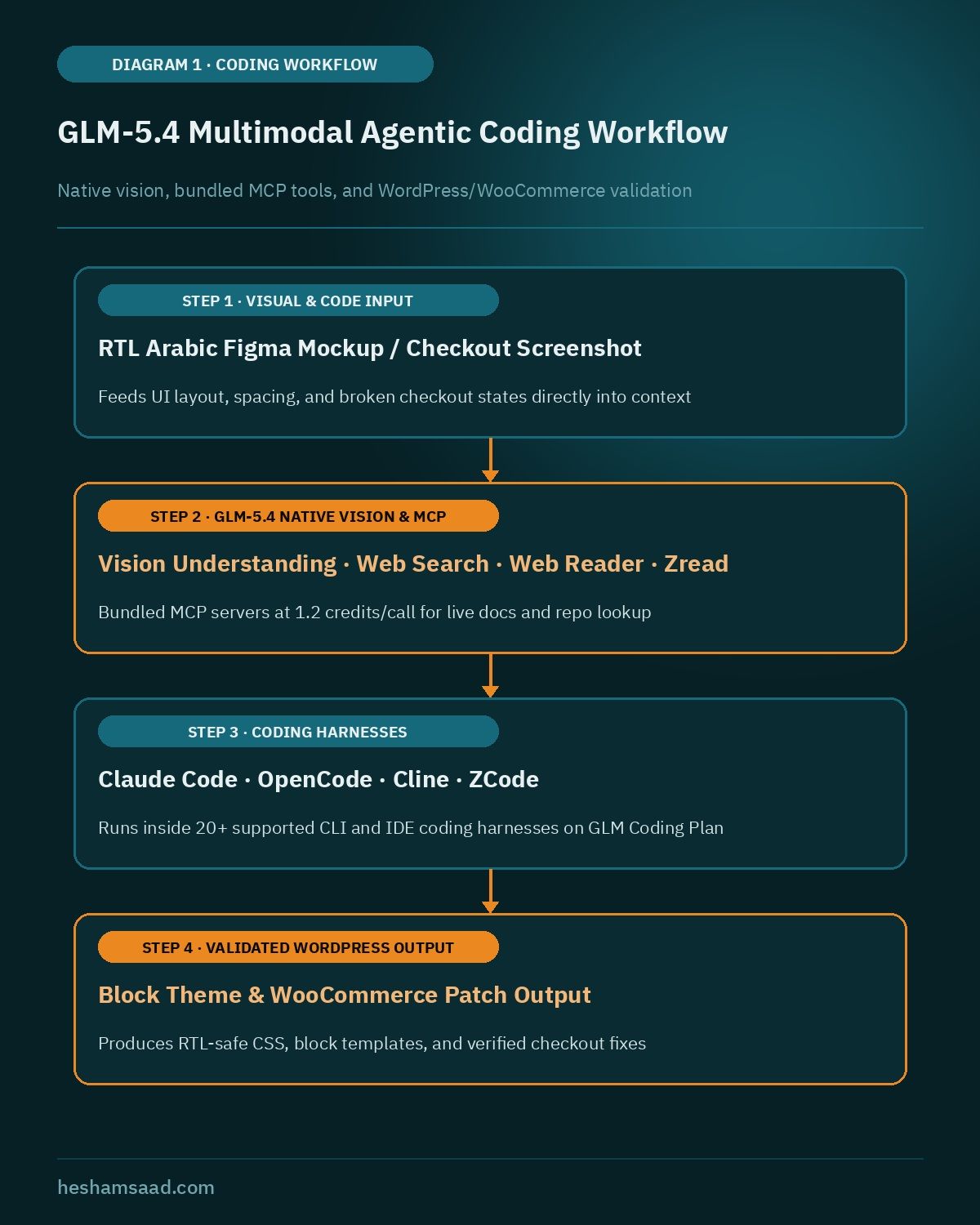
- Native multimodal vision inside the primary model: Previously, sending a screenshot or design diagram inside a Coding Plan session required routing the image through Z.ai's bundled Vision Understanding MCP Server backed by `GLM-5.3-Flash`. With `glm-5.4`, multimodal vision lives directly inside the main coding model, letting your harness inspect visual layout bugs and source files in a single unified reasoning step.
- A 50% weekly usage quota expansion: Running `glm-5.4` grants subscribers a 50% higher weekly usage allowance compared with running `GLM-5.3` on the exact same subscription tier. That expansion gives multi-file agent loops noticeably more breathing room during heavy five-day agency sprints.
- Upgraded agentic coding across more than 20 harnesses: Z.ai tuned `glm-5.4` for end-to-end tool execution, repository navigation, and multi-step patch generation across over 20 supported command-line and IDE harnesses, including `Claude Code`, `ZCode`, `Cline`, `Kilo Code`, `OpenCode`, `OpenClaw`, `Codex`, and `AutoClaw`. Existing subscribers switch immediately by setting their active model identifier to `glm-5.4` in their client configuration.
Eliminating the mandatory handoff to a separate flash model for visual prompts does more than simplify your terminal configuration file. In frontend web work, a separate vision captioning step often strips subtle spatial details, such as a two-pixel border misalignment in an Arabic navigation bar or a truncated currency symbol inside a WooCommerce mini-cart drawer. Having the core coding model read the raw pixels alongside your theme's `theme.json` and CSS rules produces far more accurate first-pass patches.
At the same time, engineering leaders must separate verified launch facts from specifications that remain undisclosed. Because Z.ai product lead Zixuan Li announced the rollout while the documentation team was still refreshing static tables on [docs.z.ai/devpack/overview](https://docs.z.ai/devpack/overview) and [Z.ai's release notes](https://docs.z.ai/release-notes/new-released), several technical items have not been published as of November 23, 2026:
- Exact token multiplier rows for glm-5.4: The static credit multiplier table in the developer documentation still displays the historical rows for `GLM-5.3` through `GLM-4.5-Air` and has not yet added the formal input, cached input, and output multiplier row for `glm-5.4`.
- Standardized benchmark scores: Z.ai has not published verified `SWE-bench Verified`, `SWE-bench Pro`, or `Terminal-Bench` percentage scores for `glm-5.4` on launch day.
- Architecture size and open weights: Total parameter count, active Mixture-of-Experts (MoE) parameter count, context window changes, and any open-weight download schedule remain undisclosed.
- Standalone pay-as-you-go API pricing: Per-million-token metered rates for calling `glm-5.4` outside the subscription Coding Plan have not been posted on the public API rate sheet.
State this distinction clearly to your procurement and engineering teams. You can test `glm-5.4` right now inside an existing Z.ai Coding Plan subscription at a fixed monthly cost, but you should run your own repository benchmark tasks rather than relying on unverified third-party social media claims.
## Official Pricing, Credit Math, and the MENA Off-Peak Advantage
Unlike metered API accounts that expose an agency to surprise thousand-dollar invoices when an autonomous agent gets stuck in a recursive test loop, Z.ai structures its Coding Plan around fixed monthly tiers with dual rolling credit windows. According to the [official Z.ai subscription portal](https://z.ai/subscribe) and the [Coding Plan FAQ](https://docs.z.ai/devpack/faq), developers choose between three monthly plans.
Every plan enforces both a 5-hour rolling burst allowance and a 7-day weekly ceiling. Credit consumption follows Z.ai's published formula: `(Input tokens * Input multiplier + Cached Input tokens * Cached Input multiplier + Output tokens * Output multiplier) / 10,000`. When your coding agent invokes Z.ai's bundled Model Context Protocol (MCP) tools, namely `Vision Understanding`, `Web Search`, `Web Reader`, or `Zread`, each tool invocation deducts a flat `1.2` credits per call. The table below compares the three tiers and illustrates how the 50% weekly quota boost on `glm-5.4` scales across each subscription.
| Plan Tier | Monthly Price (USD) | 5-Hour Rolling Credits | Base Weekly Credits (GLM-5.3 Baseline) | GLM-5.4 Weekly Quota Impact (+50% Allowance) | Bundled MCP Tool Call Cost | Overage and Cash Balance Protection |
|---|---|---|---|---|---|---|
| Lite | $18 / month | 2,000 credits | 10,000 credits | 50% higher weekly usage quota on glm-5.4 (equivalent to 15,000 baseline weekly credits) | 1.2 credits per MCP call | Hard cap; requests pause until cycle reset, $0 cash balance deduction |
| Pro | $80 / month | 12,000 credits | 60,000 credits | 50% higher weekly usage quota on glm-5.4 (equivalent to 90,000 baseline weekly credits) | 1.2 credits per MCP call | Hard cap; requests pause until cycle reset, $0 cash balance deduction |
| Max | $168 / month | 28,000 credits | 140,000 credits | 50% higher weekly usage quota on glm-5.4 (equivalent to 210,000 baseline weekly credits) | 1.2 credits per MCP call | Hard cap; requests pause until cycle reset, $0 cash balance deduction |
Notice the jump in credit density between Lite and Pro: while the monthly price increases by roughly 4.44 times (from $18 to $80), both the 5-hour burst quota and the weekly credit pool expand by a full 6 times (from 2,000 to 12,000 five-hour credits, and from 10,000 to 60,000 base weekly credits). For a full-time developer running multi-file agentic tools daily, Pro offers a significantly lower cost per thousand credits than Lite, while Lite serves as an affordable entry point for solo site owners or part-time testing.
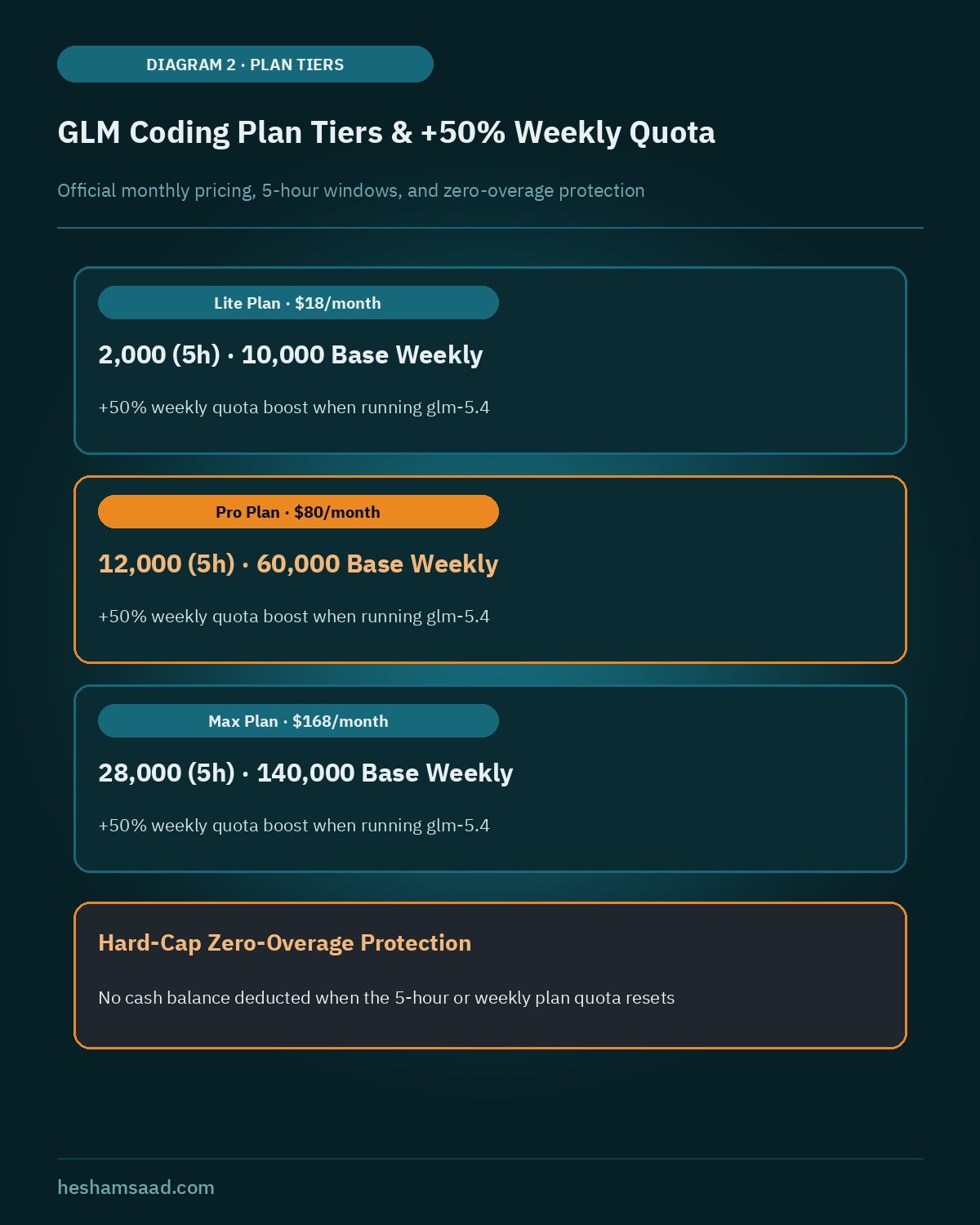Just as important for business owners managing a predictable software budget is Z.ai's hard cap protection rule. The [official Coding Plan FAQ](https://docs.z.ai/devpack/faq) confirms that API calls authenticated through the Coding Plan never deduct money from your prepaid cash account balance when your 5-hour or weekly quota runs out. Instead, requests simply pause until the current window resets. That architectural safeguard means a junior developer can run autonomous refactoring tasks in Claude Code or Cline without any risk of racking up unapproved overage charges on a company card.
### How the Singapore Peak Window Gives MENA Teams Half-Cost Credits
One of the most overlooked financial advantages in Z.ai's documentation is how its regional peak-hour calendar aligns with Middle East and North Africa working schedules. Z.ai defines peak hours strictly as Monday through Friday from `14:00 to 18:00` Singapore Standard Time (`UTC+8`), when calls consume credits at the standard `1.0x` rate. Outside that four-hour weekday window, and across all 48 hours of Saturday and Sunday, every request is billed at the `0.5x` (50%) off-peak credit rate.
When you convert `14:00 to 18:00 UTC+8` into MENA business timezones, the operational advantage becomes obvious:
- Cairo, Alexandria, and Amman (UTC+2 / UTC+3 depending on season): At standard `UTC+2` in Cairo, peak billing runs only from `08:00 to 12:00` on Monday through Friday mornings. From `12:00 noon` onward through the entire afternoon, evening, and overnight shift, Egyptian developers pay half credits (`0.5x`).
- Riyadh, Jeddah, Doha, Kuwait City, and Baghdad (UTC+3): Peak billing runs only from `09:00 to 13:00` on Monday through Friday. Every afternoon sprint after `13:00` works at the `0.5x` discount.
- Dubai, Abu Dhabi, and Muscat (UTC+4): Peak billing runs from `10:00 to 14:00` on Monday through Friday, leaving the entire post-lunch engineering block after `14:00` at half credit cost.
- Regional Sunday workdays: Because many companies across Egypt, Saudi Arabia, Qatar, and Kuwait operate on a Sunday-to-Thursday workweek, the entire Sunday workday falls inside Z.ai's weekend off-peak calendar and runs at `0.5x` credit cost all day long.
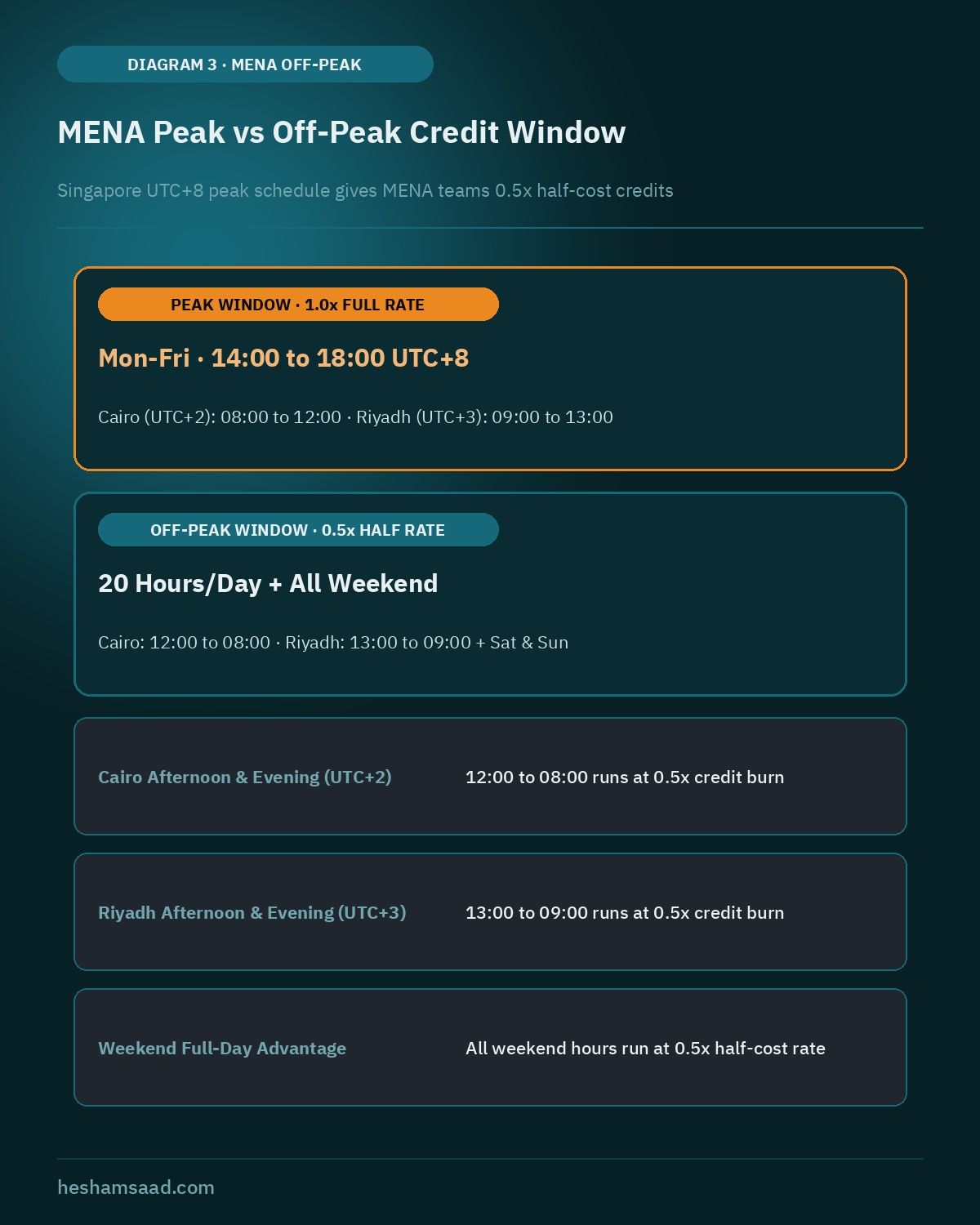For a Cairo or Riyadh agency, combining the 50% weekly quota expansion on glm-5.4 with afternoon and Sunday 0.5x off-peak billing substantially increases total weekly coding capacity. If your team schedules morning hours (`08:00 to 12:00` Cairo or `09:00 to 13:00` Riyadh) for standups, client architecture reviews, and manual code review, and schedules heavy agentic refactoring, automated test generation, and screenshot-driven UI building for Sunday and weekday afternoons, your effective credit runway stretches twice as far.
## Strengths, Blind Spots, and Comparison With Coding Rivals
Choosing an AI coding subscription in late 2026 is no longer about finding the single smartest chatbot; it is about matching model latency, visual understanding, and IDE integration to how your engineers actually ship software. Over the past month alone, engineering managers have had to weigh new releases ranging from low-latency inline completion models to dedicated desktop agent environments.
For instance, if your developers work primarily inside Visual Studio Code using GitHub Copilot and need rapid text-based multi-file completions inside an existing Microsoft enterprise agreement, examine our breakdown of [MAI-Code-2-Flash in GitHub Copilot](https://heshamsaad.com/en/mai-code-2-flash-github-copilot/). Similarly, if your team prefers an integrated desktop client built around Mistral's coding ecosystem rather than configuring custom API endpoints across third-party CLI tools, compare our review of the [Mistral Vibe desktop app](https://heshamsaad.com/en/mistral-vibe-desktop-app/). The table below contrasts `glm-5.4` on the Z.ai Coding Plan against its predecessor and major competing developer tools.
| Platform and Model | Entry Subscription Cost | Visual Input Architecture | Weekly Quota and Off-Peak Rules | Supported Coding Harnesses | Primary Trade-Off for Agencies |
|---|---|---|---|---|---|
| Z.ai Coding Plan with glm-5.4 | $18 / month (Lite), $80 (Pro), $168 (Max) | Native multimodal vision inside glm-5.4 plus optional Vision MCP Server (1.2 credits/call) | 50% higher weekly quota than GLM-5.3; 0.5x off-peak credit rate outside 14:00 to 18:00 UTC+8 | 20+ harnesses including Claude Code, Cline, Kilo Code, OpenCode, ZCode, Codex, AutoClaw | Launch-day multiplier row and formal SWE-bench scores not yet published in static docs |
| Z.ai Coding Plan with GLM-5.3 | $18 / month (Lite), $80 (Pro), $168 (Max) | Requires external Vision MCP Server routed through GLM-5.3-Flash (1.2 credits/call) | Baseline weekly credits (10k Lite, 60k Pro, 140k Max); same 0.5x off-peak window | Same 20+ terminal and IDE harnesses via Z.ai endpoint | Lower weekly quota than glm-5.4 and indirect two-model pipeline for UI screenshot debugging |
| MAI-Code-2-Flash in GitHub Copilot | Included in eligible GitHub Copilot tiers (from $10 / month) | Depends on Copilot host chat vision pipeline rather than open multi-harness endpoint | Managed under GitHub Copilot premium request and seat quotas | GitHub Copilot in VS Code, Visual Studio, JetBrains, and GitHub.com | Tied to GitHub Copilot ecosystem; cannot plug into open CLI harnesses like Claude Code or OpenCode |
| Mistral Vibe Desktop App | Tiered Mistral subscription and workspace plans | Integrated desktop agent interface with project file context | Governed by Mistral subscription tier limits without UTC+8 off-peak discount | Dedicated Mistral Vibe desktop environment and connected local repositories | Focused on Mistral's own desktop workflow rather than drop-in endpoints for 20+ external CLIs |
Looking closely at this comparison highlights where Z.ai wins and where caution is warranted. The biggest advantage of the Z.ai Coding Plan is harness freedom paired with predictable cost controls. Many senior WordPress developers have already standardized their daily terminal workflow around `Claude Code`, `Cline`, or `Kilo Code`, yet find that running heavy repository-wide migrations on standard metered APIs burns through budget rapidly. By pointing those exact same harnesses to Z.ai's endpoint and selecting `glm-5.4`, a team keeps its preferred terminal ergonomics while gaining native image comprehension, bundled web and repository reading MCPs (`Web Search`, `Web Reader`, and `Zread` at `1.2` credits per call), and a hard monthly price floor.
On the flip side, the primary blind spot on November 23, 2026 is documentation lag. Until Z.ai updates the static multiplier chart on [docs.z.ai/devpack/overview](https://docs.z.ai/devpack/overview) to display the exact per-token credit multipliers for `glm-5.4` alongside independent benchmark results, engineering managers have to verify real-world credit burn empirically on a Lite or Pro seat before migrating an entire ten-person development squad.
## Practical WordPress and WooCommerce Workflows for Native Vision
Why does native multimodal vision inside a coding model matter so much for a business owner hiring or managing a WordPress team? Because WordPress development is inherently visual. A backend PHP function might pass every unit test in the terminal while still rendering an overlapping sticky header on an iPhone screen or breaking an Arabic checkout button when switched to right-to-left (`dir="rtl"`) orientation.
With `glm-5.4` active inside `Claude Code`, `Cline`, `Kilo Code`, or `ZCode`, WordPress agencies can fold visual verification directly into three high-value engineering workflows without leaving their editor.
### 1. Translating Bilingual Figma Captures into Clean Gutenberg Block Themes
When building custom Gutenberg blocks or full-site editing (`theme.json`) templates for MENA brands, developers routinely work from side-by-side English and Arabic Figma frames. Under the older `GLM-5.3` setup, passing a design image triggered the external Vision Understanding MCP Server (`GLM-5.3-Flash`) at `1.2` credits per call to describe the image in text before the coding model wrote any CSS. That two-step relay frequently missed spacing ratios, Arabic font line-height adjustments, or logical CSS properties.
By feeding the mobile and desktop mockup images directly to `glm-5.4` alongside your block's `block.json`, `render.php`, and stylesheet files, the model can map visual spacing directly to CSS logical properties (`margin-inline-start`, `padding-inline-end`, `inset-inline`) so the single block template flips cleanly between English LTR and Arabic RTL without fragile override stylesheets.
### 2. Visual Regression Debugging Across WooCommerce Stack Upgrades
E-commerce stores across Egypt and the Gulf often combine WooCommerce core templates with regional payment gateways, WhatsApp order notifications, and custom shipping zone calculators. Whenever your team runs core, PHP, or database updates as outlined in our [WordPress and WooCommerce stack changelog and upgrade guide](https://heshamsaad.com/en/wordpress-woocommerce-stack-changelog-upgrade-guide/), checkout and cart templates are the first places where visual regressions appear.
Instead of pasting fifty lines of raw DOM markup into a chat prompt and hoping the assistant guesses why the installment payment badge overlaps the total price row, a developer can drop a screenshot of the broken staging checkout directly into their `glm-5.4` harness alongside the active child theme overrides. The model sees the exact visual collision, checks the template hook priority in PHP, and proposes a targeted patch while the 50% larger weekly quota absorbs the multi-file context scan.
### 3. Pairing Bundled MCP Tools With the WordPress REST API
Beyond native image reading, Z.ai's Coding Plan bundles four official MCP servers (`Vision Understanding`, `Web Search`, `Web Reader`, and `Zread`) priced at a flat `1.2` credits per call. When your agency builds headless frontends, mobile app connectors, or CRM webhooks powered by the official [WordPress REST API](https://developer.wordpress.org/rest-api/), developers can instruct their harness to pull live third-party gateway documentation via `Web Reader` or inspect open-source plugin repositories via `Zread`, and then validate the JSON schema and screenshot the resulting admin settings screen in one continuous loop.
Of course, an AI coding model is an accelerator, not a substitute for disciplined software architecture. Generated PHP endpoints still require strict capability checks (`current\_user\_can`), nonce verification, prepared SQL statements, and object caching review by an experienced engineer through professional [WordPress development services](https://heshamsaad.com/en/wordpress-development/) before touching a live production database.
## Who Should Use GLM-5.4, What It Costs, and Your This-Week Action Plan
Before changing your agency's model configuration or buying new developer seats, evaluate how this release fits your current engineering stack, budget rules, and compliance requirements.
Who should use glm-5.4 right now: WordPress agencies, freelance full-stack developers, and in-house MENA product teams that already run terminal or IDE coding agents (`Claude Code`, `Cline`, `Kilo Code`, `OpenCode`, `ZCode`, or `Codex`) should switch their active Coding Plan model identifier to `glm-5.4` immediately. You gain native screenshot and UI mockup comprehension plus 50% more weekly usage quota at zero additional subscription cost. Conversely, enterprise teams that require published `SWE-bench` validation, updated per-token multiplier tables in static procurement docs, self-hosted open weights, or standalone per-million-token API billing should keep their production pipelines on their current verified baselines until Z.ai finishes updating its public documentation tables.
What it costs: Access to `glm-5.4` is included across all three Z.ai Coding Plan tiers at no price increase: Lite at $18 per month (2,000 5-hour credits and 10,000 base weekly credits), Pro at $80 per month (12,000 5-hour credits and 60,000 base weekly credits), and Max at $168 per month (28,000 5-hour credits and 140,000 base weekly credits), with each tier receiving a 50% higher weekly usage quota when running `glm-5.4` over `GLM-5.3`. Bundled MCP calls (`Vision Understanding`, `Web Search`, `Web Reader`, `Zread`) cost `1.2` credits per call. MENA teams working outside the four weekday morning peak hours (`08:00 to 12:00` Cairo time or `09:00 to 13:00` Riyadh time, Monday through Friday) pay the `0.5x` half-credit off-peak rate across all afternoon, evening, and Sunday/weekend sessions, with a hard quota cap that guarantees zero cash balance overages.
Practical checklist for WordPress teams and MENA agencies this week: Follow these six concrete steps over the next five workdays to test and deploy `glm-5.4` safely.
1. Update your harness model string to glm-5.4 on one pilot seat: In your active `Claude Code`, `Cline`, `Kilo Code`, `OpenCode`, or `ZCode` configuration, change the model identifier from `GLM-5.3` to `glm-5.4` on a single $18 Lite or $80 Pro seat first.
2. Run a side-by-side RTL screenshot test on a staging theme: Take two real visual tickets from your backlog, such as an Arabic mobile menu misalignment and a WooCommerce checkout spacing bug, and pass the raw screenshots directly into `glm-5.4` without invoking the external `GLM-5.3-Flash` vision relay.
3. Measure credit burn before and after 12:00 Cairo / 13:00 Riyadh: Log your dashboard credit deductions during a morning peak hour (`08:00 to 12:00` Cairo or `09:00 to 13:00` Riyadh) versus an afternoon or Sunday off-peak session to verify the `0.5x` off-peak rate and the +50% weekly quota buffer in your own repository.
4. Shift heavy multi-file agent jobs to MENA afternoon and Sunday windows: Schedule human code reviews, client discovery calls, and architecture planning during the four weekday morning peak hours, and run high-token repository indexing, automated PHPUnit/Playwright test sweeps, and UI refactoring after 12:00 Cairo / 13:00 Riyadh and on Sundays.
5. Audit bundled MCP calls inside automated loops: Because `Web Search`, `Web Reader`, `Zread`, and `Vision Understanding` deduct `1.2` credits per invocation, configure your agent prompts to cache external documentation locally inside your repository rather than re-fetching the same WordPress or gateway docs on every turn.
6. Check docs.z.ai/devpack/overview before scaling across your full team: Bookmark the official developer overview and release notes pages to confirm when Z.ai publishes the updated static multiplier row and formal benchmark figures for `glm-5.4` before upgrading multiple developers to $80 Pro or $168 Max plans.
If you want an experienced technical partner to build, audit, or upgrade your company's bilingual WordPress or WooCommerce site using modern, well-governed engineering workflows that protect speed, security, and conversion rates, book a [free consultation](https://heshamsaad.com/en/free-consultation/) today and let us map out the right technical roadmap for your business.
## Frequently asked questions
What are the main upgrades in glm-5.4 on the Z.ai Coding Plan?Zhipu AI rolled out glm-5.4 on November 23, 2026 with three core improvements over GLM-5.3 across all subscription tiers. The model introduces native multimodal vision directly inside the primary coding weight, grants a 50% higher weekly usage quota on the same tier, and upgrades agentic coding execution across more than 20 supported terminal and editor harnesses including Claude Code, Cline, Kilo Code, OpenCode, and ZCode.
How much does the Z.ai Coding Plan cost per month and can it charge overages?Z.ai offers three monthly subscription tiers: Lite at $18 with 2,000 five-hour credits and 10,000 weekly credits, Pro at $80 with 12,000 five-hour credits and 60,000 weekly credits, and Max at $168 with 28,000 five-hour credits and 140,000 weekly credits. Subscriptions enforce a strict hard cap, so exhausting your allowance pauses requests until the cycle resets and never deducts money from your cash balance.
When do MENA developers get the 50% off-peak credit rate on the Coding Plan?Peak billing applies only from Monday to Friday between 14:00 and 18:00 Singapore Standard Time, which corresponds to 08:00 to 12:00 in Cairo and 09:00 to 13:00 in Riyadh. Outside those four weekday morning hours, every afternoon, evening, late-night, and weekend coding session across the Middle East and North Africa is billed at the 0.5x off-peak credit rate.
Has Z.ai published benchmark scores or token multipliers for glm-5.4 yet?No, as of the November 23, 2026 rollout, Z.ai product lead Zixuan Li announced the live availability of glm-5.4 before the static documentation tables were updated. Z.ai has not yet added a glm-5.4 multiplier row to the developer overview page or published official SWE-bench results, Terminal-Bench scores, total parameter counts, open weights, or standalone per-million-token API pricing.
How does native vision in glm-5.4 help WordPress and WooCommerce developers?Previously, visual debugging on the Coding Plan relied on routing images through the external Vision MCP Server paired with GLM-5.3-Flash at 1.2 credits per call. Because glm-5.4 processes images natively inside the main coding model, WordPress developers can pass mobile RTL layout screenshots, Figma block designs, and WooCommerce checkout error captures directly into their coding harness to generate accurate CSS and PHP fixes.
## References
- [Z.ai Developer Documentation: GLM Coding Plan Overview and Credit Rules](https://docs.z.ai/devpack/overview)
- [Z.ai Developer Documentation: Coding Plan Frequently Asked Questions and Quota Protection](https://docs.z.ai/devpack/faq)
- [Z.ai Official Release Notes: New Released Models and Platform Updates](https://docs.z.ai/release-notes/new-released)
- [Z.ai Official Subscription Portal: GLM Coding Plan Lite, Pro, and Max Tiers](https://z.ai/subscribe)
- [ExplainX AI: GLM-5.4 Coding Plan Rollout With Native Vision and 50% Weekly Quota Boost](https://explainx.ai/blog/glm-5-4-coding-plan-vision-50-percent-quota-boost-november-2026)
- [WordPress Developer Resources: Official WordPress REST API Handbook](https://developer.wordpress.org/rest-api/)