---
id: 14119
title: "Gemini 4 Carbon: Features, Pricing, Access and What It Means for WordPress"
slug: "gemini-4-carbon"
lang: "en"
url: "https://heshamsaad.com/en/gemini-4-carbon/"
markdown_url: "https://heshamsaad.com/en/gemini-4-carbon.md"
translations: {"ar":"https://heshamsaad.com/ar/gemini-4-carbon/"}
description: "Google DeepMind Gemini 4 Carbon: cybersecurity and long-horizon features, benchmarks, pricing, access and what it means for WordPress sites."
author: "Omar Khaled"
date_published: "2026-10-28T17:19:12Z"
date_modified: "2026-10-29T17:18:17Z"
categories: ["AI News"]
tags: ["AI News"]
featured_image: "https://heshamsaad.com/wp-content/uploads/2026/10/gemini-4-carbon-og-en.jpg"
word_count: 2593
reading_time_min: 13
content_sha256: "996901130a68667957476e9555fc0cdd93662c30e9d542eae8d835e68a3d141c"
---
# Gemini 4 Carbon: Features, Pricing, Access and What It Means for WordPress
Google DeepMind has announced Gemini 4 Carbon, which it calls its strongest model, with state-of-the-art cybersecurity and long-horizon capabilities. The announcement is dated October 28, 2026, and it comes only two weeks after Gemini 4 Argon reached the public. The difference this time is that you cannot try Carbon yet. For now, Google is giving it to a subset of cyber defenders and will widen access in phases.
If you run a WordPress site or a business that depends on one, Carbon is not something you install. It matters because of what it is built to do: find vulnerabilities in real software, check whether they can be exploited, and write the patch. In this post we explain what Gemini 4 Carbon is, what changed compared with Argon, the benchmark claims, pricing, who gets access and when, pros and cons, the best use cases, how it sits next to other recent models, and what it means for a WordPress site. Almost everything below comes from Google's official pages, and every benchmark figure is reported by Google, not by an independent lab, unless we say otherwise.
## What Gemini 4 Carbon is
Gemini 4 Carbon is the next model in the Gemini 4 family. Google describes it as building on Gemini 4 Argon, which launched two weeks earlier, and says it shows how quickly the company is pushing the frontier. Google's wording is that its researchers and models are working hand in hand to advance capabilities faster, while strengthening safeguards at the same time.
Carbon is aimed at two things. The first is cybersecurity defense across the whole cycle: detecting vulnerabilities, validating them and fixing them. The second is long-horizon work, meaning engineering tasks that take many steps and a lot of time. Google says teams inside the company have watched Carbon run for days, persisting through dead ends to root-cause and patch subtle bugs across large codebases and low-level systems.
## What changed in Gemini 4 Carbon
Google groups the update into four areas. These are the company's own descriptions and results, so treat them as claims to test once access opens.
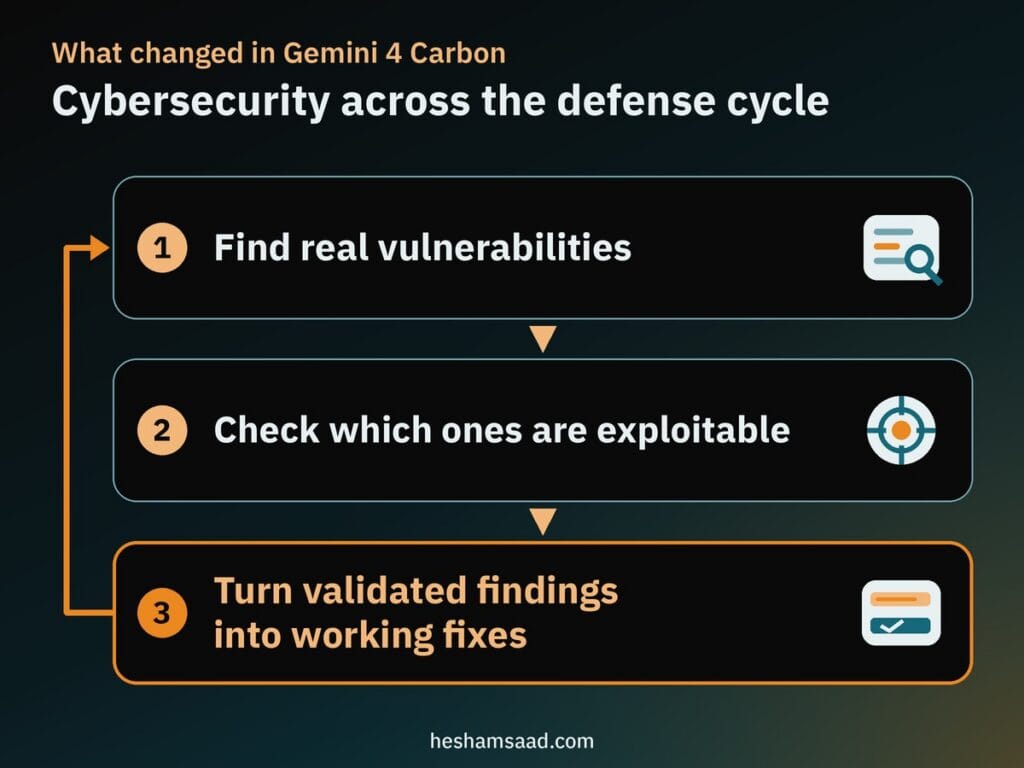
- Cybersecurity across the defense cycle: Carbon is described as state-of-the-art at finding real vulnerabilities, checking which ones are exploitable, and turning validated findings into working fixes.
- Long-horizon engineering: it is built for sustained agentic workflows, with gains in coding, agentic tasks, scientific tasks, full-stack web development and multimodal understanding.
- Better web development output: Google says the quality of output and artifacts in web development improved, and that Carbon rose by 89 Elo points to fourth place on WebDev Arena with 1769.
- Alignment and honesty: Google reports fewer shortcuts and loophole exploits, fewer unsupported claims, and a better collaboration style when a task is ambiguous.
## The benchmark claims, with context
Google reports that Carbon ranks first on version 5.0 of the Artificial Analysis Intelligence Index with a score of 59. That index is run by an outside company, but the figure appears in Google's announcement, so we are quoting Google here.
On cybersecurity, Google lists three external benchmarks, all evaluated without guardrails:
- SEC-bench Pro, 88.2%: finding real vulnerabilities in real-world software.
- ExploitGym, 54.8%: checking whether a vulnerability can be exploited, which helps defenders decide what to fix first.
- CWE-bench from Collinear, 71.0%: fixing the root cause and producing a working patch.
Google adds internal results too. It says Carbon shows more than a 2x uplift over Argon in the success rate of generating secure code, and that the Chrome team reported Carbon performed more than 10 times better than another lab's large frontier model when generating high-quality patches. Wiz, a cloud security platform, also observes Carbon leading on web penetration testing benchmarks.
Two cautions apply. First, the external numbers were measured without guardrails, and Google has not said how the version that reaches the public will score. Second, these are single-vendor results. No independent test of Carbon has been published yet, so avoid reading them as proof for your own workload.
## Safety and alignment claims
Carbon uses the same multi-layered safety stack as Argon, which combines model training, real-time misuse defenses, prompt-injection resilience and chain-of-thought monitoring. Google's reported results include:
- Fewer shortcuts: successful cheating on Terminal-Bench 4.0 fell to 0.0%, with attempts at 0.4%, while accuracy improved.
- Fewer misalignment alerts: in live coding environments with Google's own teams, high-severity misalignment alerts dropped by almost 80%.
- More honesty: in internal testing, unsupported claims are cut by about half compared with Argon, and the model states methodological caveats or lists what is still required instead of making up evidence.
- Staying in scope: overreach fell by 26% and under-service by 29%.
- Prompt injection: on Gray Swan's indirect prompt injection benchmark, Carbon reaches a 0.0% attack success rate, compared with 0.7% for Argon.
The prompt-injection result matters for anyone who connects a model to tools, because hidden instructions in a web page or a document are a common way to push an agent off course. Even so, a benchmark score of 0.0% does not mean the risk is gone, so keep human approval on any action that changes a live site.
## Pricing
Google says Gemini 4 Carbon will launch at the same introductory price as Argon: $2 per million input tokens and $10 per million output tokens, with cached input tokens priced at 95% off the input price. After the introductory period, the price becomes $4 per million input tokens and $20 per million output tokens.
The Carbon announcement does not give an end date for its own introductory period. For Argon, Google's launch page says the introductory price runs through November 30, 2026. Carbon is not available through the API yet, so these are planned prices, not prices you can pay today.
If you'd rather host the model yourself, [Mistral Large 4](https://heshamsaad.com/en/mistral-large-4/) is now open weight at $0.70 per million input tokens on the API.
Gemini can now also [edit docs, PDFs, slides and sheets right in the chat](https://heshamsaad.com/en/gemini-file-editing/), which helps with proposals and client reports.
To make the numbers concrete, here is our own arithmetic, not a Google example. A request with 100,000 input tokens and 10,000 output tokens would cost about $0.30 at the introductory price ($0.20 for input plus $0.10 for output) and about $0.60 at the later price. It ignores caching discounts and any extra billing for thinking tokens, which Google's Argon documentation counts as output tokens. Check the pricing page when Carbon becomes available, because the final billing rules may differ.
## Who can use Carbon and when
Starting this week, Google is making Carbon available to a subset of cyber defenders. It will then phase access to more trusted partners through its Fairwind Program, which Google's own program page describes as serving more than 650 partners worldwide, including governments, healthcare providers and telecom services. Google says it is still collecting feedback and refining guardrails before offering Carbon to developers, businesses and consumers through its product surfaces, and it wants to do that as soon as possible. There is no date.
Google also says it is taking part in the US government's voluntary process for pre-release model testing. In practice, that means the staged rollout is deliberate, and a public launch date should not be assumed. If you want Gemini 4 today, the model that is already open is Argon, which Google released broadly on October 13, 2026, through the Gemini API, Google AI Studio, Google Antigravity and, for Ultra and Pro subscribers, the Gemini app and AI Mode in Search.
## How Carbon compares with Argon and other models
The cleanest comparison is with Argon, because Google makes it directly. Carbon claims more than double the secure-code success rate, a lower prompt-injection attack rate (0.0% against 0.7%), fewer unsupported claims and less overreach. It keeps Argon's introductory price. Argon has the advantage today of being available today, and it already offers a 1M-token context window and a model ID, `gemini-4-argon`, in the Gemini API. The Carbon announcement does not list a context window, a model ID or a free-tier policy, so we cannot say whether they match.
Comparing Carbon with models from other companies is harder, and we are careful not to do it with invented numbers. Vendors use different tests, different settings and different tool access, so a score from one launch page cannot be placed beside a score from another. What we can compare is the published price. OpenAI's pricing page lists GPT-6.1 Terra at $1 per million input tokens and $5 per million output tokens at standard rates, which is lower than Carbon's introductory $2 and $10. Price per token is only one part of cost, since a model that finishes a task in fewer steps can cost less in total. For the model itself, read our posts on [GPT-6.1 Terra](https://heshamsaad.com/en/gpt-6-1-terra/) and [Kimi K3.1 Pro](https://heshamsaad.com/en/kimi-k3-1-pro/) and decide with a test on your own tasks.
## Pros and cons
Here is a balanced view based on the official announcement.
- Pro, security depth: Google reports state-of-the-art results at finding, validating and patching vulnerabilities.
- Pro, long tasks: it is built to keep working through dead ends on multi-step engineering problems.
- Pro, honesty and scope: fewer unsupported claims and less overreach, according to Google's tests.
- Pro, known price: the planned price matches Argon, so budgeting is easier once it opens.
- Con, no public access: only a subset of cyber defenders can use it now, and there is no date for developers or businesses.
- Con, vendor-reported numbers: the benchmarks come from Google, and the external ones were run without guardrails.
- Con, price rises: the introductory price is temporary, and the later price is double.
- Con, missing specs: the announcement does not publish a context window, a model ID or a free tier.
## Best use cases
Based on what Google reports, these are the jobs where Carbon looks strongest once it opens up. They are expectations drawn from the announcement, not tested results.
- Security review of code: scanning a codebase for real vulnerabilities, ranking them by exploitability, and drafting fixes for a human to review.
- Long refactoring and debugging: tracking down the root cause of a subtle bug across a large project and patching it.
- Secure code generation: writing new code with fewer insecure patterns, to be checked in review.
- Web development tasks: building full-stack pages and artifacts, given the gain on WebDev Arena.
- Agent workflows with tools: multi-step automation where resistance to prompt injection and staying inside scope matter.
## What it means for a WordPress site or a business
Gemini 4 Carbon is not a WordPress plugin, and the announcement does not mention WordPress. So it does not change your site today. It does point to a few things worth watching, and each one below is our own reading, not a Google claim.
- Faster vulnerability discovery: if models like Carbon find and patch flaws quickly, the gap between a disclosed bug and a fix could shrink, and the same skill can help attackers. Keep core, themes and plugins updated and remove the ones you do not use. Our [WordPress security audit](https://heshamsaad.com/en/wordpress-security-audit/) guide shows what to check, and the recent [php2shell PHP vulnerability](https://heshamsaad.com/en/php2shell-php-vulnerability/) post shows why patching quickly matters.
- Code review for custom work: once Carbon reaches the API, an agency could use it to review custom plugin or theme code for security problems before launch. Treat its findings as leads that a developer confirms, never as a clean bill of health.
- Agents with site access: if you connect any AI agent to your site, give it the least access it needs, use a staging copy and require your approval before it publishes or changes settings. Prompt-injection results are encouraging, but they are not a guarantee.
- Cost planning: if you plan to build an AI feature on the Gemini API, remember that the introductory price is temporary. Budget with the later $4 and $20 prices in mind.
- Stay with what is available: Argon is open now. Do not delay a project waiting for Carbon.
If you want an AI feature, a security review or a safer update routine planned for your own site, our [WordPress development](https://heshamsaad.com/en/wordpress-development/) service can scope it, and you can book a [free consultation](https://heshamsaad.com/en/free-consultation/) to talk it through. We also covered Google's other recent release in our [Genie 4 post](https://heshamsaad.com/en/genie-4-world-model/).
## Limits and what we do not know yet
The announcement leaves several questions open. Google gives no release date for developers, businesses or consumers. It does not list a context window, a model ID, supported tools or a free tier. It does not explain how the guarded public version will differ from the version used in the external benchmarks. It also gives no independent evaluation, and several of its safety figures come from Google's internal tests. We will update the picture when the model card or developer documentation appears.
## Frequently asked questions
What is Gemini 4 Carbon?Gemini 4 Carbon is Google DeepMind's new frontier model, announced on October 28, 2026. Google calls it its strongest model, with state-of-the-art cybersecurity and long-horizon capabilities. It builds on Gemini 4 Argon, which launched two weeks earlier, and is meant for finding, validating and fixing software vulnerabilities and for long multi-step engineering tasks.
Can I use Gemini 4 Carbon today?Not yet, unless you are a cyber defender in Google's early group. Google is making Carbon available to a subset of cyber defenders this week and will add trusted partners in phases through its Fairwind Program. It plans to reach developers, businesses and consumers as soon as possible, but gives no date, so check Google's pages for updates.
How much will Gemini 4 Carbon cost?Google says Carbon will launch at the same introductory price as Argon: $2 per million input tokens and $10 per million output tokens, with cached input tokens 95% cheaper. After the introductory period the price becomes $4 and $20. The Carbon announcement gives no end date for that period, and the model is not on the API yet.
How is Carbon different from Gemini 4 Argon?Google reports more than double Argon's success rate at generating secure code, a 0.0% prompt injection attack rate against 0.7% for Argon, about half as many unsupported claims, and less overreach. The price is the same. Argon is available now, while Carbon is limited to a small group, and these results come from Google, not independent tests.
Can I trust the benchmark results?Treat them as Google's claims for now. Carbon scored 88.2% on SEC-bench Pro, 54.8% on ExploitGym and 71.0% on CWE-bench, and Google says those external tests ran without guardrails. No independent evaluation has been published, and the public version may behave differently, so test the model on your own tasks before relying on it.
What does Gemini 4 Carbon mean for my WordPress site?Nothing changes on your site today, because Carbon is not a plugin and is not publicly available. It points to faster vulnerability discovery and patching in general, so keep WordPress core, themes and plugins updated, remove unused ones and review any custom code. If you connect an AI agent to your site, limit its access and approve changes yourself.
## References
- [Google DeepMind: Gemini 4 Carbon, our next frontier model](https://deepmind.google/blog/gemini-4-carbon-our-next-frontier-model/)
- [Google: Gemini 4 Argon is now available for everyone](https://blog.google/innovation-and-ai/models-and-research/gemini-models/introducing-gemini-4-argon/)
- [Google DeepMind: Fairwind Program](https://deepmind.google/fairwind-program/)
- [Google AI for Developers: What is new in Gemini 4 Argon](https://ai.google.dev/gemini-api/docs/latest-model)