---
id: 15370
title: "Cisco OpenAI Shirudo: Open-Source eBPF Shielding & Limits"
slug: "cisco-openai-shirudo-ebpf-agentic-security"
lang: "en"
url: "https://heshamsaad.com/en/cisco-openai-shirudo-ebpf-agentic-security/"
markdown_url: "https://heshamsaad.com/en/cisco-openai-shirudo-ebpf-agentic-security.md"
translations: {"ar":"https://heshamsaad.com/ar/cisco-openai-shirudo-ebpf-agentic-security/"}
description: "Cisco OpenAI Shirudo brings open-source eBPF upatches and TPM 2.0 attestation to Linux servers. Learn costs, kernel limits, and WordPress host impact."
author: "Omar Khaled"
date_published: "2026-11-24T02:18:03Z"
date_modified: "2026-11-24T02:18:03Z"
categories: ["AI News"]
tags: ["AI News","Cisco","Linux eBPF Security","OpenAI","WordPress AI"]
featured_image: "https://heshamsaad.com/wp-content/uploads/2026/11/cisco-openai-shirudo-ebpf-agentic-security-og-en.jpg"
word_count: 4355
reading_time_min: 22
content_sha256: "9dd5065992a1baff75a4b9b6bbf9eb179d9c1b19cb7daac8605bf98f349fd002"
---
# Cisco OpenAI Shirudo: Open-Source eBPF Shielding & Limits
On November 23, 2026, Cisco and OpenAI publicly released Cisco OpenAI Shirudo, an open-source Linux security framework designed to let autonomous AI agents shield running servers against newly discovered vulnerabilities in real time without rebooting the operating system or restarting application services. Named after the Japanese word for shield (pronounced shee-roo-doh) and published under the permissive BSD 2-Clause License, the project rewrites Isovalent's Tetragon eBPF security platform around a direct machine interface built for AI coding agents rather than human-written policy files.
For infrastructure architects, hosting providers, and businesses running high-traffic web stacks across the Middle East and North Africa, the announcement addresses one of the hardest problems in server security: what happens when automated attackers weaponize a vulnerability faster than human operations teams can test and schedule an operating system or runtime update. Rather than waiting days or weeks for a maintenance window to restart production workloads, Shirudo enables an operator or an agentic workflow such as OpenAI Codex to build, cryptographically sign, and inject a surgical micropatch called a upatch directly into the Linux kernel or a language runtime.
At the same time, the release comes with strict engineering boundaries that every technical buyer and DevOps lead needs to understand before touching production hardware. Shirudo is explicitly labeled pre-release software in its official GitHub repository, and running it on real targets requires a custom-patched Linux kernel supporting a signed-loader ABI alongside a Trusted Platform Module (TPM 2.0). This guide breaks down how the architecture works, what the verified Java4Shell and PHP exploit tests actually proved, how it compares with existing security tools, and what Linux administrators and WordPress or WooCommerce business owners should do right now.
## Why Negative Mean Time to Exploit Forced a Rethink of Linux Patching
Enterprise patch management has historically operated on a predictable timeline. A security researcher discovers a flaw, a vendor prepares an upstream software release, infrastructure teams validate the update in staging environments, and systems administrators schedule a downtime window to apply the package and restart affected daemons. Even well-run engineering organizations often take days or weeks to move a critical fix from initial disclosure to full deployment across production clusters.
Autonomous offensive tooling has compressed that defensive window to the point where Cisco security researchers describe a state of negative mean time to exploit. When AI systems can scan source repositories, reverse-engineer binary diffs, or synthesize working exploit payloads before an official vendor patch is distributed or installed, traditional maintenance cycles leave servers exposed during the exact period when attack volume peaks. Restarting core services such as database clusters, search engines, or PHP worker pools in the middle of peak business hours also carries real commercial cost for e-commerce platforms and financial applications.
Cisco and OpenAI initiated the Shirudo collaboration to shift defensive response onto the same automated timescale. By combining Cisco and Isovalent's background in kernel-level Extended Berkeley Packet Filter (eBPF) instrumentation with OpenAI's frontier coding models, the two companies built an execution layer where a defensive agent can reproduce an exploit inside an isolated sandbox, generate a minimal filter or bytecode guard that blocks the bad input, verify that legitimate traffic continues to pass, and package that fix for immediate cryptographic loading across production hosts.
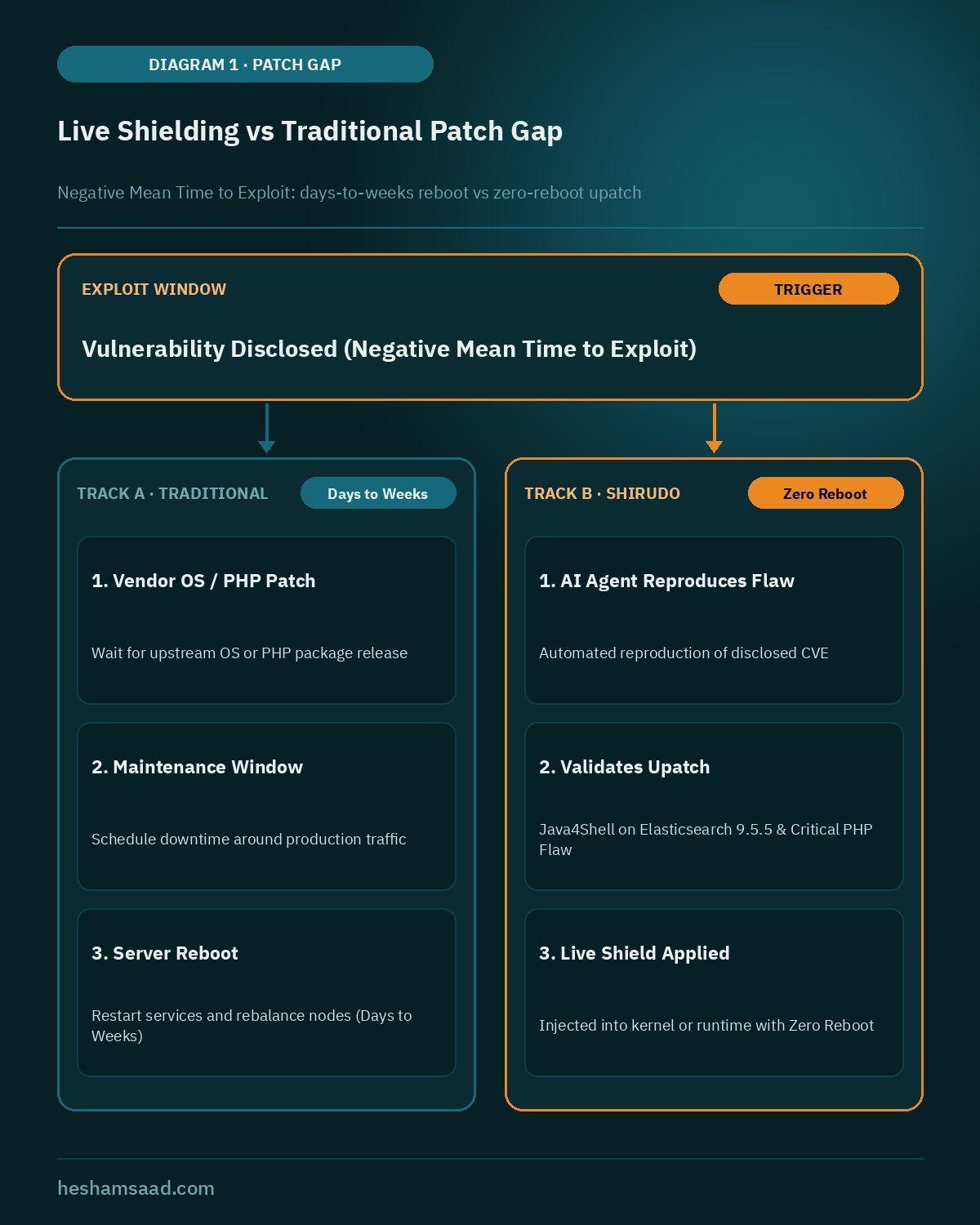Crucially, Shirudo does not replace permanent upstream software updates. Instead, it acts as a cryptographically verified shield that closes the vulnerability gap in memory the moment a threat is identified, giving engineering teams breathing room to test and schedule standard package upgrades during regular maintenance windows without risking an active breach in the interim.
## How Cisco OpenAI Shirudo Works Under the Hood
To understand why Cisco OpenAI Shirudo differs from existing Linux monitoring agents, you have to look at why Cisco chose to rewrite Isovalent's Tetragon platform rather than simply adding an AI wrapper on top of it. Existing runtime security utilities are built around human operators who read dashboards and author declarative YAML or JSON policies. Those policy languages intentionally abstract away low-level kernel structures to prevent human configuration mistakes, but that same abstraction limits how precisely an AI coding agent can inspect memory states or validate complex data structures at runtime.
Shirudo strips out the human policy translation layer so AI agents can write surgical defenses directly at the code and machine interface, while relying on the Linux kernel's built-in eBPF verifier, cryptographic signature enforcement, and hardware trust anchors to prevent a malfunctioning or compromised agent from destabilizing the host.
### Daemonless Control Plane and Boot-Guarded eBPF Initialization
Almost every conventional endpoint detection agent, container security sensor, or live-patching utility runs a persistent privileged daemon in Linux userspace. If an attacker compromises a server and escalates privileges to the `root` user, one of their first moves is to kill, hook, or blind that userspace security daemon so their post-exploitation activity goes unnoticed.
Shirudo eliminates the permanent userspace daemon entirely. Both the operator workstation and the target server use a one-shot command-line binary named `shirudo` that runs only when executing a specific action and then exits. On the protected server, the persistent control plane is an eBPF program loaded directly into the kernel at boot time from the initial ramdisk (`initrd`) via the `shirudo init` command.
Because the control plane initializes during the early boot sequence and seals its verification keys inside the kernel before regular userspace services start, Shirudo's runtime and state remain protected even if an attacker later compromises the `root` account on the machine. Without possession of the external operator's private signing key, a local root attacker cannot unload active shields, alter telemetry hooks, or forge a clean security status.
### Signed .bee Upatch Packages and OCI Registry Distribution
In the Shirudo workflow, individual defensive mitigations are packaged as lightweight micropatches called upatches. Rather than inventing a proprietary transport protocol or requiring a dedicated central management server, Shirudo packages each compiled and cryptographically signed upatch into a `.bee` archive file and distributes it through standard Open Container Initiative (OCI) registries.
- Synthesis and sandbox verification: An operator or an AI coding agent such as OpenAI Codex analyzes a vulnerability report, crafts an eBPF program or language-runtime bytecode guard, and tests it inside a clean virtual machine against both the exploit payload and normal application tests.
- Cryptographic signing and OCI push: Once validated, the upatch is packaged into a `.bee` artifact, signed using the operator's private key, and pushed to an internal OCI container registry alongside standard container images.
- Live daemonless pull and injection: Target servers invoke the one-shot `shirudo` CLI to pull the signed `.bee` package from the OCI registry and load it directly into the running kernel or target runtime with zero downtime and no process restarts.
Using standard OCI registries means DevOps teams can store, version, audit, and replicate security upatches using the exact same registry infrastructure they already maintain for Docker and Kubernetes workloads.
### Kernel Sealed Keyring Verification, TPM 2.0 Attestation, and OpenTelemetry
Granting an automated system the ability to push executable logic into production servers demands strict cryptographic proof at every step. Shirudo enforces a dual-layer verification and attestation pipeline supplemented by continuous kernel observability:
- Kernel and userspace signature checks: Every request to load or unload an eBPF upatch is verified directly by the Linux kernel against a sealed `.bpf` keyring initialized at boot. For language-level shields such as Java upatches, the signature is verified in userspace before the bytecode guard is injected into configured Java Virtual Machines (JVMs).
- TPM 2.0 measurement and offline attestation: Every time a upatch is loaded or unloaded on a target host, Shirudo extends a per-boot Platform Configuration Register (PCR) inside the server's TPM 2.0 module. Operators can run `shirudo attest` to generate cryptographically signed hardware evidence proving exactly which shields are currently active and whether any unauthorized state change occurred since boot, and verify that evidence offline.
- Built-in OpenTelemetry export via kernel-obs: Shirudo ships with a foundational observability package named `kernel-obs` that monitors process executions, network activity, and privilege changes across the host, exporting structured telemetry directly to standard OpenTelemetry collectors.
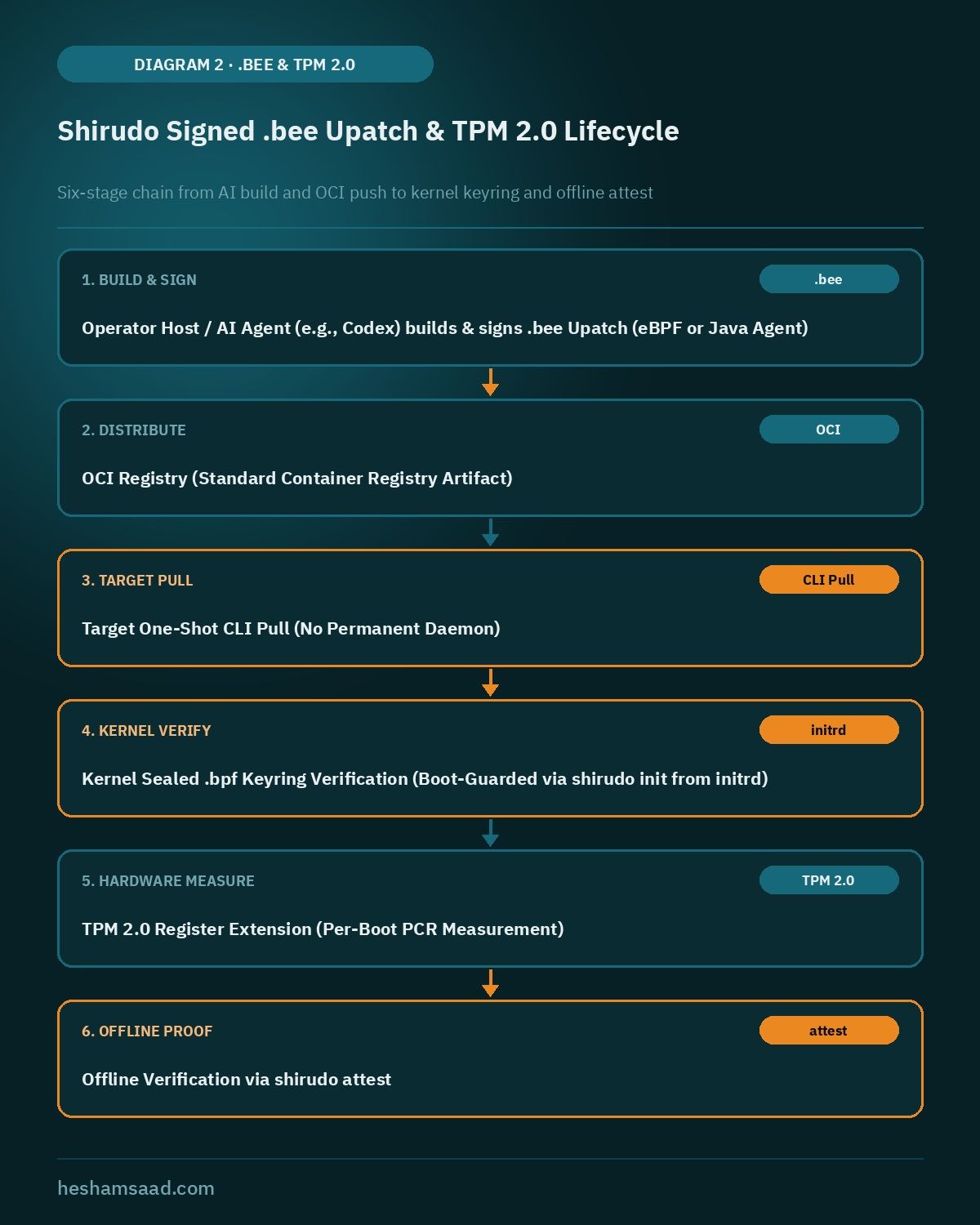This combination ensures that security teams do not have to trust the target server's operating system to tell the truth about its patch state. The hardware TPM 2.0 log and sealed kernel keyring provide tamper-evident proof that can be audited independently of the host's local user accounts.
## Verified Exploit Demonstrations: Java4Shell on Elasticsearch 9.5.5 and Critical PHP Shielding
In their November 23, 2026 announcements and repository documentation, Cisco and OpenAI published concrete details on two real-world vulnerability classes used to validate Shirudo's agentic workflow: a high-impact OpenJDK flaw dubbed Java4Shell and a critical PHP vulnerability.
In the first verified demonstration, the engineering teams used OpenAI Codex as the agentic control plane to defend against Java4Shell on a live Elasticsearch 9.5.5 instance. Rather than taking the Elasticsearch node out of the cluster, upgrading the underlying OpenJDK distribution, and waiting for shard rebalancing across the search cluster, Codex synthesized a targeted Java bytecode upatch guarding the internal method `java.util.Base64$Decoder.decode0`.
When injected into the running JVM via Shirudo, the upatch inspected incoming Base64 decoding buffers before the vulnerable routine could trigger memory corruption or remote code execution. In the published test verification, the running Elasticsearch 9.5.5 service remained online without interruption while the injected guard intercepted and rejected malformed exploit inputs, logging the exact rejection event: `Base64 guard rejected candidate: length=65, padding=1, remainder=1, alphabet=standard`.
In the second demonstration confirmed in Cisco's official press release, Shirudo generated, tested, and deployed a live shield that detected and blocked exploitation attempts targeting a critical PHP vulnerability. It is important to note transparently that Cisco's press release did not publish the specific CVE number for the PHP flaw used in that test. Even without a public CVE identifier in the announcement, demonstrating automated runtime shielding for PHP alongside OpenJDK and native Linux kernel execution paths highlights a vital expansion of scope: Shirudo is not restricted to kernel syscall filtering, but can bridge kernel eBPF protections and high-level application runtimes that power modern web infrastructure.
## How Shirudo Compares with Isovalent Tetragon, Kernel Livepatching, and WAFs
Technical buyers and infrastructure engineers evaluating Shirudo often ask how it relates to tools already running in their stack, specifically Isovalent Tetragon, Linux kernel live-patching services (such as Canonical Livepatch, Red Hat kpatch, or Oracle Ksplice), and Web Application Firewalls (WAFs). While these technologies share overlapping security goals, they solve distinct operational problems at different layers of the stack.
| Feature or Capability | Cisco OpenAI Shirudo | Isovalent Tetragon | Linux Kernel Livepatching (kpatch / Livepatch) | Web Application Firewall (WAF) |
|---|---|---|---|---|
| Primary Operator | AI coding agents (such as OpenAI Codex) and SecOps engineers working at the code interface | Platform and security engineers authoring YAML policies | OS distribution vendors shipping compiled C kernel patches | Web security teams and managed hosting providers |
| Userspace Daemon | None; uses a one-shot CLI with an initrd boot-loaded eBPF control plane | Persistent privileged userspace daemon (tetragon) | Userspace management client polling vendor patch servers | Reverse proxy, cloud edge proxy, or web server module |
| Mitigation Scope | Kernel eBPF upatches plus userspace runtime guards (such as JVM bytecode and PHP shielding) | Kernel-level process, file, network, and syscall enforcement via eBPF | Replacing vulnerable C functions inside the Linux kernel image only | Inspecting and filtering HTTP and HTTPS application requests |
| Hardware Trust Anchor | Sealed kernel .bpf keyring plus per-boot TPM 2.0 PCR extension and offline attestation | Standard Linux host permissions and Kubernetes RBAC | Kernel module signature verification | Not applicable (operates at network or HTTP layer) |
| Kernel Requirement | Patched Linux kernel with signed-loader ABI (currently pre-release) | Standard modern Linux distributions with BTF and eBPF support | Standard vendor-supported enterprise Linux kernels | Any OS or hosting environment capable of routing web traffic |
As the comparison illustrates, Shirudo is not a drop-in replacement for a cloud WAF or an enterprise Kubernetes observability daemon today. Tetragon remains the production standard for organizations that want human-managed runtime visibility and policy enforcement across standard Linux distributions without compiling custom kernels. Similarly, traditional kernel live-patching applies vendor-authored C function replacements for the kernel itself, whereas Shirudo focuses on rapid, agent-synthesized `.bee` micropatches that can guard both kernel paths and application runtimes like Elasticsearch JVMs and PHP processes.
## Hard Production Prerequisites and Current Pre-Release Limits
When a major vendor partnership announces an open-source security tool, it is easy for marketing headlines to outpace deployment reality. If you examine the technical documentation at [docs.shirudo.dev](https://docs.shirudo.dev/) and the source repository at [github.com/shirudo-dev/shirudo](https://github.com/shirudo-dev/shirudo), the maintainers are refreshingly direct about where the project stands and what it requires.
First, Shirudo is explicitly marked as pre-release software in its official README. Interfaces, package formats, and kernel integration hooks are subject to change as Cisco and OpenAI gather engineering feedback ahead of their scheduled technical deep-dive webinar on December 15, 2026.
Second, deploying Shirudo on a real target machine with full security guarantees enforces three hard infrastructure prerequisites:
1. A custom-patched Linux kernel with the signed-loader ABI: Stock kernels shipped by default in standard Ubuntu, Debian, AlmaLinux, or Rocky Linux repositories do not currently include Shirudo's signed-loader Application Binary Interface (ABI) and kernel patches out of the box. Running Shirudo in a true production configuration requires compiling and maintaining a Linux kernel with those patches applied, plus configuring the `initrd` image to invoke `shirudo init` at boot.
2. TPM 2.0 hardware or software module: Because every upatch load and unload extends a per-boot register for cryptographic verification via `shirudo attest`, target servers must provide an accessible TPM 2.0 device (either a physical chip on bare-metal servers, a virtualized vTPM in cloud instances, or a software TPM emulator in local test virtual machines).
3. Validated CPU architecture: According to the repository's continuous integration matrix, automated CI currently runs all test tiers on `x86-64` hardware and runs host tests on `arm64` (where the local test virtual machine boots cleanly on `arm64` using a software TPM). Validation for `riscv64` targets is still pending.
Beyond hardware and kernel prerequisites, engineering leaders must also account for operational governance. While the Linux kernel's eBPF verifier mathematically prevents an eBPF program from crashing the kernel or entering an infinite loop, it cannot know whether an AI-generated filter will accidentally block valid application requests. For example, if an AI agent writes a overly broad guard on a PHP function or a Base64 decoder, the server stays online, but legitimate customer checkouts or API calls could be rejected. Human review or rigorous automated regression testing against realistic traffic patterns inside the sandbox stage remains essential before signing any `.bee` package for production push.
## What Shirudo Means for WordPress and WooCommerce Infrastructure in MENA
Every WordPress and WooCommerce website ultimately runs on a Linux server executing PHP, a MySQL or MariaDB database, a web server such as Nginx or LiteSpeed, and frequently an Elasticsearch or OpenSearch node to handle fast product catalog filtering. When Cisco and OpenAI demonstrate live, zero-reboot shielding for both a critical PHP vulnerability and Java4Shell on Elasticsearch 9.5.5, they are testing the exact runtime components that power high-volume WooCommerce stores across the MENA region.
However, the practical impact splits sharply depending on whether you are a hosting provider managing physical or virtual Linux fleets or a business owner operating a WordPress site on shared or managed hosting.
If your company runs on standard shared hosting, managed WordPress platforms, or typical PaaS containers, you do not control the underlying Linux kernel or the `initrd` boot sequence, and you cannot install Shirudo yourself. Instead, Shirudo represents an upstream infrastructure capability that cloud providers and enterprise managed WordPress hosts can adopt over the coming year. When a zero-day flaw emerges in PHP or an auxiliary service like Elasticsearch, a hosting provider running Shirudo-enabled kernels could deploy a signed `.bee` upatch across tens of thousands of customer nodes in minutes without restarting PHP-FPM pools or dropping active shopping cart sessions.
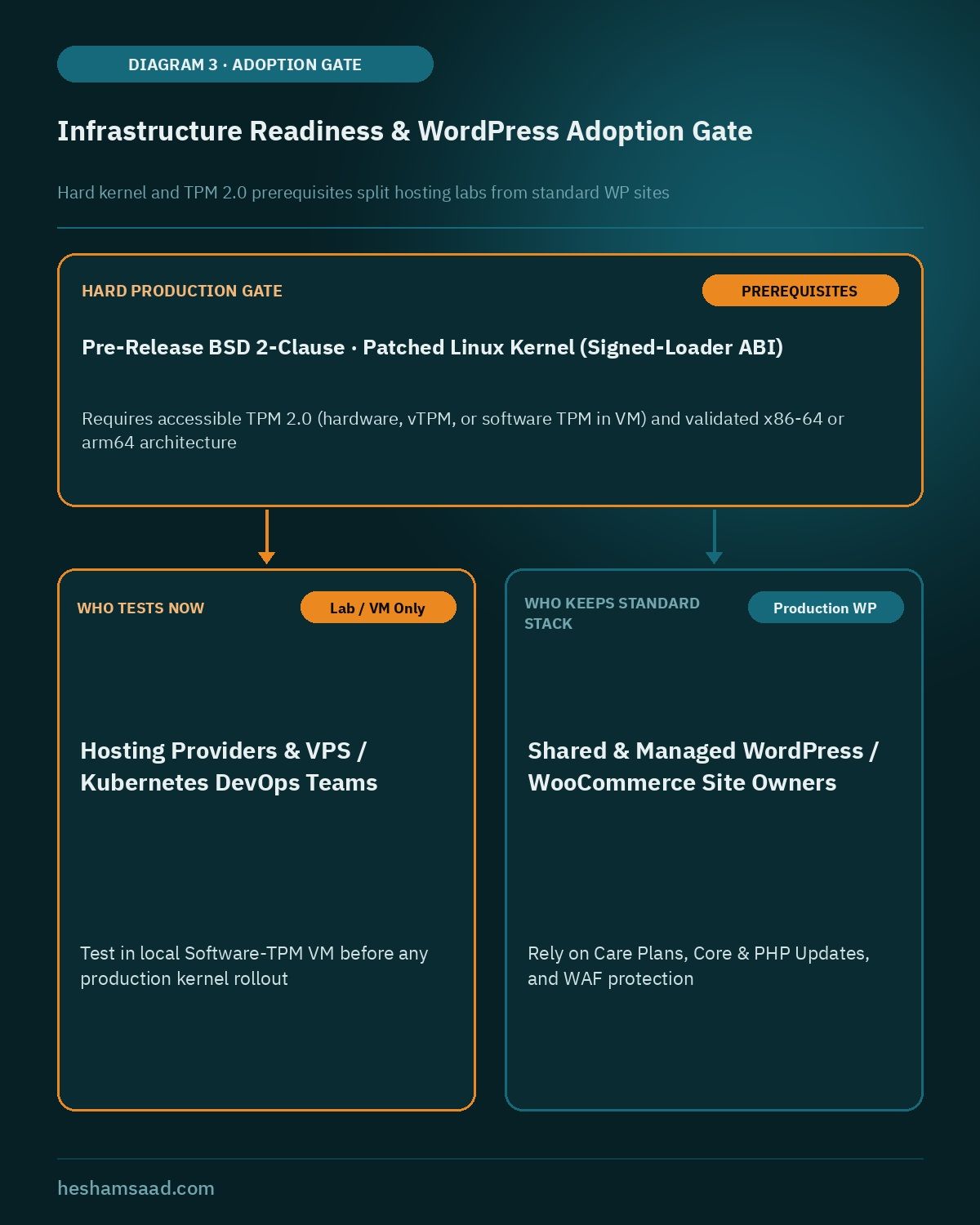For MENA business owners and digital managers, this distinction also reinforces why kernel-level tools never eliminate application-layer responsibility. Most WordPress compromises do not happen because an attacker exploits an unpatched Linux kernel zero-day; they happen through outdated third-party plugins, exposed credentials, insecure custom code, or poorly configured AI integrations. Addressing those risks requires disciplined [WordPress AI plugin security](https://heshamsaad.com/en/wordpress-ai-plugin-security/) reviews, testing updates systematically with a structured [WordPress and WooCommerce stack changelog and upgrade guide](https://heshamsaad.com/en/wordpress-woocommerce-stack-changelog-upgrade-guide/), and keeping core, plugins, and PHP versions current through proactive [WordPress maintenance](https://heshamsaad.com/en/wordpress-maintenance/).
Even if your hosting provider eventually uses eBPF upatches to shield the underlying PHP binary or Elasticsearch daemon, a logical flaw inside a vulnerable checkout plugin or a compromised administrator password still requires application-level hardening, web application firewall rules, and rapid incident response if you ever need to [fix a hacked WordPress site](https://heshamsaad.com/en/fix-hacked-wordpress-site/).
## Who Should Evaluate Shirudo Now, What It Costs, and What to Do This Week
Because Shirudo sits at the intersection of kernel engineering, hardware cryptography, and autonomous AI coding agents, deciding whether to invest engineering hours into it today comes down to how much of your Linux infrastructure you build and control directly.
### Who Should Use Shirudo Now and Who Should Wait
Shirudo is ready for hands-on laboratory evaluation by three specific groups:
- Web hosting providers and cloud platform engineers: Teams managing large fleets of multi-tenant Linux servers running PHP, Java, or containerized microservices who want to test zero-downtime vulnerability shielding in non-production staging environments.
- Enterprise DevOps and platform security engineers: Organizations that already maintain custom Linux kernel builds or bare-metal servers with TPM 2.0 chips and want to evaluate how agent-generated eBPF upatches integrate with their existing OpenTelemetry collectors and OCI registries.
- Security researchers and AI agent developers: Engineers experimenting with OpenAI Codex or local coding agents to automate vulnerability reproduction and micropatch generation inside Shirudo's local test virtual machine on `x86-64` or `arm64` hardware.
Conversely, two groups should wait and should not attempt to run Shirudo in production right now:
- Production systems relying on standard vendor Linux kernels: Any team that depends on stock Ubuntu, Debian, or RHEL kernels without an internal kernel compilation pipeline should wait until the signed-loader ABI matures beyond pre-release status or lands in upstream distribution kernels.
- WordPress and WooCommerce site owners on shared, managed, or standard VPS hosting: Running a custom-patched pre-release kernel on a live commercial store introduces unnecessary operational risk when well-configured WAFs, isolated PHP pools, and timely plugin updates already address active web threats.
### What Shirudo Costs to Run in Practice
From a software licensing standpoint, Shirudo costs $0. The entire codebase is freely available under the BSD 2-Clause License, and neither Cisco nor OpenAI has announced a paid commercial version, enterprise support subscription, or managed cloud tier as of the November 23, 2026 release.
However, free open-source licensing does not mean zero total cost of ownership. Deploying Shirudo requires specific infrastructure and engineering investments summarized below:
| Cost Category | Direct Software License Fee | Operational and Infrastructure Requirement | Budget Impact for Engineering Teams |
|---|---|---|---|
| Shirudo Core CLI, Initrd Loader, and kernel-obs | $0 (BSD 2-Clause License) | Source repository at github.com/shirudo-dev/shirudo and docs at docs.shirudo.dev | No vendor license cost; no commercial tier announced |
| Custom Linux Kernel Maintenance | $0 (Open-source Linux kernel patches) | Compiling and testing Linux kernels with the signed-loader ABI and Shirudo patches | High DevOps and kernel engineering time cost for ongoing maintenance |
| TPM 2.0 Attestation Hardware or vTPM | Included in compatible hardware or cloud VM tiers | Physical TPM 2.0 chip on bare metal, cloud vTPM instance, or software TPM in local test VMs | May require upgrading legacy VPS plans to vTPM-enabled cloud instances |
| Artifact Distribution and Observability | Existing registry and telemetry rates | OCI-compliant container registry for signed .bee packages plus OpenTelemetry collector storage | Minimal incremental storage and bandwidth cost on existing cloud infrastructure |
| AI Agent Control Plane (Optional) | Standard AI provider API or subscription usage | Using an AI coding agent such as OpenAI Codex to synthesize and test upatches automatically | Variable token or subscription cost only if automating upatch generation via commercial LLMs |
Note that using an AI agent is not strictly mandatory to load a upatch; human security engineers can also write, compile, and sign `.bee` upatches manually using the `shirudo` CLI at zero AI token cost, though doing so sacrifices the automated synthesis speed demonstrated with OpenAI Codex.
### What to Do This Week: Action Checklist for DevOps Teams and MENA Site Owners
Whether you manage Linux cloud infrastructure or oversee a revenue-generating WordPress and WooCommerce presence in the MENA region, here are the concrete actions to take this week:
1. For Linux and DevOps engineers, test Shirudo inside the isolated local VM first: Clone the repository from [github.com/shirudo-dev/shirudo](https://github.com/shirudo-dev/shirudo) on an `x86-64` or `arm64` workstation and boot the included local test virtual machine with a software TPM. Walk through building a `.bee` package, pushing it to a test OCI registry, verifying the sealed `.bpf` keyring load, and running `shirudo attest` offline before considering any bare-metal kernel compilation.
2. Register for the December 15, 2026 technical deep-dive webinar: Follow the official project documentation and Isovalent announcements for the December 15, 2026 engineering session, where the maintainers will detail the signed-loader ABI roadmap and kernel patch upstreaming plans.
3. For enterprise WooCommerce architects running dedicated Elasticsearch clusters: Review how your search nodes are isolated from public network interfaces and keep your OpenJDK and Elasticsearch versions patched on a defined schedule while monitoring when managed cloud kernels add native support for signed eBPF upatches.
4. For MENA business owners and marketing directors, audit your real WordPress attack surface today: Do not wait on futuristic kernel shields to protect your business website. Ensure your store runs on an updated PHP branch, enforce strict web application firewall rules, remove unused plugins, and partner with an experienced [WordPress development](https://heshamsaad.com/en/wordpress-development/) agency that treats security and performance as core architectural requirements.
If you are planning a custom WordPress or WooCommerce project, evaluating hosting infrastructure for high-traffic campaigns, or looking to harden an existing site against modern automated threats, book a [free consultation](https://heshamsaad.com/en/free-consultation/) so we can review your stack and build a practical, reliable security and maintenance roadmap for your business.
## Frequently asked questions
How do Shirudo eBPF upatches protect a Linux server without rebooting?Shirudo uses signed micropatches called upatches packaged as .bee archives and stored in an OCI registry. A target Linux server pulls and loads these upatches directly into the kernel or configured Java Virtual Machines using a one-shot command line interface without restarting running services. This lets administrators block active exploit payloads in memory while waiting for a full maintenance window.
How much does Shirudo cost and what license does it use?Shirudo is free open-source software released by Cisco and OpenAI under the BSD 2-Clause License on GitHub. There is no software license fee and neither company has announced a paid commercial or managed enterprise tier. Your actual expenses come from DevOps engineering hours, maintaining custom patched Linux kernels, operating an OCI registry, provisioning TPM 2.0 hardware, and optional AI agent token usage.
What Linux kernel and hardware requirements does Shirudo need?Production targets require a Linux kernel compiled with the signed-loader ABI and Shirudo kernel patches alongside a hardware or software TPM 2.0 module. The control plane loads at boot from initrd so even a compromised root account cannot tamper with active shields without the operator signing key. Automated tests currently support x86-64 and arm64 architectures while riscv64 target validation remains pending.
Can I install Shirudo directly on a shared or managed WordPress hosting plan?No, standard shared or managed WordPress hosting accounts do not grant access to replace the host Linux kernel, modify initrd boot images, or manage TPM 2.0 registers. Only infrastructure providers, cloud operators, or businesses managing dedicated Linux virtual machines with custom kernel builds can deploy Shirudo. Most WordPress and WooCommerce store owners should rely on application firewalls, PHP updates, and structured maintenance plans.
Is Shirudo ready for production Linux servers right now?Shirudo is currently marked as pre-release software in its official GitHub repository and should be evaluated in isolated test virtual machines first. While Cisco and OpenAI demonstrated working shields against a critical PHP vulnerability and Java4Shell on Elasticsearch 9.5.5, production rollout requires custom kernel compilation and rigorous validation. Engineering teams can watch the official technical deep-dive webinar on December 15, 2026 for further architectural guidance.
## References
- [Cisco Newsroom: Cisco and OpenAI Launch Shirudo, a New Project to Safeguard Agentic AI (November 23, 2026)](https://newsroom.cisco.com/c/r/newsroom/en/us/a/y2026/m11/cisco-and-openai-launch-shirudo-a-new-project-to-safeguard-agentic-ai.html)
- [OpenAI: Introducing Shirudo](https://openai.com/index/introducing-shirudo/)
- [GitHub Repository: shirudo-dev/shirudo (BSD 2-Clause License)](https://github.com/shirudo-dev/shirudo)
- [Shirudo Technical Documentation: Architecture, Upatch Lifecycle, and Attestation](https://docs.shirudo.dev/)
- [Isovalent Blog: Cisco and OpenAI Launch Shirudo for Agentic Security](https://isovalent.com/blog/post/cisco-openai-shirudo/)
- [Cisco Blogs: Expanding the Defender's Window with Self-Defending Infrastructure](https://blogs.cisco.com/news/expanding-the-defenders-window-with-self-defending-infrastructure)
- [eBPF.io: What is eBPF? An Introduction and Technical Overview of eBPF Technology](https://ebpf.io/what-is-ebpf/)