---
id: 15392
title: "AWS Strands Decider v2: Open-Weight Decision Models Guide"
slug: "aws-strands-decider-v2-open-weight-decision-models"
lang: "en"
url: "https://heshamsaad.com/en/aws-strands-decider-v2-open-weight-decision-models/"
markdown_url: "https://heshamsaad.com/en/aws-strands-decider-v2-open-weight-decision-models.md"
translations: {"ar":"https://heshamsaad.com/ar/aws-strands-decider-v2-open-weight-decision-models/"}
description: "AWS Strands Decider v2 brings five Apache 2.0 Gemma 4 decision models up to 31B for 255-choice routing, 98% lower cost, and 62 to 99 ms H100 latency."
author: "Hesham Saad"
date_published: "2026-11-25T10:17:15Z"
date_modified: "2026-11-25T10:17:15Z"
categories: ["AI News"]
tags: ["AI agents","AI News","AWS","WooCommerce","WordPress AI"]
featured_image: "https://heshamsaad.com/wp-content/uploads/2026/11/aws-strands-decider-v2-open-weight-decision-models-og-en.jpg"
word_count: 4425
reading_time_min: 22
content_sha256: "d92ff803b24a8a64951989abe5a1039b8d88deb4f689af69f8e347fe0217828a"
---
# AWS Strands Decider v2: Open-Weight Decision Models Guide
AWS Strands Decider v2 targets one of the most expensive architectural habits in modern AI engineering: paying a large generative language model to generate hundreds of reasoning and JSON formatting tokens when your application only needs to pick one category from a list, return a yes-or-no flag, or assign a numeric rubric score. Built by AWS Strands Labs on top of instruction-tuned Google Gemma 4 models and released under the permissive Apache 2.0 license, the v2 family comprises five open-weight models scaling from an edge-friendly E2B model up to a 31B dense model.
Rather than treating routing, triage, moderation, and rubric scoring as open-ended text generation problems, Strands Decider frames them as "System One" decisions. Given up to 32,768 tokens of context and up to four base64 images, the model runs a single forward pass and emits one decision token alongside calibrated probability scores across up to 255 developer-defined choices.
For software architects, e-commerce operators, and agencies building custom [WordPress development](https://heshamsaad.com/en/wordpress-development/) and WooCommerce integrations, the release comes with rare production transparency. Alongside the weights and a 17.48-million-row training Data Card, AWS published an internal production benchmark showing how swapping Claude Sonnet 4.6 for Strands Decider E4B on an internal ticketing pipeline reduced inference cost per million tickets from $22,200 to roughly $500 while cutting call latency by 78%.
## What changed in AWS Strands Decider v2: Gemma 4 bases, 32K context, and image input
The first generation of Strands Decider proved that small, purpose-trained models could match or beat general-purpose LLMs on discrete classification tasks, but its 4,096-token context ceiling and text-only architecture limited where teams could deploy it. Long customer support threads, multi-page order histories, and tickets containing user screenshots had to be truncated or pre-processed by a separate model before reaching the decider.
AWS Strands Decider v2 removes those bottlenecks through four structural upgrades across all five models in the lineup:
- Google Gemma 4 instruction-tuned foundations: Every v2 checkpoint is trained from a Google Gemma 4 instruction-tuned base (`gemma-4-E2B-it`, `gemma-4-E4B-it`, `gemma-4-12B-it`, `gemma-4-26B-A4B-it`, and `gemma-4-31B-it`), including a 26-billion-parameter Mixture-of-Experts (MoE) variant that activates roughly 4 billion parameters per token.
- A new token readout mechanism: Instead of relying on fragile prompt templates that coerce a chat model into printing an option label as text, v2 uses a dedicated token readout head that maps one forward pass directly to calibrated option probabilities and a single output token.
- An eightfold context expansion to 32,768 tokens: Jumping from 4,096 tokens in v1 to 32,768 tokens in v2 allows developers to pass complete ticket transcripts, large WooCommerce product catalogs, full code diffs, or lengthy policy lists without aggressive chunking.
- Native multimodal image input: Every v2 model accepts up to four base64-encoded images per request alongside text state, inheriting visual understanding from the underlying Gemma 4 architecture.
The table below summarizes the official benchmark scores, recommended GPU memory, and median single-request H100 latency across all five Apache 2.0 checkpoints in the 2611 release.
| Model Checkpoint | Gemma 4 Base | Decision Index 0.3 | JevBench | OpenDecisions | DecisionPivot | BEV | Recommended GPU | H100 Median Latency |
|---|---|---|---|---|---|---|---|---|
| strands-decider-E2B-gemma4-v2-2611 | gemma-4-E2B-it | 57.1 | 87.4 | 77.7 | 23.3 | 74.0 | 24 GB (or CPU / no GPU) | 62 ms |
| strands-decider-E4B-gemma4-v2-2611 | gemma-4-E4B-it | 63.2 | 88.3 | 83.9 | 45.2 | 78.9 | 40 GB (runs in ~19 GiB on 24 GB A10G) | 78 ms |
| strands-decider-12B-gemma4-v2-2611 | gemma-4-12B-it | 64.1 | 92.2 | 85.7 | 58.9 | 79.0 | 48 GB | 80 ms |
| strands-decider-26B-A4B-gemma4-v2-2611 | gemma-4-26B-A4B-it (MoE, ~4B active) | 69.0 | 92.6 | 88.6 | 69.2 | 81.4 | 80 GB | 86 ms |
| strands-decider-31B-gemma4-v2-2611 | gemma-4-31B-it | 71.5 | 93.1 | 92.2 | 84.3 | 84.5 | 80 GB | 99 ms |
Looking closely at the progression across the five sizes reveals an important pattern for capacity planning. On straightforward classification benchmarks such as JevBench, even the smallest `strands-decider-E2B-gemma4-v2-2611` model reaches 87.4, within 5.7 points of the flagship 31B model (93.1).
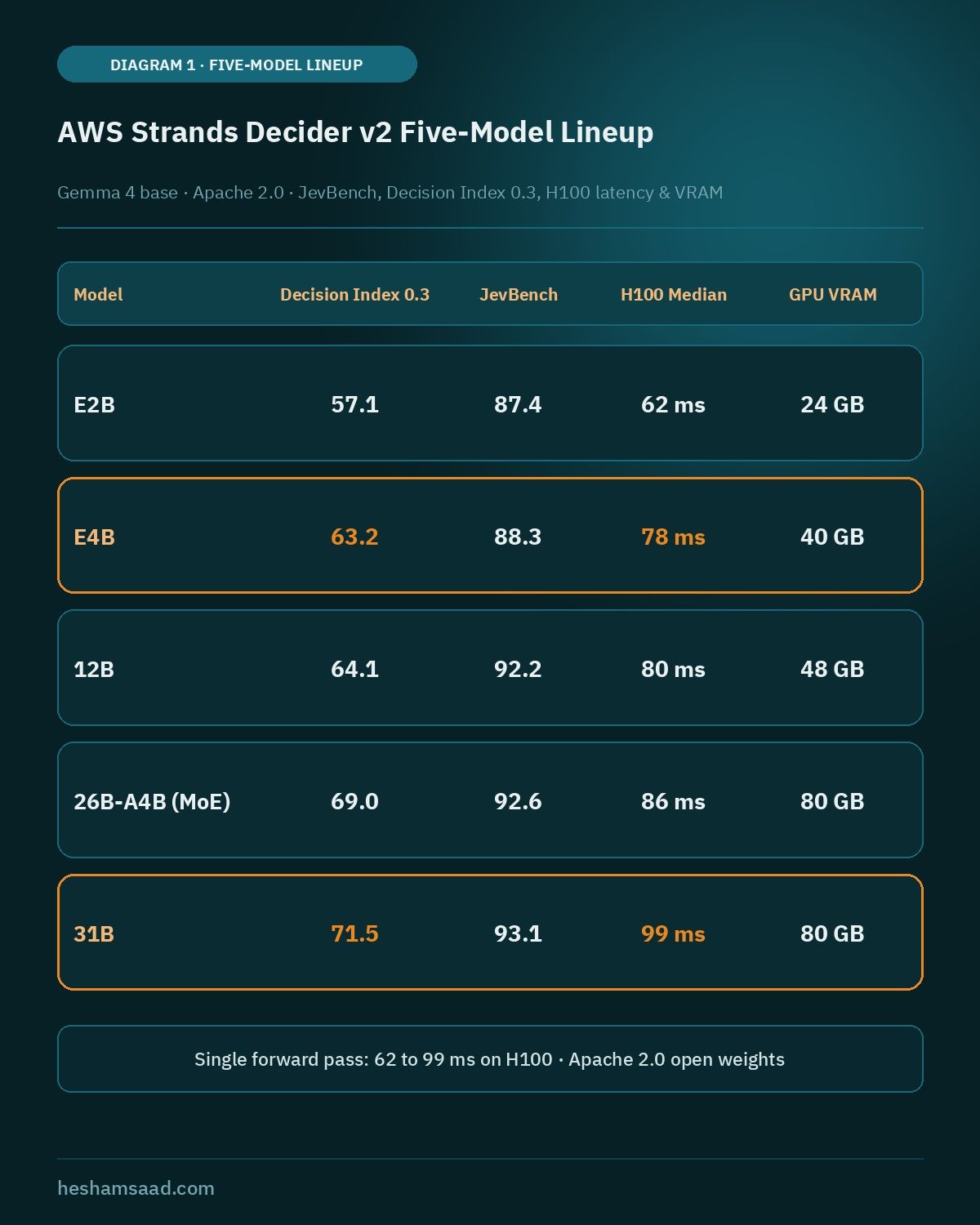The gap widens dramatically on `DecisionPivot`, which tests harder multi-constraint decisions where subtle context shifts flip the correct choice. There, E2B scores 23.3 while E4B nearly doubles that score to 45.2, 12B reaches 58.9, the 26B-A4B MoE climbs to 69.2, and the dense 31B model hits 84.3. Yet because every model emits only a single output token, H100 median latency stays tightly bounded between 62 ms on E2B and 99 ms on 31B.
## How the System One architecture scores 255 choices in a single forward pass
In cognitive psychology, "System One" refers to fast, automatic judgment, whereas "System Two" describes slow, deliberative reasoning. Most frontier models, whether Anthropic Claude Sonnet 4.6, OpenAI reasoning models, or Google's flagship models discussed in our [Gemini 4 Neon guide](https://heshamsaad.com/en/gemini-4-neon/), are optimized for System Two workflows: planning multi-step actions, drafting prose, and synthesizing code.
Inside production software, however, the majority of high-frequency calls are not creative tasks. They are control-flow gates: picking which tool an agent should invoke next, deciding whether an incoming comment violates store policy, assigning a support ticket to one of 140 internal resolver groups, or rating a sales lead from 1 to 5. Using an autoregressive text generator for those gates forces you to pay for dozens or hundreds of output tokens and parse unstructured text back into application types.
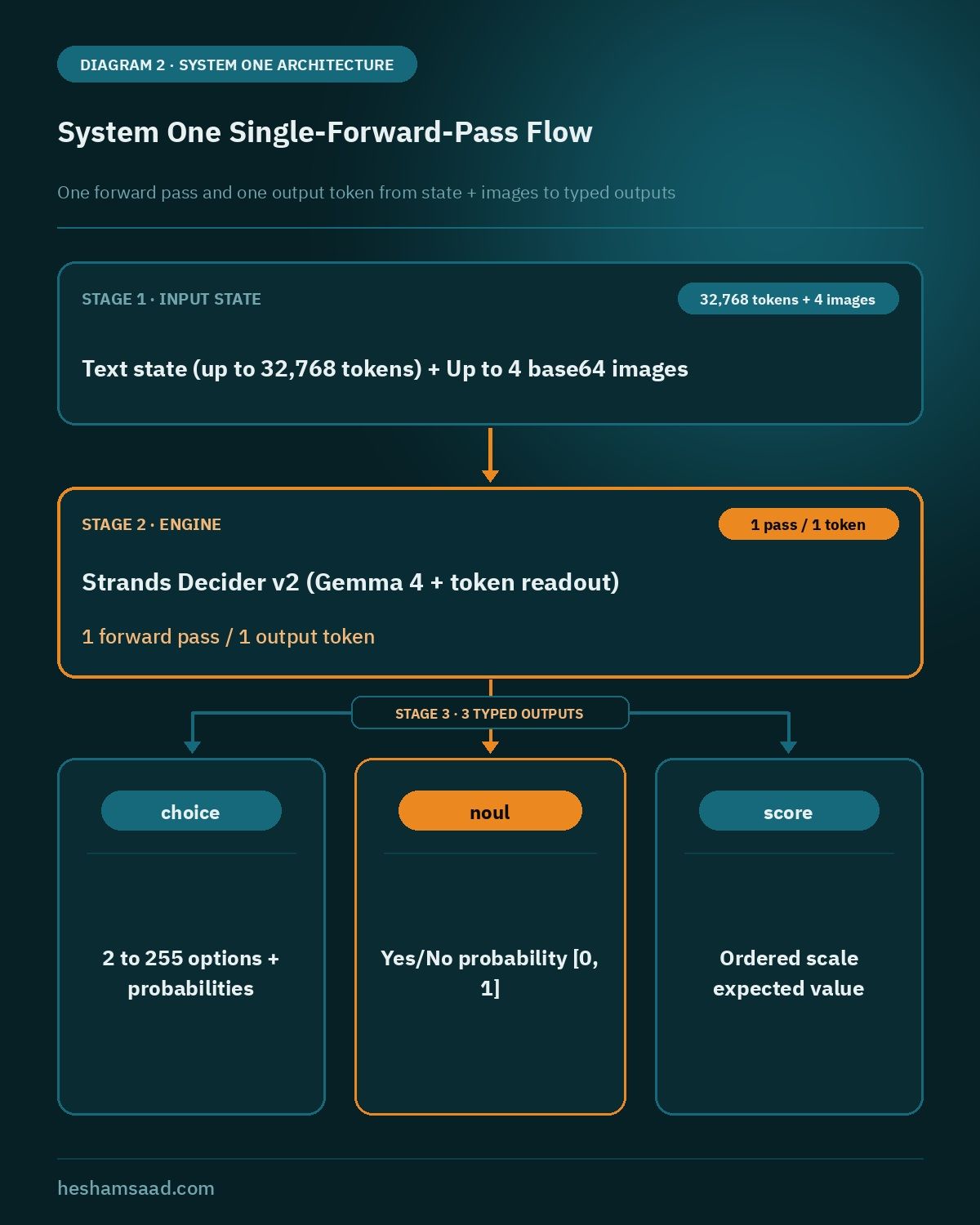Strands Decider v2 replaces free-form text generation with three strictly typed question contracts exposed through a single interface. Every call accepts a context state (up to 32,768 tokens plus up to four base64 images) and one typed question definition, then returns exactly one output token accompanied by calibrated probabilities.
### 1. Choice questions (2 to 255 options)
A `choice` question asks the model to select exactly one option from between 2 and 255 developer-supplied candidates. Along with the winning option, the token readout returns a probability distribution across all supplied options. Because the options are passed dynamically at inference time in the request payload rather than baked into a fixed classification head during training, you can add, rename, or remove categories on the fly without fine-tuning the model.
### 2. Noul questions (null-or-one binary gating)
A `noul` (null-or-one) question evaluates a binary proposition and returns a continuous yes/no probability in the interval `\[0, 1\]`. By default, a threshold of `0.5` separates positive and negative decisions, but developers can tune that cutoff per workflow. For example, an automated refund gate in WooCommerce might require a `0.92` threshold before approving an instant store-credit payout, routing anything below that mark to a human supervisor.
### 3. Score questions (ordered rubric evaluation)
A `score` question evaluates the input state against an ordered scale (such as a 1-to-5 quality or urgency rubric). Because a single forward pass yields probability mass for every level on the scale, Strands Decider returns three values simultaneously: the discrete probability of each level, a continuous expected value (the probability-weighted average across the scale), and an overall confidence metric. Continuous expected values are far more useful for ranking queues than coarse integer outputs from standard LLM prompts.
## Inside the 17.48-million-row Data Card: where Decider v2 excels and where it has limits
One of the strongest reasons to take Strands Decider v2 seriously is that AWS Strands Labs published a detailed Data Card disclosing the exact composition of its fine-tuning corpus. Rather than making vague claims about proprietary data, the documentation lays out both the scale of the dataset and its blind spots.
The v2 training set contains 17,480,970 rows totaling 8.87 billion input tokens across 13 topic domains. Sequence lengths range up to 16,384 tokens with a median of 345 tokens per example, and each question presents between 2 and 255 options. By question type, 90% of the training rows are `choice` tasks and 10% are `noul` tasks, built from three distinct sources:
- 72.1% written by language models (12,611,186 rows total): Comprising 10,575,232 newly synthesized decision tasks, 1,626,863 tasks adapted from existing datasets, and 409,091 structured rubric ratings that teach the model ordered `score` calibration.
- 22.2% drawn from more than 200 public datasets (3,876,543 rows): Anchoring the model in human-annotated classification, natural language inference, and structured decision benchmarks.
- 5.7% procedurally generated in known task formats (993,241 rows): Ensuring strict formatting compliance and stable probability calibration up to the 255-option boundary.
For engineering leads evaluating these models, the Data Card also reveals two critical limitations that never show up in headline marketing summaries:
1. The decision fine-tuning data is text only: All 17.48 million training rows in the Strands Decider Data Card are text-only examples. The v2 models accept up to four base64 images per request because they retain the native vision encoder and multimodal representations of their Google Gemma 4 instruction-tuned bases, and the token readout head transfers across modalities. However, because the decision fine-tuning itself did not include image rows, visual edge cases (such as damaged parcel photos or Arabic receipt scans) must be benchmarked on your own data.
2. The training corpus is roughly 96% English: While Google Gemma 4 base weights carry broad multilingual pretraining that includes Arabic, only about 4% of the 17.48 million decision-tuning rows are non-English. When classifying Modern Standard Arabic, Egyptian or Gulf dialect support messages, or mixed Arabic-English tickets, accuracy depends heavily on how well the base Gemma 4 representation maps onto the English-dominated decision head.
## Amazon internal ticketing benchmark: 98% lower cost and 78% faster than Claude Sonnet 4.6
Synthetic benchmarks like JevBench and DecisionPivot are helpful for picking a model size, but business owners care about real production economics. On November 9, 2026, the Strands team published an internal production case study detailing what happened when Amazon replaced Claude Sonnet 4.6 (running on Amazon Bedrock) with `strands-decider-E4B-gemma4-v2-2611` on an internal ticket classification and routing system.
To meet enterprise security standards, the team deployed Strands Decider E4B on a single Amazon SageMaker `ml.g5.xlarge` instance equipped with one NVIDIA A10G 24 GB GPU. Although the official model catalog recommends a 40 GB GPU for comfortable headroom on long-context E4B workloads, the production ticketing service ran inside approximately 19 GiB of VRAM on the 24 GB A10G card. The SageMaker container ran in network-isolated mode, pulling its Apache 2.0 model weights directly from an internal Amazon S3 bucket with no outbound internet access.
| Production Metric | Claude Sonnet 4.6 (Amazon Bedrock) | Strands Decider E4B (SageMaker ml.g5.xlarge) | Measured Difference |
|---|---|---|---|
| Hosting & Pricing Basis (us-east-1) | $3.00 / 1M input tokens, $15.00 / 1M output tokens | $1.408 / instance-hour (1x A10G 24 GB GPU, ~19 GiB used) | Dedicated GPU vs per-token API |
| Average Time per Call | 4,215 ms | 897 ms | 78% faster (Lambda duration dropped 74%) |
| Input Tokens per Ticket | 6,554 tokens | 2,009 tokens | 69.3% fewer input tokens |
| Output Tokens per Ticket | 170 tokens | 1 token | 99.4% fewer output tokens |
| Total Tokens per Ticket | 6,724 tokens | 2,010 tokens | 70% total token reduction |
| On-Demand Cost per Ticket | $0.0222 | ~$0.0005 | 98% cost reduction |
| Cost per 1,000,000 Tickets | ~$22,200 | ~$500 | ~$21,700 saved per million tickets |
Two engineering insights stand out in the table above. First, notice why total tokens per ticket dropped by 70%, from 6,724 tokens on Claude Sonnet 4.6 down to 2,010 tokens on Strands Decider E4B. Removing the 170 output tokens accounted for part of the savings, but input tokens also fell from 6,554 to 2,009. When prompting a general-purpose LLM like Sonnet 4.6 to classify tickets reliably, engineers have to pad every request with lengthy system instructions, few-shot examples, formatting constraints, and reasoning rubrics. Because Strands Decider E4B is already trained on 17.48 million structured decision rows, you pass only the ticket state and the raw option list.
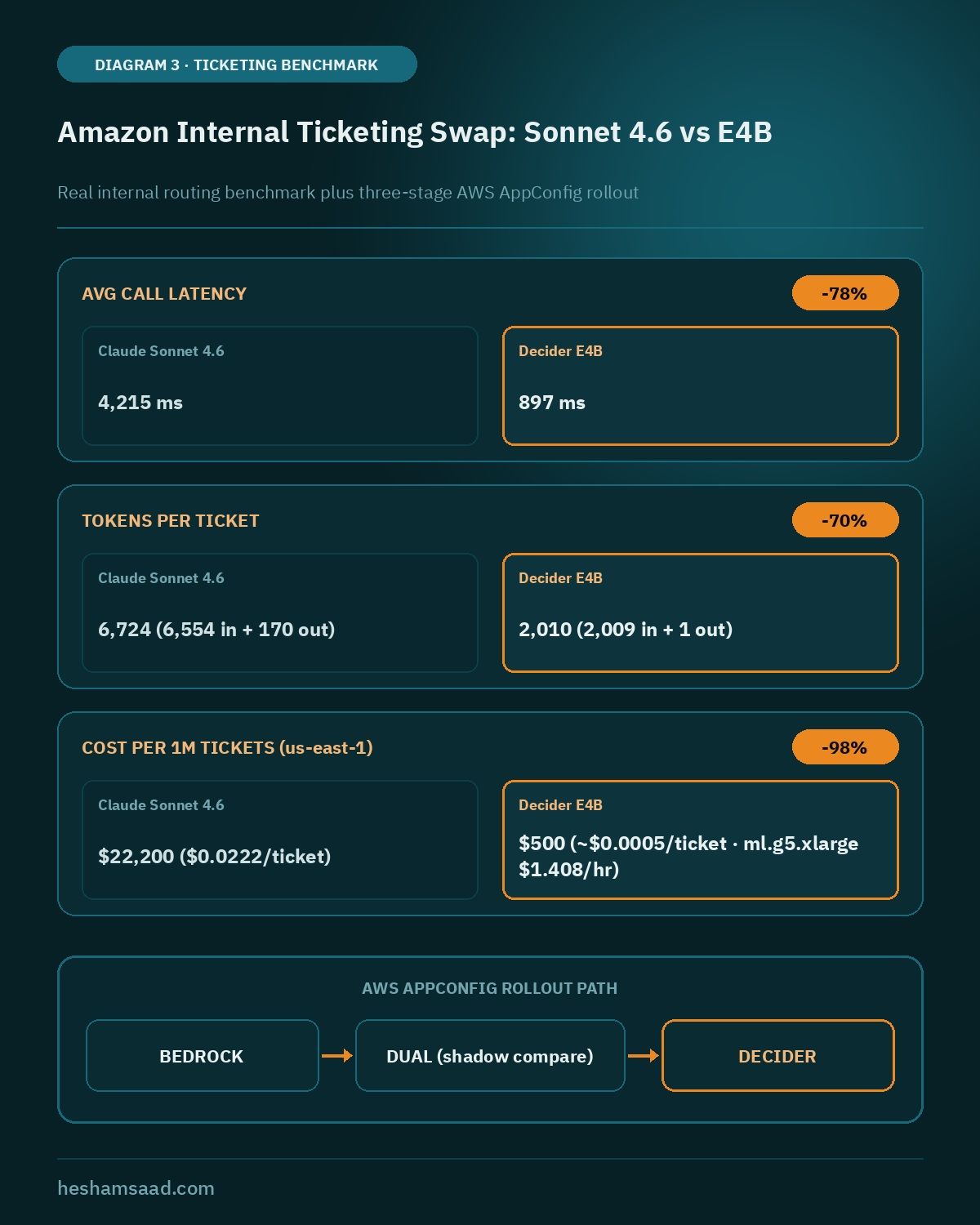Second, the migration strategy itself is a blueprint for any engineering team nervous about swapping a frontier model for an open-weight 4B model. Amazon placed an AWS AppConfig dynamic toggle in front of the caller Lambda function with three operating modes:
- `BEDROCK` mode: Legacy production path sending 100% of tickets to Claude Sonnet 4.6 on Amazon Bedrock.
- `DUAL` shadow mode: Production traffic is still answered by Claude Sonnet 4.6, while the exact same ticket payload is sent asynchronously to Strands Decider E4B on SageMaker. Engineers compare label agreement, latency, and confidence distributions on live traffic with zero customer impact.
- `DECIDER` mode: Once shadow metrics match or beat the baseline, flipping the AppConfig flag shifts live routing to Strands Decider E4B, cutting caller AWS Lambda execution duration by 74% while keeping `BEDROCK` available as an instant one-click rollback.
## How Strands Decider v2 compares with frontier LLMs, BERT classifiers, and zero-shot encoders
Before deploying a new model family, technical decision-makers should weigh it against the three existing ways teams solve routing and classification today: frontier LLM APIs, traditional fine-tuned encoder models (such as BERT or DeBERTa), and small zero-shot natural language inference (NLI) classifiers.
- Versus frontier generative LLMs (Claude Sonnet 4.6, GPT-4o, Gemini Pro): Frontier LLMs win when a task requires multi-hop synthesis, code generation, or natural-language explanations back to an end user. They lose badly on unit economics and latency when used as high-volume routers: paying $22,200 per million tickets and waiting 4.2 seconds for a single category ID is unsustainable at scale. Strands Decider v2 delivers 62 to 99 ms H100 latency (or 897 ms end-to-end on a budget A10G instance) and calibrated probabilities out of the box.
- Versus traditional fine-tuned BERT / DeBERTa encoders: A custom-trained BERT classifier is tiny and fast, but its label space is frozen at training time. Every time a product manager adds three new support queues or rewrites a moderation rule, an ML engineer must collect labeled examples, retrain the classification head, and redeploy. Strands Decider v2 evaluates arbitrary developer-supplied options dynamically at request time (up to 255 choices) across a 32,768-token window and up to four images, eliminating the retraining cycle.
- Versus zero-shot NLI and embedding routers: Traditional zero-shot cross-encoders typically cap out at 512 to 4,096 tokens, cannot ingest base64 images, and degrade sharply when asked to discriminate among more than 10 to 20 nuanced options because they score each label independently. Strands Decider v2 sees all 2 to 255 options together in a single 32,768-token context window, enabling direct comparative judgment in one forward pass.
The primary trade-off of Strands Decider v2 compared to a serverless LLM API is operational ownership. Unless you wrap the E2B model inside an AWS Lambda container for bursty workloads, running E4B through 31B requires managing a GPU endpoint (such as SageMaker or an internal GPU node) and keeping utilization high enough to justify hourly instance charges.
## Deployment options: local CLI, Apple Silicon, AWS Lambda, and Amazon SageMaker
AWS Strands Labs packaged the runtime so developers can move from local laptop testing to locked-down cloud infrastructure using the exact same HTTP contract. Getting started locally requires a single Python package installation:
- Install the CLI and SDK: Run `pip install strands-decider` in your Python environment.
- Test ad-hoc decisions from the terminal: Use `strands-decider ask` to run single `choice`, `noul`, or `score` queries directly from the command line while prototyping prompts and option wording.
- Launch a local inference server: Run `strands-decider serve --port 8000` to expose the standard `POST /v1/systemone` REST endpoint on port 8000.
- Pick your local hardware backend: Pass `--device cuda` for NVIDIA GPUs, `--device mps` or `--device mlx` for hardware-accelerated inference on Apple Silicon Macs, or `--device cpu` when testing the lightweight E2B checkpoint without a dedicated GPU.
When moving to production, teams have four officially supported deployment paths depending on traffic volume and compliance requirements:
1. Amazon SageMaker (JumpStart or AWS CDK): For steady production traffic, deploy via one-click SageMaker JumpStart or the official AWS CDK stack using AWS Deep Learning Containers. As Amazon demonstrated with `ml.g5.xlarge` ($1.408/hour in `us-east-1`), you can run the container in network-isolated mode reading weights from S3.
2. AWS Lambda (pay-per-request): For spiky or low-volume workloads where an always-on GPU instance would sit idle overnight, the official deployment guides support packaging Strands Decider inside AWS Lambda so you pay strictly per invocation.
3. Terraform modules: Teams managing multi-account cloud infrastructure can provision endpoints repeatably using the official Terraform templates.
4. On-premises or self-hosted GPU servers: Because every model carries an Apache 2.0 license, banks, government contractors, and healthcare providers can run `strands-decider serve` inside air-gapped data centers without sending a single byte to an external API.
In multi-agent software architectures, such as automated pull-request pipelines like those covered in our breakdown of [Anthropic Claude GitHub PR agents](https://heshamsaad.com/en/anthropic-claude-ship-github-pr-agents/), placing a fast `noul` or `choice` gate in front of tool execution also acts as a deterministic policy layer. Combine that decision gate with kernel-level runtime sandboxing, such as the techniques we analyzed in [Cisco and OpenAI Shirudo eBPF agentic security](https://heshamsaad.com/en/cisco-openai-shirudo-ebpf-agentic-security/), and you prevent autonomous agents from triggering expensive or high-risk actions without calibrated confidence.
## Practical WordPress, WooCommerce, and MENA business use cases
WordPress and WooCommerce do not run 4-billion-parameter neural networks inside PHP worker processes, nor should they. Instead, Strands Decider v2 fits cleanly into a modern WordPress architecture as a lightweight external microservice exposing `POST /v1/systemone`, called asynchronously via Action Scheduler, WP-Cron, or webhook queues.
Here are four concrete ways high-traffic WordPress publishers, WooCommerce marketplaces, and MENA enterprises can put the v2 models to work:
- 255-category WooCommerce catalog and ticket routing: Multi-vendor marketplaces in Saudi Arabia, the UAE, and Egypt routinely manage over 150 taxonomy branches or customer service queues. A single `choice` request to E4B or 12B can read a 32K-token order history plus customer message and assign the exact department in under a second, escalating to a human only when the top option probability falls below your confidence floor.
- Multimodal return requests and product review moderation: Because v2 accepts up to four base64 images per request, a WooCommerce return form or product review hook can send a customer's text comment along with up to four uploaded product photos to a `noul` or `score` endpoint. The model can flag policy violations or score return claim validity before a support agent opens the ticket.
- Editorial quality scoring for WordPress publishing pipelines: Teams scaling [AI content writing in WordPress](https://heshamsaad.com/en/ai-content-writing-wordpress/) often struggle with inconsistent draft quality. Before a draft enters a human editor's queue, a `score` request can evaluate the article against your editorial rubric across a full 32,768-token context window, returning a continuous expected quality score and rejecting sub-threshold drafts automatically.
- Smart cost-routing in front of generative chat widgets: Customer-facing chatbots on agency and enterprise sites waste budget when 70% of incoming queries map to known FAQ intents or order-status lookups. Placing `strands-decider-E2B-gemma4-v2-2611` in front of your chat webhook lets you intercept known intents in 62 ms (on H100) or via a low-cost CPU/Lambda endpoint, calling a frontier LLM only when a `noul` fallback check says free-form generation is genuinely required.
For MENA businesses specifically, keep the Data Card's 96% English ratio front and center. If your WooCommerce store serves customers writing in Arabic or Franco-Arabic, do not assume English benchmark numbers will transfer without loss. Test `strands-decider-E4B-gemma4-v2-2611` and `strands-decider-12B-gemma4-v2-2611` against your actual Arabic support logs, or pair a fast translation/normalization step with Decider v2 and verify whether calibrated probabilities stay reliable.
## Who should use AWS Strands Decider v2, what it costs, and what to do this week
Not every engineering team needs to spin up a dedicated decision model endpoint. Use the criteria below to decide whether this release fits your stack and budget right now.
### Who should adopt it (and who should stick to a standard LLM API)
You are a strong candidate for AWS Strands Decider v2 if your system processes tens of thousands of structured routing, labeling, moderation, or rubric-scoring calls per month, if multi-second LLM latency is hurting user experience or Lambda bills, or if data residency rules require self-hosted Apache 2.0 weights inside a private VPC. Conversely, if your WordPress site or internal tool processes fewer than a few thousand classification calls a month, or if every request requires a newly written paragraph back to the user, stick with a standard pay-per-token LLM API; the engineering overhead of running a separate decision endpoint will outweigh the token savings.
### What it actually costs and where the break-even sits
All five model checkpoints are 100% free to download, modify, and use commercially under the Apache 2.0 license. Your only direct expense is compute infrastructure. On AWS `us-east-1` on-demand pricing, keeping an `ml.g5.xlarge` SageMaker instance (1x 24 GB A10G GPU) running 24/7 at $1.408 per hour costs roughly $1,014 per month. Compared against Claude Sonnet 4.6 at $0.0222 per ticket (the 6,554-input, 170-output baseline from Amazon's benchmark), a dedicated `ml.g5.xlarge` instance breaks even at roughly 46,000 tickets per month (~1,530 tickets per day). Below that volume, deploy the E2B model on AWS Lambda pay-per-request or CPU so you never pay for idle GPU hours; above that volume, every additional million tickets saves roughly $21,700.
### What to do this week: a 3-step evaluation plan
1. Run a 100-ticket local replay today: Install `pip install strands-decider` on a developer workstation or Apple Silicon Mac (`--device mlx` or `--device cpu` with `strands-decider-E2B-gemma4-v2-2611`) and replay 100 historical support tickets or moderation logs against `POST /v1/systemone` using `choice` and `noul` questions.
2. Benchmark Arabic, English, and image payloads on E4B: Spin up `strands-decider-E4B-gemma4-v2-2611` on a temporary GPU instance (`ml.g5.xlarge`) and test your hardest mixed Arabic-English tickets and base64 product images. Check whether the returned confidence probabilities accurately separate clear hits from ambiguous edge cases.
3. Deploy in `DUAL` shadow mode for seven days: Following Amazon's AppConfig pattern (`BEDROCK`, `DUAL`, `DECIDER`), mirror live classification calls to Strands Decider without altering production responses. Once agreement and calibration meet your threshold, flip the flag to `DECIDER` and keep your generative LLM strictly as a fallback for low-confidence requests.
If you want to cut AI API costs or connect an open-weight decision microservice to your WordPress or WooCommerce platform without disrupting live store traffic, [book a free consultation](https://heshamsaad.com/en/free-consultation/) and we will map out the right architecture and break-even numbers for your workload.
## Frequently asked questions
What is AWS Strands Decider v2 and how is it different from a regular LLM?AWS Strands Decider v2 is a family of five Apache 2.0 open-weight System One decision models built on Google Gemma 4 bases from E2B to 31B. Unlike generative language models that produce long text replies token by token, Decider v2 evaluates structured choice, noul, or score questions in one forward pass and returns a single decision token with calibrated confidence probabilities.
What changed between Strands Decider v2 and v1?Version 2 moves the entire model family onto instruction-tuned Google Gemma 4 foundations across five sizes up to 31B parameters and introduces a new token readout architecture. It expands the context window eightfold from 4,096 tokens in v1 to 32,768 tokens, adds native image input supporting up to four base64 images per request, and raises accuracy across JevBench and DecisionPivot benchmarks.
What does Strands Decider v2 cost to run and what GPU do you need?The model weights are free under the Apache 2.0 license, so you only pay for compute infrastructure. The smallest E2B model runs on a 24 GB GPU or CPU, while E4B uses about 19 GiB on a 24 GB A10G SageMaker ml.g5.xlarge instance at 1.408 dollars per hour, costing roughly 500 dollars per million tickets compared to 22,200 dollars on Claude Sonnet 4.6.
Does Strands Decider v2 work well for Arabic support tickets and MENA stores?Although the Gemma 4 base models understand multilingual text and product images, the official Strands Decider v2 training dataset of 17.48 million rows is text only and about 96 percent English. MENA teams handling Arabic or mixed Arabic and English tickets should deploy Decider v2 in DUAL shadow mode first to verify classification accuracy and confidence calibration on real regional traffic.
Where does Strands Decider v2 fit in a WordPress or WooCommerce stack?Strands Decider v2 acts as a fast external decision microservice that WordPress or WooCommerce calls over REST at the POST /v1/systemone endpoint. It works well for routing customer support tickets across up to 255 categories, moderating user reviews and uploaded product photos with noul thresholds, scoring lead quality, and deciding when an agentic workflow needs a larger generative model.
## References
- [Strands Decider Overview: AWS Strands Labs Documentation](https://strandsagents.com/docs/labs/strands-decider/overview/)
- [Strands Decider v2 Models, Benchmarks, and Hardware Specifications](https://strandsagents.com/docs/labs/strands-decider/models/)
- [Introduction to System One Decision Models in Strands Decider](https://strandsagents.com/docs/labs/strands-decider/introduction/)
- [Strands Decider Quickstart: CLI, Python SDK, and POST /v1/systemone API](https://strandsagents.com/docs/labs/strands-decider/quickstart/)
- [Strands Decider Official Training Data Card (17.48M Rows)](https://strandsagents.com/docs/labs/strands-decider/data-card/)
- [Deploying Strands Decider Locally on CUDA, Apple Silicon (MPS/MLX), and CPU](https://strandsagents.com/docs/labs/strands-decider/deployment/local/)
- [Deploying Strands Decider on Amazon SageMaker with JumpStart and AWS CDK](https://strandsagents.com/docs/labs/strands-decider/deployment/sagemaker/)
- [Amazon Saves Millions Replacing Claude Sonnet 4.6 with Strands Decider E4B](https://strandsagents.com/blog/amazon-saves-millions-replacing-sonnet-with-strands-decider/)
- [Introducing Strands Decider v2 Models Built on Google Gemma 4](https://strandsagents.com/blog/strands-decider-gemma-4-models/)