---
id: 15068
title: "Astra for Law 6.2: Legal Benchmarks, 310M+ Search Index and WordPress Guide"
slug: "astra-for-law-6-2"
lang: "en"
url: "https://heshamsaad.com/en/astra-for-law-6-2/"
markdown_url: "https://heshamsaad.com/en/astra-for-law-6-2.md"
translations: {"ar":"https://heshamsaad.com/ar/astra-for-law-6-2/"}
description: "OpenAI launched Astra for Law 6.2 on GPT-6.2 Astra, leading Harvey LAB-AA with 20.8% full credit and Zero Data Retention. See what law firms should know."
author: "Omar Khaled"
date_published: "2026-11-20T16:04:36Z"
date_modified: "2026-11-20T16:04:36Z"
categories: ["AI News"]
tags: ["AI News","Astra for Law","Legal AI","OpenAI","WordPress AI"]
featured_image: "https://heshamsaad.com/wp-content/uploads/2026/11/astra-for-law-6-2-og-en.jpg"
word_count: 2980
reading_time_min: 15
content_sha256: "c66cb67925dbb6179a922c556b35af62186f9eb5bcfc28072b4b57451dfc52a7"
---
# Astra for Law 6.2: Legal Benchmarks, 310M+ Search Index and WordPress Guide
On November 17, 2026, OpenAI announced Astra for Law 6.2, a specialized legal reasoning release built on GPT-6.2 Astra. Rather than keeping the model restricted to early design partners, OpenAI opened access requests to all ChatGPT Enterprise customers and API developers through its Trusted Access Program. For managing partners, general counsel, and legal operations teams, the release shifts specialized legal AI from closed pilot programs into controlled enterprise procurement.
I am Omar, and covering domain-tuned enterprise releases for law firms and agencies requires separating headline benchmark rankings from day-to-day legal reality. OpenAI is positioning this update around verifiable legal sources, lower error rates, and strict confidentiality controls. Yet the underlying numbers and geographic boundaries show just as clearly where licensed human attorneys and disciplined web architecture remain mandatory.
## What Astra for Law 6.2 changes for legal teams
General-purpose chat models often struggle when asked to trace multi-step statutory logic, reconcile conflicting contract clauses, or draft acquisition memos without inventing authority. Astra for Law 6.2 addresses that gap by pairing the reasoning capabilities of GPT-6.2 Astra with legal workflow tuning and an expanded citation index. Instead of starting from a generic assistant prompt, enterprise legal teams can work with a model shaped around structured legal analysis.
Access is not switched on automatically for every workspace seat, which reflects the sensitivity of legal practice. ChatGPT Enterprise administrators can submit an access request directly from the admin console under OpenAI's Trusted Access Program. Organizations building internal tools or vendor integrations can also apply for API access under the same governance track.
That distribution path already powers established legal technology providers. Platforms including Harvey and Legora build specialized workflows on top of Astra for Law infrastructure via API. Opening direct enterprise and API requests means in-house legal departments and mid-sized firms can evaluate the same underlying model layer alongside third-party legal suites.
- Built on GPT-6.2 Astra for complex multi-step legal reasoning across transactional and advisory tasks.
- Requestable by all ChatGPT Enterprise customers directly inside the enterprise admin console.
- Available over the API through the Trusted Access Program for custom internal applications.
- Used as underlying infrastructure by legal AI platforms including Harvey and Legora.
## Harvey LAB-AA benchmark scores and hallucination rates
To measure whether specialized legal tuning changes actual work output, OpenAI released evaluation figures from the Harvey Legal Agent Benchmark, Artificial Analysis version (LAB-AA). Across 120 complex legal assignments spanning 24 areas of law, including contract review and acquisition strategy, Astra for Law 6.2 ranked first overall. It earned full credit on 20.8 percent of those assignments, outperforming base GPT-6.2 Astra at 15.0 percent.
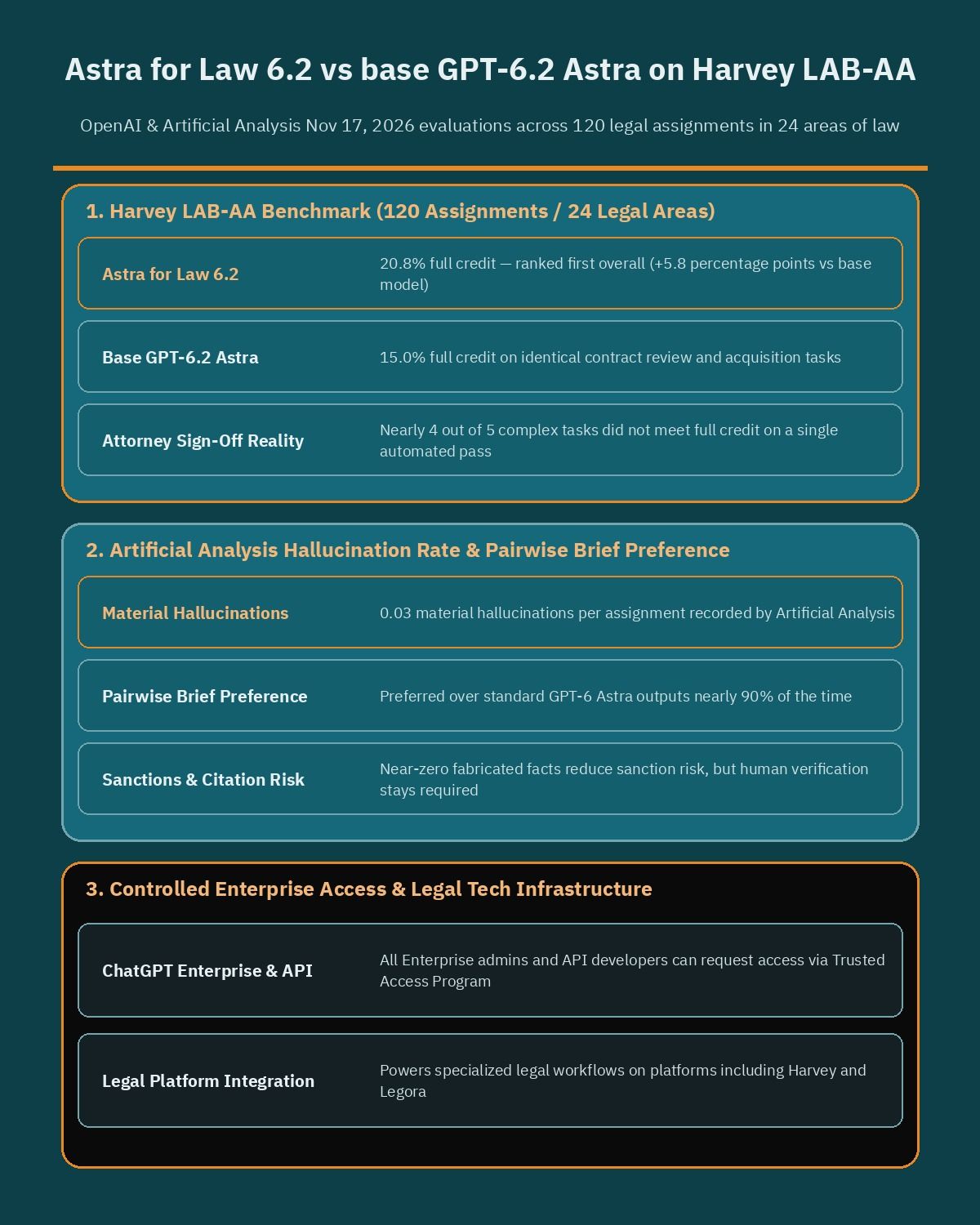While a 5.8 percentage point lead over the base model shows real gains from legal specialization, the headline figure also deserves a sober reading. Scoring full credit on 20.8 percent of assignments means nearly four out of five complex tasks did not meet the strict full-credit bar on a single automated pass. Legal leaders evaluating the release should treat that gap as proof that the system accelerates drafting and issue spotting rather than replacing partner sign-off.
Hallucination tracking from Artificial Analysis gives legal risk committees a second metric to weigh. In those evaluations, Astra for Law 6.2 recorded 0.03 material hallucinations per assignment. Keeping fabricated facts or citations near zero matters far more in legal filings than fluency alone, because one invented precedent can trigger court sanctions or undermine a commercial negotiation.
Qualitative legal review pointed in the same direction. Harvey Head of Legal Research Julio Pereyra noted that version 6.2 writes more comprehensive and better-reasoned legal briefs than earlier models. In pairwise comparisons against standard GPT-6 Astra outputs, judges preferred the Astra for Law 6.2 briefs nearly 90 percent of the time.
## Why low hallucination rates change legal review workflows
A rate of 0.03 material hallucinations per assignment does not mean zero errors, and no responsible law firm should skip cite-checking. It does mean reviewers spend less time hunting down subtle fabrications and more time evaluating legal strategy, commercial risk allocation, and client context. When an associate receives a draft memo with fewer invented assertions, human verification becomes faster and less exhausting.
This pattern matches what we are seeing across other regulated industries where mistakes carry heavy liability. Just as clinical teams must verify every step in [OpenAI computer use agents in healthcare](https://heshamsaad.com/en/openai-computer-use-agents-healthcare/) before an automated action touches patient records, legal teams need structured checkpoints before any AI-assisted brief leaves the firm. Lower error rates raise the baseline quality of first drafts, yet accountability stays strictly with the licensed practitioner.
- Run independent citation verification on every case, statute, and clause referenced in an AI draft.
- Require senior associate or partner review before external delivery, especially on novel disputes.
- Track internal firm error logs across practice areas to see where the model performs reliably and where prompts miss nuance.
## Inside the 310 million URL legal search index
Reasoning ability alone cannot keep a legal model grounded when statutes change or procedural rules vary by court. Astra for Law 6.2 pairs its model weights with an expanded legal search index spanning more than 310 million URLs. That corpus includes case law, statutes, regulations, and court rules across four major common-law jurisdictions: the United States, the United Kingdom, Australia, and Canada.
Grounding answers in an indexed repository of primary legal texts changes how teams verify outputs. Instead of guessing at regulatory phrasing from static training memory, the system can retrieve statutory text and court rules during analysis. Reviewers can then trace claims directly back to official sources before incorporating language into an opinion or agreement.
For legal software builders, combining this retrieval index with API access removes months of scraping and maintenance overhead. Platforms like Harvey and Legora already build specialized document review, due diligence, and research workflows on top of Astra for Law infrastructure via API. In-house engineering teams at larger firms can follow a similar pattern when building internal research assistants, provided they respect the geographic scope of the underlying index.
## Trusted Access Program controls and Zero Data Retention
Confidentiality rules in legal practice leave little margin for ambiguous data handling. OpenAI routes both ChatGPT Enterprise requests and API access for Astra for Law 6.2 through its Trusted Access Program. For Enterprise customers, admins initiate the request inside the admin console so access stays tied to organization-wide identity and permission policies.
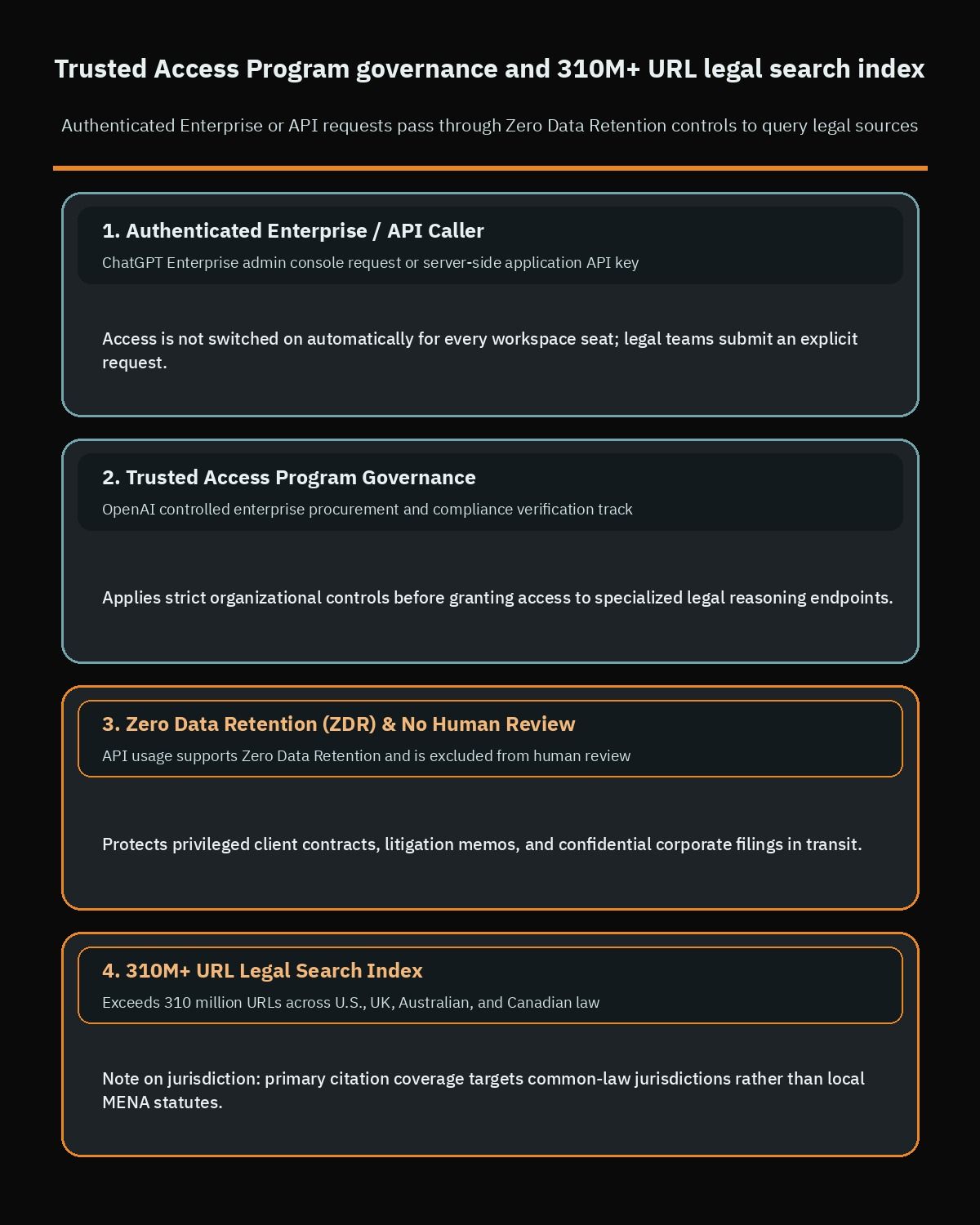Two technical safeguards stand out for compliance officers and managing partners. First, API usage supports Zero Data Retention (ZDR), meaning prompts and completions are not stored on OpenAI servers beyond real-time processing when ZDR is enabled on the account. Second, ChatGPT Enterprise inputs are automatically excluded from human review, preventing sensitive matter summaries from entering manual inspection queues.
Even with Zero Data Retention and automatic exclusion from human review, firms should verify their internal governance before granting seat access. Legal teams still need clear policies covering which client engagement letters permit third-party AI processing and how uploaded documents are stripped of unnecessary identifiers. Technical controls from the vendor only protect one side of the workflow; internal role permissions and audit logging handle the rest.
- Confirm with corporate clients whether engagement agreements allow API or enterprise cloud processing.
- Request access strictly through the central ChatGPT Enterprise admin console rather than unapproved personal accounts.
- Enable Zero Data Retention on API integrations before routing any live matter text through backend scripts.
- Restrict access by practice group and log usage metadata internally for compliance audits.
## Jurisdictional limits for MENA legal practices
For law firms and corporate legal departments across Saudi Arabia, the UAE, Egypt, and the broader MENA region, the most important detail in OpenAI's announcement is what the search index does not include. The 310 million URL legal search index covers U.S., UK, Australian, and Canadian jurisdictions. It does not index Saudi, UAE, or Egyptian civil and commercial codes, nor does it cover Arabic court rulings, ministerial circulars, or local regulatory gazettes.
Ignoring that boundary creates serious legal risk. If a lawyer asks a model grounded in common-law URLs to interpret a local civil code provision or an Arabic-language commercial dispute without supplying the exact governing texts, the model cannot rely on its built-in index for local authority. Worse, an eloquent English summary can mask subtle mismatches between common-law concepts and civil-law obligations.
That does not mean MENA firms should dismiss Astra for Law 6.2. Cross-border practices in Riyadh, Dubai, Abu Dhabi, and Cairo regularly negotiate English-language commercial agreements, international joint ventures, and financing documents governed by English or U.S. law, or handle disputes seated in common-law financial centers. In those specific workflows, access to UK, U.S., Australian, and Canadian primary materials is directly useful, while mandatory licensed attorney review remains non-negotiable for every domestic and cross-border matter.
Firms working predominantly in Arabic statutes should treat the model as a structured drafting and comparison assistant only when attorneys supply verified source clauses directly in the prompt context. Under no circumstances should any firm rely on an unindexed model output to state current local statutory law without independent verification against official national portals.
## Comparing specialized legal models with general releases
Legal teams rarely standardize on a single model for every task across a firm. While Astra for Law 6.2 targets deep legal reasoning and common-law retrieval, general-purpose models often handle multilingual translation, meeting summaries, and broad business research well. Engineering and operations leads should compare specialized legal access against broader frontier releases before committing all workflows to one API.
For example, teams evaluating multimodal document processing, large-context cross-checking, or bilingual Arabic and English summarization often benchmark [Gemini 4 Hydrogen](https://heshamsaad.com/en/gemini-4-hydrogen/) alongside OpenAI's enterprise lineup. Similarly, organizations running cost-sensitive internal triage, custom self-hosted tools, or multi-model routing pipelines frequently assess options like the [DeepSeek full-suite app and API](https://heshamsaad.com/en/deepseek-full-suite-app-api/) for non-privileged back-office tasks.
The practical distinction comes down to grounding and governance rather than raw chat fluency. If a workflow requires querying U.S., UK, Australian, or Canadian primary law with 0.03 material hallucinations per task and Zero Data Retention under Trusted Access, Astra for Law 6.2 offers targeted advantages. If the task involves general marketing copy, bilingual client newsletters, or summarizing internal operational spreadsheets, a standard general model is usually simpler to deploy.
- Use specialized legal models for common-law contract analysis, due diligence memos, and statutory research within indexed jurisdictions.
- Route bilingual Arabic-English administrative summaries and non-confidential content tasks to general-purpose models where appropriate.
- Keep strict data classification rules so privileged client files never cross into unvetted endpoints during multi-model testing.
## Preparing your law firm WordPress site and client intake
Many law firms across the MENA region run their public websites, thought leadership blogs, and initial consultation forms on WordPress. When managing partners hear about new legal AI releases, the first mistake some teams make is trying to wire AI tools directly into public site plugins or contact forms. Protecting client privilege starts with drawing a hard architectural line between your public WordPress presence and your internal legal AI workflows.
We cover the core design principles in our [law firm WordPress website guide](https://heshamsaad.com/en/law-firm-website-wordpress/), and those boundaries matter even more once AI APIs enter the picture. Public WordPress pages should attract prospective clients, explain practice areas clearly, and schedule introductory calls. They should never collect privileged dispute evidence, scanned IDs, or confidential contract drafts inside standard contact form tables or third-party plugin logs.
### Separating public intake from privileged client files
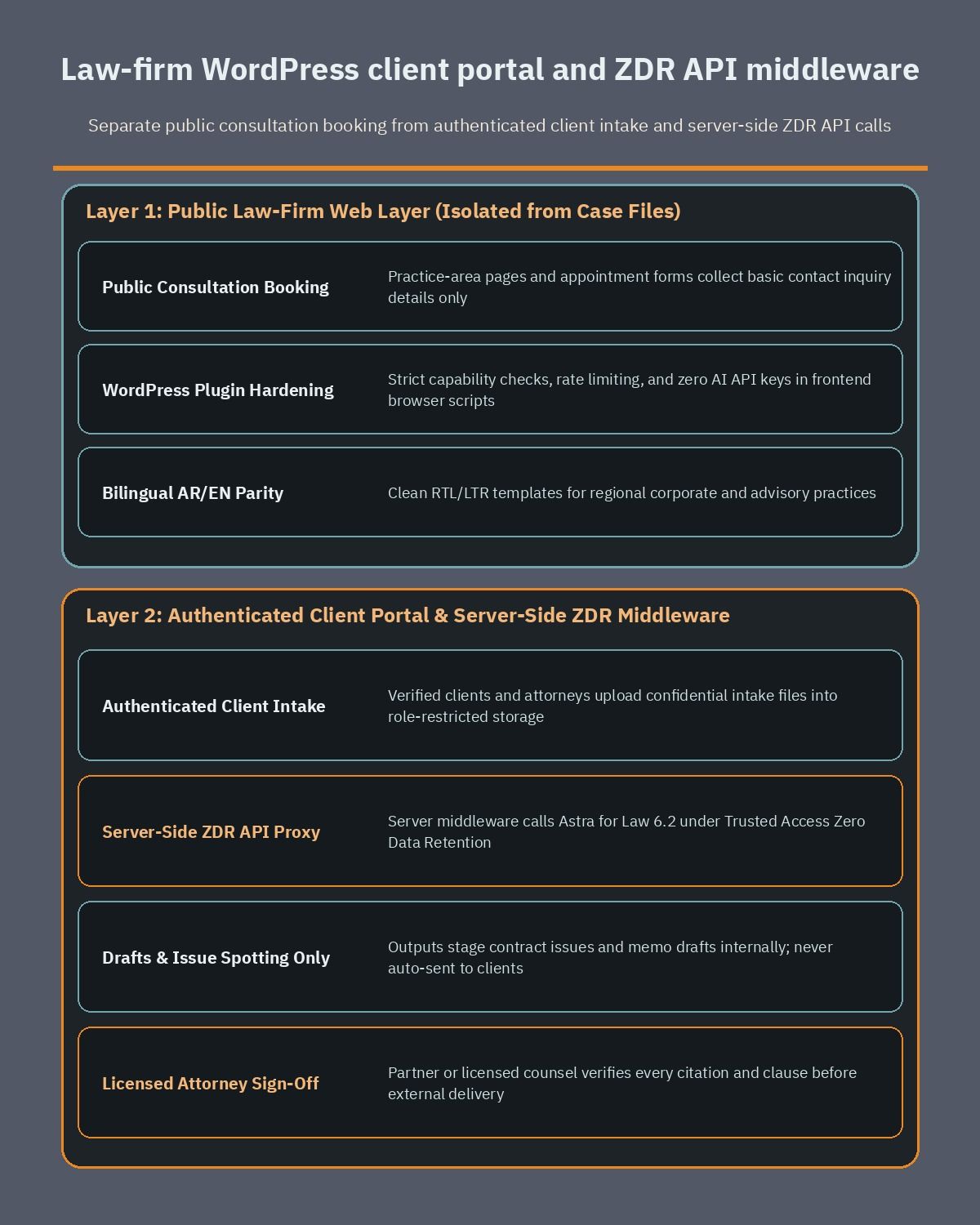
A sound law-firm architecture keeps public marketing and consultation booking completely separate from privileged matter intake. Prospective clients visiting your WordPress site should only submit basic contact details, conflict-check names, and a brief topic selection. Once a conflict check clears and an engagement letter is signed, the firm should move document uploads into an authenticated client portal with encrypted storage and strict role-based access.
If your firm wants conversational guidance on the public website, treat it strictly as a front-desk receptionist. Deploying a [WordPress AI chatbot](https://heshamsaad.com/en/wordpress-ai-chatbot/) to answer office hours, practice-area scope, and consultation booking questions can improve lead qualification without touching confidential data. Never allow a public widget to accept file uploads for legal review or pass visitor messages into an unmonitored legal analysis prompt.
### Server-side middleware and WordPress plugin hardening
Any technical bridge between your firm's intake portal and Astra for Law 6.2 API endpoints belongs in dedicated server-side middleware, never inside browser scripts or generic off-the-shelf WordPress plugins. Keeping API keys, Zero Data Retention headers, and prompt templates on an isolated backend server prevents credential leaks and lets your engineering team enforce audit logging and payload sanitization before any request leaves your network.
Even when AI processing stays off the public site, WordPress itself requires disciplined maintenance to protect firm reputation and intake data. Reviewing [WordPress AI plugin security](https://heshamsaad.com/en/wordpress-ai-plugin-security/) practices helps eliminate vulnerable third-party extensions, exposed REST endpoints, and unvalidated webhooks that attackers often target on professional service websites. Hardening your WordPress installation ensures your public site does not become a weak link while your legal team adopts enterprise AI tools.
- Limit public WordPress forms to conflict-check basics, contact fields, and consultation scheduling.
- Route privileged contract and case uploads strictly into an authenticated client portal outside standard WordPress form plugins.
- Place any Astra for Law 6.2 API integration inside server-side middleware configured for Zero Data Retention.
- Audit all installed WordPress plugins, disable unused REST routes, and enforce strict administrator access controls.
## Next steps before requesting enterprise access
Before your IT lead submits a Trusted Access Program request in the ChatGPT Enterprise console, map out two or three concrete English-language workflows where common-law grounding and low hallucination rates can save partner time. Define clear human verification checklists for every output so associates know exactly which citations, dates, and defined terms require manual sign-off. Treat the 20.8 percent LAB-AA full-credit score as a realistic reminder that domain-tuned AI assists experienced counsel rather than operating autonomously.
In parallel, audit your firm's public website and intake stack so confidential client inquiries never mix with unhardened plugins or unauthenticated forms. If you are planning a secure client intake portal, custom API middleware, or a rebuild of your firm's web infrastructure, explore our [WordPress development services](https://heshamsaad.com/en/wordpress-development/) to see how we structure professional service builds. You can also [book a free consultation](https://heshamsaad.com/en/free-consultation/) with our team to review your WordPress security posture and intake architecture before rolling out new AI tools.
## Frequently asked questions
What is Astra for Law 6.2 and who can request access?Astra for Law 6.2 is a legal reasoning model built on GPT-6.2 Astra that OpenAI announced on November 17, 2026. All ChatGPT Enterprise customers can now request access through their admin console under the Trusted Access Program. API access is also available through the same program for legal teams and platforms building custom workflows.
How did Astra for Law 6.2 score on the Harvey LAB-AA benchmark?Astra for Law 6.2 ranked first on the Harvey Legal Agent Benchmark, Artificial Analysis version, earning full credit on 20.8 percent of 120 complex assignments across 24 areas of law. Base GPT-6.2 Astra scored 15.0 percent on the same evaluation. Artificial Analysis also recorded 0.03 material hallucinations per assignment, while pairwise judges preferred its briefs nearly 90 percent of the time over standard GPT-6 Astra.
Which jurisdictions does the legal search index cover for MENA firms?The expanded legal search index covers more than 310 million URLs across U.S., UK, Australian, and Canadian case law, statutes, regulations, and court rules. It does not index Saudi, UAE, or Egyptian civil and commercial codes or Arabic court rulings. MENA firms can still evaluate the model for English cross-border contracts while keeping licensed local attorneys responsible for all legal opinions.
How does OpenAI protect confidential legal prompts under Trusted Access?Under the Trusted Access Program, Astra for Law 6.2 supports Zero Data Retention on API usage and automatically excludes ChatGPT Enterprise inputs from human review. These safeguards reduce the risk of prompt data remaining on vendor servers or entering manual review queues. Law firms still need internal retention rules and strict access controls before staff upload any client matter material.
Should law firms connect Astra for Law 6.2 directly to a public WordPress site?No, law firms should keep privileged matter files and client documents off public WordPress contact forms and unauthenticated chat widgets. A safer architecture separates public consultation booking on WordPress from an authenticated client intake portal. Any connection to the API should run through hardened server-side middleware configured with Zero Data Retention rather than exposing credentials or client data inside standard plugins.
## References
- [OpenAI: Astra for Law 6.2 announcement](https://openai.com/index/astra-law-6-2/)
- [OpenAI: Astra for Law overview](https://openai.com/index/astra-for-law/)
- [OpenAI and Harvey: From context to confidence with Astra](https://openai.com/index/harvey-from-context-to-confidence-with-astra/)
- [OpenAI Developer Platform documentation](https://developers.openai.com/)